

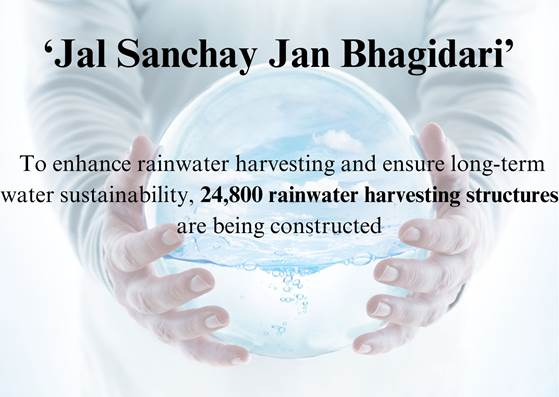
Jal Sanchay Jan Bhagidari Initiative
Institutional Framework
- The Jal Sanchay Jan Bhagidari Initiative was launched in 2024 to promote water conservation and recharge mechanisms.
- The initiative is implemented under the Ministry of Jal Shakti, which serves as the nodal ministry.
Aim and Objectives
- The initiative aims to enhance water recharge through methods such as rainwater harvesting, aquifer recharge, borewell recharge, and recharge shafts.
- It seeks to ensure that every drop of water is conserved through a whole-of-society and whole-of-government approach.
- It promotes active participation of stakeholders, including government agencies, local communities, industries, NGOs, and resident welfare associations.
Key Features and Outcomes
- It focuses on capturing rainwater and surface runoff to stabilise and increase groundwater levels.
- It promotes a culture of water conservation through community-led water resource management.
- It enhances climate resilience by creating water storage systems to manage both excess rainfall and drought conditions.
- It improves water quality by enabling natural filtration through soil layers, thereby reducing salinity and contamination.
Exchange-Traded Funds

About ETF
- An Exchange-Traded Fund (ETF) is a collection of marketable securities that tracks an underlying index.
- It combines features of mutual funds (diversification) and stocks (exchange trading).
- ETFs can be bought and sold on stock exchanges throughout the trading day at market-determined prices.
- This differs from mutual funds, which are priced only at the end of the trading day.
- ETFs are generally passively managed, resulting in lower fees and expenses compared to actively managed mutual funds.
Key Advantages
- Diversification: Investors gain exposure to a basket of assets through a single investment.
- Liquidity and Flexibility: Units can be traded anytime during market hours like shares.
- Cost Efficiency: Lower expense ratios due to passive management.
- Large ETFs often track major indices such as the S&P 500, providing broad market exposure.
Types of ETFs
- Equity ETFs: Track stock market indices.
- Debt ETFs: Invest in government and corporate bonds.
- Commodity ETFs: Track commodities such as gold and silver.
- Sectoral/Thematic ETFs: Focus on specific industries or investment themes.
- International ETFs: Track foreign market indices.
Advanced Short Range Air-to-Air Missile

About
- The Advanced Short Range Air-to-Air Missile (ASRAAM) is a short-range air-to-air missile developed by the European multinational company MBDA.
- It is designed for close-range aerial combat (dogfights).
Key Features
- The missile is about 2.9 metres long, weighs approximately 88 kilograms, and carries a high-explosive warhead.
- It uses infrared (heat-seeking) guidance technology to track targets.
- It operates on a fire-and-forget principle, allowing it to guide itself after launch without pilot intervention.
- It can achieve speeds of over Mach 3 and engage targets at ranges of more than 25 kilometres.
- It is equipped with Lock-On After Launch (LOAL) capability, enabling launch before the seeker locks onto the target.
- The missile is highly manoeuvrable, capable of sustaining extreme G-forces to track agile targets.
- Its aerodynamic design and powerful rocket motor ensure sustained energy throughout flight, enhancing accuracy.
- Deployment and Integration: The missile has been integrated with indigenous LCA Tejas and Jaguar aircraft in India.
Red-Crowned Roofed Turtle
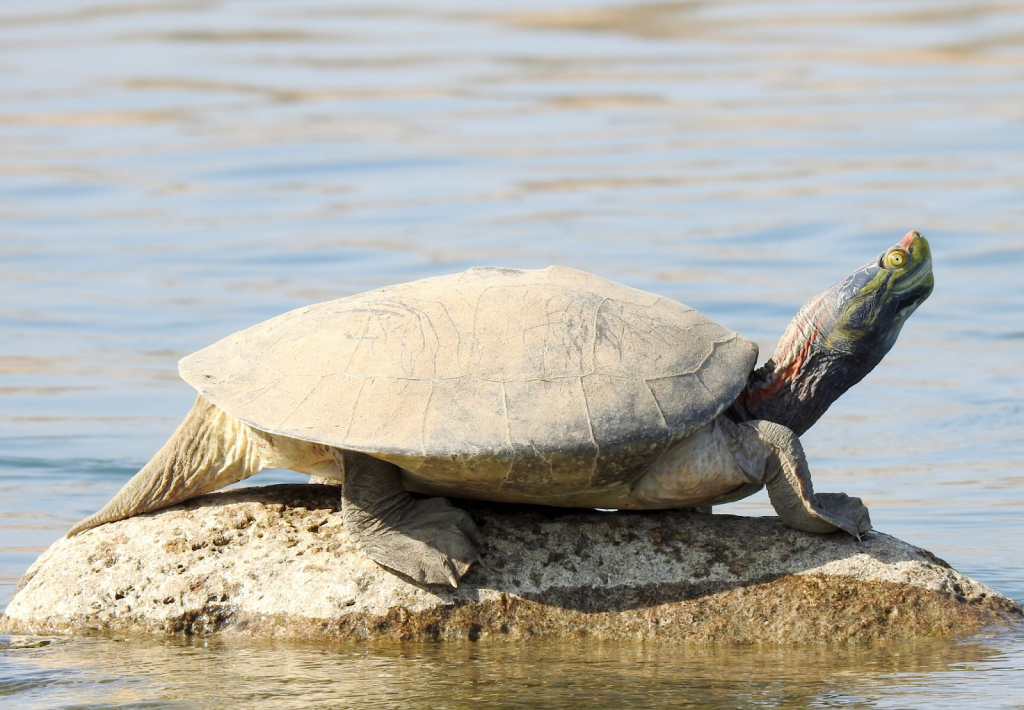
About and Distribution
- The Red-Crowned Roofed Turtle is a freshwater turtle species endemic to South Asia.
- It belongs to the genus Batagur, which includes three large freshwater turtle species found in India.
- The species is distributed in India, Bangladesh, and Nepal.
- It was historically widespread in the Ganga River system and is also found in the Brahmaputra basin.
Key Features and Ecological Role
- Males are significantly smaller, reaching only about half the length of females.
- The species is characterised by a reddish-orange head with a black crown and a greenish-brown carapace with yellow patterns.
- The plastron (lower shell) is yellow with black markings.
- It is omnivorous, feeding on both plant and animal matter.
- It acts as a bio-indicator of river health, reflecting the ecological condition of freshwater systems.
- It contributes to nutrient cycling, thereby supporting the overall aquatic ecosystem.
Conservation Status
- IUCN Red List: Critically Endangered
- CITES: Appendix II
- Wild Life (Protection) Act, 1972: Schedule I
Biotechnology Research and Innovation Council (BRIC)
Context: The inaugural meeting of the BRIC–Research Advisory Board (BRIC-RAB) was held at the Regional Centre for Biotechnology (RCB), Faridabad.
About BRIC
- The Biotechnology Research and Innovation Council (BRIC) is an apex autonomous body established as a registered society.
- It was created by subsuming 14 autonomous institutes under the Department of Biotechnology (DBT).
- It functions under the Ministry of Science and Technology.
- BRIC provides a centralised and unified governance mechanism for its institutions through intra-mural core grants.
Objectives and Functions
- BRIC promotes multi-disciplinary biotechnology research, covering the entire spectrum from basic discovery to applied research.
- It aims to foster innovation and translation across institutions, enhancing collaboration.
- It focuses on developing indigenous technologies and capabilities in line with Atmanirbhar Bharat.
- It seeks to nurture next-generation scientific leadership by supporting research in globally competitive and nationally relevant ecosystems.
- It aligns research priorities with national development goals in biotechnology.
Shigellosis (Shigella Infection)
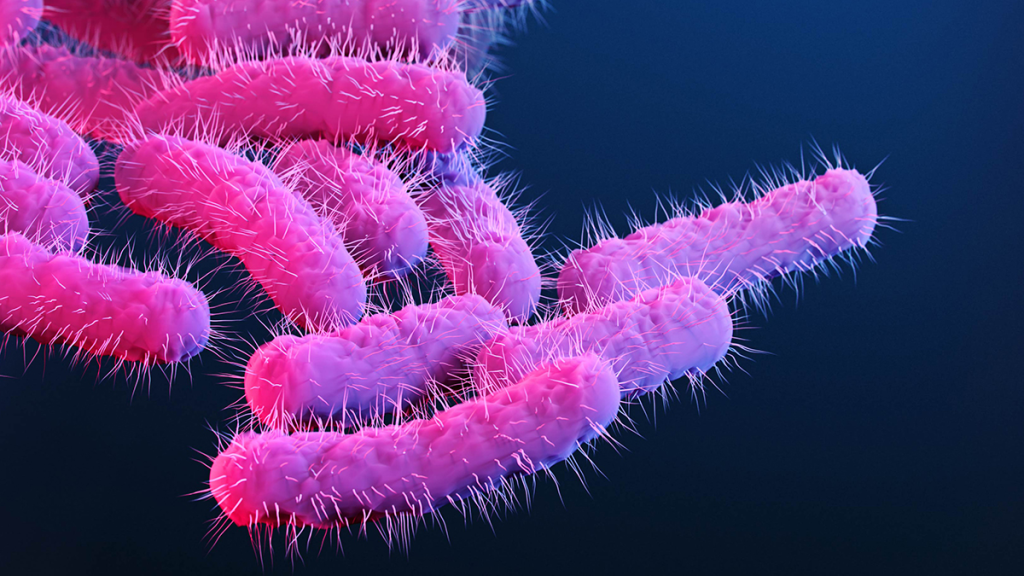
Context: A recent outbreak of Shigellosis has been reported in Kerala, raising public health concerns.
About Shigellosis
- Shigellosis is an infectious disease caused by Shigella bacteria.
- It is highly contagious and is one of the leading bacterial causes of diarrhoea worldwide.
- Humans are the only natural reservoir of the bacteria.
- The infection spreads primarily through the faecal–oral route, including:
- Direct contact with infected individuals
- Contaminated food and water
- Contact with infected faecal matter
- Sexual transmission in certain cases
Symptoms, Risk Groups and Treatment
- The most common symptom is diarrhoea, which may be bloody or mucus-filled and can last three days or more.
- Other symptoms include abdominal cramps, fever, vomiting, and tenesmus (urge to pass stool without output).
- The disease is more severe in children under five, elderly persons, immunocompromised individuals, and malnourished populations.
- It is generally self-limiting in mild cases, while antibiotics may be required in severe infections.
