

UPSC Prelims
2 Topics
Prelims Pinpointer
Prelims Pinpointer — August 27, 2026
Today’s high-yield facts — the collegium system and Acting Chief Justice appointments, and the Nepal flash flood’s lessons on Himalayan river systems and GLOFs
⚖️
Appointment and Transfer of High Court Judges
News Context
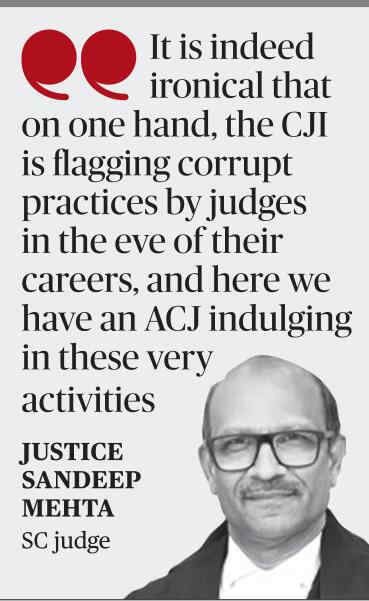
- Supreme Court judge Justice Sandeep Mehta wrote to CJI Surya Kant raising concerns over the non-transfer of the Acting Chief Justice (ACJ) of the Rajasthan High Court, spotlighting the collegium system and the ACJ’s role.
Key Constitutional Provisions
- Article 223 — Acting Chief Justice: When the office of a HC Chief Justice is vacant or the CJ is unable to act, the President appoints another judge as Acting Chief Justice.
- Article 217 — Appointment of HC Judges: Judges are appointed by the President; the Chief Justice after consultation with the CJI and Governor; other judges after consultation with CJI, Governor and the HC Chief Justice.
- Article 222 — Transfer of HC Judges: The President, after consulting the CJI, may transfer a judge between High Courts, on Collegium recommendation.
The Collegium System — Key Facts
- Mechanism for appointing/transferring SC and HC judges; not mentioned in the Constitution — evolved through the Three Judges Cases.
- SC Collegium: CJI + 4 senior-most SC judges. HC Collegium: HC Chief Justice + 2 senior-most judges.
The Three Judges Cases — Concepts for Prelims
| Case | Year | Holding |
|---|---|---|
| First Judges Case (S.P. Gupta) | 1981 | Primacy to the Executive in judicial appointments |
| Second Judges Case (SCAORA) | 1993 | Introduced Collegium System; primacy to CJI/Judiciary |
| Third Judges Case (Presidential Ref.) | 1998 | Expanded collegium to CJI + 4 senior-most SC judges |
NJAC and Removal of Judges
- NJAC was created by the 99th Constitutional Amendment Act, 2014 to replace the collegium; struck down as unconstitutional in the Fourth Judges Case (2015) for violating judicial independence (Basic Structure).
- Removal (impeachment): A HC judge can be removed only for proved misbehaviour/incapacity, via a motion passed by both Houses with a special majority (Article 217 read with 124(4)), governed by the Judges (Inquiry) Act, 1968.
Other Relevant Articles — Quick Recall
- Article 124 — SC judges; Article 214 — HCs for states; Article 216 — Constitution of HCs; Article 219 — Oath of HC judges; Article 224 — Additional/Acting Judges; Article 224A — Retired judges at HC sittings.
Exam trap: The Collegium System has no constitutional basis — it is entirely a product of judicial interpretation via the Three Judges Cases, not a textual provision.
Source: The Hindu
🏔️
Nepal Flash Flood and Himalayan Rivers
News Context
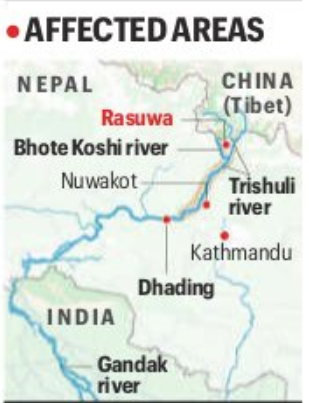
- A massive flash flood in Nepal’s Bhotekoshi River swept through villages in the Rasuwa district (bordering Tibet), killing over 150 people, linked to a rock-and-ice landslide and a possible Glacial Lake Outburst Flood (GLOF)-type mechanism.
The Bhotekoshi–Trishuli–Gandak River System
- The Bhotekoshi originates in Tibet (China), flows into Nepal’s Trishuli River, and eventually enters India as the Gandak River — a major left-bank tributary of the Ganga, joining it near Patna, Bihar.
- The Lhende River (site of the landslide) is a tributary of the Bhotekoshi. The Gandak is also known as the Narayani in Nepal.
Left-Bank Tributaries of the Ganga — Quick Recall
- Ramganga, Gomti, Ghaghara, Gandak, Kosi, Mahananda.
- The Kosi is called the “Sorrow of Bihar” due to frequent flooding and course changes.
Western Disturbance & GLOF — Key Concepts
- Western Disturbance: An extratropical storm from the Mediterranean, carried east by subtropical westerly jet streams, bringing non-monsoonal winter rainfall to NW India — important for rabi crops (wheat).
- GLOF: Sudden release of water from a bursting glacial lake, triggered by avalanches, landslides, earthquakes or ice/rock falls. Related events: 2021 Chamoli and 2023 Sikkim (South Lhonak Lake) disasters.
Source: The Hindu
