
Why in News: On 15th August 2025, Prime Minister Narendra Modi’s Independence Day speech from the Red Fort outlined a comprehensive reform agenda — covering energy security, tax reforms, digital sovereignty, critical minerals, employment generation, and welfare measure
Introduction
- PM Modi’s 78th Independence Day speech outlined a reform agenda of unprecedented scale.
- Focused on next-generation reforms, capable of shaping the destiny of 1.4 billion Indians.
- Presented as a blueprint for self-reliant, globally competitive Bharat.
1. Digital and Economic Sovereignty
UPI & Digital India:
- UPI now handles world’s real-time transactions.
- India launched its first Made-in-India chip.
- These moves place India in a global leadership role in digital economy.
Digital Swaraj:
- Represents India’s assertion of sovereignty over digital technologies.
2. Energy Security and Self-reliance
- India has ended “no-go” policies on exploration.
- Open Acreage Licensing Policy (OALP):
- 10 lakh sq. km opened for oil & gas exploration.
- Target to increase domestic gas production to 15 million tonnes by 2032.
National Deepwater Exploration Mission:
- Focused on Bay of Bengal, Arabian Sea.
- Target to double natural oil reserves.
Renewable Energy Progress:
- India achieved 50% clean power capacity 7 years ahead of 2030 target.
- Expansion of biofuels, hydrogen, ethanol blending, LNG import terminals.
- The civil nuclear sector was liberalized for private investment.
3. Tax and Economic Reforms
Replacement of Income Tax Act, 1961 with a new Income Tax Bill:
- Reduction of compliance burden (1,500 outdated laws repealed).
- Abolished 80 redundant sections.
- Income tax exemption raised to ₹12 lakh.
- Introduction of faceless assessments.
Ease of Doing Business:
- Insolvency & Bankruptcy Code strengthened.
- GST system is streamlined.
- Direct benefit transfers: ₹30 lakh crore transferred electronically.
4. Industrial Strategy & Critical Minerals
Launch of National Critical Minerals Mission:
- Focus on lithium, rare earths, cobalt, nickel.
- Target: exploration of 1,200+ sites.
- Structuring of strategic partnerships, R&D, and recycling ecosystems.
Aim: reduce dependency on imports and secure supply chains for EVs, electronics, defense.
5. Employment and MSME Support
- New initiatives in employment generation:
- PM Viashwakarma Yojana: support for artisans.
- Incentives for companies generating 15,000+ jobs.
- Focus on MSMEs and Startups: simplified credit, compliance relief.
Industrial Reforms:
- Privatization of airports, ports, logistics for greater efficiency.
- Target: 3.5 crore new jobs through reforms.
6. Welfare & Social Schemes
Direct Benefit Transfers & Jan Dhan revolution:
- Over 25 crore accounts linked, reducing leakage.
- Fertilizer subsidy reforms for self-reliance in food security.
Health sector boost:
- India as global pharmacy of the world.
- Increased vaccine & pharma exports.
7. Symbolism and Legacy
Mission Chandrayaan & National Pride:
- Embodiment of India’s technological progress.
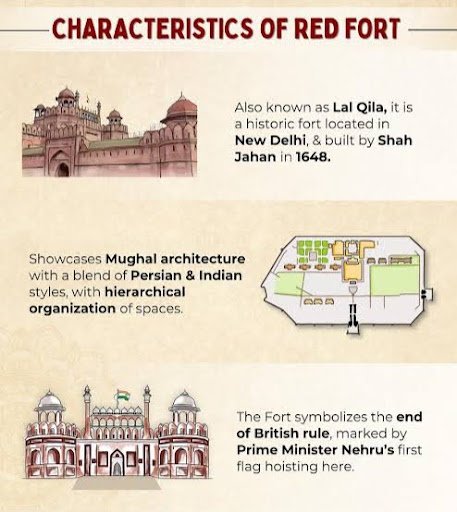
Red Fort as a platform:
- Historically linked with national transformation.
- Modi’s speech was framed as a civilizational milestone, not just governance reforms.
Conclusion
PM Modi’s address presented a comprehensive reform charter spanning:
- Energy security
- Digital sovereignty
- Tax simplification
- Industrial growth
- Employment generation
- Social welfare expansion
UPSC Relevance
GS Paper III(Economy, Governance, Polity & Welfare):
- Role of government in inclusive growth & service delivery.
Mains Practice Question
Q1. “The Red Fort Charter reflects India’s transition from incremental reforms to systemic transformation.” Discuss in the context of recent government initiatives in energy, taxation, and employment. (250 words)