


Pardoning Powers of Governor (Article 161)
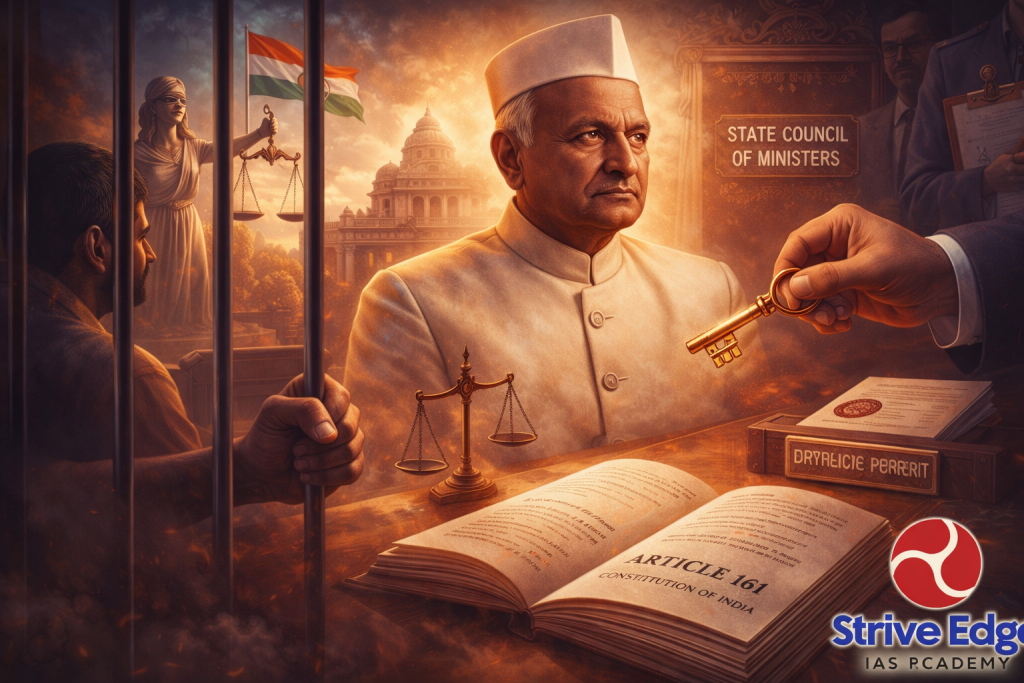
Context: The Madras High Court (Full Bench) ruled that the Governor is bound by the advice of the Council of Ministers while exercising powers under Article 161. The Court clarified that the Governor cannot act in discretion in matters of remission and premature release of convicts.
More in News
- The ruling resolved conflicting High Court judgments (2024) on the Governor’s discretion.
- It relied on Supreme Court precedents, especially:
- Maru Ram case (1980)
- Shamsher Singh case (1974)
- A.G. Perarivalan case (2022)
- The Court held that the Governor’s powers are not independent but must align with Cabinet advice.
- The court clarified that reliance on the M.P. Special Police Establishment case (2003) for discretionary power was incorrect in this context.
Types of Pardoning Powers
- Pardon: Completely absolves the offender; removes conviction and punishment.
- Reprieve: Temporarily delays execution of sentence (especially death penalty).
- Respite: Reduces punishment due to special circumstances (e.g., pregnancy, illness).
- Remission: Reduces the duration of the sentence without changing its nature.
- Commutation: Substitutes a harsher punishment with a lighter one (e.g., death to life imprisonment).
Powers of Governor (Article 161)
- Provided under Article 161 of the Constitution.
- Can grant: Pardon, reprieve, respite, remission, commutation
- Applicable to offences against laws under the State List / State executive power.
- Key features:
- Power exercised on aid and advice of Council of Ministers
- Cannot act in personal discretion (as clarified by courts)
- Used to ensure justice, fairness, and humanitarian considerations
Difference: President vs Governor (Pardoning Powers)
| Aspect | President (Article 72) | Governor (Article 161) |
| Scope | Union laws, court martial, and death sentences | State laws only |
| Death Sentence | Can pardon, remit, commute | Can commute/remit, but cannot pardon a death sentence |
| Court Martial | Has power | No power |
| Jurisdiction | Union executive domain | State executive domain |
| Advice | Union Council of Ministers | State Council of Ministers |
| Judicial Review | Subject to judicial review | Subject to judicial review |
Supreme Court Judgements
- Maru Ram v. Union of India (1980): Pardoning power must be exercised on aid and advice of Council of Ministers.
- Shamsher Singh v. State of Punjab (1974): Governor acts as a constitutional head, bound by Cabinet advice.
- Epuru Sudhakar v. Govt. of A.P. (2006): Pardoning power not absolute; subject to judicial review on grounds of arbitrariness.
- A.G. Perarivalan case (2022): Reaffirmed limits on Governor’s discretion and role of Cabinet advice.
Artemis II Mission

Context
- The Artemis II mission (2026) will be the first crewed lunar mission in over 50 years after the Apollo missions (1969–72). It is a 10-day mission involving a lunar flyby without landing.
About the Artemis Programme
- ARTEMIS is NASA’s flagship programme aimed at returning humans to the Moon.
- Seeks to establish a sustained human presence on the Moon and prepare for Mars exploration.
- Artemis Accords (2020):
- A set of international agreements for peaceful and transparent space cooperation.
- Signed by 60+ countries, including India (2023).
Artemis Mission Phases
- Artemis I (2022): Uncrewed mission testing SLS rocket and Orion spacecraft.
- Artemis II (2026): First crewed mission, lunar flyby without landing.
- Artemis III (2027): Planned demonstration mission in low Earth orbit to test landers.
- Artemis IV (2028): Targeted first lunar landing under Artemis programme.
- Artemis V (2028): Focus on scientific research and beginning lunar base construction.
Significance of Moon Exploration
- Scientific: Understanding the origin and evolution of Earth and the solar system.
- Economic: Potential use of resources like water ice and Helium-3.
- Technological: Testing long-duration missions for deep space.
- Strategic: Enhancing national prestige and space capability.
Global Moon Missions
- India:
- Chandrayaan missions
- Discovery of water molecules
- First soft landing near south pole
- China:
- Chang’e-6 lunar sample-return mission
- Japan:
- The Smart Lander for Investigating Moon (SLIM) mission achieved high-precision lunar landing
Scheduled Tribes Status

Context: Ahead of the Assam Assembly elections, a political promise was made to grant Scheduled Tribe (ST) status to six communities. The issue highlights the importance of ST classification in accessing constitutional safeguards and welfare benefits.
More in News
- Demand for ST status is closely linked to reservation benefits, socio-economic upliftment, and political representation.
- The process of inclusion remains rigorous and multi-layered, often leading to delays and debates.
- Concerns are also raised regarding the relevance of existing criteria, which many consider outdated.
Who are Scheduled Tribes? (Constitutional Basis)
- Scheduled Tribes are communities identified for special protection due to historical disadvantage and backwardness.
- The Constitution provides only a procedural definition, not fixed criteria.
- Article 366(25): STs are those notified under Article 342.
- Article 342:
- The President notifies STs for each State/UT.
- Parliament alone can include or exclude communities from the list.
- As per the Census 2011, STs constitute about 8.6% of India’s population (around 104 million people).
Criteria and Procedure for Inclusion
- Lokur Committee, 1965, mentioned broad indicators such as:
- Distinct culture and traditional lifestyle
- Geographical isolation
- Limited interaction with wider society
- Socio-economic backwardness
- These criteria have been criticised for being outdated, and later committees (e.g., Xaxa Committee, 2014) suggested a shift towards historical deprivation and marginalisation.
Procedure (Step-wise, but logically flowing)
- The process begins with a State Government recommendation, supported by ethnographic evidence.
- It is then examined by the Ministry of Tribal Affairs, followed by scrutiny by the Registrar General of India (RGI).
- After RGI’s approval, the proposal is reviewed by the National Commission for Scheduled Tribes (NCST).
- Final inclusion requires Union Cabinet approval, followed by a Parliamentary amendment to the ST list and Presidential assent.
Benefits and Constitutional Safeguards
- Inclusion in the ST list enables access to affirmative action and welfare measures.
- Political Representation
- Reservation in:
- Lok Sabha (Article 330)
- State Assemblies (Article 332)
- Local bodies (Articles 243D & 243T)
- Reservation in:
- Educational and Economic Support
- Reservation in educational institutions (Article 15(4)) and government jobs (Article 16(4)).
- State support for welfare under Article 46, including scholarships and development schemes.
Air Defence Systems
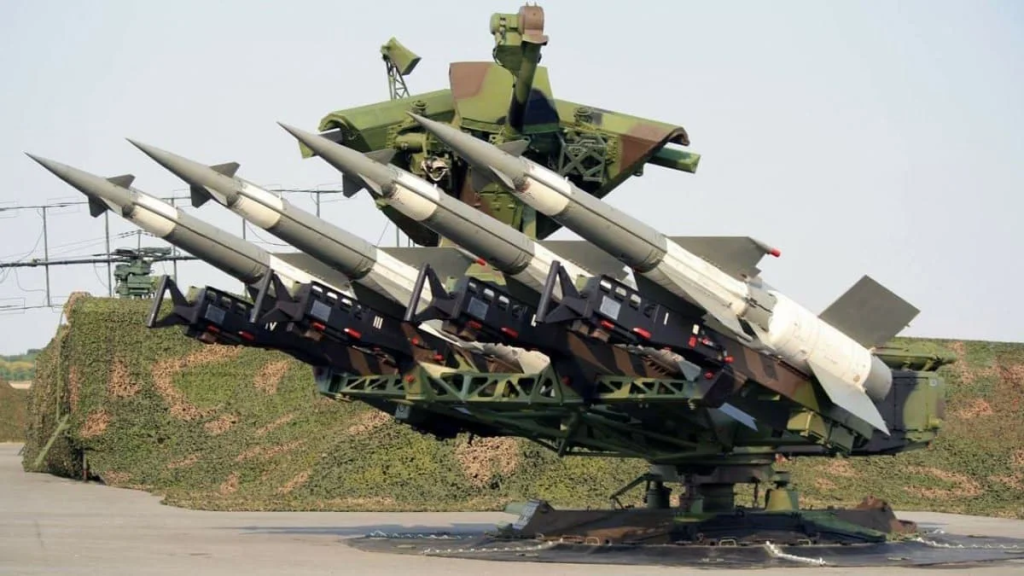
Context: Air defence systems are gaining importance due to emerging threats like drones, cruise missiles, and hypersonic weapons. India is strengthening its multi-layered air defence network through procurement and modernisation efforts.
What are Air Defence Systems?
- Air defence systems are integrated military systems designed to:
- Detect, track, intercept, and destroy hostile aerial threats.
- These threats include:
- Aircraft
- Ballistic and cruise missiles
- Unmanned Aerial Vehicles (UAVs)
- They function as part of an Integrated Air Defence System (IADS) combining:
- Surveillance radars
- Fire control systems
- Interceptor missiles
- Command and control networks
Key Global Air Defence Systems
- High-End Strategic Systems
- S-500 (Russia):
- Range: up to 600 km (ballistic)
- Intercepts hypersonic targets and satellites
- Speed: ~Mach 20
- S-400 (Russia):
- Range: 400 km
- Can engage 36 targets simultaneously
- Used by India
- THAAD (USA):
- Range: ~200 km
- Intercepts at the exo-atmospheric level
- Uses hit-to-kill technology
- S-500 (Russia):
- Medium to Long Range Systems
- David’s Sling (Israel/USA):
- Range: 300 km
- Targets: ballistic missiles, UAVs, aircraft
- Patriot PAC-3 (USA):
- Range: ~160 km
- Widely deployed globally
- Uses kinetic interception
- S-300VM (Russia):
- Range: 250 km
- Mobile system for ballistic + aerial threats
- David’s Sling (Israel/USA):
- Regional / Tactical Systems
- Aster 30 SAMP/T (France–Italy):
- Range: 120–150 km
- Effective against short-range ballistic missiles
- HQ-9 (China):
- Range: 200 km
- Uses phased-array radar
- Barak-8 (India–Israel):
- Range: 70–100 km
- Used by the Indian Navy & Air Force
- Iron Dome (Israel):
- Range: ~70 km
- Designed for short-range rockets
- Success rate: >90%
- Aster 30 SAMP/T (France–Italy):
Key Concepts
- Layered Defence: Combination of short, medium, and long-range systems.
- Hit-to-Kill Technology: Direct collision without explosive warhead (THAAD, PAC-3).
- Phased Array Radar: Enables tracking of multiple targets simultaneously.
- Hypersonic Threats: Speeds > Mach 5; driving next-gen system development.
India-Specific Angle
- India is developing a multi-layered air defence system integrating:
- S-400 (long-range)
- Barak-8 (medium-range)
- Focus on indigenisation and joint development (e.g., DRDO collaborations).
NCERT as Deemed University

Context: The Ministry of Education has declared the National Council of Educational Research and Training (NCERT) as an institution deemed to be a university. This status enables NCERT to offer academic programmes and award degrees, marking a significant shift in its institutional role.
More in News
- The status was granted following approval by the University Grants Commission (UGC) based on an expert panel’s recommendation.
- The notification applies to NCERT along with its six regional institutes, subject to prescribed conditions.
- Key conditions include:
- NCERT must avoid commercial or profit-oriented activities.
- All programmes must adhere to UGC norms and relevant statutory guidelines.
- Expansion of courses, including off-campus and offshore programmes, must follow UGC regulations.
- The Ministry has directed NCERT to:
- Initiate doctoral and research programmes.
- Develop innovative academic programmes aligned with the National Education Policy (NEP) 2020.
- Obtain accreditation from bodies such as National Board of Accreditation (NBA) and NAAC.
About NCERT
- Established in 1961, NCERT is an autonomous organisation under the Government of India.
- It functions as the nodal body for school education in India.
- Core Functions:
- Advises Central and State Governments on policies related to school education.
- Conducts and promotes research in education.
- Develops and publishes:
- Textbooks and learning materials
- Digital and multimedia content
- Governance:
- The Executive Committee is the highest decision-making body.
- It is chaired by the Union Education Minister.
Deemed University (Section 3, UGC Act, 1956)
- A Deemed University is an institution granted autonomy to function like a university under Section 3 of the UGC Act, 1956.
- Key Features:
- Can design its own courses and curriculum.
- Has authority to conduct examinations and award degrees.
- Enjoys academic and administrative flexibility.
- Benefits:
- Greater academic autonomy and innovation
- Ability to attract better faculty and funding
Types of Universities in India
- Central Universities: Established by Act of Parliament and funded by the Union Government.
- State Universities: Established by State legislation.
- Private Universities: Set up through State/Central Acts by private bodies (society, trust, company).
- Deemed Universities: Recognised under UGC Act, 1956 with academic autonomy.
- Institutions of National Importance: Declared by Parliament (e.g., IITs, NITs, AIIMS).
- Institutions under State Legislature Act: Established by specific State Acts.
Form 6 and Electoral Roll Inclusion
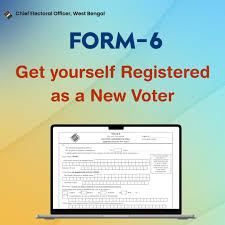
Context: Ahead of the West Bengal Assembly elections, concerns were raised regarding the large-scale submission of Form 6 applications. The issue has drawn attention to the process of voter enrolment and the integrity of electoral rolls, particularly in the context of alleged cross-State registrations.
About Form 6
- Form 6 is the prescribed application for inclusion of names in the electoral roll, as per the Registration of Electors Rules, 1960.
- It is used both by first-time voters and by individuals seeking transfer of enrolment from another constituency or State.
- The responsibility for processing applications lies with the Electoral Registration Officer (ERO), who verifies eligibility before approving inclusion.
- To qualify for enrolment, an applicant must:
- Have attained the age of 18 years or above
- Be an Indian citizen
- Submit valid proof of age and residence, along with a declaration of citizenship
- Importantly, submission of Form 6 does not automatically result in inclusion. Entry into the electoral roll is subject to verification and satisfaction of eligibility conditions by the ERO.
- Electoral rolls are updated through:
- Annual Special Summary Revision (SSR), and
- Continuous updation throughout the year
- In the present case, the authorities have clarified that all applications, irrespective of volume, are subjected to due scrutiny before acceptance.
Legal Framework
- Article 326 of the Constitution provides for universal adult suffrage, fixing the minimum voting age at 18 years.
- The Representation of the People Act, 1950 governs the preparation and maintenance of electoral rolls.
- The Registration of Electors Rules, 1960 lay down the procedural aspects of voter registration, including the use of Form 6.
Institutional Mechanism
- The Electoral Registration Officer (ERO) is the statutory authority responsible for:
- Preparation and revision of electoral rolls
- Acceptance or rejection of applications
- Adjudication of claims and objections
Safeguards in the Enrolment Process
- Mandatory verification of documents before inclusion
- Public disclosure of draft electoral rolls to invite objections
- Provision for hearings in case of disputes
- Legal consequences, including penalties or imprisonment, for false declarations
