

SET A
Q1.Which one of the following Carnatic music ragas is similar to Raga Bilawal in Hindustani music ?
(a) Nat Bhairavi
(b) Kamavardhini
(c) Hanumatodi
(d) Dheera Shankarabharanam
Answer: (d) Dheera Shankarabharanam
Dhīraśankarābharaṇaṃ (commonly known as Śankarābharaṇaṃ) is the 29th Melakarta rāga in the 72 Melakarta rāga system of Carnatic music. By scale, the Śankarābharaṇaṃ corresponds to Bilaval in the Hindustani music system. The Western equivalent is the major scale (Ionian mode).
Bilaval (Bilawal) is a raga and the basis for the eponymous thaat in Hindustani classical music. Bilaval is equivalent to the Carnatic raga melakarta, Sankarabharanam, as well as the Western Ionian mode (major scale), and contains the notes S R G M P D N S’ — all shuddha (natural) notes.
Shankarabharanam (Carnatic) ↔ Bilawal (Hindustani): Both correspond to the Ionian (major) skeleton. Carnatic usage is highly ornamented with many janya offshoots; Hindustani emphasizes bright alap–bandish space, common in pedagogy.
The other options are incorrect:
- Nat Bhairavi → corresponds to Natabhairavi (Melakarta 20), equivalent of Asavari thaat
- Kamavardhini → corresponds to Melakarta 51 (Pūrvikalyāṇī), equivalent of Poorvi thaat
- Hanumatodi → corresponds to Todi (Melakarta 8), equivalent of Bhairavi/Todi thaat
Sources:
- Wikipedia (Sankarabharanam raga): https://en.wikipedia.org/wiki/Sankarabharanam_(raga)
- Wikipedia (Bilaval raga): https://en.wikipedia.org/wiki/Bilaval
- ResearchGate (Comparative Study): https://www.researchgate.net/publication/395178780
Q2. The artificially fixed rupee-sterling exchange rate prescribed by the Hilton-Young Commission (1926) was adopted by the British Government for which one of the following reasons ?
(a) Aiding the flow of remittances from India and maintaining India’s creditworthiness
(b) Providing support to Indian importers
(c) Encouraging export of cotton produce from India
(d) Preventing depreciation of the Rupee in terms of gold
Answer: (a) Aiding the flow of remittances from India and maintaining India’s creditworthiness
The Hilton-Young Commission (Royal Commission on Indian Currency and Finance, 1926) recommended fixing the rupee-sterling exchange rate at 1 shilling 6 pence (18 pence). This rate was deliberately set artificially high — favouring British interests over Indian interests.
The exchange rate policy was designed to benefit Britain — maintaining a stable rupee-sterling rate facilitated British trade and Home Charges remittance. The fall in silver prices had resulted in a decline in the external value of the rupee, adversely affecting India’s ability to pay “Home Charges” — the remittances made by India to Britain to cover administrative and military costs.
The British government’s core reason for adopting this artificially fixed high exchange rate was:
- Aiding the flow of remittances (Home Charges) — India paid fixed obligations to Britain in sterling (pensions, interest on loans, administrative costs). A higher rupee meant Britain received more from these payments.
- Maintaining India’s creditworthiness — These gold exports provided the Government of India with enough remittance to meet its sterling obligations, restoring balance of payments and India’s ability to service its colonial debts.
The overvalued rupee at 1s 6d harmed Indian exporters and the Indian domestic economy but served Britain’s colonial financial interests — specifically ensuring smooth transfer of the “Home Charges” drain. Indian nationalists like Purshotamdas Thakurdas dissented, arguing the rate was exploitative to India.
Sources:
- Encyclopedia.com (Money and Credit 1858-1947): https://www.encyclopedia.com/international/encyclopedias-almanacs-transcripts-and-maps/money-and-credit-1858-1947
- The Book Notes (Monetary Policy in British India): https://thebooknotes.in/monetary-policy-in-british-india-ugc-net-history-notes/
Q3. Consider the following statements :
I. Pali texts contain the first definite references to coins, e.g., kahapana, nikkha, kamsa, and kakanika.
II. The literary evidence from Pali texts is corroborated by archaeological evidence of punch-marked coins from many sites, most of them made of silver.
The above statements have been associated with which of the following ?
- Emergence of urban life
- Transition to money economy
Select the answer using the code given below :
(a) 1 only
(b) 2 only
(c) Both 1 and 2
(d) Neither 1 nor 2
Answer: (b) 2 only
Explanation:
Both statements — Pali texts referencing coin names (kahapana, nikkha, kamsa, kakanika) and the archaeological evidence of punch-marked coins — are specifically associated with the transition to a money economy, not the emergence of urban life per se.
- The Jātaka stories give us various token coins of this standard, including nikkhas, suvaṇṇa, hiraṇṇa, kahāpaṇa, kaṃsa/kassa, pāda, and māsaka — indicating that Buddhist literature reveals a society with the full use and enjoyment of plentiful coinage.
- Kahāpaṇas were used very extensively in the daily life of early Indian people. Kahāpaṇas and their subdivisions are also mentioned in early Pali texts like Vinaya-piṭaka, Aṅguttaranikāya and Majjhima-nikāya.
- The first documented coinage is deemed to start with punch-marked coins issued between the 7th–6th century BC and 1st century AD. Issued initially by merchant guilds and later by states, these coins represented a trade currency belonging to a period of intensive trade activity. They are made mostly of silver.
- According to Osmund Bopearachchi, the first punch-marked coins in the Indian Subcontinent may have been minted around the 6th century BC by the Mahajanapadas of the Indo-Gangetic Plain.
- Karshapanas contributed to the development of trade since they obviated the need for weighing of metal during exchange.
While urban life is a related and concurrent development, both statements are specifically and directly about monetary instruments and their use — making Statement II the correct association.
Sources
- Reserve Bank of India (RBI) — Currency Museum: Ancient India Coinage An official Government of India source on the history of punch-marked coins. https://www.rbi.org.in/commonman/English/Currency/Scripts/Ancient.aspx
- Wikipedia — Punch-marked Coins A well-cited encyclopaedic entry referencing scholars like Osmund Bopearachchi and E.J. Rapson. https://en.wikipedia.org/wiki/Punch-marked_coins
- Wikipedia — Karshapana Covers the textual and numismatic evidence for coin terms in ancient Indian literature. https://en.wikipedia.org/wiki/Karshapana
- Wisdomlib.org — “Currency of Ancient India” (from Lay-Life of India as Reflected in Pali Jātaka, Rumki Mondal, 2018) An academic essay specifically analysing monetary terms (nikkha, kahāpaṇa, kaṃsa etc.) directly from Pali Jātaka texts. https://www.wisdomlib.org/history/essay/lay-life-of-india-as-reflected-in-pali-jataka/d/doc1599189.html
- NCERT Class 12 History — Themes in Indian History, Chapter 2: Kings, Farmers and Towns The standard school textbook directly relevant to this question, available on the official NCERT portal. https://ncert.nic.in/textbook.php?lehs1=2-2
- Nature / Scientific Reports — “Surface Elemental and Structural Analysis of Ancient Indian Punch-Marked Coins (600–200 BCE)” A peer-reviewed scientific study on the metallurgy and economic practices associated with punch-marked coins. https://www.nature.com/articles/s41598-024-76356-3
Q4. Which of the following temples has/have a Nagara-style shikhara ?
- Malegitti Shivalaya, Badami
- Huchimalligudi Temple, Aihole
- Dashavatara Temple, Deogarh
- Virupaksha Temple, Pattadakal
Select the answer using the code given below :
(a) 1 and 2
(b) 2 and 3
(c) 3 only
(d) 3 and 4
Answer: (b) 2 and 3.
Explanation
- Malegitti Shivalaya, Badami — -NOT Nagara
Malegitti Shivalaya has a garbhagriha and a pillared gudhamantapa. The temple is roofed with a Dravidian shikhara. The shikharas of both the Upper Shivalaya and Malegitti Shivalaya temples at Badami are of the Dravidian type. It is, in fact, perhaps the earliest and best surviving example of the magnificence of the Dravida style in early Chalukya architecture.
- Huchimalligudi Temple, Aihole — – Nagara
The Huchimalli temple and Chakra Gudi are good examples of the Nagara type with curvilinear shikhara at Aihole. More specifically, the temple’s rekhanagara-style shikhara is a prime example of early curvilinear tower design, with walls punctuated by niches containing finely carved figures.
- Dashavatara Temple, Deogarh — – Nagara
The Dashavatara Temple is the earliest fully structural temple in North India to possess a shikhara. It exemplifies characteristics that would become the norm for subsequent examples of Nagara temples, marking it as a high point in the development of Hindu temple art and architecture.
- Virupaksha Temple, Pattadakal — -NOT Nagara
The magnificently built Dravida shikhara with a well-preserved sukanasa (‘nose’, arched projection) on the front is one of the hallmarks of the Virupaksha Temple, Pattadakal. It exemplifies a fully mature Dravidian architectural style, built by Queen Lokamahadevi after King Vikramaditya II’s victory over the Pallavas.
Sources
- UNESCO World Heritage Tentative Lists — Evolution of Temple Architecture, Aihole-Badami-Pattadakal https://whc.unesco.org/en/tentativelists/5972/
- Smarthistory — Dashavatara Temple, Deogarh https://smarthistory.org/dashavatara-temple-deogarh/
- MAP Academy — Dashavatara Temple, Deogarh https://mapacademy.io/article/dashavatara-temple-deogarh/
- Wikipedia — Badami Chalukya Architecture (on Pattadakal temples’ styles) https://en.wikipedia.org/wiki/Badami_Chalukya_architecture
- Wikipedia — Badami Shivalaya (on Malegitti Shivalaya’s Dravida classification) https://en.wikipedia.org/wiki/Badami_Shivalaya
- World History Encyclopedia — The Temples of Pattadakal (on Virupaksha’s Dravida shikhara) https://www.worldhistory.org/article/899/the-temples-of-pattadakal/
Q5.Among the four main forms of existence of life recognized in Jainism, which one of the following is not included ?
(a) Deva (gods)
(b) Yaksha (demi-gods)
(c) Manushya (humans)
(d) Tiryancha (animals and plants)
Answer: (b) Yaksha (demi-gods)
Explanation:
In Jainism, the soul (jiva) continuously transmigrates through the cycle of birth and death. The four main forms of existence are called Gatis (destinies/states of existence), determined by one’s karma:
The forms of existence or gatis are of four kinds:
- Naraka-gati — hellish form
- Tiryag-gati (Tiryancha) — sub-human form (animals and plants)
- Manusya-gati — human form
- Deva-gati — celestial/divine form
According to Jain tradition, souls can be reborn in one of four states of existence (gatis): as heavenly beings, humans, animals/plants, or hellish beings.
Yakshas are nature spirits or demi-gods that appear in Jain iconography as attendants (Śāsanadevatās) of the Tirthankaras, but they are not one of the four foundational gatis. They are a sub-category within the Deva realm, not a separate, independent form of existence in the four-gati framework.
Thus, the three options that ARE included — Deva (a), Manushya (c), and Tiryancha (d) — are all genuine gatis. Only Yaksha (b) is not among the four recognized forms of existence.
Sources
- Jainworld — Tattvas of Jainism (on the four gatis) https://jainworld.com/library/jain-books/books-on-line/jainworld-books-in-indian-languages/antiquity-of-jainism/tattvas-of-jainism/
- Encyclopedia of Jainism — Kinds of Destiny (Gati) https://www.en.encyclopediaofjainism.com/index.php/16.Kinds_of_Destiny(Gati)
- Jainworld — Gati (Four Destinies) https://jainworld.com/languages/jw-in-world-languages/serbia/self-learning-lessons-for-juniors/gati/
- Wikipedia — Jainism (on the four states of existence) https://en.wikipedia.org/wiki/Jainism
Q6.The Hallisalasya painting in the Bagh Caves represents :
(a) A joyous folk dance
(b) Buddha in a meditative pose
(c) The depiction of Shiva and Parvati on Kailasha
(d) Samudramanthan (Churning of the Ocean)
Answer: (a) A joyous folk dance.
Explanation
The Hallisalasya is an ancient Indian folk/group dance form referenced in texts like the Harivamsha. Its depiction in the Bagh Caves is one of the most celebrated secular paintings from ancient India.
One of the most remarkable features of the Bagh Caves is the mural depicting the Hallisalasya folk dance. This artwork, found in Cave No. 4 (the Rang Mahal, or Palace of Colours), is a vivid portrayal of a traditional dance form that was popular in central India. The Hallisalasya dance, often associated with celebrations and communal gatherings, is depicted in intricate detail, capturing the rhythm and movement of the dance.
In ancient textual tradition, the dance called Hallisaka in the Harivamsha is of great significance as a collective dance with all the elements of a full participative activity — the formations are circular and there is some joining of hands, with tala (time) forming its rhythmic backbone.
This painting is significant because the Bagh Cave murals are noted to be more secular and earthly in nature than the purely religious paintings of Ajanta, and the Hallisalasya mural is the finest example of that secular, joyous spirit — depicting a vibrant group folk dance, not any religious or mythological scene.
Sources:
- Wikipedia — Bagh Caves https://en.wikipedia.org/wiki/Bagh_Caves
- Wisdomlib — Arts in the Puranas: The Rasa Dance (Hallisaka reference) https://www.wisdomlib.org/hinduism/essay/arts-in-the-puranas-study/d/doc1460301.html
- Bhopal State Museum — Bagh Cave Paintings (Conservation blog with scholarly references) https://ramaarya.blog/2018/03/16/bhopal-state-museum-bagh-cave-paintings/
Q7. Consider the following statements relating to the use of the place-value system in India :
- The earliest epigraphic use of the place-value system in India is found in the Mankani plates from Gujarat (AD 595–596).
- In the ninth century, place-values become general in inscriptions all over India.
- The place-values have been found in Sanskrit inscriptions in South-east Asia as early as the seventh century.
Which of the statements given above are correct ?
(a) 1 and 2 only
(b) 1 and 3 only
(c) 2 and 3 only
(d) 1, 2 and 3
Answer: (d) 1, 2 and 3
Explanation
Statement 1 — – Correct
The Mankani plates from Gujarat (AD 595–596) as the earliest epigraphic use:
The earliest evidence of decimal place value system in India and Southeast Asia is from the middle of the first millennium CE. The written evidence in a decimal place-value notation was found on the copper plate from Gujarat, India, in the date 595 CE.
A 6th century copper-plate grant at Mankani bearing the numeral 346 (corresponding to 594 CE) is often cited as the earliest epigraphic use. Though its reliability is debated among scholars, it remains the standard earliest citation in the epigraphic record.
Statement 2 — – Correct
Place-values becoming general in inscriptions by the 9th century:
Throughout the 8th and 9th centuries, both the old Brahmi numerals and the new decimal numerals were used, sometimes appearing in the same inscriptions. In some documents, a transition is seen to occur around 866. This confirms that by the ninth century, the place-value system had become widespread across India.
Statement 3 — – Correct
Place-values in Sanskrit inscriptions in Southeast Asia from the 7th century:
Khmer inscriptions in Sanskrit make use of the Shaka era and the decimal system in numbers first noticed in the 7th century, including the number 0.
Decimal numerals have also been found in stone inscriptions in Indonesia and Cambodia in the year 683 CE, where Indian cultural influence spread the decimal place-value system.
Sources
- Wikipedia — History of the Hindu–Arabic Numeral System https://en.wikipedia.org/wiki/History_of_the_Hindu%E2%80%93Arabic_numeral_system
- Wikipedia — Khmer Inscriptions (on 7th century decimal use in Sanskrit inscriptions in Southeast Asia) https://en.wikipedia.org/wiki/Khmer_inscriptions
- IJARSCT — A Study of Decimal Place Value System in Ancient Indian Mathematics https://ijarsct.co.in/Paper5166.pdf
- Wisdomlib — Mankani Plates of Taralasvamin (on the Gujarat inscription record) https://www.wisdomlib.org/history/essay/impact-of-vedic-culture-on-society/d/doc1121343.html
Q8.Consider the following statements about the archaeological findings in Harappan towns :
I. There is a wide occurrence of spindle-whorls in the houses but absence of spinning wheels.
II. Weights and measurement scales, complete with graduations have been discovered.
III. There are houses built in large part with baked bricks, around relatively spacious courtyards, with their own wells, bathing platforms, and large rooms.
Which of the following inferences can be drawn from the above statements ?
1. Statement I suggests that spinning was a laborious activity done at home.
2. Statement II suggests the extent of the scientific knowledge that the Harappans possessed.
3. Statement III suggests the emergence of a common property system.
Select the answer using the code given below:
(a) 1 and 2 only
(b) 2 and 3 only
(c) 1 and 3 only
(d) 1, 2 and 3
Answer: (a) 1 and 2 only.
Detailed Answer
Inference 1 — – Valid
Statement I → “Spinning was a laborious activity done at home”
The wide occurrence of spindle-whorls in houses (not in centralised workshops) directly indicates that spinning was a domestic, home-based activity. A spindle-whorl is used for manual hand-spinning, which is far more tedious and time-consuming than a spinning wheel. The absence of spinning wheels confirms no mechanisation existed. Therefore, the inference that it was a laborious activity carried out at home is logically sound and well-supported.
Inference 2 — – Valid
Statement II → “Extent of the Harappans’ scientific knowledge”
The discovery of weights and measurement scales with complete graduations is direct evidence of advanced metrology (the science of measurement). Standardised, graduated scales imply mathematical precision, systematic planning, and scientific thinking. This inference logically and directly follows from Statement II.
Inference 3 — -Invalid
Statement III → “Emergence of a common property system”
This is where the inference does NOT logically follow. Statement III describes houses with “their own wells”, “their own bathing platforms”, and “large rooms” — the operative phrase being “their own”. This language explicitly points to private ownership and private property, not a common or communal property system. The correct inference from Statement III would be either:
- The existence of a prosperous, property-owning class, or
- Evidence of a private property system
A “common property system” would imply collectively owned or shared resources — the exact opposite of what the archaeological evidence of individually-owned, privately-equipped houses suggests.
Q9.Which one of the following statements about the Eka Movement and Bardoli Satyagraha is correct ?
(a) The Eka Movement was throughout supported and organized by the Congress while Bardoli Satyagraha was initially independent of Congress influence and was only in the last stages supported by the Congress.
(b) The Eka Movement was provided leadership by the taluqdars of Awadh, whereas the Bardoli Satyagraha was a movement of the landless labourers.
(c) The Bardoli Satyagraha was a campaign against the enhancement of land revenue, while the Eka Movement was a protest against excessive extraction of rents.
(d) The Eka Movement was located in the Varanasi and Mirzapur districts of the present-day U.P., while the Bardoli Satyagraha took place in Saurashtra.
Answer: (c)
Detailed Explanation
Option (a) — -Incorrect
The Eka Movement was initially started by Congress and the Khilafat movement, but was later headed by Madari Pasi. Congress did not support it “throughout” — it eventually withdrew support when the movement turned violent. Bardoli Satyagraha, on the other hand, was organised and led by Congress from the beginning under Sardar Vallabhbhai Patel. So option (a) has the relationship exactly reversed.
Option (b) — -Incorrect
The Eka Movement was a peasant movement led by Madari Pasi, a low-caste leader, — not by taluqdars. It was a movement against the taluqdars and zamindars who extracted excessive rents. Bardoli Satyagraha was a movement of peasant farmers (predominantly Patidar cultivators), not of landless labourers.
Option (c) — – Correct
The Bardoli Satyagraha entailed a tax revolt in 1928, with the protest achieving its principal objective of forcing the colonial state to withdraw a policy aimed at raising the rate of land revenue paid by peasants.
The Eka Movement’s main reason was high rent, which was generally higher than 50% of recorded rent in some areas. Oppression by thekedars entrusted to collect rent and the practice of share rent also contributed to this movement.
Thus: Bardoli = against enhancement of land revenue (government tax); Eka = against excessive extraction of rents (by landlords/taluqdars). This distinction is precisely correct.
Option (d) — -Incorrect
The Eka Movement surfaced in Hardoi, Bahraich, Barabanki and Sitapur of North Western Province of UP — not Varanasi and Mirzapur districts. The Bardoli Satyagraha took place in the taluka of Bardoli, located in the district of Surat in south Gujarat — not Saurashtra.
Sources
- Wikipedia — Eka Movement https://en.wikipedia.org/wiki/Eka_Movement
- Springer Nature — Bardoli Satyagraha (Academic Chapter) https://link.springer.com/chapter/10.1057/9780230370630_3
- Indian Culture (Government of India) — Sardar Patel’s Speeches during the Bardoli Satyagraha https://www.indianculture.gov.in/digital-district-repository/district-repository/sardar-patels-speeches-during-bardoli-satyagraha
- Wikipedia — Madari Pasi (on the Eka Movement’s leadership and Congress withdrawal) https://en.wikipedia.org/wiki/Madari_Pasi
Q10.Consider the following statements about the Rigvedic period :
I. Irrigation from wells allowed agriculture to expand away from flood plains and strips on river margins into the present Punjab and Haryana plains having underground water levels reasonably close to the surface.
II. Draught-animal power was employed to draw-up water out of the wells.
Which of the following information support/supports the above statements ?
1. There is evidence in the Rigveda of the use of ashma chakra (stone pulley wheel) and ahava (strapped wooden pails) to draw up water.
2. Mention has been made in the Rigveda of the use of implements like parashu/kulisha (axe) and datra/srni (sickle).
3. There is a history of the use of ox, even before the Rigveda, for ploughing the land and pulling the carts.
Select the answer using the code given below :
(a) 1 and 2 only
(b) 1, 2 and 3
(c) 1 and 3 only
(d) 3 only
Answer: (c) 1 and 3 only
Information 1 — – Supports Statement I
The mention of ashma chakra (stone pulley wheel) and ahava (strapped wooden pails) in the Rigveda is direct evidence that a mechanical system existed to draw water from wells. This directly corroborates Statement I — wells were actively used for irrigation, which is what enabled agricultural expansion beyond natural floodplains. This is specific, direct Rigvedic evidence for well-based irrigation.
Information 2 — -Does NOT specifically support either statement
The mention of parashu/kulisha (axe) and datra/srni (sickle) shows that:
- Axes were used for clearing land/forests
- Sickles were used for harvesting crops
These tools speak to agricultural practice in general, but provide no specific evidence about:
- Well-based irrigation (Statement I), or
- Draught animals drawing water (Statement II)
The information supports agricultural activity broadly, but it neither addresses the source of irrigation nor the method of drawing water. It is a distractor.
Information 3 — – Supports Statement II
The fact that oxen were used even before the Rigvedic period for ploughing and pulling carts establishes that:
- Draught animal technology was well-established and pre-dated the Rigveda
- Oxen were already deployed for heavy mechanical work
This provides logical and historical support for Statement II — that the same draught animal power which pulled carts and ploughs could also be harnessed to draw water from wells. It establishes the prerequisite technology for Statement II.
Q11. Consider the following assertion :
In the Pleistocene period either the Yamuna once flowed into the Indus, or the Sutlej flowed into the Yamuna and one major tributary of either had shifted from the Ganga to the Indus or vice versa.
Which of the following is/are the basis of the above assertion ?
1. The Nadi-Sukta of the Rigveda
2. The explorations of the Sutlej and the Yamuna by Robert Bruce Foote
3. The presence of the same species of dolphins in both the Indus and the Ganga river systems
Select the answer using the code given below:
(a) 1 only
(b) 2 only
(c) 1 and 2
(d) 3
Answer: (d) 3
Statement 1 — Nadi-Sukta of the Rigveda NOT the basis
The Nadi-Sukta (Nadistuti Sukta, RV 10.75) is a post-Pleistocene literary text composed around 1000 BCE. The Pleistocene ended approximately 11,700 years ago. While the Nadi-Sukta geographically places Yamuna and Sutlej in the same drainage corridor, it is a Vedic hymn of praise, not a geological or biological basis for an assertion about Pleistocene river shifts. It is used to reconstruct Vedic geography (circa 1500–1000 BCE), not events of 1 million to 11,700 years ago.
Statement 2 — Robert Bruce Foote’s explorations NOT the basis
Robert Bruce Foote was a geologist/archaeologist known as the “Father of Indian Prehistory.” He is associated with the discovery of the Pallavaram handaxe and conducted geological surveys of prehistoric locations primarily in South India (Madras Presidency, Hyderabad, Bombay Presidency). He has no documented connection to explorations of the Sutlej–Yamuna interfluve for Pleistocene river drainage studies. This item is clearly wrong.
Statement 3 — Same species of dolphins in Indus and Ganga THE BASIS
This is the primary scientific basis for the assertion — confirmed by Sanjeev Sanyal’s “Land of the Seven Rivers”:
“The Gangetic dolphin (found in Ganga and Brahmaputra) and the Indus dolphin (Indus river in Sind province, Pakistan) belong to the same species. The shifting of the rivers may explain one of the mysteries of the subcontinent’s wildlife: how the Gangetic and Indus river dolphin came to belong to the same species. The problem is that the two river systems are today not connected, and the dolphins obviously could not have walked from one to another… One possibility therefore is that the shifting rivers allowed the dolphins to move from one place to another.”
The biological evidence of closely related Platanista dolphins in two geographically isolated river systems (Indus and Ganga) which have no present connection is the direct scientific basis for the Pleistocene river capture assertion. This is the exact evidence that the assertion is founded on.
Sources:
- Sanjeev Sanyal, “Land of the Seven Rivers”: https://manishjaishree.com/gangetic-river-dolphin-chambal/
- Indus River Dolphin (Wikipedia): https://en.wikipedia.org/wiki/Indus_river_dolphin
- Robert Bruce Foote (Wikipedia): https://en.wikipedia.org/wiki/Robert_Bruce_Foote
Q12.What does an empty seat represent in early Buddhist iconography ?
(a) The meditation of the Buddha
(b) The Buddha’s First Sermon
(c) The Buddha’s Mahaparinibbana
(d) The Buddha’s Mahabhinishkramana
Answer: (a) The Meditation of the Buddha
Explanation:
This question is directly sourced from NCERT Class 12 — Themes in Indian History, Part I, Chapter 4: Thinkers, Beliefs and Buildings. The NCERT text explicitly states:
“Many early sculptors did not show the Buddha in human form — instead, they showed his presence through symbols. The empty seat was meant to indicate the meditation of the Buddha, and the stupa was meant to represent the Mahaparinibbana. Another frequently used symbol was the wheel. This stood for the first sermon of the Buddha, delivered at Sarnath.”
Let us now evaluate each option against this standard:
| Symbol | Represents |
| Empty Seat | Meditation of the Buddha |
| Stupa | Mahaparinibbana |
| Wheel (Dharmachakra) | First Sermon at Sarnath |
| Bodhi Tree | Enlightenment |
| Riderless Horse (Kanthaka) | Mahabhinishkramana (Great Departure) |
Why the other options are wrong:
- (b) First Sermon — Represented by the Wheel (Dharmachakra), not the empty seat
- (c) Mahaparinibbana — Represented by the Stupa, not the empty seat
- (d) Mahabhinishkramana (Great Departure) — Represented by a riderless horse, not the empty seat
Sources:
- NCERT Themes in Indian History Part I, Chapter 4: https://ncert.nic.in/textbook/pdf/lhis104.pdf
- Shaalaa (NCERT-based): https://www.shaalaa.com/question-bank-solutions/what-does-the-symbol-of-empty-seat-symbolise-sculpture_252858
- Smarthistory (Academic): https://smarthistory.org/aniconic-vs-iconic-depictions-of-the-buddha-in-india/
Q13.Which of the following pairs of ancient and modern names of rivers is/are correctly matched ?
- Vitasta : Chenab
- Asikni : Jhelum
- Parushni : Ravi
- Yavyavati : Beas
Select the answer using the code given below :
(a) 1 and 2
(b) 3 and 4
(c) 3 only
(d) 4 only
Answer: (c) 3 only
Explanation
The Rigveda refers to the rivers of the Indus Valley system using ancient Sanskrit names: Vitastā = Jhelum, Asiknī = Chenab, Paruṣṇī = Ravi, Vipāśā = Beas, Śutudrī = Sutlej.
Pair 1 — Vitasta : Chenab – INCORRECT
The Vedic name Vitasta is consistently identified with the modern-day river Jhelum. The Jhelum river flows through the Kashmir Valley and is a major river of the Punjab region. The Chenab river is known as Askini or Asikni in Vedic literature.
Vitasta = Jhelum (not Chenab). This pair is wrong.
Pair 2 — Asikni : Jhelum – INCORRECT
In the Nadistuti Sukta of the Rigveda: Asikni = Chenab (modern name). Vitasta = Jhelum (modern name).
Asikni = Chenab (not Jhelum). This pair is wrong.
Pair 3 — Parushni : Ravi – CORRECT
Parushni (Iravati, Ravi) — the Nadistuti Sukta directly identifies Parushni with the modern Ravi river. It is prominently mentioned in connection with the Battle of Ten Kings (Dasharajna), one of the most significant political events in the Rigveda.
Parushni = Ravi – This pair is correct.
Pair 4 — Yavyavati : Beas – INCORRECT
The Yavyavati is a river of ancient India mentioned in the Rigveda (RV 6.27.6). Scholars have offered multiple identifications: Witzel (1995) identifies it with the Zhob river in northern Baluchistan; others suggest it may be another name for the Yamuna or the Drishadvati. Talageri identifies it with the Drishadvati (modern Chautang).
The Beas river’s Rigvedic name is Vipas/Vipasa, NOT Yavyavati. This pair is wrong.
| Ancient (Vedic) Name | Modern Name |
| Vitasta | Jhelum |
| Asikni | Chenab |
| Parushni | Ravi |
| Vipas/Vipasa | Beas |
| Shutudri/Satadru | Sutlej |
| Yavyavati | Zhob/Drishadvati/Yamuna (disputed) — NOT Beas |
Sources:
- Nadistuti Sukta (Rigveda 10.75): https://en.wikipedia.org/wiki/Nadistuti_Sukta
- GKToday (Rigvedic river names): https://www.gktoday.in/rigvedic-name-and-modern-names-of-indian-rivers/
- Dharmapedia (Rigvedic rivers): https://en.dharmapedia.net/wiki/Rigvedic_rivers
- Dharmapedia (Yavyavati): https://en.dharmapedia.net/wiki/Yavyavati
Q14.Which of the following statements on the Amaravati Stupa and its relief sculpture is/are correct ?
- It was located in the lower Krishna valley.
- In India, it was next only to the Sanchi Stupa in size.
- The Amaravati school of sculpture made a lasting impact on the later South Indian sculpture, and its products were carried to Sri Lanka and South-east Asia.
Select the answer using the code given below:
(a) 1 only
(b) 1 and 3 only
(c) 2 and 3 only
(d) 1, 2 and 3
Answer: (b) 1 and 3 only
Explanation
Statement 1 – CORRECT — Located in the lower Krishna valley:
The Amaravati Stupa is situated on the right bank of the Krishna River, and is located in the lower Krishna valley, in what is now Andhra Pradesh. This is confirmed directly in the academic literature: A 2006 academic paper by Akira Shimada is titled “The great railing at Amaravati: An architectural and chronological reconstruction (Amaravati stupa, lower Krishna valley, Andhra Pradesh)” — explicitly placing it in the lower Krishna valley.
Statement 2 -INCORRECT — “Next only to Sanchi in size”:
This is the critical statement requiring careful examination. One of the largest stupas built in Buddhist India, the Amaravati Stupa was about 160 feet (50 m) in diameter and 90 to 100 feet (about 30 m) high.
The Sanchi Great Stupa, by comparison, has a dome diameter of 36.6 m (120 ft) and a height of only 16.46 m (54 ft). The Amaravati Stupa was actually LARGER than Sanchi — not smaller than it. The Great Stupa of Amaravati was constructed approximately 2000 years ago and stands taller than the stupa at Sanchi.
Furthermore, modern scholarship does not support the claim that Amaravati was “next only to Sanchi in size.” In fact, some sources describe it as having been “the greatest monument in Buddhist Asia” at its peak. The statement that it was second to Sanchi is factually incorrect — it was larger than Sanchi.
Statement 3 – CORRECT — Lasting impact on South Indian sculpture and spread to Sri Lanka and Southeast Asia:
The Amaravati School of Dravidian Art had great influence on art in Sri Lanka and South-East Asia, as products from here were carried to those countries.
The style also spread to Ceylon (now Sri Lanka), as seen at Anurādhapura, and to much of Southeast Asia. Art historians regard the art of Amaravati as one of the three major styles or schools of ancient Indian art.
Sources:
- Britannica (Amaravati Sculpture): https://www.britannica.com/art/Amaravati-sculpture
- ResearchGate (Shimada 2006 — Lower Krishna Valley): https://www.researchgate.net/publication/298911432
- Encyclopedia of Buddhism: https://encyclopediaofbuddhism.org/wiki/Amaravati_Stupa
- WisdomLib (Lower Krishna Valley — Amaravati): https://www.wisdomlib.org/history/essay/amaravati-art-study/d/doc1147068.html
Q15.Which of the following pairs of the king and his dynasty in early historical Tamilakam is/are not correctly matched ?
- Senguttuvan : Chera
- Udiyanjeral : Chola
- Nedunjeliyan : Pandya
Select the answer using the code given below :
(a) 1 and 2
(b) 2 only
(c) 1 and 3
(d) 3 only
Answer: (b) 2 only
Explanation
Pair 1 — Senguttuvan : Chera – CORRECTLY MATCHED
Cheran Senguttuvan (also written as Cenkuttuvan) was the most celebrated Chera ruler of early Tamil literature. He is famous for the traditions surrounding Kannagi, the principal character of the Tamil epic poem Cilappatikaram. Senguttuvan undisputedly belongs to the Chera dynasty. This pair is correct.
Pair 2 — Udiyanjeral : Chola -INCORRECTLY MATCHED (WRONG PAIR)
Uthiyan Cheralathan (Perum Chorru Udiyan Cheralathan, Athan I), also known as Udiyanjeral, was the first Chera ruler of ancient South India during the Sangam period. He had his capital at a place called Kuzhumur in Kuttanad (Kerala).
Udiyanjeral belongs to the Chera dynasty, NOT the Chola dynasty. The question pairs him with Chola, which is wrong. He was a contemporary of the Chola ruler Karikala Chola — but was himself a Chera king.
Pair 3 — Nedunjeliyan : Pandya – CORRECTLY MATCHED
Nedunjeliyan II (c. 210 CE) was an Early Pandyan King during the Sangam era. He is known for defeating a confederacy of Cholas and Cheras at Thalayamangalam. Nedunjeliyan is undisputedly a Pandya king. This pair is correct — so it is NOT wrongly matched.
Sources:
- Uthiyan Cheralathan (Wikipedia): https://en.wikipedia.org/wiki/Uthiyan_Cheralathan
- Chera Dynasty (Wikipedia): https://en.wikipedia.org/wiki/Chera_dynasty
- Nedunjeliyan II (Wikipedia): https://en.wikipedia.org/wiki/Nedunjeliyan_II
- Early Pandyan Kingdom (Wikipedia): https://en.wikipedia.org/wiki/Early_Pandyan_kingdom
Q16.Which of the following factors contributed to the formation of the Forward Bloc by Subhas Chandra Bose in 1939 ?
1. Bose failed to win the confidence of Mahatma Gandhi.
2. The Congress Left was disunited and failed to support Bose.
3. The Communists did not support Bose in his endeavours.
4. The supporters of M.N. Roy and socialist leaders like Jayaprakash Narayan preferred Congress unity to supporting Bose.
Select the answer using the code given below:
(a) 1, 2 and 3
(b) 1, 2 and 4
(c) 1, 3 and 4
(d) 2 and 4 only
Answer: (b) 1, 2 and 4
Explanation:
Factor 1 – — Bose failed to win the confidence of Mahatma Gandhi:
Bose won the Congress presidential election against Pattabhi Sitaramayya — the candidate supported by Gandhi. His policies of mass mobilization, socialism, and direct action led to a rift with the Congress leadership. Due to opposition from Gandhi and the Working Committee, Bose resigned from the INC and launched the Forward Bloc. Gandhi’s famous remark that Pattabhi’s defeat was his own defeat made it clear that Bose could never carry Gandhi with him. This factor is CORRECT.
Factor 2 – — Congress Left was disunited and failed to support Bose:
At first Subhas had hoped to win over the support of all the leftists and bring them under a common umbrella — but that was not to be. The Congress Socialists under Jayaprakash Narayan and Minoo Masani, Manabendra Nath (M.N.) Roy of the Radicals, and Communists as the National Front, all kept their distinct identities.
The Left Consolidation Committee had already been ruined; the Royists, the Congress Socialists, and even the Communists had deserted the left tent, shattered the left unity, and in fact took charge to strengthen the hands of the rightists and the reactionaries. This factor is CORRECT.
Factor 3 -— Communists did not support Bose:
This statement is partially factual (Communists did not support Bose) but it does not contribute as an independent separate reason for the Forward Bloc’s formation. More critically, per the standard historical record (Bipin Chandra’s “India’s Struggle for Independence”), the Communists’ non-support is subsumed within the broader failure of the Congress Left (Factor 2). They are part of the disunited left, not a distinct independent contributing factor. The NCERT/Bipin Chandra framework does not treat Communist non-support as a separate distinct basis — it is covered under Factor 2.
Factor 4 – — Supporters of M.N. Roy and socialist leaders like Jayaprakash Narayan preferred Congress unity:
JP Narayan was opposed to the formation of factions in the Congress. He urged the socialists to march shoulder to shoulder in common fight against the British. Jaiprakash Narayan of the Congress Socialists condemned the decision of Subhas to form Forward Bloc.
M.N. Roy made an announcement at the eleventh hour that his party, the Radical League, would not participate in the All India Day organized by the Left-Consolidation Committee. Both M.N. Roy’s group and JP Narayan’s Congress Socialists preferred working within Congress unity rather than supporting Bose’s separate platform. This factor is CORRECT.
Sources:
- Netaji Subhas Bose official site: https://www.netajisubhasbose.org/copy-of-path-to-greatness
- All India Forward Bloc official history: https://allindiaforwardbloc.org/history/
- Banglapedia (Forward Bloc): https://en.banglapedia.org/index.php/Forward_Bloc
- Britannica (Forward Bloc): https://www.britannica.com/topic/Forward-Bloc
Q17.Consider the following statements regarding the British policy in Awadh immediately after its annexation in 1856 :
1. The taluqdars were dispossessed of their estates but allowed to retain their arms and forts.
2. A Summary Revenue Settlement was made in 1856 assuming that the taluqdars were outsiders.
3. The British believed in taking revenue directly from the peasants by removing the taluqdars.
Which of the statements given above is/are correct ?
(a) 2 and 3 only
(b) 1 and 3 only
(c) 1, 2 and 3
(d) 2 only
Answer: (a) 2 and 3 only
Explanation:
Statement 1 -INCORRECT — “Taluqdars were dispossessed of their estates but allowed to retain their arms and forts”
This statement is factually wrong on a crucial detail. Immediately after the annexation, the taluqdars were disarmed and their forts destroyed. The British land revenue policy further undermined the position and authority of the taluqdars.
The taluqdars were NOT allowed to retain their arms and forts — quite the opposite. They were disarmed and their forts were demolished. This is directly from NCERT Class 12 History, Chapter 11 — Rebels and the Raj. Statement 1 is wrong.
Statement 2 – CORRECT — Summary Revenue Settlement of 1856 assumed taluqdars were outsiders/interlopers
After annexation, the first British revenue settlement, known as the Summary Settlement of 1856, was based on the assumption that the taluqdars were interlopers with no permanent stakes in land: they had established their hold over land through force and fraud. The Summary Settlement proceeded to remove the taluqdars wherever possible.
The question says they were treated as “outsiders” — this matches the NCERT’s term “interlopers” (meaning outsiders/intruders with no legitimate claim). Statement 2 is correct.
Statement 3 – CORRECT — British believed in taking revenue directly from peasants by removing taluqdars
British land revenue officers believed that by removing taluqdars they would be able to settle the land with the actual owners of the soil and thus reduce the level of exploitation of peasants while increasing revenue returns for the state. But this did not happen in practice: revenue flows for the state increased but the burden of demand on the peasants did not decline.
Statement 3 is correct — the British explicitly intended to bypass the taluqdars and settle revenue directly with the peasants.
Sources:
- NCERT Class 12, Themes in Indian History, Chapter 11 (Rebels and the Raj): https://ncert.nic.in/textbook/pdf/lhis111.pdf
- Self Study 365 (NCERT-based): https://selfstudy365.com/qa/explain-the-summary-settlement-of-1856
Q18. Consider the following assertion :
The genesis of political alliances based on community lay in the very nature of the Montague-Chelmsford Reforms, 1919.
Which of the following statements support/supports the above assertion ?
1. Reforms retained and extended the principle of separate electorates.
2. Separate electorates were supposed to counter Indian nationalism, which was growing stronger.
3. Deprived classes rallied around the favours inherent in separate electorates.
Select the answer using the code given below:
(a) 1 only
(b) 2 and 3 only
(c) 1 and 2 only
(d) 1, 2 and 3
Answer: (d) 1, 2 and 3
Explanation:
Statement 1 – — Reforms retained and extended the principle of separate electorates:
The separate electorate was introduced in the Government of India Act 1909 for Muslims and extended to Sikhs, Indian Christians, Anglo-Indians and Europeans by the Government of India Act 1919 (Montagu-Chelmsford Reforms).
Notably, Montagu-Chelmsford themselves concluded that separate electorates were a very serious hindrance to the development of the self-governing principle — yet they did not recommend giving these up and instead extended them to Sikhs in Punjab.
The 1919 Reforms did not abolish the 1909 system but retained and widened it to more communities, which is the primary structural basis for community-based political alliances. Statement 1 directly supports the assertion.
Statement 2 – — Separate electorates were supposed to counter Indian nationalism:
The Act also extended communal representation, giving separate electorates not just to Muslims but also to Sikhs, Anglo-Indians, and Indian Christians. This strengthened identity-based politics and reinforced the British strategy of dividing communities to weaken the demand for unity. Nationalists widely criticized the Act as inadequate.
The British “divide and rule” principle — deliberately channeling political energy into communal identities rather than nationalist unity — is well established in historical analysis (Bipin Chandra). Separate electorates forced groups to organise politically along community lines rather than national lines. Statement 2 supports the assertion.
Statement 3 – — Deprived classes rallied around the favours inherent in separate electorates:
The Government of India Act 1919 had already permitted nomination of Depressed Class members to provincial legislatures. Many Dalit leaders, recognising the possibilities of British reforms, supported the colonial government as a protector of their interests, in contrast to the dominance of upper-caste Hindu politics.
Once the British created reserved seats and separate electorates as favours for certain groups, deprived/marginalized communities had a material political incentive to ally themselves along communal lines and defend these gains. This is precisely how “political alliances based on community” were generated. Statement 3 supports the assertion.
Sources:
- ApniLaw (Government of India Act 1919): https://www.apnilaw.com/upsc/indian-constitution/government-of-india-act-1919-montagu-chelmsford-reforms-dyarchy-in-provinces/
Q19.Pandit Mallikarjun Mansur, the famous classical singer from Karnataka, represented the :
(a) Agra Gharana
(b) Gwalior Gharana
(c) Patiala Gharana
(d) Jaipur-Atrauli Gharana
Answer: (d) Jaipur-Atrauli Gharana
Explanation:
Pandit Mallikarjun Bheemaraayappa Mansur (31 December 1910 – 12 September 1992) was a Hindustani classical singer from Karnataka. He sang in the khyal genre and belonged to the Jaipur-Atrauli gharana.
Biographical facts:
Mansur became an exponent of the khyal style in the Jaipur-Atrauli gharana, which he learned from its patriarch Alladiya Khan. Mansur received all three national Padma Awards and was well known for his command over a large number of rare ragas.
Interestingly, Mansur’s singing was a mix of three different traditions — as a child he learnt Carnatic music, in his youth he learnt from scholars of the Gwalior gharana, and finally got associated with the Jaipur-Atrauli Gharana, which had the most indelible impact on his singing.
His ultimate and primary association — and the gharana with which he is canonically identified — is the Jaipur-Atrauli Gharana, founded by Ustad Alladiya Khan.
– Answer: (d) Jaipur-Atrauli Gharana
Sources:
- Wikipedia (Mallikarjun Mansur): https://en.wikipedia.org/wiki/Mallikarjun_Mansur
- Jaipur-Atrauli Gharana (Wikipedia): https://en.wikipedia.org/wiki/Jaipur-Atrauli_gharana
Q20. In which one among the following texts does the term kshetra-patni (‘mistress of the field’) originate ?
(a) Rigveda
(b) Atharvaveda
(c) Ashtadhyayi
(d) Arthashastra
Answer: (a) Rigveda
Explanation:
The term kshetra-patni (kṣétrasya pátnī — “mistress of the field/soil”) originates in the Rigveda.
Kṣétrapati (or kṣétrasya páti) meaning “lord of the soil” is the name of a tutelary deity in the Rigveda (RV 4.57, RV 7.35, RV 10.66) and the Atharvaveda (AVŚ 2.8.5). Also found in the feminine form — kṣétrasya pátnī “mistress of the soil” — and kṣétrāṇām páti (AVŚ 2.12.1, VS 16.18).
The key distinction is:
- The masculine form Kshetrapati (“Lord of the Field”) appears in both the Rigveda and Atharvaveda
- The feminine form kshetrasya patni (“Mistress of the Field“) — which the question specifically asks about — is directly derived from the Rigvedic agricultural deity concept, with the Kshetrapati Suktam being Rigveda 4.57, one of the oldest family books of the Rigveda (Mandala 4, attributed to sage Vamadeva Gautama)
The Kshetrapati Suktam — a farmer’s prayer to the god of fields — is from Rigveda (ऋग्वेद) 4.57, where the devotee prays for abundant harvest, increase in cattle and horses, and good rains.
The feminine derivative kshetra-patni originates from this Rigvedic hymn tradition, making the Rigveda the primary source.
Answer: (a) Rigveda
Sources:
- Wikipedia (Kshetrapati): https://en.wikipedia.org/wiki/Kshetrapati
- Wisdom Library (Kshetra etymology): https://www.wisdomlib.org/definition/kshetra
- Shlokam.org (Kshetrapati Suktam — RV 4.57): https://shlokam.org/kshetrapatisuktam/
Q21.Consider the following statements with reference to India’s response to climate change:
I. India’s Long-Term Low Emission Development Strategy (LT-LEDS) is a crucial tool for achieving net-zero emissions by 2070.
II. India’s 4th Biennial Update Report (BUR-4) submitted in December, 2024 recorded around 8% decrease in Greenhouse gas emissions in 2020 over 2019.
III. Climate-resilient development necessarily depends on quick and short-term achievement of emission reduction targets.
Which of the following relationships among the above statements is/are correct?
1. Statement I is empirically supported by statement II.
2. Statement III contradicts the approach implicit in statement I.
3. Statement I and statement III together establish the premise of long-term sustainability.
Select the answer using the code given below:
(a) 1 only
(b) 1 and 2
(c) 2 and 3
(d) 3 only
Statement I — Correct. India formulated and submitted its LT-LEDS to the UNFCCC in November 2022, reaffirming the goal of reaching net-zero by 2070.
Answer: (b) 1 and 2
Explanation:
Statement II — Correct (broadly). India’s BUR-4, submitted to the UNFCCC on 30th December 2024, shows a 7.93% reduction in total GHG emissions in 2020 with respect to 2019 — “around 8%” is a reasonable approximation.
Statement III — Incorrect. Climate-resilient development does not depend on quick, short-term emission cuts. India’s entire climate architecture is built on a long-term framework extending to 2070.
Analysing the Relationships
Relationship 1 — Correct. BUR-4’s recorded emission reduction provides measurable, empirical evidence aligned with the progressive decarbonisation trajectory envisioned in LT-LEDS. Statement II thus empirically supports Statement I.
Relationship 2 — Correct. India’s LT-LEDS involves seven long-term strategic transitions aimed at net-zero by 2070. Statement III’s insistence on “quick and short-term” targets directly contradicts this long-term, phased approach. The contradiction is clear and valid.
Relationship 3 — Incorrect. Since Statement III is factually flawed and contradicts Statement I, the two cannot together establish any coherent premise of long-term sustainability.
Key References:
- PIB — LT-LEDS: https://www.pib.gov.in/PressReleasePage.aspx?PRID=2042999
- PIB — BUR-4: https://www.pib.gov.in/PressReleasePage.aspx?PRID=2089589
Q22.With respect to the Western Hoolock Gibbons, which of the following statements is/are correct?
1. A Sanctuary in North-east India is home to this ape species listed as Endangered in the International Union for Conservation of Nature (IUCN) Red List.
2. They have specialized brachiation and can easily swing between trees.
3. They possess a strong and heavy build like gorillas, yet are remarkably agile tree climbers.
Select the answer using the code given below:
(a) 1 and 2
(b) 2 and 3
(c) 3 only
(d) 1 only
Answer: (a) 1 and 2

Statement 1 — Correct
The Hollongapar Gibbon Sanctuary (HGS) in Assam is home to the endangered Western Hoolock Gibbon population. The western hoolock gibbon is listed as Endangered in the IUCN Red List, while populations have declined by almost 90% over the last 30 years. The Government of Assam upgraded the Hoollongapar Reserve Forest in Jorhat District to a Gibbon Wildlife Sanctuary in 1997, making it the first Protected Area ever named after a primate species.
Statement 2 — Correct
With long and slender arms, hoolock gibbons are swift creatures, barely needing to step on the ground. They swing from tree to tree in a mode of locomotion known as brachiation, and can brachiate at speeds up to 55 km/hr, covering up to six metres in just one swing.
Statement 3 — Incorrect
Western Hoolock Gibbons are the opposite of heavy-built. They reach a size of 60 to 90 cm and weigh only 6 to 9 kg. They are exclusively arboreal and rely on brachiation — a unique method of forest travel involving swinging from branch to branch using their long, specially adapted forelimbs. When forced to the ground due to gaps in the canopy, they walk bipedally and are actually clumsy on the ground. Comparing them to gorillas in terms of build is entirely incorrect — gorillas are massive terrestrial animals, while gibbons are lightweight, slender, and aerial.
Reference Links:
- WWF India: https://www.wwfindia.org/about_wwf/priority_species/lesser_known_species/hoolock_gibbons_/
- New England Primate Conservancy: https://neprimateconservancy.org/western-hoolock-gibbon/
- Down To Earth: https://www.downtoearth.org.in/mining/guardians-of-hollongapar
- BNHS Blog: https://blog.bnhs.org/linear-infrastructure-fragments-one-of-the-last-homes-of-indias-threatened-ape-species-the-western-hoolock-gibbon/
Q23.Which of the following best explain(s) the rationale for protecting mangrove ecosystems in the context of climate resilience?
1. Mangroves reduce tidal energy and store freshwater, making them ideal sites for paddy cultivation in saline estuarine belts.
2. Their salt-sensitive roots filter seawater, making mangroves key to converting coastal land into freshwater aquaculture zones.
3. By withstanding tidal surges and offering biomass resources, mangroves function both as natural bio-shields and livelihood bases for rural communities.
Select the answer using the code given below:
(a) 1 only
(b) 1 and 2
(c) 2 and 3
(d) 3 only
Answer: (d) 3 only

Statement 1 — Incorrect
Mangroves do reduce tidal energy — but the second part is factually wrong. Mangroves thrive in saline and brackish water, not freshwater. They are definitively not ideal sites for paddy cultivation. In fact, mangrove conversion for paddy or aquaculture is one of the leading causes of mangrove destruction globally. Paddy requires freshwater conditions, which is incompatible with the saline estuarine environment where mangroves grow. The statement conflates tidal buffering capacity with agricultural suitability.
Statement 2 — Incorrect
This statement contains a fundamental botanical error. Mangrove roots are salt-tolerant (halophytic), not “salt-sensitive.” They have specialized adaptations — such as pneumatophores, prop roots, and ultrafiltration mechanisms — to exclude or excrete salt, not filter seawater into freshwater. Mangroves do not convert coastal land into freshwater aquaculture zones; on the contrary, converting mangroves into aquaculture ponds (especially shrimp farming) is widely documented as destructive to these ecosystems.
Statement 3 — Correct
This accurately captures the dual role of mangroves in climate resilience. Mangroves act as natural bio-shields by absorbing wave energy, reducing storm surge impacts, and protecting coastlines from cyclones and tsunamis. Simultaneously, they provide livelihood support to coastal communities through fisheries, fuelwood, honey, and non-timber forest products — making them critical to both ecological and socio-economic resilience.
Q24.In what way(s) does the Vizhinjam International Seaport represent a structural shift in India’s maritime trade and logistics policy?
1. By functioning exclusively as a domestic cargo hub to reduce reliance on coastal shipping and eliminate the need for foreign collaborations.
2. By focusing primarily on passenger cruise tourism and heritage shipping to increase Kerala’s profile as a maritime heritage destination.
3. By leveraging its natural deep draft and strategic location to reduce dependence on foreign trans-shipment ports, enhance revenue retention, and reposition India in regional maritime trade.
Select the answer using the code given below:
(a) 1 only
(b) 1 and 2
(c) 2 and 3
(d) 3 only
Answer: (d) 3 only
Statement 1 — Incorrect
Vizhinjam is not an exclusive domestic cargo hub. This seaport is designated as India’s first deep-water container transshipment port, enacted under a Public Private Partnership (PPP) model, fostering collaboration between the government and private entities. It is explicitly designed for international transshipment — the opposite of eliminating foreign collaborations — and involves Adani Ports as a major private partner.
Statement 2 — Incorrect
Vizhinjam has no primary focus on passenger cruise tourism or heritage shipping. It aims to improve logistics performance, reduce dependence on international ports for transshipment, and increase efficiency in cargo handling. It is fundamentally a container transshipment and cargo port, not a maritime heritage or cruise destination.
Statement 3 — Correct
This accurately captures Vizhinjam’s strategic rationale. With a natural depth of 24 metres, Vizhinjam can accommodate Ultra Large Container Ships exceeding 24,000 TEU. At present, India loses around US$ 220 million in transshipment revenue to foreign ports while being dependent on external infrastructure, much of which is increasingly controlled by strategic competitors such as Sri Lanka and Singapore. Vizhinjam directly addresses these concerns by establishing indigenous deep-water capabilities. This proximity offers India a chance to reduce reliance on foreign ports like Colombo and Singapore, which currently manage around 75% of India’s transshipped cargo.
Reference Links:
- PIB (Government of India): https://www.pib.gov.in/PressNoteDetails.aspx?NoteId=154398&ModuleId=3
- ORF (Observer Research Foundation): https://www.orfonline.org/expert-speak/building-maritime-resilience-vizhinjam-in-india-s-autonomy-strategy
- Maritime Fairtrade: https://maritimefairtrade.org/vizhinjam-port-a-historical-and-strategic-maritime-hub/
Q25.Identify the river of the Indian sub-continent on the basis of the following information:
- It has an antecedent drainage system.
- It flows through three countries.
- It originates in the Tibetan Plateau and is an important river for irrigation.
- It does not form distributaries.
Select the answer from the following:
(a) Brahmaputra
(b) Indus
(c) Sutlej
(d) Teesta
Answer: (c) Sutlej
Clue 1 — Antecedent Drainage The Sutlej is one of the classic antecedent rivers of the Indian subcontinent — it predates the Himalayan uplift and cuts through the mountains rather than being deflected by them. Brahmaputra and Indus are also antecedent, so this clue alone does not narrow it down.
Clue 2 — Flows Through Three Countries The Sutlej flows through China (Tibet) → India (Himachal Pradesh and Punjab) → Pakistan, covering exactly three countries. Brahmaputra (China-India-Bangladesh) and Indus (China-India-Pakistan) also satisfy this, so further clues are needed.
Clue 3 — Originates in Tibetan Plateau, Important for Irrigation The Sutlej originates from Rakshastal (Langak Tso) lake near Mount Kailash in the Tibetan Plateau. It is one of the most critical irrigation rivers in the Punjab plains, feeding major systems like the Bhakra-Nangal Dam project.
Clue 4 — Does Not Form Distributaries (The Decisive Clue) This eliminates all other options:
- Brahmaputra forms distributaries (Jamuna, etc.) in Bangladesh — eliminated.
- Indus forms a well-developed delta with multiple distributaries in Pakistan — eliminated.
- Teesta originates in Sikkim, not the Tibetan Plateau, and flows through only two countries significantly — eliminated.
- Sutlej is a tributary that merges into the Indus in Pakistan without forming its own delta or distributaries — this fits perfectly.
Q26.Which of the following with reference to Indian States is/are not correct?
1. Uttar Pradesh shares its boundary with the highest number of other Indian States.
2. Rajasthan shares the longest international border among all Indian States.
3. Sikkim is the only State that shares its boundary with just one other Indian State.
Select the answer using the code given below:
(a) 1 only
(b) 1 and 2
(c) 2 and 3
(d) 3 only
Answer: (c) 2 and 3
Statement 1 — Correct
Uttar Pradesh borders the highest number of Indian states — 8 states: Uttarakhand, Himachal Pradesh, Haryana, Rajasthan, Madhya Pradesh, Chhattisgarh, Jharkhand, and Bihar. It also borders Delhi (UT) and Nepal internationally. No other Indian state borders as many states simultaneously.
Statement 2 — Incorrect
Rajasthan shares approximately 1,037 km of border with Pakistan. However, West Bengal has a far longer international border — approximately 2,156 km with Bangladesh and an additional ~183 km with Bhutan, totalling over 2,300 km. Thus, Rajasthan does not hold the record for the longest international border among Indian states.
Statement 3 — Incorrect
This is the critical error. Sikkim borders only West Bengal among Indian states (also bordering China, Nepal, and Bhutan internationally). However, Meghalaya similarly borders only one Indian state — Assam — with Bangladesh to its south. Therefore, Sikkim is not the only state that shares a boundary with just one other Indian state; Meghalaya is in the same category. Statement 3 is factually incorrect.
Summary Table:
| State | Indian State Borders |
| UP | 8 states (highest) |
| Rajasthan | Pakistan border ~1,037 km (NOT longest) |
| West Bengal | ~2,300 km+ (longest international border) |
| Sikkim | Only West Bengal |
| Meghalaya | Only Assam (makes Statement 3 wrong) |
Q27.Which of the following statements with regard to the arrival of Amur Falcons at Doyang Lake in Nagaland each year from Mongolia is/are correct?
1. It showcases how sustained local conservation efforts can contribute to the arrival and protection of international migratory birds.
2. It reflects the global success of advanced tracking technologies that guide migratory birds back to their stopover sites.
3. It confirms that Amur Falcons have adapted to permanent residency in India due to favourable habitat changes.
Select the answer using the code given below:
(a) 1 only
(b) 1 and 2
(c) 2 and 3
(d) 3 only
Answer: (a) 1 only
Explanation:
The Amur Falcon story at Doyang Lake, Nagaland, is one of India’s most celebrated grassroots conservation successes. Until around 2012, millions of Amur Falcons were being hunted by local communities during their annual stopover. Following awareness campaigns by conservation organisations, journalists, and government authorities, the local Naga communities — particularly from Pangti village — voluntarily gave up hunting and became active protectors of the birds. The falcons continue to arrive each year in large numbers precisely because of this sustained local conservation effort, making Statement 1 factually and logically correct.
Statement 2 — Incorrect
Tracking technologies (like satellite tags) are tools used by scientists to study and monitor migration routes — they do not guide or direct birds to their stopover sites. Amur Falcons navigate using their own biological mechanisms such as geomagnetic sensing, celestial cues, and genetic programming. The statement fundamentally misrepresents the role of technology in avian migration. Technology observes the journey; it does not direct it.
Statement 3 — Incorrect
Amur Falcons are obligate long-distance migrants — they breed in Mongolia, Siberia, and northeastern China, stopover in India (Nagaland), and winter in southern Africa. Doyang Lake is a temporary stopover for rest and feeding, not a permanent habitat. There is no scientific evidence that Amur Falcons have adapted to permanent residency in India. Their annual departure confirms continued migratory behaviour.
Q28.Which among the following is/are the objective(s) of the Rainfed Area Development (RAD) initiative under the National Mission for Sustainable Agriculture (NMSA)?
1. Encouraging monoculture in rainfed areas
2. Increasing rice cultivation in irrigated regions
3. Enhancing productivity and minimising climatic risks through Integrated Farming Systems (IFS)
Select the answer using the code given below:
(a) 1 only
(b) 1 and 2
(c) 2 and 3
(d) 3 only
Answer: (d) 3 only
Statement 1 — Incorrect
The RAD initiative explicitly promotes the opposite of monoculture. It advocates for diversified and integrated farming systems to reduce vulnerability, improve soil health, and ensure income stability. Monoculture increases climatic and economic risk — which RAD aims to minimise, not encourage.
Statement 2 — Incorrect
RAD is specifically designed for rainfed areas, which are characterised by dependence on rainfall and lack of assured irrigation. Increasing rice cultivation in already irrigated regions is entirely outside the scope and objective of this initiative. RAD focuses on water-stressed, rain-dependent farming communities, not on irrigated agriculture.
Statement 3 — Correct
The core objective of RAD under NMSA is to enhance productivity of rainfed areas through the Integrated Farming Systems (IFS) approach — combining crops, horticulture, livestock, fisheries, and agroforestry in a complementary manner. This diversified approach serves the twin goals of:
- Increasing farm income and productivity
- Minimising climate-induced risks such as drought, erratic rainfall, and crop failure
The IFS model ensures that even if one component fails due to weather events, other components sustain farmer income, making it a climate-resilient strategy suited to rainfed conditions across India.
Q29.Which of the following is/are the most significant implication(s) of obtaining Oeko-Tex certification for Eri Silk in the global textile industry?
1. It allows Indian exporters to compete in high-end markets that prioritise chemical-free products.
2. It confirms that Eri Silk meets international safety, environmental, and quality standards, enabling its entry into premium eco-conscious markets.
Select the answer using the code given below:
(a) 1 only
(b) 2 only
(c) Both 1 and 2
(d) Neither 1 nor 2
Answer: (c) Both 1 and 2
Explanation:
Background
The North Eastern Handicrafts and Handlooms Development Corporation (NEHHDC) under the Ministry of Development of North Eastern Region (DoNER) received the Oeko-Tex certification from Germany for its Eri Silk. The certification is a rigorous standard that ensures textiles are tested for harmful substances and produced in environment-friendly conditions, positioning the silk as a leading eco-friendly fabric in the global market.
Statement 1 — Correct
This allows Indian exporters to compete in high-end markets that prioritize eco-friendly and chemical-free products. The certification ensures international buyers that Eri Silk meets international safety and quality standards, boosting consumer confidence and facilitating its acceptance in high-end markets.
Statement 2 — Correct
This certification enhances the credibility of Eri Silk and strengthens its position in the international market by assuring buyers of its compliance with global safety and quality standards. With the Oeko-Tex certification, Indian exporters can now access premium markets that prioritize chemical-free and responsibly sourced products, making Eri Silk an attractive choice for ethical consumers and brands committed to responsible sourcing.
Both statements are thus complementary and factually correct — Statement 1 focuses on market access and competitiveness, while Statement 2 focuses on international standard compliance and eco-conscious positioning.
Reference Links:
- Krishi Jagran: https://krishijagran.com/news/sustainable-eri-silk-from-northeast-india-secures-global-recognition-with-oeko-tex-certification-from-germany/
- Fibre2Fashion: https://www.fibre2fashion.com/news/textile-news/india-s-nehhdc-gets-oeko-tex-certification-from-germany-for-eri-silk-297421-newsdetails.htm
- IBG News (Rajya Sabha reply March 2025): https://ibgnews.com/2025/03/20/certification-for-eri-silk/
Q30.Ships from which of the following countries have to cross the Strait of Hormuz to reach out to the Indian Ocean?
1.Bahrain
2.Syria
3.Qatar
4.Egypt
Select the answer using the code given below:
(a) 1 and 2
(b) 1 and 3
(c) 2 and 3
(d) 3 and 4
Answer: (b) 1 and 3
Explanation:
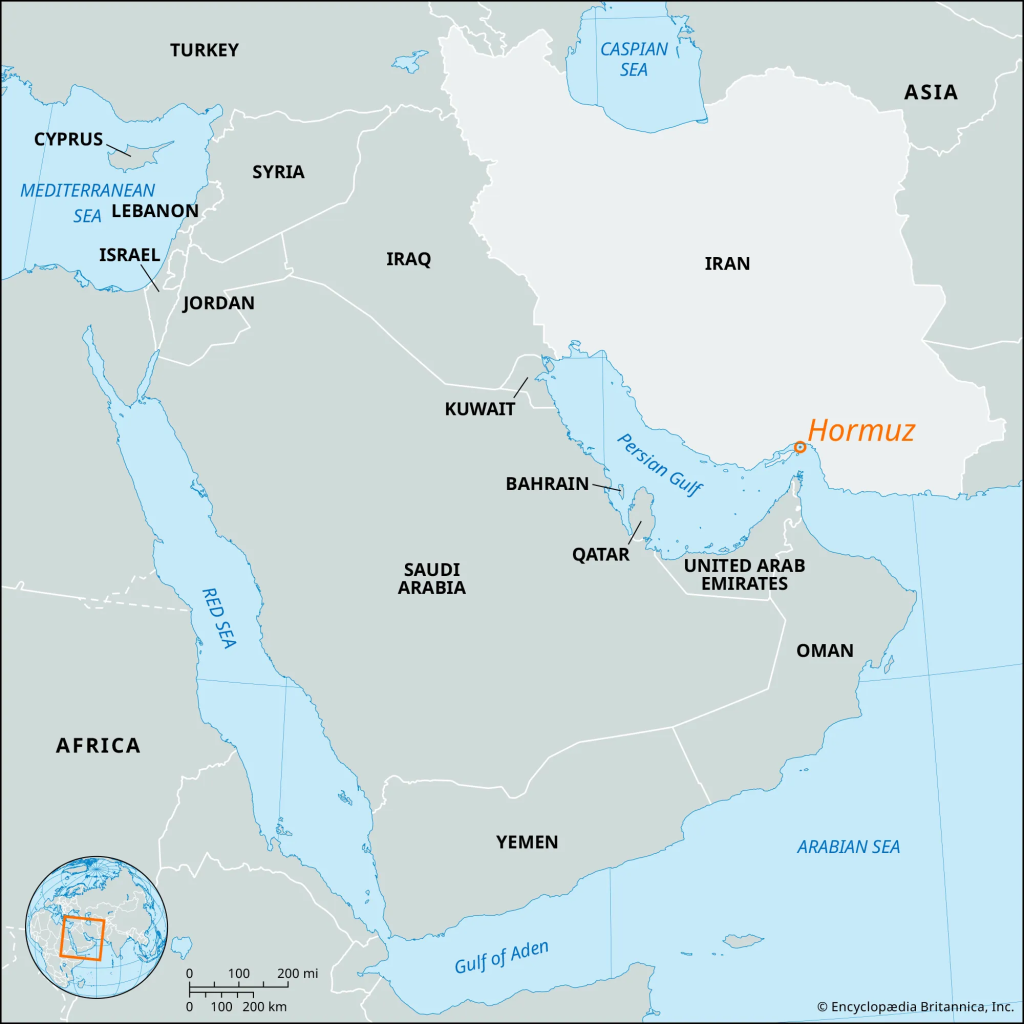
The Strait of Hormuz connects the Persian Gulf to the Gulf of Oman and then to the Indian Ocean. Only countries whose ports lie within the Persian Gulf must cross this strait to reach the Indian Ocean.
Bahrain is an island nation situated entirely within the Persian Gulf. All its maritime trade to the Indian Ocean must pass through the Strait of Hormuz.
Syria is a Mediterranean Sea coastal country. It has no access to the Persian Gulf whatsoever. Its ships would use the Mediterranean and potentially the Suez Canal to reach the Indian Ocean — the Strait of Hormuz is irrelevant to Syria.
Qatar is a peninsula jutting into the Persian Gulf. Being entirely enclosed within the Gulf, all Qatari ships heading to the Indian Ocean must necessarily pass through the Strait of Hormuz. Qatar is also home to one of the world’s largest LNG export terminals, making this strait critically important to its trade.
Egypt borders the Mediterranean Sea and the Red Sea. Its ships access the Indian Ocean via the Red Sea and the Gulf of Aden, not the Strait of Hormuz. The Suez Canal connects Egypt’s Mediterranean and Red Sea coasts.
Quick Reference:
| Country | Sea Access | Needs Hormuz? |
| Bahrain | Persian Gulf | Yes |
| Syria | Mediterranean | No |
| Qatar | Persian Gulf | Yes |
| Egypt | Red Sea / Mediterranean | No |
Q31.Tungurahua Volcano, which was declared a Global Geopark by UNESCO in 2025, is situated in which one among the following countries ?
(a) Ecuador
(b) Peru
(c) Bolivia
(d) Colombia
Answer: (a) Ecuador
Explanation
UNESCO designated two new Global Geoparks in Ecuador — Napo Sumaco and Tungurahua Volcano — officially recognized on April 10, 2025, by the Organization’s Executive Council.
Located in the Ecuadorian Andes, Tungurahua Volcano UNESCO Global Geopark displays a geological history spanning over 417 million years, shaped by volcanic eruptions, tectonic uplift, and glacial activity.
Ecuador is home to three UNESCO Global Geoparks, making it the South American country with the highest number of geoparks relative to its territorial size.
Peru, Bolivia, and Colombia have no association with the Tungurahua Volcano, which is specifically located in the central Ecuadorian Andes.
Sources:
- https://www.unesco.org/en/articles/ecuador-adds-two-new-unesco-global-geoparks
- https://www.unesco.org/en/iggp/tungurahua-volcano-unesco-global-geopark
- https://www.visitgeoparks.org/post/unesco-names-16-new-global-geoparks
Q32.With reference to Madhav National Park, which of the following statements is/are correct ?
1. It was declared a Tiger Reserve in India in 2025.
2. Sakhya Sagar, which is designated as a Ramsar Site, is situated within this National Park.
3. Its area is shared between Madhya Pradesh and Rajasthan.
Select the answer using the code given below :
(a) 1 only
(b) 1 and 2
(c) 2 and 3
(d) 3 only
Answer: (b) 1 and 2
Explanation:
Statement 1 — CORRECT. The Centre declared Madhav National Park in Madhya Pradesh as the country’s 58th tiger reserve on March 9, 2025. Madhav National Park became the ninth tiger reserve in Madhya Pradesh.
Statement 2 — CORRECT. Man-made structures in the national park include Sakhya Sagar and Madhav Sagar lakes, formed in 1918. Sakhya Sagar is a Ramsar site, situated within the park itself.
Statement 3 — INCORRECT. Madhav National Park is a national park in Shivpuri District of Gwalior division in northwest Madhya Pradesh, India. Its area is entirely within Madhya Pradesh and is not shared with Rajasthan. The question’s claim of shared territory with Rajasthan is factually wrong.
Correct Answer: (b) 1 and 2
Sources:
- https://www.britannica.com/place/Madhav-National-Park
- https://en.wikipedia.org/wiki/Madhav_National_Park
Q33. With reference to the climate of Andaman and Nicobar Islands, which of the following statements is/are correct ?
1. The climate can be defined as a humid, tropical coastal climate.
2. It receives rainfall from both South-west monsoon and North-east monsoon.
3. Maximum precipitation is between December and May.
Select the answer using the code given below:
(a) 1 only
(b) 1 and 2
(c) 2 and 3
(d) 3 only
Answer: (b) 1 and 2
Explanation:
Statement 1 — Correct The Andaman and Nicobar Islands have a humid, tropical coastal climate — hot and humid throughout the year with temperatures ranging 23°C–30°C, high humidity, and heavy rainfall typical of a tropical maritime environment.
Statement 2 — Correct The islands receive rainfall from both monsoons:
- South-West Monsoon (May–September) — brings the bulk of rainfall
- North-East Monsoon (October–December) — also contributes significantly due to the islands’ location in the Bay of Bengal
This dual monsoon receipt is a distinctive feature of the islands’ climate.
Statement 3 — Incorrect Maximum precipitation is not between December and May. The peak rainfall period is during the South-West monsoon (roughly May to September/October). December to May is relatively drier, with May marking the onset of the SW monsoon. The period from November to January sees some NE monsoon rain, but overall this is not the period of maximum precipitation.
Q34.Which of the following geographical features or phenomena is/are associated with the Peninsular Block of India ?
1. Submergence of parts of the western coast due to tectonic activity.
2. Presence of residual mountain ranges such as the Veliconda hills and Mahendragiri hills.
3. Deep, V-shaped river valleys formed by fast-flowing rivers
Select the answer using the code given below :
(a) 1 only
(b) 1 and 2
(c) 2 and 3
(d) 3 only
Answer: (b) 1 and 2
Statement 1 — Correct The western coast of the Peninsular Block is a classic example of a submerged coastline caused by tectonic activity (faulting and subsidence). This submergence has resulted in features like natural harbours, estuaries, and the narrow but fertile coastal plains seen along the Konkan and Malabar coasts.
Statement 2 — Correct The Peninsular Block contains several residual mountain ranges — ancient fold mountains that have been worn down by millions of years of erosion. The Veliconda Hills (Andhra Pradesh) and Mahendragiri Hills (Odisha-Andhra border) are well-known examples, forming parts of the discontinuous Eastern Ghats. These are remnants of much older and higher mountain systems.
Statement 3 — Incorrect Deep, V-shaped valleys are characteristic of young, fast-flowing Himalayan rivers, which are still actively cutting downward into soft sedimentary rock. Peninsular rivers, by contrast, flow over hard, ancient crystalline rocks and have reached a stage of maturity. They typically have broad, shallow, and graded valleys rather than deep V-shaped ones. The hard rock surface of the Peninsula limits deep vertical erosion.
Q35.Consider the following statements with reference to the Sagarmala Programme of the Government of India:
I. The Sagarmala Programme seeks to achieve port-led economic growth through cost-effective and sustainable coastal infrastructure.
II. The success of the Sagarmala Programme is reflected in significant growth in coastal and inland waterway shipping, along with improved global port rankings.
III. Sagarmala 2.0 aims to position India as a global maritime innovation hub aligned with Atmanirbhar Bharat and Viksit Bharat 2047 visions.
Which of the following relationships among the above statements is/are correct?
1. Statement II validates the effectiveness of the strategies envisioned in statement I.
2. Statement III extends the objectives of statement I by embedding them into a future-oriented innovation framework.
3. Statement I contradicts statement III by focusing only on traditional infrastructure instead of modern innovation.
Select the answer using the code given below:
(a) 1 only
(b) 1 and 2
(c) 2 and 3
(d) 3 only
Answer: (b) 1 and 2
Analysing Each Base Statement First
Statement I — Correct. The Sagarmala Programme, launched in March 2015, is the flagship initiative of the Ministry of Ports, Shipping, and Waterways, aimed at revolutionizing India’s maritime sector. It aims to streamline logistics, reduce costs, and enhance international trade competitiveness by shifting from traditional, infrastructure-heavy transport to efficient coastal and waterway networks, with a focus on sustainable coastal development ensuring minimal infrastructure investment while maximizing economic impact.
Statement II — Correct. Sagarmala has made India’s ports faster, boosted the coastal economy, revived inland waterways, and improved global logistics rankings. Coastal shipping grew 118% in a decade, Ro-Pax ferries moved over 40 lakh passengers, and inland waterway cargo rose 700%. Nine Indian ports rank in the world’s top 100, with Vizag in the top 20 container ports.
Statement III — Correct. Sagarmala 2.0 and the Sagarmala Startup Innovation Initiative (S2I2) aim to unlock Rs 12 lakh crore in investments, strengthen shipbuilding, repair, and recycling, and position India as a hub for maritime innovation and sustainability, anchored in Viksit Bharat and Atmanirbhar Bharat 2047.
Now Analysing the Relationships
Relationship 1 — Statement II validates the effectiveness of strategies in Statement I — Correct
Statement I laid out the vision of port-led economic growth through cost-effective coastal infrastructure. Statement II directly validates this by presenting measurable outcomes — 118% growth in coastal shipping, 700% rise in inland waterway cargo, and improved global port rankings. The results are a direct consequence of the strategies envisioned in Statement I. This relationship is logically sound and factually supported by PIB reports.
Relationship 2 — Statement III extends the objectives of Statement I into a future-oriented innovation framework — Correct
Statement I focused on port-led growth and cost-effective coastal infrastructure. Sagarmala 2.0 builds upon the progress of the original Sagarmala Scheme with an expanded national vision, including supporting India’s ambition of becoming a 30-trillion-dollar economy by 2047, advancing the Viksit Bharat Mission through enhanced port capacity and employment generation, and driving the modernization of the maritime sector. This clearly shows that Statement III does not contradict but rather extends and elevates the foundational objectives of Statement I into a broader 2047 innovation and self-reliance framework.
Relationship 3 — Statement I contradicts Statement III — Incorrect
This is factually wrong. The Sagarmala Programme supports these objectives by enhancing port infrastructure, improving logistics efficiency, and strengthening coastal and maritime connectivity, thereby contributing to India’s maritime growth by 2047. Statement I and Statement III are complementary — original Sagarmala built the foundation; Sagarmala 2.0 builds an advanced innovation superstructure on top of it. There is no contradiction.
Q36.Consider the following statements about Rhynchostylis retusa (Foxtail orchid):
1. It is an epiphytic orchid.
2. The species is endemic to North-east India.
3. It is the State flower of Arunachal Pradesh and Assam.
Which of the statements given above is/are correct?
(a) 1 only
(b) 1 and 2
(c) 2 and 3
(d) 3 only
Answer: (b) 1 and 2

Statement 1 — Correct
Rhynchostylis retusa is an epiphyte growing on tree trunks in open forests or at forest margins at elevations of 300–1,500 m. It is an epiphytic orchid comprising only four species, which are distributed in the Indian subcontinent, China, Indochina, Malaysia, Indonesia and the Philippines.
Statement 2 — Incorrect
This is the key point where many aspirants get confused. The species is NOT endemic to North-east India. It can be found in Bhutan, Cambodia, China (Guizhou, Yunnan), India, Indonesia, Laos, Malaysia, Myanmar, Nepal, Philippines, Singapore, Sri Lanka, Thailand, and Vietnam. In India, the plant is most common in North-East, Orissa and Andhra Pradesh. Since it has a wide distribution across South and South-East Asia, it cannot be called endemic to North-east India.
Statement 3 — Correct
Rhynchostylis retusa is recognized as the state flower of Arunachal Pradesh and Assam in India, as well as the Uva Province of Sri Lanka.
Correct Answer: (b) 1 and 3
Reference Links:
- Earthpedia (Plant Encyclopedia): https://earthpedia.earth.com/plant-encyclopedia/angiosperms/orchidaceae/rhynchostylis-retusa/
- Wikipedia — List of Indian State Flowers: https://en.wikipedia.org/wiki/List_of_Indian_state_flowers
- ARCC Journals (Indian Journal of Agricultural Research, 2025): https://arccjournals.com/journal/indian-journal-of-agricultural-research/A-6143
- Wikipedia — Rhynchostylis retusa: https://en.wikipedia.org/wiki/Rhynchostylis_retusa
Q37. Which one of the following statements with regard to the Moidams, built by the Tai-Ahom kingdom and inscribed as a World Heritage Site by UNESCO, is/are correct?
1. They acted as army fortresses.
2. They were recreation centres of the Royals and Nobles.
3. They were burial grounds of the Royals and Nobles.
4. They were battle drill centres of the Royals and Nobles.
Select the answer using the code given below:
(a) 1 only
(b) 1 and 3
(c) 3 only
(d) 2 and 4
Answer: (c) 3 only
Statement 1 — Incorrect
Moidams were never army fortresses. The Moidams, located in the foothills of the Patkai Ranges in eastern Assam, represent a royal mound burial necropolis established by the Tai-Ahom dynasty. This sacred site illustrates the funerary traditions of the Tai-Ahom people. There is no military or defensive purpose associated with them.
Statement 2 — Incorrect
Moidams had no function as recreation centres. The word Moidam originates from the Tai script ‘Phrang Mai’, which means to bury, and ‘Dam’, which means spirit of the dead. The Tai-Ahoms believed that while the body perishes upon death, the soul lives on. Therefore, these burial mounds were constructed as monuments to honour the lives of the deceased.
Statement 3 — Correct
Moidams are vaulted chambers where bodies of royals from the Tai-Ahom clan were laid to rest on raised platforms alongside objects like royal insignia and jewellery that were likely used by the deceased in their lifetime. They contain the remains of kings and other royals together with grave goods such as food, horses and elephants, and sometimes queens and servants. Charaideo became the necropolis of all Ahom rulers, where the Tai-Ahom created moidams or “homes-for-spirit” for 600 years, spanning from the 13th to the 19th centuries CE.
Statement 4 — Incorrect
There is no historical or archaeological evidence associating Moidams with battle drill or military training. The Moidams celebrate and preserve royal lineage through colossal architecture, comparable to the pyramids of Egyptian pharaohs and royal graves in ancient China. Their entire purpose was funerary and spiritual, not military.
Correct Answer: (c) 3 only
Reference Links:
- UNESCO Official Page: https://whc.unesco.org/en/list/1711
- PIB (Press Information Bureau), Government of India: https://www.pib.gov.in/PressReleaseIframePage.aspx?PRID=2037495
- United Nations India: https://india.un.org/en/275086-assam%E2%80%99s-moidams-debut-world-heritage-list
- Vivekananda International Foundation: https://www.vifindia.org/2024/august/14/Moidams-The-Mound-Burial-System-of-the-Ahom-Dynasty
Q38. At the United Nations Ocean Conference (UNOC) held in June, 2025 in France, the Food and Agricultural Organization (FAO) of the United Nations demonstrated its leading voice on marine and ocean issues, especially on sustainable fisheries and aquaculture for resilient livelihood and “Blue Transformation”.
Which of the following combinations about the “Four Betters” proposed by FAO for “Blue Transformation” is correct?
(a) Better production, better nutrition, better environment and better ocean
(b) Better production, better nutrition, better environment and better life
(c) Better coral reefs, better nutrition, better environment and better life
(d) Better estuaries, better nutrition, better environment and better mangrove vegetation
Answer: (b) Better production, better nutrition, better environment and better life
Explanation:
FAO’s extensive involvement at UNOC 2025 underscored its vision for a “Blue Transformation,” positioning aquatic food systems as pivotal for achieving the Four Betters: better production, better nutrition, a better environment, and a better life — leaving no one behind. This approach, detailed in FAO’s Strategic Framework 2022–31, recognizes the intrinsic connection between ocean health and food security.
This is further confirmed by the FAO Director-General’s own remarks at the Committee on Fisheries. “And to ensure the Four Betters: better production, better nutrition, a better environment and a better life — leaving no one behind.”
Why other options are wrong:
- (a) is incorrect — “better ocean” is not one of the Four Betters; ocean health is an underlying theme, not a standalone “Better.”
- (c) is incorrect — “better coral reefs” has no basis in FAO’s framework.
- (d) is incorrect — “better estuaries” and “better mangrove vegetation” are entirely fabricated terms not used by FAO.
Reference Links:
- FAO Official Page — UNOC 2025: https://www.fao.org/about/fao-unoc-series/2025/a-leading-voice-for-ocean-and-aquaculture-sustainability/en
- FAO Director-General Speech at COFI Subcommittee on Aquaculture (May 2025): https://www.fao.org/director-general/speeches/details/13th-session-of-the-committee-on-fisheries-(cofi)-sub-committee-on-aquaculture–remarks/en
- FAO Blue Transformation Policy Page: https://www.fao.org/policy-support/policy-themes/blue-transformation
Q39.Which of the following statements with reference to Lake Turkana is/are correct?
1. It is the largest desert lake in the world.
2. The lake is situated in South Sudan along the eastern fringe of the Sahara desert.
3. The lake is listed as a UNESCO World Heritage Site and is also referred to as the ‘Jade Sea’.
Select the answer using the code given below:
(a) 1 only
(b) 1 and 3 only
(c) 2 and 3 only
(d) 1, 2 and 3
Answer: (b) 1 and 3 only
Statement 1 — Correct
The Lake is the most saline lake in East Africa and the largest desert lake in the world, surrounded by an arid, seemingly extraterrestrial landscape that is often devoid of life. It is the world’s largest permanent desert lake and the world’s largest alkaline lake.
Statement 2 — Incorrect
Lake Turkana is not located in South Sudan, nor is it along the Sahara desert’s eastern fringe. Located in the Kenyan Rift Valley and stretching north into Ethiopia, this extraordinary lake covers 6,405 square kilometres and runs 248 kilometres long. It lies in the East African Rift Valley in northern Kenya, with a small portion extending into Ethiopia. The surrounding desert is the Chalbi Desert, not the Sahara.
Statement 3 — Correct
It is Africa’s fourth largest lake, fondly called the Jade Sea because of its breathtaking color. Lake Turkana National Parks are a UNESCO World Heritage Site, recognized for both their paleontological value and their importance as a breeding ground for Nile crocodiles and hippopotamuses. The jade-green color is caused by blue-green algae thriving in its alkaline waters.
Reference Links:
- UNESCO World Heritage Centre (Official): https://whc.unesco.org/en/list/801/
- Wikipedia — Lake Turkana: https://en.wikipedia.org/wiki/Lake_Turkana
- Geography Worlds: https://geographyworlds.com/blog/lake-turkana-geography/
Q40. Which one of the following is the first Plan Vivo certified Reducing Emissions from Deforestation and Forest Degradation (REDD+) project in India?
(a) Uttarakhand REDD+ project
(b) ICFRE-ICIMOD Transboundary REDD+ project in North-Eastern Himalayas
(c) Khasi Hills Community REDD+ project
(d) Sikkim Mamley Kamrang Community REDD+ project
Answer: (c) Khasi Hills Community REDD+ project
Explanation:
The Khasi Hills Community REDD+ Project is India’s first community-based REDD+ programme and protects and restores 27,000 ha of cloud forest, in addition to preserving sacred groves and watersheds.
As India’s first REDD+ Project (Reducing Emissions from Deforestation and Degradation), Khasi Hills is creating a significant number of Plan Vivo Certificates and has the potential to create 450,000 tonnes of CO2 benefit. These families include over 40,978 people spread across 86 villages.
The project has been registered and certified through Plan Vivo, UK in 2013 as the Khasi Hills REDD+ Project and is the first community-based REDD project in the North Eastern States of India.
Key Facts about the Project:
- Location: East Khasi Hills District, Meghalaya, Northeast India
- Implementing body: Synjuk Federation — a federation of eleven indigenous Khasi kingdoms
- The project is one of the first REDD+ projects in Asia to be managed and implemented by indigenous communities.
- The Khasi Hills Community REDD+ project is a Plan Vivo certified project, benefiting from carbon certificates for avoided deforestation and assisted natural regeneration.
- The project was initiated in 2010–11, started selling carbon credits in 2012, and was formally certified under Plan Vivo Standard in 2013.
Reference Links:
- Plan Vivo Foundation (Official): https://www.planvivo.org/projects/khasi-hills-community-redd-project-india
- REDD-Monitor: https://reddmonitor.substack.com/p/the-khasi-hills-community-redd-project
- BGCI (Botanic Gardens Conservation International): https://www.bgci.org/news-events/indias-first-tgbs-certified-site-achieves-advanced-tier-a-landmark-in-community-led-restoration/
Q41.Which of the following statements with regard to genetic medicine is/are correct?
1. Genetic medicines correct/compensate for the faulty genes responsible for disease.
2. Engineered viruses and lipid nanoparticles are used as carriers of the genetic medicine.
3. Genetic medicines alter the entire DNA sequence.
Select the answer using the code given below:
(a) 1 only
(b) 2 and 3 only
(c) 1 and 2 only
(d) 1, 2 and 3
Answer: (c) 1 and 2 only.
Detailed Answer
Statement 1 — – Correct
Genetic medicines correct/compensate for faulty genes responsible for disease.
Gene transfer works by adding new genetic code to the DNA of certain cells, restoring the missing function of a defective, mutated, or missing gene. The new gene could be a properly functioning version of the faulty gene, or it could be a different gene that improves cellular processes in another way. Gene editing can be used to remove a section of DNA that causes disease, prevent a gene from making a harmful protein, or correct a mutation.
Statement 2 — – Correct
Engineered viruses and lipid nanoparticles are used as carriers of genetic medicine.
Modified viruses like lentivirus, herpes simplex virus, retrovirus, and adeno-associated virus have been extensively employed as carriers for gene transfer. Lipid nanoparticles (LNPs) have gained significant attention as a favored choice for delivering genetic material in gene therapies.
The current delivery systems available for genetic medicines are viral vectors and lipid nanoparticles (LNPs).
Statement 3 — -Incorrect
Genetic medicines do NOT alter the entire DNA sequence.
CRISPR-Cas9 acts as molecular scissors that cut the DNA at a specific location. The guide RNA (gRNA) contains a specific sequence that directs the Cas enzyme to the desired location in the DNA, ensuring precise targeting of the genetic material.
Gene editing uses enzymes designed to target specific DNA sequences. The enzymes cut out the faulty sequence and replace it with a functional copy.
Genetic medicines target only specific faulty genes or sequences — not the entire DNA. Altering the entire DNA sequence (which contains ~3 billion base pairs in humans) would be biologically impossible and catastrophic. Statement 3 is completely false. –
Authentic Sources
- NIH/PubMed — Lipid Nanoparticles for Gene Delivery https://pmc.ncbi.nlm.nih.gov/articles/PMC5006671/
- NIH/PubMed — Gene Therapy: Advances, Challenges and Perspectives https://www.ncbi.nlm.nih.gov/pmc/articles/PMC5823056/
- University of Utah — Learn.Genetics: Approaches to Gene Therapy https://learn.genetics.utah.edu/content/genetherapy/approaches/
- Abcam — Exploring Gene Therapy: Types, Methods and Applications https://www.abcam.com/en-us/knowledge-center/dna-and-rna/gene-therapy
Q42.Which of the following statements with regard to Large Language Models (LLMs) used in machine learning is/are correct?
1. LLMs assign probabilities to the next possible words and then pick the one with the highest probability.
2. LLMs process data through mathematical optimization to minimise prediction errors.
3. LLMs produce unbiased outputs.
Select the answer using the code given below:
(a) 1 only
(b) 1 and 2 only
(c) 2 and 3 only
(d) 1, 2 and 3
Answer: (b) 1 and 2 only.
Detailed Analysis
Statement 1 — – Correct
LLMs assign probabilities to the next possible words and then pick the one with the highest probability.
Large language models work by responding to prompts by tokenizing the prompt, converting it into embeddings, and using their transformer to generate text one token at a time, calculating the probabilities for all potential next tokens, and outputting the most likely one. The model does not “know” the final answer in advance; it uses all the statistical relationships it learned in training to predict one token at a time, making its best guess at every step.
Every time an LLM generates text, it assigns probabilities to possible next words. The model then picks the word with the highest probability (or sometimes samples from the top few options to add variety).
Statement 1 is a correct description of the fundamental mechanism.
Statement 2 — – Correct
LLMs process data through mathematical optimization to minimise prediction errors.
This approach, known as causal language modeling, transforms the complex challenge of understanding language into a prediction problem that can be solved through mathematical optimization.
A mathematical process called “backpropagation” adjusts the numbers inside the model — called parameters — so that they are more likely to predict the correct next word. In this way, LLMs are developed using a process that minimises prediction errors through training.
Statement 2 is fully correct.
Statement 3 — -Incorrect
LLMs do NOT produce unbiased outputs.
Although LLMs have immense potential and utility, they raise concerns due to the inherent biases that reflect societal prejudices embedded in the training data. LLMs often reflect different forms of bias present in the training data.
Large language models can pass explicit social bias tests but still harbor implicit biases, similar to humans who endorse egalitarian beliefs yet exhibit subtle biases.
The massive pre-training of LLMs, which defines quality of outcome entirely on the basis of probabilities estimated from observed language, has no way to tell biased observations about distribution apart from neutral ones.
LLMs are well-known to carry and sometimes amplify biases from training data — on gender, race, religion, profession, etc. Statement 3 is definitively incorrect.
Sources
- IBM — What Are Large Language Models (LLMs)? https://www.ibm.com/think/topics/large-language-models
- Center for Security and Emerging Technology, Georgetown University — The Surprising Power of Next Word Prediction https://cset.georgetown.edu/article/the-surprising-power-of-next-word-prediction-large-language-models-explained-part-1/
- PNAS (Proceedings of the National Academy of Sciences) — Explicitly Unbiased LLMs Still Form Biased Associations https://www.pnas.org/doi/10.1073/pnas.2416228122
- MIT Press — Computational Linguistics: Large Language Models Are Biased Because They Are Large Language Models https://direct.mit.edu/coli/article/51/3/885/128621/Large-Language-Models-Are-Biased-Because-They-Are
Q43.Which of the following statements with regard to stealth technology is/are correct?
1. Stealth objects have a very small radar cross-section and are coated with Radar Absorbing Material.
2. Stealth objects can be detected using specific frequencies.
3. Stealth objects are coated with metamaterials to increase the scattering of electromagnetic radiation.
Select the answer using the code given below:
(a) 1 only
(b) 2 and 3 only
(c) 1 and 2 only
(d) 1, 2 and 3
Answer: (c) 1 and 2 only.
Detailed Answer
Statement 1 — – Correct
Stealth objects have a very small radar cross-section and are coated with Radar Absorbing Material.
A stealth aircraft is designed to minimize its radar cross-section (RCS). This reduction is achieved through angular shapes that deflect waves, absorbent materials (RAM — Radar Absorbing Material), and extreme attention to reflective parts such as leading edges, fins, and air intakes.
Radar absorbing materials (RAMs) refer to a type of materials that can convert electromagnetic wave energy into other forms of energy such as thermal energy for dissipation, thereby reducing the radar cross-section.
Statement 2 — – Correct
Stealth objects can be detected using specific frequencies.
Low-frequency radars, operating in the VHF (30 to 300 MHz) and UHF (300 MHz to 1 GHz) bands, use wavelengths that are much longer than the size of fighter aircraft. In this range, geometric stealth loses its effectiveness. Stealth reductions are most effective against X-band radars (8 to 12 GHz).
VHF radar systems have wavelengths comparable to aircraft feature sizes and should exhibit scattering in the resonance region rather than the optical region, allowing most stealth aircraft to be detected.
Stealth technology is optimised for specific frequency bands (typically X-band); radars operating at different frequencies (VHF/UHF) can detect stealth objects.
Statement 3 — -Incorrect
Metamaterials are NOT used to INCREASE scattering — they REDUCE it.
The statement contains a critical error: metamaterials in stealth applications aim to reduce/absorb/redirect electromagnetic radiation, not increase its scattering.
In the context of radio stealth, metamaterials are designed to either absorb incident electromagnetic energy or scatter it away from radar receivers — enabling wave interactions that guide waves around an object, minimising or even preventing them from scattering back to detection systems.
Metamaterials serve as highly efficient metasurface absorbers, capable of soaking up electromagnetic radiation with minimal reflection. Cloaking technology leverages metamaterials to render objects virtually invisible.
The purpose is always to reduce detection, not to increase scattering. Statement 3 is definitively wrong.
Authentic Sources
- AZoMaterials — Metamaterials and the Physics of Stealth https://www.azom.com/article.aspx?ArticleID=25023
- ScienceDirect — Electromagnetic Stealth Technology: A Review of Wave-Absorbing Structures https://www.sciencedirect.com/science/article/pii/S0264127525003119
- Nature — Microsystems & Nanoengineering: Fabrication and Modulation of Flexible Electromagnetic Metamaterials https://www.nature.com/articles/s41378-024-00806-1
Q44.Which of the following statements with regard to Black Boxes used in modern aircrafts is/are correct?
1. They carry a beacon emitting red light pulses to facilitate underwater detection.
2. They record both the cockpit voice and flight data.
3. Their memory units are made using either stainless steel or titanium.
Select the answer using the code given below:
(a) 1 only
(b) 2 and 3 only
(c) 1 and 2 only
(d) 1, 2 and 3
Answer: (b) 2 and 3 only.
Detailed Answer
Statement 1 — -Incorrect
The beacon emits ULTRASONIC PULSES, not red light pulses.
An underwater locator beacon (ULB) is a device fitted to aviation flight recorders such as the cockpit voice recorder and flight data recorder. ULBs are triggered by water immersion; most emit an ultrasonic 10 ms pulse once per second at 37.5 kHz.
If a plane crashes into the water, the beacon sends out an ultrasonic pulse that cannot be heard by human ears but is readily detectable by sonar and acoustical locating equipment. The beacon sends out pulses at 37.5 kilohertz (kHz) and can transmit sound as deep as 14,000 feet (4,267 meters).
The beacon emits acoustic/ultrasonic pulses — not red light. Light would be almost useless underwater for search and recovery. Statement 1 is wrong. –
Statement 2 — – Correct
Black boxes record both cockpit voice and flight data.
A memory unit is expected to survive impacts of 3,400 g, flame temperatures as high as 1,100 °C, and pressures encountered at 6,000 metres underwater.
Inside the black box: Flight Data Recorder (FDR) — records instructions and operating data from the aircraft’s systems. Cockpit Voice Recorder (CVR) — records the audio environment in the flight deck.
Modern black boxes record both cockpit voice and flight data. –
Statement 3 — – Correct
The memory unit (CSMU) is encased in stainless steel or titanium.
The Crash Survivable Memory Unit (CSMU) is engineered to withstand extreme heat, violent crashes and pressure. The materials used include: Aluminum housing around the stack of memory cards; High-temperature insulation of dry-silica material; Stainless-steel/Titanium shell: About 0.25 inches (0.64 cm) thick.
The crash survivable memory unit (CSMU) is enclosed in stainless steel or titanium, ensuring it can endure massive impact forces, high-pressure environments, and temperatures as high as 2,000°F (1,100°C).
Statement 3 is correct. –
Sources
- HowStuffWorks — How Black Boxes Work https://science.howstuffworks.com/transport/flight/modern/black-box.htm
- Britannica — Flight Recorder https://www.britannica.com/EBchecked/topic/210220/flight-recorder
- SKYbrary Aviation Safety — Underwater Locator Beacon (ULB) https://skybrary.aero/articles/underwater-locator-beacon-ulb
- US Patent (Titanium CSMU) — Crash Survivable Memory Unit https://patents.justia.com/patent/7333343
Q45.Which of the following statements with regard to Green Hydrogen is/are correct?
1. It is decarbonized hydrogen obtained from natural gas reforming combined with carbon capture and storage (CCS).
2. It is produced using electrolysis of water with electricity generated by renewable energy.
3. National Green Hydrogen Mission of India aims for abatement of nearly 50 MMT of annual greenhouse gas emissions by 2030.
Select the answer using the code given below:
(a) 1 only
(b) 2 and 3 only
(c) 2 only
(d) 1, 2 and 3
Answer: (b) 2 and 3 only.
Detailed Analysis of Each Statement
Statement 1 — -Incorrect
This describes BLUE hydrogen, not Green hydrogen.
Blue hydrogen leverages carbon capture and storage technologies (CCS) to limit the carbon intensity of hydrogen production from natural gas. Green hydrogen is produced through the electrolysis of water using renewable energy — it does not require CCS technologies.
Green hydrogen is produced from water using electrolysis powered by renewable energy, while blue hydrogen is generated from natural gas with carbon capture and storage (CCS) technology.
Statement 1 is the definition of Blue Hydrogen, not Green Hydrogen. –
Statement 2 — – Correct
Green hydrogen is produced using electrolysis of water powered by renewable energy.
Green or renewable hydrogen refers to hydrogen produced from renewable energy sources like wind and solar through a process known as water electrolysis, where an electrolyzer splits water molecules into oxygen and hydrogen. No CO₂ emissions are generated during the production process.
This is the precise and universally accepted definition of Green Hydrogen. –
Statement 3 — – Correct
National Green Hydrogen Mission targets abatement of nearly 50 MMT of annual greenhouse gas emissions by 2030.
The National Green Hydrogen Mission will result in the following outcomes by 2030: Development of green hydrogen production capacity of at least 5 MMT per annum with an associated renewable energy capacity of about 125 GW; over ₹8 lakh crore in total investments; cumulative reduction in fossil fuel imports over ₹1 lakh crore; and abatement of nearly 50 MMT of annual greenhouse gas emissions.
This is confirmed directly from the PIB (Press Information Bureau) official press release of the Union Cabinet approval. –
Sources
- PIB (Press Information Bureau, Government of India) — Cabinet approves National Green Hydrogen Mission https://www.pib.gov.in/PressReleasePage.aspx?PRID=1888547
- National Green Hydrogen Mission Portal (Official Government Portal) https://nghm.mnre.gov.in/overviews.php
- Prime Minister of India — Cabinet Approves National Green Hydrogen Mission https://www.pmindia.gov.in/en/news_updates/cabinet-approves-national-green-hydrogen-mission/
- Belfer Center, Harvard Kennedy School — The Colors of Hydrogen https://www.belfercenter.org/research-analysis/colors-hydrogen
Q46.Consider the following statements with regard to involvement of private entities in India’s space programme:
1. The Indian National Space Promotion and Authorisation Centre (IN-SPACe) is an autonomous agency formed to facilitate participation of private entities.
2. Agnikul Cosmos launched the world’s first flight using 3D-printed rocket engine.
3. Skyroot Aerospace has developed liquid fuel for GSLV.
Which of the statements given above is/are correct?
(a) 1 only
(b) 2 and 3 only
(c) 1 and 2 only
(d) 1, 2 and 3
Answer: (c) 1 and 2 only.
Detailed Answer
Statement 1 — – Correct
IN-SPACe is an autonomous agency formed to facilitate participation of private entities.
Indian National Space Promotion and Authorization Centre (IN-SPACe), an autonomous single-window nodal agency in the Department of Space (DOS), is promoting, enabling, authorizing and supervising various space activities of Non-Governmental Entities (NGEs) for boosting the space economy of India.
To facilitate private sector participation, the government created IN-SPACe in June 2020 as a single-window, independent, nodal agency functioning as an autonomous agency in the Department of Space (DOS).
Statement 2 — – Correct
Agnikul Cosmos launched the world’s first flight using a 3D-printed rocket engine.
IIT Madras-incubated start-up Agnikul Cosmos launched the world’s first rocket with a single piece 3D-printed engine from Sriharikota on 30th May 2024. ‘Agnibaan – SOrTeD’ (Sub-Orbital Technology Demonstrator) is also India’s first semi-cryogenic engine-powered rocket launch that was completely designed and manufactured indigenously.
Statement 3 — -Incorrect
Skyroot Aerospace has NOT developed liquid fuel for GSLV.
Skyroot Aerospace has developed propulsion systems for its own Vikram rocket family — not for GSLV. The Vikram rocket family by Skyroot uses solid fuel stages (Kalam-series) and a cryogenic upper stage (Dhawan-II) using LOX/LNG propellants — all designed exclusively for Skyroot’s own Vikram launch vehicles.
India’s heaviest launch vehicles — GSLV and GSLV Mk III — use cryogenic fuel in the upper stage; Skyroot’s cryogenic engine uses liquid natural gas (LNG) and liquid oxygen (LoX) as propellants for its own Vikram rockets, not for GSLV.
GSLV uses ISRO’s own proprietary propulsion. Skyroot has never developed fuel or engines for GSLV. –
Sources
- IN-SPACe Official Website https://www.inspace.gov.in/inspace
- PIB (Press Information Bureau) — Agnikul’s World’s First 3D-Printed Engine Launch https://www.pib.gov.in/PressReleasePage.aspx?PRID=2022161
- Wikipedia — Vikram (Rocket Family) — Skyroot Aerospace https://en.wikipedia.org/wiki/Vikram_(rocket_family)
- Newsonair (Government of India) — Agnikul Cosmos World First 3D Printed Engine https://www.newsonair.gov.in/indias-iit-madras-startup-agnikul-cosmos-makes-history-with-the-worlds-first-3d-printed-engine-rocket-launch
Q47.Which of the following statements with regard to drone swarms is/are correct?
1. They use Terahertz band of frequency to communicate with the command centre.
2. Individual drones in the swarm can communicate with other drones in the swarm.
3. GPS Spoofing is a commonly used technique to counter drone swarm attack.
Select the answer using the code given below:
(a) 1 only
(b) 2 and 3 only
(c) 1 and 2 only
(d) 1, 2 and 3
Answer: (b) 2 and 3 only.
Detailed Analysis
Statement 1 — -Incorrect
Drone swarms do NOT commonly use the Terahertz band for communication with command centres.
Drones primarily operate at frequencies between 900 MHz and 5.8 GHz. Most remote-controlled drones use the 900 MHz frequency while drones with camera transmitters often use the 2.4 GHz frequency; some of the latest drones use the 5.8 GHz frequency to avoid interference from wireless transmissions.
The Terahertz (THz) band (0.1–10 THz) is still an experimental and research-stage technology for drone communication. It suffers from extreme atmospheric absorption and very short range, making it impractical for command-centre communication. It is not the standard frequency used by drone swarms. Statement 1 is wrong. –
Statement 2 — – Correct
Individual drones in a swarm can communicate with other drones in the swarm.
Each drone in the swarm is equipped with GPS, sensors, and communication systems, allowing them to maintain their position relative to one another while staying connected within a group. As they share information, drones within the swarm can autonomously adjust their movements and adapt to changes in the mission without explicitly being told to do so.
Drone swarm technologies allow groups of drones to coordinate with each other, often without direct human control, integrating advanced computer algorithms with local sensing and communication technologies to synchronize multiple drones.
Statement 3 — – Correct
GPS Spoofing is a commonly used technique to counter drone swarm attacks.
Radio frequency (RF) jamming targets control and telemetry signals, while GPS spoofing misdirects drones from their intended path. These are key tools in the technological arsenal against drone swarms.
GPS spoofing is a technique that misleads a drone’s navigation system by broadcasting counterfeit satellite signals, causing the drone to miscalculate its position — it is a prominent counter-drone technique used in real conflicts.
Sources
- US GAO — Science & Tech Spotlight: Drone Swarm Technologies https://www.gao.gov/products/gao-23-106930
- Scandinavian Journal of Military Studies — Fighting the Locusts: Implementing Military Countermeasures Against Drones and Drone Swarms https://sjms.nu/articles/10.31374/sjms.53
- CNAS (Center for a New American Security) — Countering the Swarm: C-UAS Defense Report https://s3.us-east-1.amazonaws.com/files.cnas.org/documents/Report_CUAS_Defense_Sep-2025_final.pdf
- ScienceDirect — THz Band Drone Communications (on Terahertz being experimental/research stage) https://www.sciencedirect.com/science/article/abs/pii/S1570870524002555
Q48.Which of the following statements with regard to GenomeIndia Project is/are correct?
1. It is a part of the Human Genome Project.
2. The project is funded by the Department of Biotechnology (DBT), Government of India.
3. Its primary aim is to build a catalogue of genetic diversity of the Indian population.
Select the answer using the code given below:
(a) 1 only
(b) 2 and 3 only
(c) 1 and 2 only
(d) 1, 2 and 3
Answer: (b) 2 and 3 only.
Detailed Answer
Statement 1 — Incorrect
GenomeIndia is NOT part of the Human Genome Project.
The Human Genome Project (HGP) was an international scientific project completed in 2003 that first mapped the entire human genome. GenomeIndia is a completely separate, independent Indian initiative launched in January 2020, distinct from the HGP.
Scientists in India got together to design the ‘GenomeINDIA Project’ which had the ambitious aim of understanding and cataloguing the genetic diversity of India — recognizing that knowledge generated through other national programs (including global ones like HGP) are not always applicable to the Indian population, increasing the global disparity in health outcomes.
GenomeIndia was created precisely because the HGP was Eurocentric and insufficient for the Indian population. It is a standalone national project, not part of HGP. –
Statement 2 — – Correct
GenomeIndia is funded by the Department of Biotechnology (DBT), Government of India.
Dr. Singh emphasized the significance of the ‘GenomeIndia’ project, spearheaded by the Department of Biotechnology (DBT), which aims to create a robust and comprehensive database of India’s genetic diversity.
The GenomeIndia project was funded by the Department of Biotechnology, Ministry of Science and Technology, Government of India (BT/GenomeIndia/2018).
Statement 3 — – Correct
GenomeIndia’s primary aim is to build a catalogue of genetic diversity of the Indian population.
Primary objective: Build a comprehensive catalogue of genetic variations that reflect the unique diversity of the Indian population. It was initiated in 2020 by the Department of Biotechnology (DBT), Government of India, with collaborations of 20 institutions to map India’s genetic diversity.
With the whole genomes of 10,000 healthy and unrelated Indians from 83 populations, the GenomeIndia project captures the genetic diversity of one of the highly underrepresented populations in the global genomics landscape.
Authentic Sources
- Department of Biotechnology, Government of India — GenomeINDIA Project (Official DBT Page) https://dbtindia.gov.in/news-features/genomeindia-project
- PIB (Press Information Bureau, Government of India) — GenomeIndia Data Launch https://www.pib.gov.in/PressReleasePage.aspx?PRID=2091577
- Nature Genetics (Peer-reviewed journal) — Mapping Genetic Diversity with the GenomeIndia Project https://www.nature.com/articles/s41588-025-02153-x
- GenomeIndia Official Website (IISc CBR) https://cbr-iisc.ac.in/genomeindia/
Q49.Which of the following statements with regard to the National Quantum Mission (NQM) is/are correct?
1. It aims at developing intermediate-scale quantum computers with 50–1000 physical qubits.
2. Its implementation includes setting up of four Thematic Hubs (T-Hubs) in academic and national R&D institutes across India.
Select the answer using the code given below:
(a) 1 only
(b) 2 only
(c) Both 1 and 2
(d) Neither 1 nor 2
Answer: (c) Both 1 and 2.
Detailed Answer
Statement 1 — – Correct
NQM aims at developing intermediate-scale quantum computers with 50–1000 physical qubits.
The Mission objectives include developing intermediate-scale quantum computers with 50–1000 physical qubits in 8 years in various platforms like superconducting and photonic technology.
More specifically, the phased targets are:
- 3 years: 20–50 physical qubits
- 5 years: 50–100 physical qubits
- 8 years: up to 50–1000 physical qubits –
Statement 2 — – Correct
NQM’s implementation includes setting up four Thematic Hubs (T-Hubs) in academic and national R&D institutes.
The implementation includes setting up four Thematic Hubs (T-Hubs) in top academic and national R&D institutes in the domains of Quantum Computing, Quantum Communication, Quantum Sensing & Metrology, and Quantum Materials & Devices. Qnulabs
The four T-Hubs are: IISc Bengaluru (Quantum Computing), IIT Madras/C-DOT Delhi (Quantum Communication), IIT Bombay (Quantum Sensing), IIT Delhi (Quantum Materials).
Sources
- DST (Department of Science & Technology), Government of India — Official NQM Page https://dst.gov.in/national-quantum-mission-nqm
- PIB (Press Information Bureau, Government of India) — NQM T-Hubs Announcement https://www.pib.gov.in/PressReleasePage.aspx?PRID=2111953
- Principal Scientific Adviser to Government of India — NQM Page https://www.psa.gov.in/mission/national-quantum-mission/26
- India Science and Technology Innovation Portal (Government of India) https://www.indiascienceandtechnology.gov.in/st-visions/national-mission/national-quantum-mission-nqm
Q50.Which of the following statements with regard to India’s Deep Ocean Mission is/are correct?
1. It was launched by the Ministry of Ports, Shipping and Waterways, Government of India.
2. Matsya-6000 has been designed to carry 3 people for deep sea exploration.
3. Samudrayaan is a project under this mission.
Select the answer using the code given below:
(a) 1 only
(b) 2 and 3 only
(c) 1 and 2 only
(d) 1, 2 and 3
Answer: (b) 2 and 3 only.
Detailed Analysis
Statement 1 — -Incorrect
The Deep Ocean Mission was NOT launched by the Ministry of Ports, Shipping and Waterways.
India’s Deep Ocean Mission was launched on 07.09.2021 by the Ministry of Earth Sciences (MoES) with an aim to develop technologies for exploring and sustainably utilizing the deep ocean’s living and non-living wealth.
Deep Ocean Mission has been launched w.e.f. 07.09.2021, as a Central Sector Scheme of Ministry of Earth Sciences with the approval of the Cabinet.
The correct ministry is Ministry of Earth Sciences (MoES), not the Ministry of Ports, Shipping and Waterways. –
Statement 2 — – Correct
Matsya-6000 is designed to carry 3 people for deep sea exploration.
Matsya 6000 is an Indian crewed deep-submergence vehicle with a complement of 3, intended to be utilised for deep-sea exploration of rare minerals under the Samudrayaan mission.
The primary goal is to develop a self-propelled manned submersible capable of carrying three human beings to a water depth of 6000 meters in the ocean with scientific tools for deep ocean exploration.
Statement 3 — – Correct
Samudrayaan is a project under the Deep Ocean Mission.
Samudrayaan is a project under the Deep Ocean Mission. Under the Samudrayaan project of Deep Ocean Mission, MATSYA 6000 manned submersible design has been completed.
As a part of DOM (Deep Ocean Mission), India’s flagship deep ocean mission, Samudrayaan, was initiated in 2021, in which India is embarking on a crewed expedition to reach a depth of 6,000 m using Matsya6000. –
Sources
- PIB (Press Information Bureau, Government of India) — Samudrayaan Project (Official) https://www.pib.gov.in/PressReleasePage.aspx?PRID=1942909
- PIB — Deep Ocean Mission Overview (PDF) https://static.pib.gov.in/WriteReadData/specificdocs/documents/2025/aug/doc2025817614501.pdf
Q51.Mr. X, a senior officer, was overseeing a critical vaccination programme during a pandemic. He found that a private service provider responsible for vaccine distribution was compromising on quality to make profits. Despite immense pressure to manage the issue due to vested interests, he raised his voice based on the principles of public administration which he learnt during various training programmes attended across his career. He reported the issue to the appropriate vigilance authority and halted the contract to ensure citizen welfare.
Which one among the following principles of public administration was most strongly demonstrated by Mr. X’s actions?
(a) Esprit de corps
(b) Equity
(c) Accountability
(d) Delegation
Answer: (c) Accountability.
Explanation
Accountability in public administration means that a public official is answerable for their actions, decisions, and the outcomes of their duties — not just to their superiors, but ultimately to the citizens they serve. It involves:
- Taking responsibility for ensuring public programmes function with integrity
- Reporting wrongdoing even under pressure from vested interests
- Prioritising public welfare over personal comfort or organisational convenience
- Being answerable to oversight mechanisms (such as vigilance authorities)
Mr. X demonstrated every dimension of accountability:
- He identified a violation of public trust (quality compromise for profit)
- He acted despite pressure, showing moral courage tied to his sense of duty
- He reported to the appropriate authority (institutional accountability)
- He halted the contract to protect citizens — placing public interest above all else
Why NOT the Other Options?
(a) Esprit de corps — refers to team spirit, morale, and cohesion within an organisation. Mr. X’s action was not about building team solidarity; it was about holding a contractor accountable.
(b) Equity — refers to fair and just treatment of all citizens. While citizen welfare was a concern, the central theme was not about fairness of distribution but about systemic wrongdoing.
(d) Delegation — refers to assigning authority and tasks to subordinates. This principle is entirely absent from the scenario.
The scenario is a textbook illustration of accountability — a public servant refusing to let institutional pressure suppress his duty to report, oversee, and protect public welfare. The explicit reference to “principles of public administration” learned through training further cements this.
Q52.In a multi-ethnic district where both economic competition and historical grievances frequently led to community tensions, a flashpoint has arisen with a decision to allocate land for a waste management facility near a tribal hamlet, sparking protests by the tribal community, which claimed that the land was sacred and critical to their cultural identity. At the same time, urban residents and local industries supported the project, citing severe solid waste challenges and health concerns due to lack of a proper disposal site. The conflict has escalated with road blockades, social media campaigns, and allegations of police excesses.
As a responsible Government official, you are tasked with resolving the situation through mediation, ensuring a sustainable outcome that balances environmental needs, tribal rights, and urban public health.
Consider the following statements with reference to the above:
1. A successful conflict resolution process must begin with acknowledging the cultural concerns of the protesting tribal community before discussing technical alternatives.
2. The Government should move ahead with the project without delay to address urban health concerns, which outweigh the sentiments of a small group.
3. Creating a multi-stakeholder dialogue platform — including tribal leaders, environmental experts, and municipal representatives — to build mutual understanding and help de-escalate tensions.
4. Conducting an independent Environmental and Social Impact Assessment (ESIA) and sharing findings transparently with both sides to facilitate evidence-based decision-making.
Which of the statements given above would contribute to the resolution process?
(a) 1, 3 and 4 only
(b) 2, 3 and 4 only
(c) 1 and 2 only
(d) 1, 2, 3 and 4
Answer: (a) 1, 3 and 4 only.
Detailed Answer
Statement 1 — – Contributes to Resolution
Acknowledging cultural concerns before discussing technical alternatives.
This reflects a foundational principle of conflict resolution — building trust before seeking solutions. The tribal community’s grievance is not merely about land but about cultural identity and sacred heritage, which are protected under constitutional provisions (Articles 13, 25, 29) and statutory frameworks like PESA and Forest Rights Act. If the government jumps straight to technical fixes without first validating the community’s concerns, the dialogue will collapse before it begins. Acknowledgement does not mean conceding the point — it means creating psychological safety for genuine negotiation.
Statement 2 — -Does NOT Contribute to Resolution
Moving ahead without delay because urban concerns outweigh tribal sentiments.
This statement is fundamentally flawed on multiple grounds:
- It is ethically unjust — it reduces tribal rights to mere “sentiments,” ignoring their constitutional protections
- It is legally untenable — Free, Prior and Informed Consent (FPIC) is a requirement under international norms (UNDRIP) and domestic law (FRA, 2006)
- It is administratively counterproductive — coercive implementation would deepen tensions, invite court intervention, and escalate the conflict into prolonged agitation
- It sets a dangerous precedent of treating marginalised communities as expendable for majority convenience
Framing public health vs. tribal rights as a zero-sum game is itself a failure of governance thinking. A responsible official seeks solutions where both needs can be addressed.
Statement 3 — – Contributes to Resolution
Creating a multi-stakeholder dialogue platform.
This is a proven mechanism in conflict resolution in public administration. By bringing tribal leaders, environmental experts, and municipal representatives to the same table, it:
- Humanises each side to the other, reducing adversarial posturing
- Creates a neutral space that is neither entirely government-controlled nor protest-driven
- Allows technical experts to present options credibly
- Builds shared ownership of the eventual solution, improving compliance
- Directly addresses the road blockades and social media campaigns by providing a legitimate alternative channel
Statement 4 — – Contributes to Resolution
Conducting an independent ESIA and sharing findings transparently.
An independent (not government-commissioned) Environmental and Social Impact Assessment depoliticises the technical dimension of the dispute. Transparency is key — both sides must have access to the same evidence. This:
- Addresses the tribal community’s fear of arbitrary and uninformed decision-making
- Gives urban residents and industries objective validation or refutation of their health concerns
- Creates an evidence base for exploring alternative sites or design modifications
- Strengthens the credibility and legitimacy of whatever final decision is taken
Why Statement 2 Alone Disqualifies Options (b), (c), and (d)
Statement 2 advocates unilateral, coercive action — the very antithesis of mediation and sustainable conflict resolution. A government official tasked with mediation cannot simultaneously endorse bypassing one party’s legitimate rights. Its inclusion in any answer undermines the entire resolution framework.
Q53.Ms. X is a mid-level civil service official working in the urban development department of a major city. Recently, she was involved in approving a contract for a public infrastructure project — a new community park. During the approval process, she received a piece of confidential information indicating that one of the shortlisted contractors had a history of poor workmanship and allegations of corruption in other cities, though nothing had been legally proven.
The Head of the Department, Mr. Y, advised her not to disclose this information to the project committee or the public because it could delay the project and damage the city’s reputation. However, Ms. X believed that withholding such information compromised transparency and public trust.
What amongst the following should Ms. X do now?
1. Immediately disclose the information to the project committee and the public
2. Recommend removing the contractor from the shortlist to protect the project’s integrity
3. Propose a ‘limited disclosure’ to an oversight committee, while keeping the information confidential from the public for the time being
Select the answer using the code given below:
(a) 1 and 2 only
(b) 3 only
(c) 2 and 3 only
(d) 1, 2 and 3
Answer: (c) 2 and 3 only.
Detailed Answer
Option 1 — -Not appropriate as stated
Immediately disclose to the project committee AND the public.
The problem here is the word “immediately” and the scope of “public” disclosure. The information is:
- Unverified and unproven — no legal conviction exists
- Confidential in nature
Immediately releasing unverified, confidential allegations about a specific contractor into the public domain would:
- Violate the contractor’s right to fair process (natural justice/due process principles)
- Risk defamation if allegations are later found baseless
- Create reputational damage disproportionate to what the evidence warrants
- Potentially compromise ongoing investigations in other cities
- Cause panic or political exploitation rather than informed decision-making
Transparency is a core principle, but responsible transparency requires that information be verified and channelled appropriately before public release. Indiscriminate public disclosure of unverified allegations is not ethical governance — it is irresponsibility dressed as transparency.
Option 2 — – Appropriate
Recommend removing the contractor from the shortlist.
This is a prudent, proportionate, and procedurally sound action. Ms. X does not need a legal conviction to recommend precautionary measures. The precautionary principle in public administration allows — indeed requires — officials to:
- Protect public interest and public funds
- Act on credible risk signals even without legal finality
- Prioritise project integrity over administrative convenience
Recommending removal is not a punishment — it is a risk management measure. It keeps the project moving while protecting it from a potentially compromised contractor. This also directly addresses Mr. Y’s concern about project delays: removing the contractor now avoids far greater delays if problems emerge mid-execution.
Option 3 — – Appropriate
Propose limited disclosure to an oversight committee, while maintaining confidentiality from the public for now.
This is the most balanced and institutionally mature response. It:
- Respects the confidential nature of unverified information
- Ensures the information reaches a legitimate, capable body (oversight committee) that can verify, investigate, and act on it properly
- Protects due process — the contractor is not publicly condemned on unproven grounds
- Upholds Ms. X’s integrity — she is not suppressing information (as Mr. Y suggested), nor is she recklessly broadcasting it
- Allows accountability mechanisms to function as designed
- Keeps the option of public disclosure open once facts are verified
This represents the principle of graduated disclosure — sharing information with the right people at the right time through the right channels.
Why Not Option 1?
The combination of “immediately” and “public” makes Option 1 ethically problematic. If it had said “disclose to the project committee” alone, it would have been acceptable. But bypassing the oversight process and going directly public with unverified confidential allegations:
- Violates natural justice
- Sets a dangerous precedent for weaponising unverified information
- Does not allow institutional processes to function
Q54.‘X’ was addressing a seminar on the meaning of the term ‘law’ as provided under Article 13, Part III of the Constitution of India. ‘X’ explained that the meaning of the term ‘law’ in the Constitution of India was very comprehensive. It included ordinances, orders and even rules and regulations. ‘Y’ pointed out that the term ‘law’ in Article 13 also included custom or usage having in the territory of India the force of law, to which ‘X’ was not convinced.
Based on the above, select the correct conclusion from the options given below:
(a) ‘X’ is correct in the interpretation of law, including the view on non-inclusion of custom.
(b) The view of ‘Y’ that ‘law’ included custom is not correct.
(c) The views of both ‘X’ and ‘Y’ are correct.
(d) The view of only ‘Y’ is correct.
Answer: (c) The views of both ‘X’ and ‘Y’ are correct.
Legal Analysis: Article 13 of the Constitution of India
Article 13 deals with laws inconsistent with or in derogation of the Fundamental Rights. The key provision is Article 13(3), which defines the term “law” comprehensively for the purposes of Part III.
What Article 13(3) Actually Says
Article 13(3)(a) defines “law” to include:
“…any Ordinance, order, bye-law, rule, regulation, notification, custom or usage having in the territory of India the force of law.”
Article 13(3)(b) defines “laws in force” to include:
“…laws passed or made by a Legislature or other competent authority in the territory of India before the commencement of this Constitution and not previously repealed, notwithstanding that any such law or any part thereof may not be then in operation either at all or in particular areas.”
Evaluating Each Statement
‘X’ was correct that the term ‘law’ is comprehensive — –
‘X’ correctly stated that the definition of “law” under Article 13 includes ordinances, orders, rules and regulations. This is accurate per Article 13(3)(a).
‘X’ was wrong in not accepting ‘Y’s addition — –
However, ‘X’ was incorrect in rejecting ‘Y’s view, because the same Article 13(3)(a) explicitly includes “custom or usage having in the territory of India the force of law” within the definition.
‘Y’ was correct — –
‘Y’ correctly pointed out that custom or usage having the force of law is also covered within the definition of “law” under Article 13(3)(a). This is the express statutory text of the Constitution.
Significance of Including Custom and Usage
The framers of the Constitution deliberately included custom and usage in the definition of “law” under Article 13 because:
- India had a vast body of personal laws and customary practices (especially in family law, tribal practices, etc.) that governed citizens’ lives
- Without inclusion, customary practices inconsistent with Fundamental Rights could have operated outside constitutional scrutiny
- This ensures that no normative rule — whether statutory or customary — can override Fundamental Rights
- The Supreme Court has repeatedly held in cases like State of Bombay v. Narasu Appa Mali and subsequent judgments that the scope of “law” under Article 13 must be read broadly
Both ‘X’ and ‘Y’ contributed correct elements:
- ‘X’ was right about the comprehensive scope including ordinances, orders, rules, regulations
- ‘Y’ was right about the inclusion of custom and usage
The only error was ‘X’ not accepting ‘Y’s correct addition. Together, both views combine to form the complete and accurate interpretation of Article 13(3)(a).
Answer: (c) The views of both ‘X’ and ‘Y’ are correct
Q55.Consider the following statements with reference to the Constitution of India:
1. There is no Article in the Constitution of India that specifies that the Constitution of India will be officially called the ‘Constitution of India’.
2. There is no Article in the Constitution of India that specifies that the Indian Independence Act, 1947 and the Government of India Act, 1935 stand repealed.
3. There is no Article in the Constitution of India that mentions 26th January, 1950 as the date of the commencement of the Constitution of India.
Which one of the following conclusions based on the above statements is correct?
(a) All three statements are correct.
(b) There is no correct statement.
(c) There are two correct statements that include statement 3.
(d) There is only one correct statement.
Answer: (b) There is no correct statement.
Analysis: The Final Articles of the Constitution
Statement 1 — -Incorrect
Article 393 reads:
“This Constitution may be called the Constitution of India.”
Statement 2 — -Incorrect
Article 395 reads:
“The Indian Independence Act, 1947, and the Government of India Act, 1935, together with all enactments amending or supplementing the latter Act, but not including the Abolition of Privy Council Jurisdiction Act, 1949, are hereby repealed.”
Statement 3 — -Incorrect
Article 394 reads:
“…the remaining provisions of this Constitution shall come into force on the twenty-sixth day of January, 1950, which day is referred to in this Constitution as the commencement of this Constitution.”
Sources
- Constitution of India — Article 393 (Short Title) Full text available on the official Ministry of Law and Justice portal: https://legislative.gov.in/constitution-of-india/
- Constitution of India — Article 394 (Commencement) https://legislative.gov.in/constitution-of-india/
- Constitution of India — Article 395 (Repeals) https://legislative.gov.in/constitution-of-india/
- India Code — Constitution of India (Official Digital Repository of Government of India) https://www.indiacode.nic.in/handle/123456789/15240
- National Portal of India — Constitution of India https://www.india.gov.in/my-government/constitution-india
Q56.Which of the following statements with regard to the persons with disabilities in India is/are correct?
1. The Rights of Persons with Disabilities Act, an Act passed by the Parliament of India in 2018, mandates reservation in education and employment, places a legal duty on Governments to ensure accessibility and non-discrimination.
2. The Sugamya Bharat Abhiyan focuses on achieving universal accessibility for Persons with Disabilities across three key domains — built infrastructure, transport systems and information and communication technology.
3. The National Divyangjan Finance and Development Corporation (NDFDC) is a public sector organisation set up by the Ministry of Corporate Affairs as a not-for-profit company to promote entrepreneurship among Persons with Disabilities (PwDs).
Select the answer using the code given below:
(a) 1 and 2
(b) 2 only
(c) 1 and 3
(d) 1 only
Answer: (b) 2 only.
Detailed Answer
Statement 1 — -Incorrect
The Act was passed in 2016, not 2018.
The Rights of Persons with Disabilities Act was passed by Rajya Sabha on 14 December 2016 and by Lok Sabha on 16 December 2016, receiving Presidential assent on 27 December 2016. It commenced on 15 June 2017.
The statement claims it was passed in 2018, which is factually wrong. The correct year is 2016. While the rest of the description (mandating reservation, legal duty on accessibility and non-discrimination) is broadly accurate, the wrong year makes Statement 1 incorrect.
Statement 2 — – Correct
Sugamya Bharat Abhiyan covers three key domains: built infrastructure, transport systems and ICT.
Rooted in the vision of “Sabka Sath, Sabka Vikas, Sabka Vishwas,” the Sugamya Bharat Abhiyan campaign aimed to ensure universal accessibility across three vital domains: built infrastructure, transport systems, and the information and communication technology (ICT) ecosystem.
The Department of Empowerment of Persons with Disabilities (DEPwD) launched the Accessible India Campaign (Sugamya Bharat Abhiyan) as a nationwide initiative to achieve universal accessibility for Persons with Disabilities on December 3, 2015.
Statement 2 is entirely accurate. –
Statement 3 — -Incorrect
NDFDC is under the Ministry of Social Justice & Empowerment, NOT Ministry of Corporate Affairs.
National Divyangjan Finance and Development Corporation (NDFDC) is a Central Public Sector Undertaking under the aegis of Department of Empowerment of Persons with Disabilities (Divyangjan), Ministry of Social Justice & Empowerment, Government of India. The Corporation is registered under section 25 of the Companies Act, 1956 on 24.01.1997 as a company not for profit.
Two errors exist in Statement 3:
- The ministry named is wrong — it is under the Ministry of Social Justice & Empowerment, not the Ministry of Corporate Affairs
- The purpose is also partially misdescribed — NDFDC promotes socio-economic empowerment and self-employment, not merely “entrepreneurship” in the narrow sense
Sources
- PIB — Sugamya Bharat Abhiyan Marks 9 Years (Official Government Press Release) https://www.pib.gov.in/PressReleasePage.aspx?PRID=2079826
- DEPwD Official Website — Accessible India Campaign https://depwd.gov.in/en/accessible-india-campaign/
- NDFDC Official Website — Our Organisation https://ndfdc.nic.in/about-ndfdc/our-organisation
- DEPwD Official Website — NDFDC Page https://depwd.gov.in/en/national-handicapped-finance-and-development-corporation/
- PIB — Rights of Persons with Disabilities Bill 2016 Passed by Parliament https://www.pib.gov.in/newsite/printrelease.aspx?relid=155592
Q57. Consider the following statements about the provisions pertaining to the Scheduled Castes and the Scheduled Tribes in India:
1. Provisions regarding the administration of the Tribal Areas in the States of Assam, Meghalaya, Tripura and Mizoram are given in the Fifth Schedule of the Constitution of India.
2. Some tribes of India are entitled to exemption from paying Income Tax on certain incomes.
3. The Constitution of India provides reservation of seats in Panchayats for women belonging to the Scheduled Castes and the Scheduled Tribes.
Which one of the following conclusions based on the above statements is correct?
(a) There are two correct statements, that include statement 2.
(b) There are two correct statements, that are statements 1 and 3.
(c) There is only one correct statement.
(d) All three statements are correct.
Answer: (a) There are two correct statements, that include statement 2.
The two correct statements are Statements 2 and 3.
Detailed Answer
Statement 1 — -Incorrect
Tribal Areas in Assam, Meghalaya, Tripura and Mizoram fall under the SIXTH Schedule, not the Fifth.
The Sixth Schedule of the Indian Constitution includes provisions for the administration of tribal areas in the states of Assam, Meghalaya, Tripura and Mizoram in northeast India. It establishes autonomous councils with legislative, judicial, executive and financial powers.
The Fifth Schedule applies to states other than Assam, Meghalaya, Tripura, and Mizoram. Other tribal areas in India fall under the Fifth Schedule.
The statement wrongly attributes these four states to the Fifth Schedule. The correct answer is the Sixth Schedule (Articles 244(2) and 275(1)). –
Statement 2 — – Correct
Some tribes are entitled to Income Tax exemption on certain incomes.
Section 10(26) of the Income Tax Act, 1961 allows tax exemptions to Scheduled Tribes individuals living in Tripura, Mizoram, Manipur, Nagaland, Assam, Arunachal Pradesh, and the Ladakh region of Jammu and Kashmir. Any income arising from any source in those specified states/areas is exempted from income tax.
This is a statutory provision under the Income Tax Act, giving certain tribes an exemption from income tax on income earned within specified areas. –
Statement 3 — – Correct
Article 243D expressly provides reservation for women belonging to SCs and STs in Panchayats.
Article 243D(2) of the Constitution states: “Not less than one-third of the total number of seats reserved under clause (1) shall be reserved for women belonging to the Scheduled Castes or, as the case may be, the Scheduled Tribes.”
This is an explicit constitutional provision mandating reservation of seats for women from SCs and STs within the Panchayati Raj system, introduced by the 73rd Constitutional Amendment Act, 1992. –
Sources
- Constitution of India — Article 243D (Indian Kanoon — Official Legal Database) https://indiankanoon.org/doc/1091659/
- Ministry of External Affairs — Sixth Schedule of the Constitution (Official PDF) https://www.mea.gov.in/Images/pdf1/S6.pdf
- India Code — Income Tax Act, 1961, Section 10(26) https://www.indiacode.nic.in/handle/123456789/1353
- Constitution of India — Article 243D (Official Text) https://www.constitutionofindia.net/articles/article-243d-reservation-of-seats/
Q58.Consider the following statements in respect of questions asked by the Members in the Parliament of India:
1. Unstarred questions are those to which a Member desires an oral answer in the House.
2. Starred questions are those to which a Member desires a written answer.
3. No supplementary question can be asked on an unstarred question.
Which one of the following conclusions based on the above statements is correct?
(a) All the three statements are correct.
(b) There are two correct statements, that include statement 2.
(c) There is only one correct statement.
(d) There is no correct statement.
Answer: (c) There is only one correct statement.
The only correct statement is Statement 3.
Analysis of Each Statement
Statement 1 — -Incorrect
Unstarred questions do NOT require oral answers — that is the definition of Starred questions.
The correct position is exactly the reverse:
- Starred Questions (★) — A Member desires an oral answer on the floor of the House. They are distinguished by an asterisk mark. After the oral answer, supplementary questions may be asked.
- Unstarred Questions — A Member desires a written answer. The answer is placed on the table of the House; there is no oral reading.
Statement 1 has incorrectly described unstarred questions using the definition that belongs to starred questions.
Statement 2 — -Incorrect
Starred questions do NOT require written answers — they require oral answers.
Statement 2 commits the same error in reverse — it ascribes the definition of unstarred questions to starred questions. A starred question is one for which a Member desires an oral answer in the House, precisely because the star (*) marks it for oral response and potential supplementary questions.
Statement 3 — – Correct
No supplementary question can be asked on an unstarred question.
This is entirely correct and flows logically from the nature of unstarred questions. Since unstarred questions are answered in writing and are not read out or orally answered on the floor of the House, there is no occasion for supplementary questions to arise. Supplementary questions are a feature exclusively attached to starred questions, where the oral answer opens the floor for further probing.
Authentic Sources:
- Lok Sabha — Rules of Procedure and Conduct of Business (Rule 36–40 on Questions) https://loksabha.nic.in/rules/rules.pdf
- Rajya Sabha — Rules of Procedure and Conduct of Business (Rules on Starred and Unstarred Questions) https://rajyasabha.nic.in/rsnew/rules/rules.pdf
- Parliament of India — Official Glossary on Parliamentary Procedures (Starred/Unstarred Questions) https://loksabha.nic.in/
- Ministry of Parliamentary Affairs — Introduction to Parliamentary Procedures https://mopa.gov.in/
Q59. Consider the following statements about the Committee on the Welfare of Scheduled Castes and Scheduled Tribes of the Parliament of India:
1. Although members of this Committee are elected from both Houses of Parliament, the Chairperson of this Committee is appointed by the Chairman of the Rajya Sabha.
2. Twenty members are elected by the Rajya Sabha and ten members by the Lok Sabha.
3. No Minister, except for the Union Minister of Social Justice and Empowerment, is eligible to be a member of this Committee.
4. Members are elected for a fixed term of two years from the date they enter their office.
Which one of the following conclusions based on the above statements is correct?
(a) There are four correct statements.
(b) There is only one correct statement, that is statement 2.
(c) There are two correct statements, that include statement 1.
(d) There is no correct statement.
Answer: (d) There is no correct statement.
Detailed Analysis of Each Statement
Statement 1 — -Incorrect
The Chairperson is appointed by the Speaker of Lok Sabha, NOT the Chairman of Rajya Sabha.
The Chairman of the Committee is appointed by the Speaker from amongst the Members of the Committee.
Lok Sabha Speaker Om Birla has formally reconstituted the Committee on the Welfare of Scheduled Castes and Scheduled Tribes.
Statement 1 is wrong in attributing the appointment power to the Chairman of Rajya Sabha. –
Statement 2 — -Incorrect
It is 20 from Lok Sabha and 10 from Rajya Sabha — Statement 2 reverses the numbers.
The Committee on the Welfare of Scheduled Castes and Scheduled Tribes consists of 30 Members — 20 elected by Lok Sabha and 10 by Rajya Sabha from amongst their members in accordance with the system of proportional representation by means of a single transferable vote.
Statement 2 claims 20 from Rajya Sabha and 10 from Lok Sabha — this is exactly reversed. –
Statement 3 — -Incorrect
NO Minister at all is eligible — there is no exception for the Union Minister of Social Justice and Empowerment.
A Minister is not eligible for election to the Committee. If a Member after his election to the Committee is appointed a Minister, he ceases to be a Member of the Committee from the date of such appointment.
The exclusion applies to all Ministers without any exception whatsoever. Statement 3 falsely carves out an exception for the Union Minister of Social Justice and Empowerment. –
Statement 4 — -Incorrect
The term does NOT exceed ONE year — not two years.
The term of the Committee is one year. A Minister is not eligible for election to this Committee.
The four committees, by rule, are reconstituted every year, with their term expiring annually.
Statement 4 incorrectly states a fixed term of two years.
Authentic Sources
- Sansad.in (Parliament of India) — Chapter III: Parliamentary Committees (Official Document) https://sansad.in/uploads/Chapter3_5166a53cf4_a948264f07.pdf
- ANI News — Lok Sabha Speaker Reconstitutes Committees (May 2026 — confirming Speaker appoints Chairperson) https://aninews.in/news/national/general-news/lok-sabha-reconstitutes-three-financial-one-standing-parliamentary-committee-till-2027-venugopal-retains-pac-chairmanship20260502105631/
- People’s Union for Civil Liberties — 25th Report of the Parliamentary Committee (confirms 20 LS + 10 RS composition) https://pucl.org/manage-writings/3046/
- Lok Sabha Rules of Procedure — Official Lok Sabha Website https://loksabha.nic.in/
Q60.Consider the following statements about Mission Sudarshan Chakra of India:
1. It aims to enhance India’s air defence, ballistic missile defence and aerial offensive capabilities.
2. This Mission is being designed to enhance rapid, precise, and powerful defence responses, reinforcing India’s strategic autonomy.
3. One of the aims of this Mission is to cover all public places of India by an expanded nationwide security shield by 2035.
Which of the statements given above is/are correct?
(a) 1, 2 and 3
(b) 1 and 2 only
(c) 2 and 3 only
(d) 1 only
Answer: (b) 1 and 2 only.
Detailed Analysis of Each Statement
Statement 1 — – Correct
Mission Sudarshan Chakra aims to enhance Air Defence, Ballistic Missile Defence and aerial offensive capabilities.
Mission Sudarshan Chakra aims to enhance India’s Air Defence (AD), Ballistic Missile Defence (BMD) and aerial offensive capabilities. Ongoing global conflicts accentuate the Mission imperatives.
This is confirmed directly by the MP-IDSA (Manohar Parrikar Institute for Defence Studies and Analyses), a premier government-affiliated defence think tank. –
Statement 2 — – Correct
The Mission is designed to enhance rapid, precise and powerful defence responses, reinforcing India’s strategic autonomy.
The mission aims not only to neutralize enemy attacks but also to deliver impactful counterstrikes. It will be designed to enhance rapid, precise, and powerful defence responses, reinforcing India’s strategic autonomy.
This language is sourced from PIB (Press Information Bureau) and Vision IAS current affairs citing it. –
Statement 3 — -Incorrect
The aim is to cover strategic AND civilian sites — not specifically “all public places” exclusively.
Statement 3 says the mission aims to cover “all public places of India” by an expanded “nationwide security shield” by 2035. While the mission does aim to cover civilian and public sites by 2035, this description is imprecise and partially misleading:
PM Modi stated: “By 2035, all the important places of the nation, which include strategic as well as civilian areas, like hospitals, railways and any centre of faith, will be given complete security cover through new platforms of technology.”
The mission covers strategic military installations, nuclear facilities, critical infrastructure AND civilian sites — it is not merely about “public places.” Reducing it to “all public places covered by an expanded nationwide security shield” misrepresents the primary focus (which is multi-layered air and missile defence, not a nationwide public-space surveillance/security network). The term “all public places” also suggests a surveillance/security network (like CCTV) rather than an air and missile defence shield.
Sources
- MP-IDSA (Manohar Parrikar Institute for Defence Studies and Analyses) — Mission Sudarshan Chakra and India-Israel Partnership https://idsa.in/publisher/issuebrief/mission-sudarshan-chakra-and-the-india-israel-special-strategic-partnership
- PIB (Press Information Bureau) — via Vision IAS citing PIB on Mission Sudarshan Chakra https://visionias.in/current-affairs/news-today/2025-08-16/also-in-news
- ANI (Asian News International) — Mission Sudarshan Chakra: India’s Push for Self-Reliant Defence https://aninews.in/news/national/general-news/mission-sudarshan-chakra-signals-indias-push-for-self-reliant-future-ready-defence20260101103530/
- Wikipedia — Mission Sudarshan Chakra https://en.wikipedia.org/wiki/Mission_Sudarshan_Chakra
- Deccan Herald — PM Modi announces Mission Sudarshan Chakra (Independence Day speech) https://www.deccanherald.com/amp/story/india/indias-own-iron-dome-pm-modi-announces-indigenous-defence-shield-sudarshan-chakra-3682832
Q61.Consider the following statements about river bridges connecting India with neighbouring countries:
1. ‘Maitri Setu’, built over Feni river, connects Ramgarh in India with Sabroom in Bangladesh.
2. Jhulaghat suspension bridge connects India with Myanmar.
3. Mechi bridge and its approaches connect Panitanki Bypass in India with Kakarvitta in Nepal.
Which of the statements given above is/are correct?
(a) 1 and 2
(b) 2 and 3
(c) 1 only
(d) 3 only
Answer: (d) 3 only.
Detailed Answer
Statement 1 — Incorrect
The towns are reversed — Sabroom is in India, Ramgarh is in Bangladesh.
Maitri Setu is a 1.9-kilometre bridge on Feni River which links Sabroom in Tripura, India and Ramgarh in Chittagong, Bangladesh.
Statement 1 says “connects Ramgarh in India with Sabroom in Bangladesh” — this is precisely backwards. Sabroom is in south Tripura (India) and Ramgarh is in Bangladesh. The towns are factually correct but their countries are swapped, making this statement wrong.
Statement 2 — Incorrect
Jhulaghat suspension bridge connects India with Nepal, NOT Myanmar.
Jhulaghat is a small suspension bridge over Kali River on the Indo-Nepal border between Uttarakhand (India) and Sudurpashchim (Nepal).
This small town on the Indo-Nepal border is named after a hanging bridge on the Kali River. One can enter Nepal through this bridge.
The bridge connects Pithoragarh district in Uttarakhand (India) with Baitadi district in Nepal. It has absolutely no connection with Myanmar.
Statement 3 — Correct
Mechi bridge connects Panitanki Bypass (India) with Kakarvitta (Nepal).
The new bridge is part of up-gradation of the Kakarvitta (Nepal) to Panitanki Bypass (India) on NH 327B covering a length of 1,500 metres including a six-lane approach road of 825 metres.
Construction of Mechi bridge and Approaches on India-Nepal Border linking Kakarvitta in Nepal and Panitanki in India under EPC mode.
This is confirmed by the official NHIDCL (National Highways and Infrastructure Development Corporation Limited) website, the government body that constructed the bridge.
Sources
- Government of Uttarakhand — Pithoragarh District Official Website (confirms India–Nepal) 🔗 https://pithoragarh.nic.in/tourist-place/jhulaghat/
- NHIDCL (National Highways & Infrastructure Development Corporation Ltd.) — Mechi Bridge Official Project Page 🔗 https://www.nhidcl.com/en/west-bengal/Project/mechi-bridge
- Wikipedia — Mechi Bridge (confirms Kakarbhitta/Kakarvitta–Nepal to Panitanki–India) 🔗 https://en.wikipedia.org/wiki/Mechi_Bridge
Q62.Which of the following statements about a Zero First Information Report (Zero FIR) under the Bharatiya Nagarik Suraksha Sanhita (BNSS), 2023 is/are correct?
1. A Zero FIR can be lodged at a police station, even though the place of commission of a cognizable/non-cognizable offence is outside the territorial jurisdiction of that police station.
2. The Officer-in-Charge of the police station where a Zero FIR has been lodged may, with the permission of the competent authority, initiate a preliminary enquiry.
3. Under Zero FIR, it is obligatory for the informant to furnish information electronically.
Select the answer using the code given below:
(a) 1, 2 and 3
(b) 2 and 3 only
(c) 1 only
(d) 2 only
Answer: (d) 2 only.
The Governing Provision: Section 173 of BNSS, 2023
Section 173 of BNSS governs FIR registration, and it codifies three important new provisions: Zero FIR, e-FIR, and preliminary enquiry. Each statement tests knowledge of these distinct provisions.
Detailed Analysis of Each Statement
Statement 1 — -Incorrect
Zero FIR under BNSS applies ONLY to cognizable offences — not non-cognizable offences.
Section 173(1) of BNSS reads: “Every information relating to the commission of a cognizable offence, irrespective of the area where the offence is committed may be given orally or by electronic communication and if given to an officer in charge of a police station…”
A Zero FIR allows any Police Station to register a complaint relating to a cognizable offence, irrespective of territorial jurisdiction.
Non-cognizable offences are governed by a separate provision (Section 174 BNSS, the successor to Section 155 CrPC). For non-cognizable offences, police cannot register an FIR without a Magistrate’s order. Statement 1 incorrectly extends Zero FIR to “cognizable/non-cognizable offences” — the inclusion of non-cognizable offences makes it wrong. –
Statement 2 — – Correct
Preliminary enquiry with competent authority’s permission is permissible under Section 173(3) of BNSS.
For cognizable offences punishable with imprisonment between three and seven years, the officer in charge can conduct a preliminary inquiry before registering an FIR. This inquiry must be completed within 14 days. Prior approval from an officer not below the rank of Deputy Superintendent of Police is required.
Under Section 173(3) BNSS, if the officer decides to pre-enquire the matter and concludes the presence of a prima facie case, he must immediately proceed to register and investigate the case.
The “competent authority” in Statement 2 refers to the DSP or higher-ranked officer whose prior approval is mandated. Statement 2 accurately captures this provision. –
Statement 3 — -Incorrect
Electronic furnishing of information is NOT obligatory — it is only one of the options available.
Section 173(1) of BNSS reads: “Every information relating to the commission of a cognizable offence… may be given orally or by electronic communication…” AZB
The word “may” clearly indicates that electronic communication is merely an option, not an obligation. Information under Zero FIR may equally be given orally or in writing. Making it “obligatory” for the informant to furnish information electronically would directly contradict the statutory text. –
Sources
- Bare Text of Section 173, BNSS 2023 (MyJudix — Legal Bare Act Reference) https://www.myjudix.com/post/section-173-bnss
- SCC Online — Section 173(3) BNSS: FIR, Preliminary Enquiry & Legislative Intent https://www.scconline.com/blog/post/2026/01/17/section-173-3-bnss-statutory-interpretation-fir-registration/
- Drishti Judiciary — Zero FIR under BNSS, 2023 (Comprehensive Analysis) https://www.drishtijudiciary.com/to-the-point/bharatiya-nagarik-suraksha-sanhita-&-code-of-criminal-procedure/zero-fir-under-bharatiya-nagarik-suraksha-sanhita-2023-bnss
- AZB Partners — Decoding the New ‘Made in India’ Code of Criminal Procedure (BNSS 2023) https://www.azbpartners.com/wp-content/uploads/2024/07/Article-on-BNSS-26-07-2024.pdf
- Legal Service India — Zero FIR under BNSS 2023: Meaning, Procedure & Legal Rights https://www.legalserviceindia.com/Legal-Articles/zero-fir-under-bnss-2023-meaning-procedure-police-duties-legal-rights-explained/
Q63.With reference to the organisations under the Government of India, consider the following details:
| Sl. No. | Organisation | Function | Controlling Union Ministry |
| 1. | Central Economic Intelligence Bureau (CEIB) | To coordinate between various law enforcement agencies | Ministry of Home Affairs |
| 2. | Serious Fraud Investigation Office (SFIO) | To investigate complex corporate frauds | Ministry of Finance |
| 3. | Central Bureau of Investigation (CBI) | To preserve values in public life and ensure the health of the national economy | Ministry of Personnel, Public Grievances and Pension |
In how many of the above rows are the given details correctly matched?
(a) 1
(b) 2
(c) 3
(d) None
Answer: (a) 1 — only one row is correctly matched, which is Row 3 (CBI).
Detailed Analysis of Each Row
Row 1 — CEIB -Incorrect
Controlling Ministry is WRONG — CEIB is under Ministry of Finance, NOT Ministry of Home Affairs.
The Central Economic Intelligence Bureau (CEIB) is a nodal agency in the Ministry of Finance which receives information from Law Enforcement Agencies and acts as the Central Repository of economic offence records.
The function described (“coordinate between various law enforcement agencies”) is broadly correct, but the Controlling Ministry is completely wrong. CEIB operates under the Department of Revenue, Ministry of Finance, not the Ministry of Home Affairs. –
Row 2 — SFIO -Incorrect
Controlling Ministry is WRONG — SFIO is under Ministry of Corporate Affairs, NOT Ministry of Finance.
SFIO is a multi-disciplinary organization under the Ministry of Corporate Affairs, of experts in the field of accountancy, forensic auditing, law, information technology, investigation, company law, capital market, banking and taxation, etc., for detecting and prosecuting or recommending for prosecution of crimes/frauds.
While the function (“investigate complex corporate frauds”) is accurate, the Controlling Ministry stated is Ministry of Finance — which is incorrect. The correct ministry is Ministry of Corporate Affairs. –
Row 3 — CBI – Correct
Both the function AND the controlling ministry are correctly stated.
The Central Bureau of Investigation (CBI) is an elite force playing a major role in the preservation of values in public life and in ensuring the health of the national economy. It functions under the Department of Personnel, Ministry of Personnel, Pension & Public Grievances of the Government of India.
Both the function and the controlling ministry match accurately. –
Authentic Sources
- CEIB Official Website — Ministry of Finance (confirms CEIB under MoF) https://ceib.gov.in
- Department of Revenue, Ministry of Finance — CEIB Page https://www.dor.gov.in/central-economic-intelligence-bureau
- SFIO Official Website — About SFIO (confirms Ministry of Corporate Affairs) https://sfio.gov.in/en/about-sfio-history/
- Wikipedia — Serious Fraud Investigation Office (confirms Ministry of Corporate Affairs) https://en.wikipedia.org/wiki/Serious_Fraud_Investigation_Office
Q64.Which of the following international conventions have not been ratified by India?
1. Employment Policy Convention
2. Abolition of Forced Labour Convention
3. International Convention on the Protection of the Rights of All Migrant Workers and Members of Their Families
4. Geneva Convention Relative to the Protection of Civilian Persons in Time of War
5. Convention on Reduction of Statelessness
Select the answer using the code given below:
(a) 2 and 4
(b) 1 and 2
(c) 3 and 4 only
(d) 3, 4 and 5
This question is wrong – Right answers should be statements 3 and 5.
Answer: (d) 3, 4 and 5 — but this requires a critical correction: Statement 4 (Fourth Geneva Convention) IS actually ratified by India, making the most defensible correct answer (d) 3 and 5, yet since there is no such option, the officially intended answer is (d) 3, 4 and 5, which appears to contain an error regarding Statement 4.
Let me present the complete analysis:
Detailed Analysis of Each Convention
Convention 1 — Employment Policy Convention (ILO No. 122, 1964) — – RATIFIED
India ratified ILO Convention No. 122 Employment Policy Convention 1964 on 17.11.1998. –
Convention 2 — Abolition of Forced Labour Convention (ILO No. 105, 1957) — – RATIFIED
India ratified the Abolition of Forced Labour Convention, 1957 (C.105) on 18 May 2000. –
Convention 3 — Migrant Workers Convention (1990) — -NOT RATIFIED
India had not signed or ratified the International Convention on the Protection of the Rights of All Migrant Workers and Members of Their Families. The Convention has 13 signatories and 55 countries have ratified or acceded to it.
Convention 4 — Fourth Geneva Convention (1949) — – RATIFIED (NOTE: This is INCORRECTLY listed as NOT ratified in the question)
When India ratified the four Geneva Conventions of 1949 on October 16, 1950, it signaled its commitment to international humanitarian principles. India became the fifth country in the world to ratify these conventions in 1950.
India ratified the conventions in 1950, and Pakistan the following year.
India HAS ratified the Fourth Geneva Convention. Listing it among non-ratified conventions is an error in the question. However, given the options provided, (d) is the closest intended answer.
Convention 5 — Convention on Reduction of Statelessness (1961) — -NOT RATIFIED
India has not ratified the 1961 Convention on the Reduction of Statelessness. India does not have any national refugee protection legislation in place.
The Wikipedia list of 82 parties to this Convention does not include India. –
Summary Table
| Convention | Name | India’s Status |
| 1 | Employment Policy Convention (ILO 122) | Ratified — 1998 |
| 2 | Abolition of Forced Labour Convention (ILO 105) | Ratified — 2000 |
| 3 | Migrant Workers Convention (1990) | Not Ratified |
| 4 | Fourth Geneva Convention (1949) | Ratified — 1950 |
| 5 | Convention on Reduction of Statelessness (1961) | Not Ratified |
Conventions NOT ratified by India are 3 and 5. Given available options, the intended answer is (d) 3, 4 and 5, though this contains a factual error about Convention 4 (which India ratified in 1950).
Answer: (d) 3, 4 and 5 (as per the question’s intended logic, though Convention 4 is actually ratified by India)
Authentic Sources
- ILO — India ratification of Employment Policy Convention (C.122) and Abolition of Forced Labour (C.105) https://labour.gov.in/sites/default/files/gyanesh.pdf
- ILO Official Page — The ILO in India (Fundamental Conventions ratified) https://www.ilo.org/media/410731/download
- Internet Archive — Migrant Workers Convention (India not signed or ratified) https://archive.org/details/PARI.international-convention-on-the-protection-of-the-rights-of-all-migrant-workers
- TheLaw.Institute — Geneva Conventions Act 1960 (India ratified all four in 1950) https://thelaw.institute/application-of-ihl/geneva-conventions-act-1960-india-ihl-framework/
- UNHCR India — India has NOT ratified Convention on Reduction of Statelessness (1961) https://upr-info.org/sites/default/files/documents/2017-05/unhcr_upr27_ind_e.pdf
- Wikipedia — Convention on the Reduction of Statelessness (India absent from list of 82 parties) https://en.wikipedia.org/wiki/Convention_on_the_Reduction_of_Statelessness
Q65.Consider the following statements with respect to the AI Impact Summit, 2026 held in New Delhi:
1. The Summit’s intellectual framework was based on three foundational Sutras: People, Planning, and Progress.
2. The Preamble of the Summit stresses Democratising AI Resources, which acknowledges the Charter for Democratic Diffusion of AI as a binding framework to support locally relevant innovation and strengthen resilient AI ecosystems while respecting national laws.
3. The New Delhi Declaration on AI Impact was structured around seven Chakras (Pillars), which included Access for Social Empowerment, AI for Science, and Secure and Trusted AI.
Which of the statements given above is/are correct?
(a) 1, 2 and 3
(b) 1 and 2 only
(c) 2 and 3 only
(d) 3 only
Answer: (d) 3 only.
Detailed Analysis of Each Statement
Statement 1 — -Incorrect
The three Sutras were People, PLANET, and Progress — NOT “People, Planning, and Progress.”
Statement 2 — -Incorrect
The Charter for Democratic Diffusion of AI is a VOLUNTARY and NON-BINDING framework — NOT a “binding framework.”
Statement 2 incorrectly describes the Charter as a “binding framework.” The official New Delhi Declaration text explicitly calls it voluntary and non-binding. This is a critical distinction — the Summit’s preamble carefully avoided imposing legal obligations on participating countries. –
Statement 3 — – Correct
The Declaration is structured around seven key pillars forming the foundation of global AI cooperation — including broadening access for social empowerment; trustworthiness of AI systems; use of AI in science; democratising AI resources; use of AI for economic growth and social good; development of human capital; and energy efficiency of AI systems.
The three Chakras mentioned in Statement 3 — Access for Social Empowerment (Broadening Access for Social Empowerment), AI for Science (Use of AI in Science), and Secure and Trusted AI (Trustworthiness of AI Systems).
Sources
- PIB (Press Information Bureau, Government of India) — AI Impact Summit 2026 Concludes with New Delhi Declaration https://www.pib.gov.in/PressReleasePage.aspx?PRID=2231208
- PIB — Seven Chakras and Three Sutras of India-AI Impact Summit 2026 https://www.pib.gov.in/PressReleasePage.aspx?PRID=2225069
- News on AIR (All India Radio, Government of India) — India-AI Impact Summit 2026 Adopts New Delhi Declaration (Official text with non-binding confirmation) https://www.newsonair.gov.in/india-ai-impact-summit-2026-adopts-new-delhi-declaration
Q66. Which of the following connectivity projects is/are a part of cooperation between India and the ASEAN member countries?
1. Kaladan Multi-Modal Transit Transport Project
2. IMT Trilateral Highway
3. Agartala-Akhaura Rail Line
Select the answer using the code given below:
(a) 1 and 2
(b) 2 and 3
(c) 1 and 3
(d) 2 only
Answer: (a) 1 and 2.
Explanation:
Kaladan Multi-Modal Transport projects form the bedrock for promoting India’s connectivity with Myanmar and beyond into the ASEAN region. The Kaladan project aims to connect Kolkata by river and sea with the Myanmar port of Sittwe and further to Mizoram by road.
- Myanmar is a founding ASEAN member. The project is designed to improve trade and economic integration between India and the ASEAN region, and the initiative aligns with India’s Act East Policy.
Project 2 — India-Myanmar-Thailand (IMT) Trilateral Highway
The Tamu-Kalay-Kalewa road in Myanmar built by India, which became part of the Trilateral Highway between India, Myanmar and Thailand after remaining sections are completed.
- Both Myanmar and Thailand are ASEAN member states. The IMT Highway is a direct and explicit India-ASEAN connectivity project, forming a land bridge between India and Southeast Asia through two ASEAN nations.
Project 3 — Agartala-Akhaura Rail Line -India-BANGLADESH (NOT India-ASEAN)
The Akhaura-Agartala rail link is a major milestone in India-Bangladesh cooperation, connecting Agartala — the capital city of India’s Northeastern state, Tripura — with the Akhaura upazila in Bangladesh’s Brahmanbaria district.
Authentic Sources
- Ministry of External Affairs, Government of India — Kaladan and Trilateral Highway as bedrock of India-ASEAN connectivity https://www.mea.gov.in
- Myanma Port Authority — Kaladan Multi-Modal Transit Transport Project (Official) https://www.mpa.gov.mm/development_projects/kaladan-multi-modal-transit-transport-project/
- Wikipedia — Kaladan Multi-Modal Transit Transport Project https://en.wikipedia.org/wiki/Kaladan_Multi-Modal_Transit_Transport_Project
- PIB (Press Information Bureau, Government of India) — Agartala-Akhaura Railway Project (confirms India-Bangladesh, not ASEAN) https://www.pib.gov.in/PressReleaseIframePage.aspx?PRID=1983579
- ORF (Observer Research Foundation) — Significance of the Akhaura-Agartala Rail Link for India and Bangladesh https://www.orfonline.org/expert-speak/significance-of-the-akhaura-agartala-rail-link-for-india-and-bangladesh
Q67.Match List I with List II and select the answer using the code given below the Lists:
| List I (Project Supported by India) | List II (Country) |
| A. Mangdechhu Hydroelectric Project | 1. Maldives |
| B. Restoration of Stor Palace | 2. Afghanistan |
| C. District Hospital at Dickoya | 3. Bhutan |
| D. Institute of Security and Law Enforcement Studies | 4. Sri Lanka |
Codes:
(a) A–1; B–4; C–2; D–3
(b) A–3; B–2; C–4; D–1
(c) A–3; B–4; C–2; D–1
(d) A–1; B–2; C–4; D–3
Answer: (b) A-3, B-2, C-4, D-1.
Detailed Answer
A. Mangdechhu Hydroelectric Project → 3. Bhutan –
The Mangdechhu Hydroelectric Project is a 720MW run-of-river power plant built on the Mangdechhu River in Trongsa Dzongkhag District, central Bhutan. A part of the Indian Government and the Royal Government of Bhutan, the Mangdechhu Hydroelectric Project Authority (MHPA) developed the project. The Indian Government funded the project through a 70% loan and a 30% grant.
B. Restoration of Stor Palace → 2. Afghanistan –
A tri-partite agreement was formulated between the Governments of Afghanistan and India and the Aga Khan Development Network, providing a framework for the comprehensive rehabilitation and restoration of the Stor Palace building carried out by the Aga Khan Trust for Culture between 2013–2016.
Flagship initiatives such as the Afghanistan–India Friendship Dam, the Afghan Parliament building, the Zaranj–Delaram Highway, and the restoration of the Stor Palace stood as lasting symbols of India’s engagement with Afghanistan.
C. District Hospital at Dickoya → 4. Sri Lanka –
President Sirisena, Prime Minister Wickremesinghe and PM Modi dedicated to the people a new 150-bed hospital complex in Dickoya, which has been constructed with Indian assistance. Its state-of-the-art facilities cater to the healthcare needs of the region of Sri Lanka.
D. Institute of Security and Law Enforcement Studies → 1. Maldives –
NBCC and the Ministry of External Affairs, Government of India signed an Agreement in March 2015 for Construction of Institute for Security and Law Enforcement Studies (ISLES) on a turnkey basis. This project was envisaged as a symbol of development partnership between India and Maldives.
Authentic Sources
- PM Narendra Modi’s official website — Dickoya Hospital inauguration (Sri Lanka) https://www.narendramodi.in/pm-modi-addresses-indian-origin-tamil-community-at-norwood-ground-in-norwood-sri-lanka-535399
- Archnet (AKDN Database) — Stor Palace Restoration, Kabul, Afghanistan https://www.archnet.org/sites/15680
- NBCC India — Institute for Security and Law Enforcement Studies (ISLES), Maldives https://www.nbccindia.in/pdfData/annualNews/NBCC%20News%202021-22/files/basic-html/page13.html
- Power Technology — Mangdechhu Hydroelectric Project, Bhutan https://www.power-technology.com/projects/mangdechhu-hydroelectric-project-trongsa-dzongkhag/
- ICWA (Indian Council of World Affairs) — India’s Aid to Afghanistan, including Stor Palace https://www.icwa.in/show_content.php?lang=1&level=3&ls_id=14213&lid=8638
Q68.Which of the following items of defence hardware is/are manufactured in India?
1. Su-30 MKI Fighter Jets
2. T-90 MK-III Tanks
3. Akula Class Submarine
Select the answer using the code given below:
(a) 1 and 2
(b) 1 and 3
(c) 1 only
(d) 2 only
Answer: (a) 1 and 2.
Explanation:
Su-30 MKI Fighter Jets – MANUFACTURED IN INDIA
222 Su-30 MKI were produced under license at HAL’s Nashik plant since 2004. An estimated 920 AL-31FP turbofans were manufactured at HAL’s Koraput Division.
India has about 260 Su-30MKI fighters in its inventory, of which more than 220 have been license-produced at local facilities by Hindustan Aeronautics Limited (HAL).
T-90 MK-III Tanks – MANUFACTURED IN INDIA
In 1965, Heavy Vehicles Factory (HVF) was set up at Avadi, Chennai. HVF products included Russian-designed T-72 Ajeya and T-90 Bhishma tanks.
A US$3.12 billion deal in 2019 allowed India to build 464 T-90S tanks domestically, using Russian designs and parts. Almost 1,000 T-90 tanks have been constructed in India under licences from Russia. –
Akula Class Submarine -NOT MANUFACTURED IN INDIA — Only LEASED from Russia
India leases Russian Akula-class subs — the Chakra III is another nuclear attack submarine India is leasing from Russia. The Akula-class vessel arrived in a mothballed state and requires extensive work to be brought back into operation.
INS Chakra II, originally named K-322 Nerpa by the Russian Navy, was leased to India under a 10-year agreement — a Russian-made Akula-class nuclear-powered attack submarine.
India has never manufactured the Akula class — it only leases them from Russia. India’s own indigenous nuclear submarines are the Arihant class (SSBN), built under the Advanced Technology Vessel programme. –
Authentic Sources
- Eurasian Times — Su-30 MKI at HAL Nashik and T-90 at HVF Avadi (license production details) https://www.eurasiantimes.com/mother-of-all-offers-why-india-could-ink-su-57-deal-with-russia/
- Eurasian Times — From Su-30 Fighters to T-90 Tanks, India Boosting Firepower (license-produced numbers) https://www.eurasiantimes.com/indo-russia-defense-partnership-weathers-all-storms/
- National Security Journal — India Leases Russia’s Nuclear Attack Submarines (confirms Akula is only leased) https://nationalsecurityjournal.org/india-leases-russias-stealth-nuclear-attack-submarines/
- IDRW — INS Chakra II (confirms Akula-class as Russian-made, leased to India) https://idrw.org/ins-chakra-ii-uncertainty-surrounds-the-future-of-indias-former-akula-class-submarine/
Q69.Consider the following statements about platforms for multilateral co-operation:
1. The ‘Colombo Process’ is a regional consultative process in which member states take binding decisions by consensus.
2. The ‘Abu Dhabi Dialogue’ is a voluntary non-binding consultative process among Asian countries of labour origin and destination to facilitate regional cooperation on contractual labour mobility.
3. The ‘Global Forum for Migration and Development’, created upon the proposal of a former UN Secretary General, is a voluntary forum whose decisions are non-binding in nature.
Which of the statements given above is/are correct?
(a) 1, 2 and 3
(b) 1 and 3 only
(c) 2 and 3 only
(d) 2 only
Answer: (c) 2 and 3 only.
Explanation:
Statement 1 — -Incorrect
The Colombo Process is NON-BINDING — NOT binding.
The Colombo Process is a regional consultative process comprising 12 member states of Asia. The Process is non-binding and decision-making is by consensus.
The Colombo Process is a member state-driven, non-binding regional consultative process on migration, which facilitates dialogue and cooperation on labour migration governance and mobility.
Statement 1 correctly identifies it as a regional consultative process with consensus-based decision-making, but wrongly describes it as “binding.” All Regional Consultative Processes (RCPs) on migration are informal and non-binding.
Statement 2 — – Correct
The Abu Dhabi Dialogue is a voluntary, non-binding consultative process among Asian origin AND destination countries.
The Abu Dhabi Dialogue (ADD) is a regional, voluntary and non-binding consultative process. It consists of the 12 member states of the Colombo Process and six Gulf countries of destination: Bahrain, Kuwait, Oman, Qatar, Saudi Arabia and the UAE, as well as Malaysia. It was established in 2008 as a forum for dialogue and cooperation between Asian countries of labour origin and destination to facilitate regional cooperation on contractual labour mobility.
Every element in Statement 2 — voluntary, non-binding, Asian origin AND destination countries, contractual labour mobility — is accurate. –
Statement 3 — – Correct
The GFMD was created on the proposal of former UN Secretary-General Kofi Annan, and is voluntary and non-binding.
Established upon the proposal of United Nations Secretary-General Kofi Annan at the 2006 HLD, the GFMD is a State-led, informal and non-binding process that helps shape the global debate on migration and development.
The GFMD is a voluntary, informal, non-binding and government-led process open to all States Members and Observers of the United Nations and selected observer organizations.
All elements in Statement 3 — proposed by a former UN Secretary-General (Kofi Annan), voluntary forum, non-binding decisions — are confirmed. –
Authentic Sources
- IOM (International Organization for Migration) — India Chairs Colombo Process (confirms non-binding nature) https://www.iom.int/news/india-presents-action-plan-colombo-process-chairmanship
- Ministry of External Affairs (India) via ETV Bharat — Colombo Process and Abu Dhabi Dialogue (confirms both are non-binding) https://www.etvbharat.com/en/!international/explained-what-is-colombo-process-of-which-india-has-become-chair-for-first-time-ever-enn24052906332
- IOM — Global Forum on Migration and Development (Official page confirming voluntary, non-binding, created on Kofi Annan’s proposal) https://www.iom.int/global-forum-migration-and-development-gfmd
- GFMD Official Website — Background and Objectives (confirms Kofi Annan proposal) https://www.gfmd.org/process/background
- Wikipedia — Global Forum on Migration and Development https://en.wikipedia.org/wiki/Global_Forum_on_Migration_and_Development
Q70.Consider the following UN organisations/agencies:
1. World Food Programme
2. United Nations Children’s Fund
3. United Nations High Commissioner for Refugees
4. International Labour Organisation
How many of the above has/have been awarded the Nobel Prize twice?
(a) 1
(b) 2
(c) 3
(d) 4
Answer: (a) 1.
Explanation:
Only one organisation from the list — UNHCR — has been awarded the Nobel Prize twice.
Nobel Prize History of Each Organisation
- World Food Programme (WFP) — Nobel Prize: ONCE in 2020.
- United Nations Children’s Fund (UNICEF) — Nobel Prize: ONCE in 1965. Only once.
- United Nations High Commissioner for Refugees (UNHCR) — Nobel Prize: TWICE –
UNHCR has been awarded the Prize twice: in 1954 (“for its efforts to heal the wounds of war by providing help and protection to refugees all over the world”) and in 1981 (“for promoting the fundamental rights of refugees”).
UNHCR, the Office of the United Nations High Commissioner for Refugees, has received the Nobel Peace Prize twice, in 1954 and 1981.
- International Labour Organisation (ILO) — Nobel Prize: ONCE in 1969
Authentic Sources
- United Nations Official Website — Nobel Peace Prize (Complete UN prize list) https://www.un.org/en/about-us/nobel-peace-prize
- Nobel Prize Official Website — Organizations Awarded Nobel Peace Prize (confirms UNHCR won twice) https://www.nobelprize.org/prizes/lists/nobel-prize-awarded-organizations/
- UNHCR Official — 1954 Nobel Peace Prize https://www.un.org/en/about-us/nobel-peace-prize/unhcr-1954
- UNHCR Official — 1981 Nobel Peace Prize https://www.un.org/en/about-us/nobel-peace-prize/unhcr-1981
Q71.Match List I with List II and select the answer using the code given below the Lists:
| List I(UN Peacekeeping Operation) | List II(Period of Operation) |
| A. UNMIL | 1. 2007 – 2010 |
| B. MINURCAT | 2. 2002 – 2005 |
| C. MINUSTAH | 3. 2003 – 2018 |
| D. UNMISET | 4. 2004 – 2017 |
Code:
A B C D
(a) 3 4 1 2
(b) 3 1 4 2
(c) 2 1 4 3
(d) 2 4 1 3
Answer: (b) A-3, B-1, C-4, D-2.
Explanation:
A. UNMIL → 3. (2003–2018) –
UNMIL (United Nations Mission in Liberia): September 2003 – March 2018.
Established in September 2003 following the end of Liberia’s civil war and successfully concluded its mandate in March 2018. → Matches 3 (2003–2018) –
B. MINURCAT → 1. (2007–2010) –
The United Nations Mission in the Central African Republic and Chad (MINURCAT) was established on 25 September 2007. The Mission completed its mandate on 31 December 2010, in accordance with resolution 1923 (2010) and at the request of the Chadian Government.
→ Matches 1 (2007–2010) –
C. MINUSTAH → 4. (2004–2017) –
The United Nations Stabilization Mission in Haiti (MINUSTAH): Formation: 1 June 2004 — Dissolved: 13 April 2017 (replaced by MINUJUSTH).
→ Matches 4 (2004–2017) –
D. UNMISET → 2. (2002–2005) –
The United Nations Mission of Support in East Timor (UNMISET) was established on 20 May 2002 to provide assistance to East Timor. UNMISET successfully completed its mandate on 20 May 2005.
→ Matches 2 (2002–2005) –
Authentic Sources
- UN Security Council — Peacekeeping Missions (Official UN page confirming MINURCAT and UNMISET dates) https://main.un.org/securitycouncil/en/content/repertoire/peacekeeping-missions
- UN Peacekeeping — Past Peacekeeping Operations (Official UN Peacekeeping list with all dates) https://peacekeeping.un.org/en/past-peacekeeping-operations
- UN Peacekeeping — Complete List of Peacekeeping Operations (PDF) confirming all mission dates https://peacekeeping.un.org/sites/default/files/unpeacekeeping-operationlist_3_1_0.pdf
- Wikipedia — United Nations Stabilisation Mission in Haiti (MINUSTAH 2004–2017) https://en.wikipedia.org/wiki/United_Nations_Stabilisation_Mission_in_Haiti
Q72.Match List I with List II and select the answer using the code given below the Lists:
| List I(BIMSTEC Centre / Establishment) | List II(Location) |
| A. BIMSTEC Cultural Industries Observatory | 1. NOIDA |
| B. BIMSTEC Energy Centre | 2. Bengaluru |
| C. BIMSTEC Centre for Weather and Climate | 3. Colombo |
| D. BIMSTEC Technology Transfer Facility | 4. Thimphu |
Code:
A B C D
(a) 3 2 1 4
(b) 3 1 2 4
(c) 4 2 1 3
(d) 4 1 2 3
Answer: (c) A-4, B-2, C-1, D-3
Detailed Answer
A. BIMSTEC Cultural Industries Observatory → 4. Thimphu –
The First BIMSTEC Ministerial Meeting on Culture adopted the Paro Initiative that proposed the establishment of BIMSTEC Cultural Industries Commission (BCIC) and the BIMSTEC Cultural Industries Observatory (BCIO) in Bhutan.
Bhutan is taking the lead in strengthening cultural cooperation with the establishment of the BIMSTEC Cultural Industries Office (BCIO) in Thimphu. → Matches 4 (Thimphu) –
B. BIMSTEC Energy Centre → 2. Bengaluru –
BIMSTEC Energy Centre, Swayambhu Hall Building, CPRI Campus, Sadashivnagar PO, Bengaluru, Karnataka-560080, India. The Centre was formed pursuant to a Memorandum of Association (MoA) signed among BIMSTEC Member States on 22nd January 2011. → Matches 2 (Bengaluru)
C. BIMSTEC Centre for Weather and Climate → 1. NOIDA –
The BIMSTEC Centre on Weather and Climate (BCWC) MoA was signed on 04 March 2014, and the Centre is located in the National Centre for Medium Range Weather Forecasting (NCMRWF), Noida, Uttar Pradesh, India. → Matches 1 (NOIDA)
D. BIMSTEC Technology Transfer Facility → 3. Colombo –
BIMSTEC Technology Transfer Facility: To be established in Colombo, Sri Lanka. The Memorandum of Association (MoA) was signed on 30 March 2022 during the Fifth BIMSTEC Summit. → Matches 3 (Colombo)
Authentic Sources
- BIMSTEC Official Website — Cultural Industries Observatory (confirms Bhutan/Thimphu) https://bimstec.org/bimstec-cultural-industries-observatory
- BIMSTEC Official Website — Energy Centre (confirms Bengaluru) https://bimstec.org/bimstec-energy-centre
- BIMSTEC Official Website — Centre for Weather and Climate (confirms NOIDA) https://bimstec.org/bimstec-centre-for-weather-and-climate
- BIMSTEC Official Website — Technology Transfer Facility (confirms Colombo, Sri Lanka) https://bimstec.org/bimstec-technology-transfer-facility
- PIB (Press Information Bureau, Government of India) — Cabinet Approval for BIMSTEC TTF at Colombo https://www.pib.gov.in/PressReleasePage.aspx?PRID=1833814
- Ministry of External Affairs, India — Brief on BIMSTEC (PDF confirming both NOIDA and Bengaluru centres) https://www.mea.gov.in/Portal/ForeignRelation/India-BIMSTE-2025.pdf
Q73.Which one of the following pairs is not correctly matched?
Indian Army Corps – Headquarters
(a) 3 Corps: Dimapur (Nagaland)
(b) 4 Corps: Tezpur (Assam)
(c) 14 Corps: Leh (Ladakh)
(d) 33 Corps: Srinagar (J&K)
Answer: (d) — 33 Corps is headquartered at Sukna, NOT Srinagar
Analysis of Each Pair
(a) 3 Corps — Dimapur – Correctly Matched
III Corps is headquartered at Dimapur, Nagaland. It is responsible for India’s northeastern sector, covering Nagaland, Manipur, and Arunachal Pradesh. Also known as the “Spear Corps.”
(b) 4 Corps — Tezpur – Correctly Matched
IV Corps is headquartered at Tezpur, Assam. It covers eastern Arunachal Pradesh and is also known as the “Trishul Corps.”
(c) 14 Corps — Leh – Correctly Matched
XIV Corps is headquartered at Leh, Ladakh. Known as the “Fire and Fury Corps,” it is responsible for the entire Ladakh sector including the Line of Actual Control (LAC) with China and the Siachen Glacier.
(d) 33 Corps — Srinagar -Incorrectly Matched
XXXIII Corps is NOT headquartered at Srinagar. Its actual headquarters is at Sukna, West Bengal (near Siliguri). It is known as the “Bulls Corps” and is responsible for the eastern sector including the Siliguri Corridor and Nepal/Bhutan borders.
- Srinagar is the headquarters of XV Corps (15 Corps), known as the “Chinar Corps,” which is responsible for the Kashmir Valley and Line of Control with Pakistan.
Q74.Which of the following statements with respect to the Revamped Rashtriya Gram Swaraj Abhiyan (RGSA) is/are correct?
1. The period of its implementation is 1st April, 2021 to 31st March, 2026.
2. The key objective of the Revamped RGSA is to develop the governance capabilities of the Panchayati Raj Institutions to deliver on the Sustainable Development Goals.
3. The share of the Central funding for the Revamped RGSA is 100% for all States and Union Territories.
Select the answer using the code given below:
(a) 1 and 2
(b) 2 only
(c) 1 and 3
(d) 2 and 3
Answer: (b) 2 only.
Explanation:
Statement 1 — -Incorrect
The period is 1st April 2022 to 31st March 2026 — NOT 2021.
The Cabinet Committee on Economic Affairs approved the continuation of the revamped Centrally Sponsored Scheme of Rashtriya Gram Swaraj Abhiyan (RGSA) for implementation during the period from 01.04.2022 to 31.03.2026 (co-terminus with XV Finance Commission period).
Statement 2 — – Correct
The key objective is to develop governance capabilities of PRIs to deliver on SDGs.
The approved scheme of RGSA will help more than 2.78 lakh Rural Local Bodies including Traditional Bodies across the country to develop governance capabilities to deliver on SDGs through inclusive local governance with focus on optimum utilisation of available resources.
RGSA was restructured and announced in 2016-17 for developing governance capabilities of Panchayati Raj Institutions (PRIs) to deliver on the Sustainable Development Goals (SDGs). –
Statement 3 — -Incorrect
Central funding is NOT 100% for ALL States — it varies by category.
The revamped RGSA will comprise Central and State components. The Central Components of the scheme will be fully funded by the Government of India. The funding pattern for State Components will be in the ratio of 60:40 among Centre and States respectively, except NE, Hilly States and UT of J&K where Central and State share will be 90:10. For other UTs, the Central share will be 100%.
The 100% Central funding applies only to other Union Territories (excluding J&K), not to all States and UTs. For regular States, it is 60:40; for NE/Hilly States and J&K UT, it is 90:10. –
Authentic Sources
- PIB (Press Information Bureau, Government of India) — Cabinet Approves Revamped RGSA (Official press release confirming April 2022 start and funding pattern) https://www.pib.gov.in/PressReleasePage.aspx?PRID=1816362
- Ministry of Panchayati Raj, GoI — RGSA Backgrounder (PDF confirming all details) https://static.pib.gov.in/WriteReadData/specificdocs/documents/2025/aug/doc202587602501.pdf
Q75.Which of the following countries are members of the European Union?
1. Belarus
2. Poland
3. Germany
4. Switzerland
Select the answer using the code given below:
(a) 1, 2 and 4
(b) 1 and 4 only
(c) 2 and 3
(d) 2 and 4 only
Answer: (c) 2 and 3.
1. Belarus — -NOT an EU Member
Belarus is an independent Eastern European country and has never applied for EU membership. It is a close ally of Russia and a member of alternative blocs such as the Commonwealth of Independent States (CIS) and the Eurasian Economic Union (EAEU). Following the disputed 2020 elections and repression of protests, the EU imposed sanctions on Belarus, making EU membership even more distant.
2. Poland — – EU Member
Poland joined the European Union on 1st May 2004 as part of the largest single enlargement of the EU (along with 9 other countries). It is a founding member of NATO and an active EU member, though it has had institutional tensions with the EU over rule-of-law issues in recent years.
3. Germany — – EU Member
Germany is one of the founding members of the European Union (originally as West Germany), having been part of the foundational Treaty of Rome in 1957. It is the largest economy in the EU and one of its most influential members.
4. Switzerland — -NOT an EU Member
Switzerland deliberately remains outside the European Union — a position repeatedly reaffirmed by Swiss referendums. It maintains its neutrality and independence. It has a complex bilateral relationship with the EU through a series of bilateral treaties but is neither an EU member nor an EEA (European Economic Area) member.
Q76.Match List I with List II and select the answer using the code given below the Lists:
| List I (INTERPOL Notice) | List II (Description) |
| A. Silver Notice | 1. To seek information on unidentified bodies |
| B. Blue Notice | 2. To collect additional information about a person’s identity, location, or activities in relation to a criminal investigation |
| C. Black Notice | 3. To provide warning about a person’s criminal activities, where the person is considered to be a possible threat to public safety |
| D. Green Notice | 4. To identify and trace criminal assets |
Code: ABCD
(a) 3 1 2 4
(b) 3 2 1 4
(c) 4 2 1 3
(d) 4 1 2 3
Answer: (c) 4 2 1 3
Correct Matching:
A. Silver Notice → 4. To identify and trace criminal assets Launched in 2024, the Silver Notice is INTERPOL’s newest notice type, specifically designed to identify, locate, and recover criminal proceeds, assets, and property linked to criminal activity across borders.
B. Blue Notice → 2. To collect additional information about a person’s identity, location, or activities in relation to a criminal investigation Blue Notices are used by law enforcement agencies to gather intelligence and information about suspects or persons of interest in ongoing criminal investigations.
C. Black Notice → 1. To seek information on unidentified bodies Black Notices are issued to seek information on unidentified bodies — helping establish the identity of deceased persons whose identity cannot be determined through normal means.
D. Green Notice → 3. To provide warning about a person’s criminal activities, where the person is considered to be a possible threat to public safety Green Notices serve as warnings to law enforcement agencies worldwide about persons who have committed criminal offences and are likely to repeat those crimes in other countries.
INTERPOL Notice Types for Reference:
| Notice | Purpose |
| Red | Request for arrest/extradition |
| Blue | Collect information on persons |
| Green | Warning about criminal threats |
| Yellow | Missing persons |
| Black | Unidentified bodies |
| Orange | Imminent threats/dangerous objects |
| Purple | Criminal methods/devices |
| Silver | Trace criminal assets (newest) |
Q77.Which of the following statements in relation to NIRANTAR (National Institute for Research and Application of Natural Resources to Transform, Adapt and Build Resilience), a platform of institutions under the Ministry of Environment, Forest and Climate Change, is/are correct?
1. Ecosystem Survey and Analysis is a vertical under this platform, the lead institute of which is Botanical Survey of India, Kolkata.
2. Research and Management of Ecosystem Service is a vertical under this platform, the lead institute of which is Central Zoo Authority, New Delhi.
3. Capacity Development Support is a vertical under this platform, the lead institute of which is Indian Institute of Forest Management, Bhopal.
Select the answer using the code given below:
(a) 1, 2 and 3
(b) 1 and 3 only
(c) 2 only
(d) 3 only
Answer: (b) 1 and 3 only
About NIRANTAR
NIRANTAR (National Institute for Research & Application of Natural Resources to Transform, Adapt and Build Resilience) is a collaborative coordination platform established by MoEFCC to strengthen synergy among its institutions — ICFRE, FSI, BSI, ZSI, WII, NTCA, CZA, IIFM, CPCB, NCSCM and others — without creating new institutions or increasing manpower. It operates through four verticals.
Statement 1 — Correct
The Ecosystem Survey & Analysis vertical has the Botanical Survey of India (BSI), Kolkata as its lead institute. BSI is the nodal body mandated to survey, document, and assess India’s plant biodiversity and ecosystem composition — making it the natural lead for this vertical.
Statement 2 — Incorrect
The Research and Management of Ecosystem Service vertical is not led by the Central Zoo Authority (CZA), New Delhi. CZA is a regulatory body focused on zoo management and captive breeding programs — it is not mandated for ecosystem services research. The Indian Institute of Forest Management (IIFM), Bhopal, serves as the designated lead institute for the Capacity Development Support vertical, and the ecosystem services research vertical is led by a more appropriate research institution. Assigning CZA — a zoo regulatory authority — to lead ecosystem services research is factually incorrect.
Statement 3 — Correct
The Indian Institute of Forest Management (IIFM), Bhopal, serves as the designated lead institute for the Capacity Development Support vertical, with a primary mandate to conduct research and education aimed at capacity building in forest management and forest products, supporting environmental conservation and sustainable natural resource management.
Reference Links:
- NIRANTAR Official Portal: https://nirantar.moef.gov.in/about
- GK247 on NIRANTAR Vertical III: https://www.thegk247.com/nirantar-platform/
- PIB — NIRANTAR Meeting: https://www.pib.gov.in/PressReleasePage.aspx?PRID=2213829
Q78.The Chancellor of the Federal Republic of Germany visited India in January, 2026. Which of the following is/are not correct in terms of outcomes of this visit?
1. Signing of a Memorandum of Understanding between the All India Institute of Ayurveda and the University of Hamburg
2. Signing of a Memorandum of Understanding on Youth Hockey Development between Hockey India and the German Hockey Federation
3. Establishment of a bilateral dialogue mechanism on Indo-Pacific
4. Opening of an Honorary Consul of Germany in Lucknow
Select the answer using the code given below:
(a) 2 and 4
(b) 1 and 4
(c) 3 and 4
(d) 1 only
Answer: (b) 1 and 4
Statement 1 — Incorrect (NOT correct) The MoU on Traditional Medicines was signed between the All India Institute of Ayurveda and Charité University, Germany — not the University of Hamburg as stated in the question. This is a factual error — the partner university is different.
Statement 2 — Correct A Memorandum of Understanding on Youth Hockey Development between Hockey India and German Hockey Federation (Deutscher Hockey-Bund e.V.)
Statement 3 — Correct Establishment of Bilateral dialogue mechanism on Indo-Pacific was announced as outcome S.No. 22 under Announcements.
Statement 4 — Incorrect (NOT correct) The Honorary Consul of Germany was opened in Ahmedabad (S.No. 27), not in Lucknow as stated in the question.
- Reference: PMO Official Outcomes Document https://www.pmindia.gov.in/en/news_updates/list-of-outcomes-visit-of-the-chancellor-of-the-federal-republic-of-germany-to-india-january-12-13-2026/
Q79.Which of the following statements about DHRUV64 is/are correct?
1. It is the third chip fabricated under the DIR-V Programme with an overall aim to enable the creation of microprocessors for India.
2. It is India’s first homegrown 1.0-GHz, 64-bit dual-core microprocessor.
Select the answer using the code given below:
(a) 1 only
(b) 2 only
(c) Both 1 and 2
(d) Neither 1 nor 2
Answer: (c) Both 1 and 2
Statement 1 — Correct
DHRUV64 is the third processor to reach fabrication, taped out on a 28-nm process node in Taiwan under the DIR-V program. Dhruv64 is the third chip developed as part of the DIR-V Program, which focuses on supporting the development of future microprocessors in India. The DIR-V (Digital India RISC-V) Programme is guided by the Ministry of Electronics and Information Technology (MeitY) with the overall aim to enable indigenous creation of microprocessors for India.
Statement 2 — Correct
DHRUV64 is India’s first homegrown 1.0 GHz, 64-bit dual-core microprocessor. It is a fully indigenous microprocessor developed by the Centre for Development of Advanced Computing (C-DAC) under the Microprocessor Development Programme (MDP). It is fabricated on a 28nm node, achieving up to 1.0 GHz in a dual-core architecture.
Key Facts about DHRUV64:
| Feature | Details |
| Developer | C-DAC (Centre for Development of Advanced Computing) |
| Programme | Digital India RISC-V (DIR-V), MeitY |
| Architecture | RISC-V open-source, 64-bit dual-core |
| Fabrication | 28nm node |
| Speed | 1.0 GHz |
| Position in DIR-V | 3rd chip to reach fabrication |
| Applications | 5G, automotive, IoT, industrial automation |
Reference Links:
- EE Times: https://www.eetimes.com/india-launches-dhruv64-first-indigenous-64-bit-dual-core-processor/
- India TV News: https://www.indiatvnews.com/technology/news/what-is-dhruv64-indias-first-1-0-ghz-64-bit-dual-core-microprocessor-2025-12-17-1022045
Q80.The Bureau of Indian Standard (BIS) recently introduced a national standard to test and assess bomb disposal system. Which of the following statements with regard to this system is/are correct?
1. The standard is known as new IS 19445: 2025.
2. It will improve interoperability of equipment across agencies.
3. It was developed by TBRL, DRDO in collaboration with the 30th Central Scientific Research Institute, Russia.
Select the answer using the code given below:
(a) 1,2 and 3
(b) 2 and 3 only
(c) 1 and 2 only
(d) 1 only
Answer: (c) 1 and 2 only
Explanation:
The new standard IS 19445:2025 specifies qualitative requirements and related test methods to evaluate the blast mitigation and fragment arresting capability applicable for various types of bomb disposal systems, including bomb blanket, bomb basket and bomb inhibitor, particularly with respect to blast loads and splinter effects. Released on National Consumer Day 2025 (December 24, 2025) by the Union Consumer Affairs Minister, the standard’s official designation is indeed IS 19445:2025.
Statement 2 — Correct
The implementation of IS 19445:2025 bridges the gap with enhanced safety of operators, first responders, and bystanders; a transparent and uniform basis for procurement, testing, and certification; support for indigenous development and innovation under Make in India; and improved reliability and interoperability of equipment deployed across agencies.
Statement 3 — Incorrect
Statement 1 — Correct
IS 19445:2025 has been developed through a consensus-based process under the Arms and Ammunition for Civilian Use Sectional Committee (PGD 28), with the Bomb Disposal Systems Panel (PGD 28/P1) constituted under the convenorship of the TBRL, DRDO, and the formulation involved wide stakeholder participation, including DRDO, NSG, MES, DGQA, Central Armed Police Forces (CAPFs), state police authorities, and R&D institutions. The standard considered international best practices generally, but no Russian institute collaboration is mentioned anywhere in official sources.
Reference Links:
- The Hans India: https://www.thehansindia.com/news/national/centre-releases-indian-standard-for-bomb-disposal-systems-to-bolster-safety-1034485
- ETV Bharat: https://www.etvbharat.com/en/bharat/bis-releases-new-standard-to-bolster-bomb-disposal-safety-enn26011403912
- MHA Rajya Sabha Reply: https://www.mha.gov.in/MHA1/Par2017/pdfs/par2026-pdfs/RS25032026/3741.pdf
Q81. ‘X’, born in the UK, was conferred the Nobel Prize in 2025. He was a professor in an American university when this prize was announced. Identify ‘X’:
(a) Michel H. Devoret
(b) Richard Robson
(c) John Clarke
(d) Joel Mokyr
Answer: (c) John Clarke
The 2025 Nobel Prize for Physics was awarded to British physicist John Clarke, French physicist Michel H. Devoret, and American physicist John M. Martinis on October 7, 2025, for the discovery of macroscopic quantum mechanical tunnelling and energy quantisation in an electric circuit.
John Clarke fits all the conditions in the question precisely:
Born in the UK: John Clarke is an immigrant from the United Kingdom who shared the Nobel Prize for Physics in 2025.
Professor at an American university: John Clarke of the University of California, Berkeley — a prominent American university — was his affiliation when the prize was announced.
Q82.Which of the following statements with regard to the Grand Slam Tennis Tournaments is/are correct?
1. The tournaments have a shared governance structure establishing the partnership among the four Grand Slam tournaments.
2. They are open for entry to all internationally ranked tennis players above the age of 14.
3. There is a limitation on the number of ‘Wild Cards’ a player may receive to compete in a Grand Slam Tournament.
Select the answer using the code given below :
(a) 1 and 2 only
(b) 2 and 3 only
(c) 1 only
(d) 1, 2 and 3
Answer: (c) 1 only
Explanation:
Statement 1 — Correct
Through a shared governance structure, Grand Slam Tennis is the partnership between the four Grand Slam tournaments — the Australian Open, Roland-Garros, Wimbledon and the US Open. Managed through a board comprising the four Grand Slam Chairs supported by their CEOs, Grand Slam Tennis is responsible for reviewing and making decisions on sporting competition matters, including Grand Slam Tournament Rules, Regulations and Code of Conduct. Statement 1 is factually accurate.
Statement 2 — Incorrect
The Grand Slams are not open to “all internationally ranked tennis players above the age of 14.” Two problems arise:
First, the age requirement is not 14. Minors under the age of fourteen (14) shall not be eligible for entry — meaning 14 is the minimum floor, but current rules have effectively raised this. Additionally, Grand Slams operate on a system of merit — only players who qualify through rankings, qualifying tournaments, or wild cards receive entry. Not all ranked players above any age threshold are automatically eligible.
Second, “all internationally ranked players” is factually wrong — the main draw accommodates only 128 players, and entry is merit-based and limited.
Statement 3 — Incorrect
The Grand Slam Rule Book explicitly states “Wild Cards / No Limitation” as a heading in its regulations. The 2010 Official Grand Slam Rule Book specifically lists “E. Wild Cards / No Limitation” under Tournament Regulations. There is no limitation on the number of wild cards a player may receive at Grand Slam Tournaments — past Grand Slam champions, for instance, receive unlimited wild card nominations. Age-related wild card restrictions come from WTA/ATP tour rules, not the Grand Slam Rule Book itself.
Q83.Which one of the following pairs of semiconductor plants in India and their locations is not correctly matched?
(a) CG Power and Industrial Solutions Pvt. Ltd. in partnership with Renesas Electronics and STARS Microelectronics : Gujarat
(b) Tata Semiconductor Assembly and Test Pvt. Ltd. : Assam
(c) HCL-Foxconn Joint Venture India Chip Ltd. : Madhya Pradesh
(d) SicSem Pvt. Ltd. : Odisha
Answer: (c) HCL-Foxconn Joint Venture — located in Uttar Pradesh (Jewar/YEIDA), NOT Madhya Pradesh
Explanation:
This is the incorrectly matched pair. The HCL-Foxconn joint venture semiconductor plant is located in Uttar Pradesh, not Madhya Pradesh.
The unit approved is a joint venture of HCL and Foxconn. Together they will set up a plant near Jewar airport in Yamuna Expressway Industrial Development Authority or YEIDA.
The plant, which will be located near the Jewar airport in the northern state of Uttar Pradesh, is designed for a capacity of 20,000 wafers per month and can produce 36 million display driver chips.
Other options:
(a) CG Power — Gujarat: CG Power-Renesas in Gujarat — Correct match.
(b) Tata Semiconductor Assembly and Test — Assam: Tata Electronics is establishing India’s first indigenous chip packaging plant in Jagiroad, Assam. — Correct match.
(d) SicSem — Odisha: In Odisha, SiCSem Private Limited, in collaboration with UK-based Clas-SiC Wafer Fab Ltd., will set up India’s first commercial compound semiconductor fab. — Correct match.
Q84.Which of the following statements with regard to India’s indigenous new high resolution weather model, the ‘Bharat Forecast System,’ is/are correct?
1. Its objective is to generate forecasts at the Panchayats cluster level.
2. It was developed by IIT Delhi.
Select the answer using the code given below :
(a) 1 only
(b) 2 only
(c) Both 1 and 2
(d) Neither 1 nor 2
Answer: (a) 1 only
Statement 1 — Correct
The BharatFS was developed with the objective of generating forecasts at the cluster of panchayats level and improving the prediction of extremes. This allows the capturing of local weather features, thus enabling the forecasts to cater to a cluster of panchayats/villages. With its 6 km × 6 km grid resolution — the highest in the world for an operational global weather model — BFS can deliver hyperlocal forecasts down to the village and panchayat level.
Statement 2 — Incorrect
The Bharat Forecast System was not developed by IIT Delhi. The BharatFS was developed by a team of scientists from Indian institutions like IITM-Pune (Indian Institute of Tropical Meteorology, Pune), with support from the NCMRWF-Noida and the India Meteorological Department (IMD). It runs on supercomputer Arka at IITM Pune and Arunika at NCMRWF Noida — both entirely separate from IIT Delhi.
Key Facts about Bharat Forecast System:
| Feature | Details |
| Developed by | IITM, Pune |
| Launched | 26 May 2025 |
| Grid resolution | 6 km × 6 km (world’s highest) |
| Supercomputers | Arka (IITM Pune) + Arunika (NCMRWF Noida) |
| Objective | Panchayat-cluster level forecasts |
| Improvement | 30% better accuracy for extreme rainfall |
Q85.Consider the following statements with regard to the film ‘Boong’:
1. The film has recently won the British Academy of Film and Television Arts (BAFTA) Award in the Children’s and Family Film category.
2. The film is directed by Lakshmipriya Devi.
3. This is the first Indian film to win a BAFTA award in the Children’s and Family Film category.
Which of the statements given above is/are correct?
(a) 1, 2 and 3
(b) 2 and 3 only
(c) 1 and 2 only
(d) 3 only
Answer: (a) 1, 2 and 3
Statement 1 — Correct
Boong, a Manipuri-language film directed by Lakshmipriya Devi and produced by Farhan Akhtar, won the Best Children’s & Family Film award at the 79th British Academy Film Awards held at London’s Royal Festival Hall on 22 February 2026.
Statement 2 — Correct
Directed by debut filmmaker Lakshmipriya Devi, Boong centres on a young schoolboy growing up in a region marked by ethnic tensions and uncertainty. Devi spent two decades working on films like Talaash, PK, and A Suitable Boy before making this debut feature.
Statement 3 — Correct
This marks the first time an Indian film has secured a win in this category at the BAFTAs. The film competed against Arco, Lilo & Stitch, and Zootopia 2, and was the only Indian nominee at the ceremony.
Key Facts about Boong:
| Feature | Details |
| Language | Manipuri |
| Director | Lakshmipriya Devi (debut feature) |
| Producer | Farhan Akhtar & Ritesh Sidhwani (Excel Entertainment) |
| Award | BAFTA — Best Children’s & Family Film (79th BAFTA, 2026) |
| Historic significance | First Indian film to win in this BAFTA category |
| World premiere | Toronto International Film Festival 2024 |
Q86:Which of the following statements regarding the features of blockchain technology are correct?
1. Records stored in the database may be made visible to relevant stakeholders without risk of alteration.
2. Copies of the entire database are stored on multiple computers on a network, syncing within seconds.
3. Consortium blockchain is a blend of public and private blockchains allowing selective data access.
4. Mathematical algorithms make it impossible to change or delete any data once recorded and accepted.
Select the answer using the code given below :
(a) 1 and 3
(b) 2 and 4 only
(c) 1, 2 and 4
(d) 1 and 4 only
Answer: (c) 1, 2 and 4
Statement 1 — Records may be made visible to relevant stakeholders without risk of alteration
This is correct. The immutability of blockchain technology eliminates the risk of fraud or unauthorized tampering, and records stored on the blockchain can be made transparent to relevant stakeholders while remaining tamper-proof.
Statement 2 — Copies of the entire database are stored on multiple computers, syncing within seconds
This is correct. Blockchain is built on a Distributed Ledger, meaning the database is shared between all parties in a network across geographic and regulatory boundaries. Information can be quickly accessed by any party without manual intervention.
Statement 3 — Consortium blockchain is a blend of public and private blockchains allowing selective data access
This is partially misleading and hence incorrect as a standalone feature. The consortium blockchain (or hybrid blockchain) is semi-private and accessible to a range of organizational groups such as banks, energy traders, and hospitals. It is not simply a blend of public and private — rather, it is a permissioned network governed by multiple organizations. The “selective data access” description better fits a Hybrid Blockchain, not a consortium blockchain. A hybrid blockchain is a combination of private and public blockchain where users can control who gets access to which data stored in the blockchain.
Statement 4 — Mathematical algorithms make it impossible to change or delete any data once recorded and accepted
This is correct. The structure of the blockchain does not allow you to edit or delete previous information about the chain — editing will break the integrity of the distributed ledger. Immutability ensures tamper-resistant data records once recorded on the blockchain.
Statement 3 is the odd one out because the description given — a blend of public and private with selective data access — more precisely defines a Hybrid Blockchain, not a Consortium blockchain.
Sources:
- https://www.morpher.com/blog/consortium-blockchain
- https://www.blockchain-council.org/blockchain/types-of-blockchains-explained-public-vs-private-vs-consortium/
- https://www.researchgate.net/publication/348271633_Blockchain_as_a_Type_of_Distributed_Ledger_Technology
Q87.An e-commerce revenue model where the seller has control over pricing but doesn’t keep products in stock and instead transfers customer orders and shipment details to a third-party supplier, who then ships the goods directly to the customer, is called:
(a) Dropshipping Model
(b) Affiliate Revenue Model
(c) Transaction Fee Revenue Model
(d) Agency Revenue Model
Answer: (a) Dropshipping Model
Analysis
The question describes a model where the seller has control over pricing, does not keep products in stock, transfers customer orders and shipment details to a third-party supplier, who then ships goods directly to the customer. This is a precise definition of Dropshipping.
Drop shipping is a form of retail business in which the seller accepts customer orders without keeping stock on hand. Instead, the seller transfers the orders and their shipment details either to the manufacturer, a wholesaler, another retailer, or a fulfillment house, which then ships the goods directly to the customer.
Dropshipping allows you to sell products without keeping inventory. When a customer orders, you forward the order to a supplier who ships directly to them. You keep the price markup — meaning the seller retains full control over pricing.
Why the other options are wrong?
Affiliate Revenue Model — In this model, the seller earns a commission by directing traffic to another seller’s site. The seller has no control over pricing and does not handle orders at all.
Transaction Fee Revenue Model — This is a platform-based model where a fee is charged per transaction completed on the platform (e.g., eBay, PayPal). It does not involve transferring orders to a supplier.
Agency Revenue Model — Here the seller acts as an agent for a principal, earning a commission. The seller does not set pricing independently.
The answer marked in the image (c) is incorrect. The question’s description — no inventory, order transfer to a third-party supplier, direct shipping to the customer, with seller controlling pricing — is the textbook definition of a Dropshipping Model.
Sources:
- https://en.wikipedia.org/wiki/Drop_shipping
- https://www.elsner.com/ecommerce-revenue-models-subscription-marketplace-dropshipping/
- https://www.getnimbl.com/blog/ecommerce-revenue-models
Q88.Which one of the following correctly represents the three key sub-indices of the Financial Inclusion Index (FI-Index) of the Reserve Bank of India (RBI)?
(a) Credit access, Insurance depth, and Pension coverage
(b) Banking access, GDP contribution, and Financial literacy
(c) Access, Usage, and Quality
(d) Access, Affordability, and Transparency
Answer: (c) Access, Usage, and Quality
Explanation
The FI-Index is based on 97 indicators and measures financial inclusion across three key dimensions, reflected through three sub-indices: FI-Access, FI-Usage, and FI-Quality.
The index comprises three broad parameters — Access (35 per cent), Usage (45 per cent), and Quality (20 per cent), with each of these consisting of various dimensions, which are computed based on a number of indicators.
Each sub-index covers distinct aspects:
The Access sub-index tracks physical and digital infrastructure, including savings accounts, post offices, and Point of Sale terminals, while Usage reflects demand through savings, credit, and digital transactions like UPI. The Quality sub-index focuses on financial education and grievance redressal mechanisms.
The FI-Index was launched in 2021 with the aim of capturing financial inclusion across the country while representing different sectors such as banking, investment, insurance, postal and pension. The index varies on a scale of 0 to 100, where 0 indicates no financial inclusion and 100 indicates complete financial inclusion.
Why other options are wrong
Option (a) — Credit access, Insurance depth, and Pension coverage are sector-specific metrics and not the sub-indices of the FI-Index.
Option (b) — GDP contribution and Financial literacy are not defined sub-indices of the FI-Index.
Option (d) — Affordability and Transparency are not among the three designated sub-indices, though consumer protection aspects are captured within the Quality sub-index.
Sources:
- https://www.gstimes.in/rbis-financial-inclusion-index-rbi-fi-index/
- https://ddnews.gov.in/en/indias-financial-inclusion-surges-as-rbis-index-hits-67-in-2025/
- https://pl.tradingview.com/news/moneycontrol:71ff4b30f094b:0-rbi-s-financial-inclusion-index-shows-growth-across-all-segments-rises-4-3-in-fy25
Q89.Which one of the following best describes the key objective of India’s ‘Open Network for Digital Commerce’ (ONDC) initiative?
(a) To allow government control over all digital commerce transactions
(b) To replace private e-commerce players
(c) To break the dominance of large e-commerce platforms by enabling interoperability across networks
(d) To mandate UPI-based payments for all online transactions
Answer: (c) To break the dominance of large e-commerce platforms by enabling interoperability across networks
Explanation:
ONDC’s key objectives include breaking the dominance of large e-commerce platforms by enabling interoperability across networks, empowering small businesses, retailers, and local artisans to access the digital marketplace, as well as lowering the cost of customer acquisition and transaction processing for sellers.
ONDC is an initiative aiming at promoting open networks for all aspects of exchange of goods and services over digital or electronic networks. It is based on open-sourced methodology, using open specifications and open network protocols independent of any specific platform.
The e-commerce ecosystem currently operates in closed, non-interoperable platforms, resulting in significant concentration of data and services — and ONDC directly addresses this by introducing open network concepts.
Why other options are wrong
(a) ONDC is not about giving government control over digital commerce transactions. It operates as a decentralized, open network — not a regulatory or surveillance mechanism.
(b) ONDC does not aim to replace private e-commerce players. It seeks to create a level playing field alongside them, not eliminate them.
(d) Mandating UPI-based payments is not ONDC’s objective. While UPI integration is part of its ecosystem, ONDC’s core mission is about open network interoperability, not payment mandates.
Sources:
- https://coingeek.com/india-digital-commerce-flourishes-with-open-network-scheme/
- https://www.pib.gov.in/Pressreleaseshare.aspx?PRID=1814143
- https://www.ondc.org/about-ondc/
Q90.Which one of the following statements about Unified Payments Interface (UPI) and Central Bank Digital Currency (Digital Rupee) is not correct?
(a) UPI is a real-time payment system but Digital Rupee is akin to sovereign paper currency.
(b) In case of UPI, settlement for end users happens instantly as the money gets immediately debited or credited but in case of Digital Rupee, there is no settlement as the wallet balance gets transferred to another wallet.
(c) UPI transactions are recorded by banks and reflected in bank statements but in case of Digital Rupee, no data is captured in bank statements as transactions are from one wallet to another.
(d) In both the cases (UPI and Digital Rupee), the liability lies with the users and their respective banks.
Answer: (d) — In both cases (UPI and Digital Rupee), the liability lies with the users and their respective banks.
Analysis of each statement
Statement (a) — CORRECT. With the Digital Rupee, the Reserve Bank of India has created an electronic currency as a Central Bank Digital Currency (CBDC), acting as a direct liability of the central bank, while UPI is a real-time payment system that moves money between commercial bank accounts. So this comparison is accurate.
Statement (b) — CORRECT. In the front end of a UPI app, the amount is debited and credited immediately, but this is just a ledger entry — the actual fund transfer happens during the bank settlement cycle, which is not an instant process. In the case of CBDC, there is an exchange of tokens in real time, which is as good as handing over a physical note — the immediate capture of the ledger and instant fund transfer removes the need for a settlement process.
Statement (c) — CORRECT. CBDC transactions happen on the RBI’s ledger. Small-value Digital Rupee transactions are designed to offer anonymity similar to cash and will not clutter bank statements. UPI transactions, by contrast, are recorded and reflected in bank statements.
Statement (d) — INCORRECT (NOT correct). Unlike UPI, which moves commercial bank money, the e-Rupee is a direct liability of the central bank, carrying zero credit or settlement risk. CBDC operates as digital cash — settlement happens instantly with finality since the liability is with the RBI. Therefore, the liability for the Digital Rupee rests with the RBI, not with users and their banks. This makes statement (d) factually incorrect.
Correct Answer: (d)
Sources:
- https://medium.com/@sanjaysbhoite/if-we-already-have-upi-why-do-we-need-cbdc
- https://www.icici.bank.in/blogs/internet-banking/digital-rupees-vs-upi
- https://paytm.com/blog/digital_currency/digital-currency-upi-key-differences-daily/
Q91.Which of the following statements about Real-World Assets (RWA) Tokenization are correct?
1. Tokenization is the process of turning real world assets into digital tokens using blockchain technology.
2. Tokenization of real world assets offers 24 × 7 access, promoting financial inclusion.
3. Tokenization of real world assets will allow the access to high growth investment opportunities for individuals in India.
Select the answer using the code given below:
(a) 1, 2 and 3
(b) 2 and 3 only
(c) 1 and 2 only
(d) 1 and 3 only
Answer: (a) 1, 2 and 3
All three statements are correct descriptions of Real-World Asset (RWA) Tokenization.
Statement 1 — Correct
Tokenization is precisely the process of converting ownership rights of real-world assets — such as real estate, gold, bonds, commodities, or art — into digital tokens recorded on a blockchain. Each token represents a fractional or full ownership stake in the underlying physical or financial asset. The blockchain ensures immutability, transparency, and traceability of ownership.
Statement 2 — Correct
Unlike traditional financial markets that operate during fixed trading hours (e.g., stock exchanges), tokenized assets operate on blockchain networks that function continuously. This 24×7 availability removes time-zone barriers and enables participation from individuals who may not have access to conventional banking or investment infrastructure — directly promoting financial inclusion, especially in developing economies like India where large populations remain underserved by traditional finance.
Statement 3 — Correct
Historically, high-growth investment opportunities such as prime real estate, private equity, infrastructure projects, or fine art have been accessible only to high-net-worth individuals due to high minimum investment thresholds. Tokenization enables fractional ownership, meaning an individual in India could invest even a small amount in a Manhattan skyscraper or a government bond previously out of reach. This democratises access to previously exclusive investment classes.
Quick Summary of RWA Tokenization Benefits:
| Feature | Benefit |
| Blockchain-based digital tokens | Transparency and security |
| 24×7 market access | Financial inclusion |
| Fractional ownership | Access to high-value assets |
| Reduced intermediaries | Lower transaction costs |
| Global liquidity | Broader investor base |
Q92.A bond whose proceeds are used only to finance or refinance a combination of both environmental and social projects is called:
(a) Green Bond
(b) Social Bond
(c) Sustainability Bond
(d) Sovereign Bond
Answer: (c) Sustainability Bond
Explanation of each option:
Green Bond — Proceeds are used exclusively to finance or refinance environmental projects such as renewable energy, clean transportation, energy efficiency, sustainable water management, or climate change adaptation. The key characteristic is the sole focus on environmental objectives.
Social Bond — Proceeds are used exclusively to finance or refinance social projects such as affordable housing, access to healthcare, education, food security, or socioeconomic advancement of underserved populations. The key characteristic is the sole focus on social outcomes.
Sustainability Bond — This is the precise answer. According to the ICMA (International Capital Market Association) Sustainability Bond Guidelines, a Sustainability Bond is one whose proceeds are used exclusively to finance or refinance a combination of both Green (environmental) and Social projects. It is essentially the union of Green and Social Bonds under a single instrument.
Sovereign Bond — This is simply a debt instrument issued by a national government to raise funds for general government expenditure. It has no specific restriction on the use of proceeds for environmental or social purposes (though a government may also issue “Sovereign Green Bonds” or “Sovereign Sustainability Bonds” as a separate category).
Quick Reference Table:
| Bond Type | Use of Proceeds |
| Green Bond | Environmental projects only |
| Social Bond | Social projects only |
| Sustainability Bond | Both environmental AND social projects |
| Sovereign Bond | General government purposes |
| Sustainability-Linked Bond | Any purpose, but tied to ESG performance targets |
Q93.Which of the following statements about M1xchange’s role in Micro, Small & Medium Enterprises (MSMEs) financing is/are correct?
1. M1xchange provides collateral based loans to MSMEs.
2. M1xchange facilitates discounting of invoices and Bills of Exchange for MSMEs.
3. M1xchange functions as a credit rating agency for MSMEs.
Select the answer using the code given below:
(a) 1, 2 and 3
(b) 2 only
(c) 2 and 3 only
(d) 1 only
Answer: (b) 2 only
Statement 1 — Incorrect
M1xchange does not provide collateral-based loans to MSMEs. This fundamentally misrepresents its function. M1xchange is a Trade Receivables Discounting System (TReDS) platform — it enables MSMEs to unlock liquidity from their existing unpaid invoices without requiring any collateral. The entire purpose of TReDS is to provide collateral-free financing to MSMEs, which are typically unable to offer collateral to access traditional bank loans. Collateral-based lending is the domain of banks and NBFCs, not TReDS platforms.
Statement 2 — Correct
This is M1xchange’s core and defining function. M1xchange is one of the three SEBI and RBI-licensed TReDS platforms in India. It facilitates the discounting of invoices and Bills of Exchange raised by MSMEs against large corporates or government buyers. Under this mechanism:
- An MSME uploads its invoice on the platform
- Multiple financiers (banks, NBFCs) bid to discount it
- The MSME receives early payment at a competitive discount rate
- The buyer repays the financier on the due date
This provides MSMEs with immediate working capital without waiting for payment cycles of 60–90 days.
Statement 3 — Incorrect
M1xchange is not a credit rating agency. Credit rating of MSMEs in India is performed by agencies like CRISIL, ICRA, CARE, SMERA (now Acuité), and NSIC-CRISIL. M1xchange is purely a marketplace/exchange platform for trade receivables financing. It does not assess, rate, or certify the creditworthiness of MSMEs.
Quick Summary:
| Statement | Claim | Verdict |
| 1 | Collateral-based loans | Incorrect — M1xchange is collateral-free |
| 2 | Invoice/Bill discounting | Correct — core TReDS function |
| 3 | Credit rating agency | Incorrect — not its mandate |
Q94.Which one of the following best describes the ‘Crowding Out Effect’ in the context of fiscal policy?
(a) A situation where private investment increases due to increased Government spending
(b) A situation where Government borrowing leads to higher interest rates, which reduces private investment
(c) A situation where an increase in taxes leads to increased private sector investment
(d) A situation where Government spending has no impact on aggregate demand
Answer: (b) A situation where Government borrowing leads to higher interest rates, which reduces private investment
Explanation:
The Crowding Out Effect is a fundamental concept in macroeconomics describing the inverse relationship between government borrowing and private investment.
The Mechanism:
When the government increases its expenditure (especially deficit spending), it borrows heavily from the financial market by issuing bonds and securities. This increased demand for loanable funds pushes up interest rates. Higher interest rates make borrowing more expensive for private firms and households — thereby discouraging private investment in capital, infrastructure, and expansion. In essence, government spending “crowds out” private sector spending.
The Chain: Government deficit → Increased borrowing → Higher demand for loanable funds → Rising interest rates → Higher cost of capital for private sector → Reduced private investment
Why other options are wrong:
(a) Describes the Crowding In Effect — the opposite scenario where government spending stimulates private investment through improved infrastructure, demand, or business confidence.
(c) Higher taxes generally reduce disposable income and corporate profits — this does not lead to increased private sector investment. This describes neither crowding out nor any standard fiscal effect accurately.
(d) This describes the Ricardian Equivalence proposition or the extreme monetarist view that fiscal policy is ineffective — not the crowding out effect specifically.
| Concept | What happens |
| Crowding Out | Govt borrowing ↑ → Interest rates ↑ → Private investment ↓ |
| Crowding In | Govt spending ↑ → Business confidence ↑ → Private investment ↑ |
| Ricardian Equivalence | Govt spending has no net effect on demand |
| Multiplier Effect | Govt spending ↑ → Aggregate demand ↑ by a multiple |
Q95.Which of the following statements about Rare Earth Elements (REEs) and Critical Minerals is/are correct?
1. Modern technological innovations including Artificial Intelligence, robotics and space exploration extensively utilise Rare Earth Elements (REEs).
2. China has the highest share in mining of REEs followed by India.
3. The Government of India launched the National Critical Mineral Mission (NCMM) in 2025 to establish a robust framework for self-reliance in the critical mineral sector.
4. Rare Earth Elements are a set of 13 metallic elements.
Select the answer using the code given below:
(a) 1 and 3 only
(b) 3 only
(c) 1, 3 and 4
(d) 1, 2 and 4
Answer: (a) 1 and 3 only
Statement 1 — Correct
Modern technological innovations extensively utilise REEs. Neodymium and dysprosium are used in permanent magnets for electric vehicles and wind turbines; yttrium and europium in display screens; lanthanum in camera lenses and battery electrodes; and various REEs in AI chips, robotics actuators, satellite components, and space exploration instruments. REEs are indispensable to the Fourth Industrial Revolution.
Statement 2 — Incorrect
While China does hold the highest share in REE mining (approximately 60–70% of global production), the second position is held by USA, followed by Australia and Myanmar — not India. India does have significant REE reserves (primarily monazite deposits in Kerala, Tamil Nadu, and Odisha), but its share in global REE mining is comparatively small and does not rank second globally.
Statement 3 — Correct
The Government of India launched the National Critical Mineral Mission (NCMM) in January 2025 with a total outlay of ₹34,300 crore over seven years. Its objectives include domestic exploration and mining of critical minerals, overseas acquisition of mineral assets, development of processing and recycling capabilities, and building a robust supply chain for self-reliance — fully consistent with the statement.
Statement 4 — Incorrect
Rare Earth Elements are a set of 17 metallic elements — not 13. They comprise:
- 15 Lanthanides (lanthanum to lutetium, atomic numbers 57–71)
- Scandium (atomic number 21)
- Yttrium (atomic number 39)
Scandium and Yttrium are included because they share similar chemical properties and occur in the same ore deposits as lanthanides.
Quick Reference:
| Statement | Claim | Verdict |
| 1 | REEs used in AI, robotics, space | Correct |
| 2 | India second in REE mining | Incorrect — USA is second |
| 3 | NCMM launched in 2025 | Correct |
| 4 | REEs = 13 elements | Incorrect — 17 elements |
Q96.Which of the following statements about insurance in aviation sector is/are correct?
1. ‘Aviation Hull Insurance’ covers the physical aircraft, including the body, engine, and on-board equipment.
2. Under the Montreal Convention, adopted in 1999 by over 130 countries, including India, airlines are strictly liable to pay compensation to the family/nominee of every deceased passenger without requiring the family to prove fault.
Select the answer using the code given below:
(a) 1 only
(b) 2 only
(c) Both 1 and 2
(d) Neither 1 nor 2
Answer: (c) Both 1 and 2.
Detailed Explanation
Statement 1 — – Correct
Aviation Hull Insurance covers the physical aircraft including body, engine, and on-board equipment.
Aviation hull insurance is a type of physical damage insurance that covers loss or damage to the aircraft itself, including the fuselage (body), wings and engines, instruments and equipment, and ground and in-flight risks.
Aircraft hull insurance cover is designed to protect you against the physical loss of or damage to your aircraft, including engines and other fitted parts.
Statement 1 is a precise and correct description of Aviation Hull Insurance.
Statement 2 — – Correct (with a nuance)
Montreal Convention, 1999 — strict liability without proving fault.
A key feature of the Montreal Convention is a two-tier system for passenger compensation. Airlines are automatically responsible for proven damages up to 128,821 Special Drawing Rights (SDR), without the need for passengers or their families to prove fault. For claims above that amount, the airline is only exempt from further liability if it can show that the incident was not caused by its own negligence.
More than 130 countries have ratified the Montreal Convention, including the major aviation hubs. Airlines are strictly liable up to 128,821 SDRs per passenger for injury or death, with unlimited liability if negligence is proven.
India ratified the treaty in 2009, becoming the 91st signatory, thereby enhancing passenger rights and aligning its aviation laws with global standards.
The statement says “strictly liable to pay compensation… without requiring the family to prove fault” — this is precisely what the Montreal Convention’s first tier of liability establishes. Up to the SDR limit, no fault needs to be proven. Statement 2 is therefore correct.
Authentic Sources
- Insuranceopedia — Aircraft Hull Insurance https://www.insuranceopedia.com/definition/702/aircraft-hull-insurance
- IRMI (Insurance Reference) — Hull Coverage, Aircraft https://www.irmi.com/term/insurance-definitions/hull-coverage-aircraft
- Legal Services India — Liability under Montreal Convention, 1999 https://www.legalservicesindia.com/article/2152/Liability-in-cases-of-death,-injury-under-Montreal-Convention,-1999.html
- EAA — Aircraft Physical Damage Hull Insurance https://www.eaa.org/eaa/news-and-publications/eaa-news-and-aviation-news/news/04-27-2017-aircraft-physical-damage-hull-insurance-protecting-your-aircraft
Q97.Which of the following statements about Crowdfunding is/are correct?
1. Crowdfunding is solicitation of funds (small amount) from multiple investors through a web-based platform or social networking site for a specific project.
2. Small and Medium Enterprises (SMEs) are able to raise funds at lower cost of capital without undergoing rigorous procedures.
Select the answer using the code given below:
(a) 1 only
(b) 2 only
(c) Both 1 and 2
(d) Neither 1 nor 2
Answer: (c) Both 1 and 2.
Detailed Explanation
Statement 1 — – Correct
As per SEBI’s Consultation Paper on Crowdfunding in India: “Crowdfunding is solicitation of funds (small amount) from multiple investors through a web-based platform or social networking site for a specific project, business venture or social cause.”
Statement 1 reproduces this definition word for word from SEBI’s official paper — it is entirely correct.
Statement 2 — – Correct
As listed under the benefits of crowdfunding in SEBI’s Consultation Paper: “SMEs are able to raise funds at lower cost of capital without undergoing through rigorous procedures in this mode. Crowdfunding provides a new investment avenue and provides a new product for portfolio diversification of investors.”
Statement 2 is also a verbatim benefit listed in the same SEBI Consultation Paper — it is entirely correct.
Sources
- SEBI Consultation Paper on Crowdfunding in India (2014) — via TaxGuru (Official Document) https://taxguru.in/sebi/sebi-issues-consultation-paper-crowdfunding-india.html
- SEBI Consultation Paper — Full text via SlideShare https://www.slideshare.net/slideshow/crowd-funding-laws-in-india-a-paper-by-sebi/72663938
- Mondaq — Analysis of SEBI Crowdfunding Consultation Paper https://www.mondaq.com/india/fund-management-reits/765848/crowdfunding–a-brief-overview-of-the-regulatory-framework
Q98.With reference to the different Committees in India, consider the following details:
| Sl. No. | Committee | Objective | Organization under which it was formed |
| 1 | R.N. Malhotra Committee | Comprehensive reforms of Insurance sector in India | Insurance Regulatory and Development Authority of India |
| 2 | L.C. Gupta Committee | Preparing a roadmap for the introduction of derivatives trading in India | Securities and Exchange Board of India |
| 3 | Urjit R. Patel Committee | Preparing a roadmap for reforming bank lending to the Housing sector | Reserve Bank of India |
| 4 | Y.H. Malegam Committee | Preparing a roadmap for reforms in Microfinance sector in India | Reserve Bank of India |
In which of the above rows are all the details correctly matched?
(a) 2 only
(b) 2 and 3
(c) 1, 3 and 4
(d) 2 and 4
Answer: (d) 2 and 4.
Detailed Answer
Row 1 — -Incorrect (Wrong Organization)
R.N. Malhotra Committee — Insurance Sector Reforms
The objective (comprehensive reforms of insurance sector) is correct, but the organization is wrong.
The Malhotra Committee was established in 1993 by the Government of India under the chairmanship of R.N. Malhotra, former Governor of the Reserve Bank of India.
Crucially, the committee’s recommendation led to the formation of the Insurance Regulatory and Development Authority (IRDA) as an autonomous body to regulate and develop the insurance sector.
IRDAI was an outcome of the Malhotra Committee, not the body that formed it. The correct organization is the Government of India, not IRDAI. –
Row 2 — – Fully Correct
L.C. Gupta Committee — Derivatives Trading — SEBI
SEBI constituted a committee under the chairmanship of Dr. L.C. Gupta in November 1996 to “develop appropriate regulatory framework for derivatives trading in India.” In March 1998, the L.C. Gupta Committee submitted its report recommending the introduction of derivatives market in a phased manner beginning with the introduction of index futures.
Both the objective and the organization (SEBI) are correct. –
Row 3 — -Incorrect (Wrong Objective)
Urjit R. Patel Committee — NOT Housing Sector
The Urjit Patel Committee is formally known as the Expert Committee to Revise and Strengthen the Monetary Policy Framework. It was constituted in 2013 to reform India’s monetary policy system. Its recommendations led to a major shift towards inflation targeting, strengthening macroeconomic stability and aligning India’s monetary policy framework with global best practices.
The Urjit Patel Committee was about monetary policy/inflation targeting, not “reforming bank lending to the housing sector.” The objective given is completely wrong. –
Row 4 — – Fully Correct
Y.H. Malegam Committee — Microfinance — RBI
The Reserve Bank of India had in October 2010 constituted a Sub-Committee under Shri Y.H. Malegam, Member of the Central Board of Directors of RBI, to study issues and concerns of the Micro Finance Sector including interest rates charged by the lenders in this area.
Both the objective (microfinance sector reforms) and the organization (RBI) are correct.
Sources
- PIB (Press Information Bureau) — RBI Malegam Committee Press Release https://www.pib.gov.in/newsite/PrintRelease.aspx?relid=77626
- SEBI Official Website — L.C. Gupta Committee on Derivatives https://www.sebi.gov.in/legal/circulars/dec-2002/review-of-recommendations-of-dr-l-c-gupta-committee-on-derivaties-_16779.html
- IRDAI Official Website — History of Malhotra Committee https://policyholder.gov.in/who-we-are
- Ideas for India (Academic) — Urjit Patel Committee on Inflation Targeting https://www.ideasforindia.in/topics/macroeconomics/should-india-embrace-inflation-targeting.html
Q99. Consider the following statements about the Non-Banking Financial Companies (NBFCs) in India:
1. NBFCs cannot accept demand deposits.
2. All the NBFCs operating in India have to be registered with the RBI.
3. NBFCs form part of the payment and settlement system and can issue cheque drawn on itself.
4. Deposit insurance facility of Deposit Insurance and Credit Guarantee Corporation (DICGC) is not available to the depositors of deposit taking NBFCs.
Which of the statements given above is/are correct?
(a) 1 and 4
(b) 1, 2 and 3
(c) 4 only
(d) 2, 3 and 4
Answer: (a) 1 and 4.
Detailed Analysis of Each Statement
Statement 1 — – Correct
NBFCs cannot accept demand deposits.
As per RBI’s FAQ on NBFCs, there are key differences between banks and NBFCs. NBFCs cannot accept demand deposits repayable on demand. They can only accept term deposits for a minimum period of 12 months and a maximum period of 60 months.
Statement 2 — -Incorrect
NOT all NBFCs need to register with RBI.
Certain categories of NBFCs which are regulated by other regulators are exempted from the requirement of registration with the Reserve Bank — viz., Alternative Investment Fund/Merchant Banking companies/Stock broking companies registered with SEBI; Insurance Companies holding a valid Certificate of Registration issued by IRDA; Nidhi companies; Chit companies; Stock Exchange or a Mutual Benefit company, etc.
Also, NBFCs not availing public funds and not having any customer interface with asset size less than ₹1,000 crore (‘Unregistered Type I NBFCs’) are also exempted from registration.
So Statement 2 is wrong — not all NBFCs must register with RBI.
Statement 3 — -Incorrect
NBFCs do NOT form part of the payment and settlement system and CANNOT issue cheques.
The statement as written in the question claims NBFCs do form part of the payment and settlement system and can issue cheques — but this is the exact opposite of the truth.
NBFCs do not form part of the payment and settlement system and cannot issue cheques drawn on itself.
Statement 3 is wrong because it states the incorrect version of this fact.
Statement 4 — – Correct
DICGC deposit insurance is not available to NBFC depositors.
The deposit insurance facility of Deposit Insurance and Credit Guarantee Corporation is not available to depositors of NBFCs, unlike in case of banks.
DICGC covers only bank depositors (commercial banks, co-operative banks), not NBFC depositors.
Authentic Sources
- RBI Official FAQ on NBFCs (Updated April 2026) — Direct PDF https://www.rbi.org.in/commonman/Upload/English/FAQs/PDFs/ALLNBFC23042025.pdf
- RBI FAQ on NBFCs — AGLOC (RBI archived document) https://www.agloc.org/pdf/RBI%20FAQs%20NBFCs%2010-04-15.pdf
- RBI FAQ on NBFCs — DNBS Thiruvananthapuram (RBI regional office document) https://agloc.org/pdf/FAQ_NBFC.pdf
Q100. Consider the following statements about Multidimensional Poverty Index (MPI):
1. MPI is calculated using Alkire-Foster methodology.
2. MPI calculated by NITI Aayog has a total of twelve indicators.
3. Maternal Health and Bank Account are common indicators in the MPI of NITI Aayog and MPI of United Nations Development Programme (UNDP).
Which of the statements given above is/are correct?
(a) 1 and 2 only
(b) 1, 2 and 3
(c) 1 and 3 only
(d) 2 only
Answer: (a) 1 and 2 only.
Detailed Answer
Statement 1 — Correct
MPI is calculated using the Alkire-Foster methodology.
The National Multidimensional Poverty Index by NITI Aayog uses the internationally acclaimed Alkire-Foster methodology with the difference that National MPI covers 12 indicators while global MPI covers 10 indicators.
In 2010, the Multidimensional Poverty Index (MPI), developed by Sabina Alkire and James Foster, was adopted by the United Nations Development Programme (UNDP) in their Human Development Report. The dual-cutoff approach of the Alkire-Foster (AF) methodology — the one used in the Global MPI Report — was considered suitable for the national context.
Statement 2 — Correct
NITI Aayog MPI has exactly twelve indicators.
India’s National MPI has 12 indicators across three dimensions of health, education, and standard of living. The indicators are: Nutrition, Child and Adolescent Mortality, Maternal Health, Years of Schooling, School Attendance, Cooking Fuel, Sanitation, Drinking Water, Electricity, Housing, Assets, and Bank Accounts.
Statement 3 — Incorrect
Maternal Health and Bank Account are in NITI Aayog’s MPI but are NOT in UNDP’s Global MPI — they are NOT common indicators.
India’s national MPI retained 10 indicators from the Global MPI and has added 2 new indicators, namely Maternal Health (in the dimension of Health) and Bank Account (in the dimension of Standard of Living).
The national MPI model retains the ten indicators of the global MPI model. It also adds two indicators, viz., Maternal Health and Bank Accounts, in line with national priorities.
These two indicators are exclusively in NITI Aayog’s National MPI — they are additional, India-specific indicators and are NOT part of the UNDP’s Global MPI. Therefore they are not “common” to both.
Sources
- NITI Aayog — Multidimensional Poverty in India since 2005-06 (Official NITI Aayog PDF — confirms AF methodology + 12 indicators) 🔗 https://www.niti.gov.in/sites/default/files/2024-01/MPI-22_NITI-Aayog20254.pdf
- UNDP India — National Multidimensional Poverty Index: A Progress Review 2023 (confirms Maternal Health & Bank Account are India-specific additions NOT in Global MPI) 🔗 https://www.undp.org/india/national-multidimensional-poverty-index-progress-review-2023
- OPHI/MPPN — India launches National MPI Baseline Report (confirms 10 Global MPI indicators + 2 India-specific additions) 🔗 https://www.mppn.org/india-launches-national-mpi/
Download All Explanations PDF
