

UPSC Mains
GS Paper II & III
Environment & Tribal Rights
Why Adivasis are Resisting the Ken-Betwa River-Linking Project
Tribal communities in Bundelkhand are protesting India’s first river-interlinking project, with women using the Chita Aandolan (symbolic pyre protest) against displacement and loss of forest livelihoods.
VILLAGES AFFECTED
22 across Panna & Chhatarpur
TREES TO BE FELLED
~23 lakh in Panna Tiger Reserve
CANAL LENGTH
231 km, Ken to Betwa
🏗️
About the Project
- Approved by the Union Cabinet in 2021, it is India’s first major river-interlinking project.
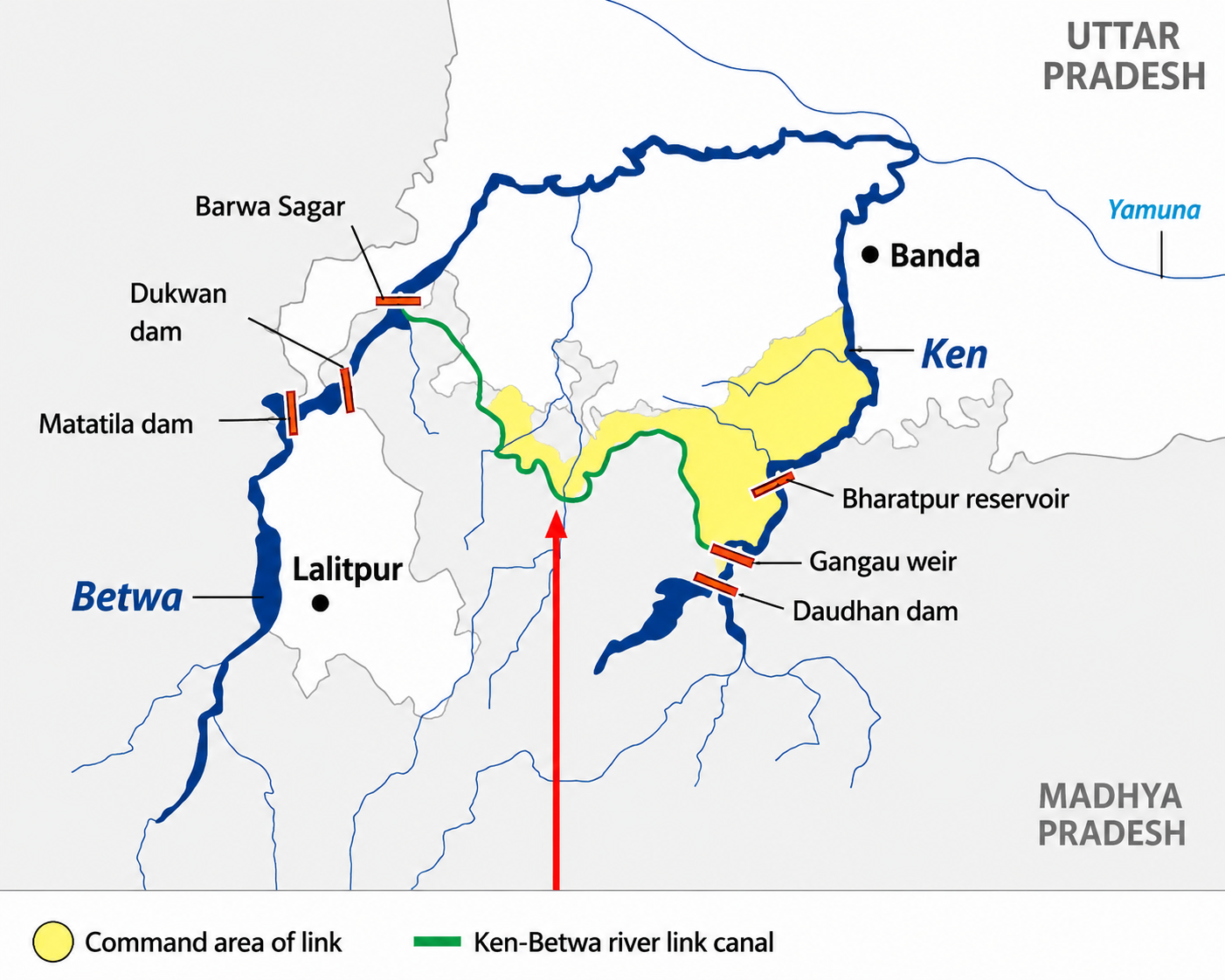
- Transfers “surplus” water from the Ken to the Betwa river via a 231-km canal, centred on the Daudhan Dam, for irrigation and drinking water in water-stressed Bundelkhand.
✊
Key Concerns / Reasons for Resistance
- Displacement: submergence of the Daudhan Dam will affect 22 villages across Panna and Chhatarpur; 10 submerged directly, 12 more displaced for forest offset.
- Compensation issues: many tribal families do not have formal land titles (patta) and may not receive proper compensation.
- Livelihood loss: dependence on minor forest produce (mahua, tendu, charwa) sustains households; monetary compensation cannot replicate this.
- Ecological damage: an estimated 23 lakh trees to be felled within the Panna Tiger Reserve, threatening biodiversity and a critical tiger habitat.
- Rehabilitation gaps: allegations of house demolitions without notice, breakdown of dialogue, and use of police force.
Cultural & emotional rupture: loss of ancestral land, deities, language, and community cohesion cannot be captured by monetary compensation alone.
⚖️
Legal & Constitutional Dimensions
- The move violates the spirit of the Forest Rights Act, 2006 (community forest rights) and PESA Act, 1996 (gram sabha consent).
- LARR Act, 2013 mandates fair compensation, consent, and Social Impact Assessment.
- Article 21 (right to life and livelihood) and Fifth Schedule protections for tribal areas.
🐅
Key Concepts for Prelims
About the Two Rivers
- Ken River: originates in the Vindhyan Plateau (Kaimur range, MP), flows mainly through MP, and joins the Yamuna at Banda (UP).
- Betwa River: originates in the Vindhyan Plateau (Raisen, MP), flows through MP and UP, and joins the Yamuna at Hamirpur (UP).
- Both are right-bank tributaries of the Yamuna.
Governance & Panna Tiger Reserve
- Nodal Ministry: Ministry of Jal Shakti (Department of Water Resources, RD & GR); implementing agency is the National Water Development Agency (NWDA).
- Panna Tiger Reserve is on the Vindhyan ranges, declared a UNESCO Biosphere Reserve (2020), known for successful tiger reintroduction after local extinction (2009); the Ken river flows through it, home to the Ken Gharial Sanctuary.
Exam trap: the Daudhan Dam is built across the Ken river (not the Betwa) in Chhatarpur district — a frequently tested fact.
🧭
Way Forward
Land-for-Land Rehabilitation
Wherever possible, rehabilitate with equivalent land.
Protect Community Forest Rights
Recognise and safeguard rights under FRA, 2006.
Involve Gram Sabhas
Bring local communities into decision-making.
Updated Impact Studies
Conduct independent, current environmental and social impact assessments.
The Ken-Betwa project highlights the development-vs-displacement debate. A sustainable solution must balance water needs, environmental protection and tribal rights.
📰
Source: The Hindu
