

Syllabus: Infrastructure: Energy, Ports, Roads, Airports, Railways etc.
Background and Context
- Parliament passed the SHANTI Bill, despite Opposition demands for amendments and Select Committee review.
- Government boosted the Nuclear Energy Mission with ₹20,000 crore for SMRs and advanced reactors.
- India’s nuclear sector remained State-controlled since 1956, restricting private and foreign entry.
- Strict liability under earlier laws discouraged private and foreign participation.
What is the SHANTI Bill?
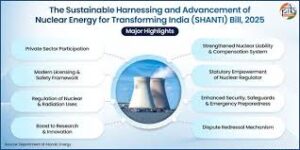
- SHANTI Bill opens India’s nuclear power sector to private and foreign participation.
- Allows private Indian companies to own, build, and operate nuclear power plants.
- Permits foreign suppliers, while limiting private participation to 49%, retaining 51% government control.
- Ends NPCIL’s monopoly in plant construction and operation.
- Encourages public–private partnerships across fuel fabrication, equipment, operations, and R&D.
- Supports Small Modular Reactors (SMRs) and indigenous reactor deployment.
Role and Powers of Atomic Energy Regulatory Board (AERB)
- AERB granted statutory status, accountable directly to Parliament.
- Responsible for nuclear safety, radiation protection, emergency preparedness, and quality assurance.
- Issues licences, standards, inspections, and safety clearances across civilian nuclear installations.
- Expanded role due to increased private sector participation, raising concerns of power concentration.
Safeguards and Regulatory Controls
- Bill does not explicitly permit FDI in nuclear power.
- Mandatory AERB authorisation for radioactive material production, operation, disposal, and facility withdrawal.
- Government retains control over spent fuel reprocessing, heavy water production, enrichment, and waste management.
- Establishes a nuclear liability fund for accident compensation.
Changes in Nuclear Liability Regime
- Introduces clear liability caps for operators:
- ₹3,000 crore for large plants (3,600 MW).
- ₹1,500 crore for medium plants.
- ₹100 crore for SMRs.
- Government bears liability beyond caps, supported by liability fund.
- Supplier liability removed, unlike earlier regime.
- Penalties for severe violations capped at ₹1 crore.
Government’s Rationale
- Enhances energy security, reduces fossil fuel dependence, and supports 24×7 baseload power.
- Strengthens clean energy transition with low-carbon nuclear power.
- Supports India’s net-zero target by 2070.
- Revives stalled civil nuclear cooperation beyond Russia.
Opposition’s Criticism
- Bill dilutes accountability, shifting risks to State and society.
- Removal of supplier liability undermines ‘polluter pays’ principle.
- Liability caps considered inadequate compared to Fukushima and Chernobyl costs.
- Section 39 overrides RTI Act, reducing transparency and public scrutiny.
- Section 42 excludes nuclear workers from labour safety laws.
- Lacks provisions for public hearings, EIAs, community consent, and Parliamentary oversight.
- Accused of being vendor-driven, pro-profit, and compromising public safety.
