

Context
- The ongoing conflict involving Israel, Iran, and the United States has intensified geopolitical instability in West Asia.
- The crisis poses a major challenge to India’s long-standing doctrine of strategic autonomy in foreign policy.
- India’s stakes in a stable Iran remain significant due to concerns regarding energy security, regional connectivity, and geopolitical balance.
Meaning and Importance of Strategic Autonomy
- Concept of Strategic Autonomy
- Strategic autonomy refers to India’s ability to pursue independent foreign policy choices without external coercion.
- The doctrine enables India to maintain relations simultaneously with competing global powers.
- India historically balanced ties with the U.S., Russia, Iran, China, Israel, and Europe without rigid alliance commitments.
- Relevance for India
- Strategic autonomy provides flexibility in managing economic, defence, and geopolitical interests.
- The policy supports India’s aspiration to function as an autonomous pole within a multipolar world order.
- Independent decision-making remains crucial for preserving India’s long-term national interests.
Impact of the Iran War on India
- Energy Security Concerns
- India remains heavily dependent upon imported energy supplies from the West Asian region.
- Escalation of conflict may disrupt oil supply chains and increase global energy prices.
- Instability around the Strait of Hormuz threatens maritime trade and energy transportation routes.
- Geopolitical and Connectivity Challenges
- Iran occupies a strategically important position within India’s regional connectivity strategy.
- U.S. pressure regarding Chabahar port and ties with Tehran complicates India’s regional outreach.
- The conflict restricts India’s ability to balance relations across competing regional powers.
- Strategic and Diplomatic Pressure
- The United States increasingly expects alignment of partners with American geopolitical interests.
- India faces pressure regarding Russian oil imports, BRICS de-dollarisation debates, and Iran relations.
- Such pressures reduce policy flexibility traditionally associated with strategic autonomy.
Emerging Challenges to Strategic Autonomy
- Rise of American Unilateralism
- U.S. economic and military actions reflect growing unilateral strategic behaviour.
- Tariff wars and coercive economic measures challenge the post-war liberal economic order.
- Economic relations are increasingly being linked with geopolitical alignment requirements.
- Weakening of Multipolarity
- The Iran conflict indicates that American unipolar dominance continues despite expectations of multipolarity.
- Europe largely continues aligning with U.S. strategic priorities during major geopolitical crises.
- This limits the emergence of alternative centres of global power balancing.
- Constraints in Defence Autonomy
- India recently signed a major Rafale fighter jet deal with France to diversify defence partnerships.
- However, concerns persist regarding technology transfer and dependence upon foreign-controlled software systems.
- Limited transfer of source codes and algorithms may weaken India’s Make in India aspirations.
- Risks within Economic Partnerships
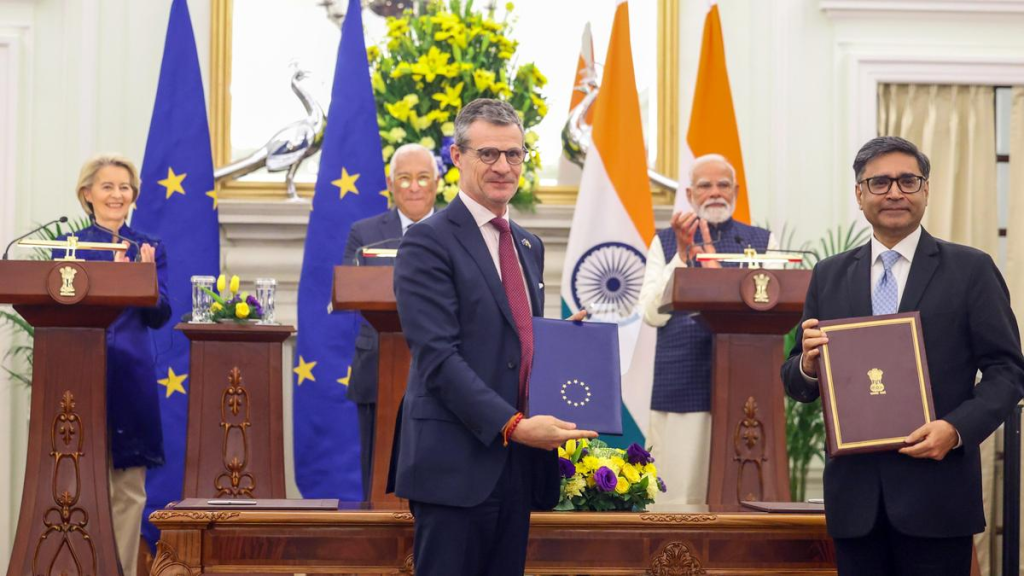
- The India-EU Free Trade Agreement was viewed as an attempt to diversify strategic economic relations.
- Domestic concerns from farmers and industrial workers may complicate implementation of the agreement.
- Europe may also use trade relationships to gain strategic leverage over India.
Limits of European Support
- Europe’s Strategic Dependence on U.S.
- The European countries generally align with American strategic leadership during geopolitical crises.
- Despite temporary disagreements, Europe and the U.S. continue functioning within a broader western strategic framework.
- India may therefore find limited support from Europe regarding independent strategic positioning.
- Exclusionary Geoeconomic Trends
- Emerging western supply-chain frameworks increasingly reflect civilisational and strategic exclusivity.
- The Global South risks becoming an arena of competition rather than an equal strategic partner.
- Such developments may reduce policy space for developing countries pursuing autonomous foreign policies.
Implications for India
- Pressure on Multi-Alignment Policy
- India’s traditional strategy of maintaining balanced ties with rival powers faces increasing external constraints.
- Simultaneous engagement with Russia, Iran, the U.S., and Europe is becoming more difficult under intensifying geopolitical rivalries.
- Challenges to Economic Sovereignty
- Strategic dependence in trade, technology, and defence procurement may affect India’s long-term policy independence.
- External powers increasingly seek influence over domestic economic and strategic choices.
- Regional Security Vulnerabilities
- West Asian instability directly affects India’s energy security, diaspora interests, and maritime trade routes.
- Geopolitical escalation may increase strategic uncertainty within the Indian Ocean region.
Way Forward
- Strengthening Strategic Diversification
- India should continue diversifying its energy, trade, and defence partnerships across multiple regions.
- Greater engagement with the Global South can strengthen India’s independent geopolitical position.
- Enhancing Domestic Capabilities
- India should accelerate indigenous defence production and technological self-reliance under Make in India.
- Reducing external dependence can improve long-term strategic and economic autonomy.
- Balanced Diplomatic Engagement
- India should maintain pragmatic engagement with all major powers while avoiding rigid bloc politics.
- Diplomatic flexibility remains essential in an increasingly polarised global order.
- Strengthening Multipolar Institutions
- India should continue supporting multilateral institutions promoting a rules-based multipolar order.
- Platforms such as BRICS and the Global South can provide alternative avenues for strategic cooperation.
Conclusion
- The Iran war represents a significant test for India’s doctrine of strategic autonomy and multi-alignment. India’s long-term resilience will depend upon balancing external partnerships with domestic self-reliance and diplomatic flexibility.
