

Background and Paris Commitments
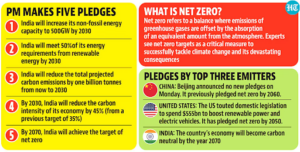
- India committed to four quantified climate targets at the Paris Summit, 2015.
- Targets based on Common but Differentiated Responsibilities (CBDR) principle.
- Key pledges included 33–35% emissions-intensity reduction by 2030 from 2005 levels.
- Other commitments were 40% non-fossil power capacity, 175 GW renewables, and 2.5–3 billion tonnes carbon sink.
- India’s per capita emissions remained historically low, though it is now the third-largest absolute emitter.
Emissions Intensity: Partial Success
- India reduced GDP emissions intensity by about 36% by 2020, exceeding targets early.
- Expansion of non-fossil power sources reduced electricity-related carbon intensity.
- Non-fossil capacity crossed 43% by 2023 and reached ~50% by mid-2025.
- Economic shift towards services and digital sectors lowered emissions per GDP unit.
- Efficiency schemes like PAT and UJALA achieved measurable energy savings.
- However, absolute GHG emissions remained high, around 2,959 MtCO₂e in 2020.
- GDP growth outpaced emissions growth, leading to incomplete decoupling.
- Emissions continue rising in cement, steel, and transport sectors.
Renewable Capacity versus Generation Gap
- Non-fossil capacity increased from 29.5% (2015) to 51.4% (June 2025).
- Solar power expanded sharply, from 2.8 GW (2014) to ~110.9 GW (2025).
- Wind capacity growth slowed due to land, grid, and regulatory constraints.
- Renewables supplied only ~22% of electricity generation in 2024–25.
- Coal remains dominant, providing over 70% of electricity with ~240–253 GW capacity.
- Energy storage is a major bottleneck; 336 GWh needed, only 500 MWh operational.
- Renewable targets mask gaps between installed capacity and actual generation.
Forest Carbon Sink: Accounting versus Ecology
- India reported 30.43 billion tonnes CO₂ stock in forest carbon by 2023.
- Only 0.2 billion tonnes remain to meet the 2030 carbon sink target.
- Forest definition includes plantations and monocultures, not just natural forests.
- Actual forest cover increased marginally by 156 sq km between 2021 and 2023.
- CAMPA funds (~₹95,000 crore) face uneven utilisation across States.
- Climate stress reduces net productivity, despite satellite “greening” indicators.
Way Forward
- India must convert intensity gains into absolute emission reductions.
- Priorities include battery storage scaling, coal transition roadmap, and forest governance reform.
- Next five years are critical for grid upgrades, land acquisition, and data transparency.
