

Syllabus: Science and Technology – developments and their applications and effects in everyday life
Background and Context
- Submarine cable networks are expanding continuously to meet exponential global data demand growth.
- These systems underpin international connectivity across digital, financial, and communication platforms worldwide.
About Submarine Cable Networks
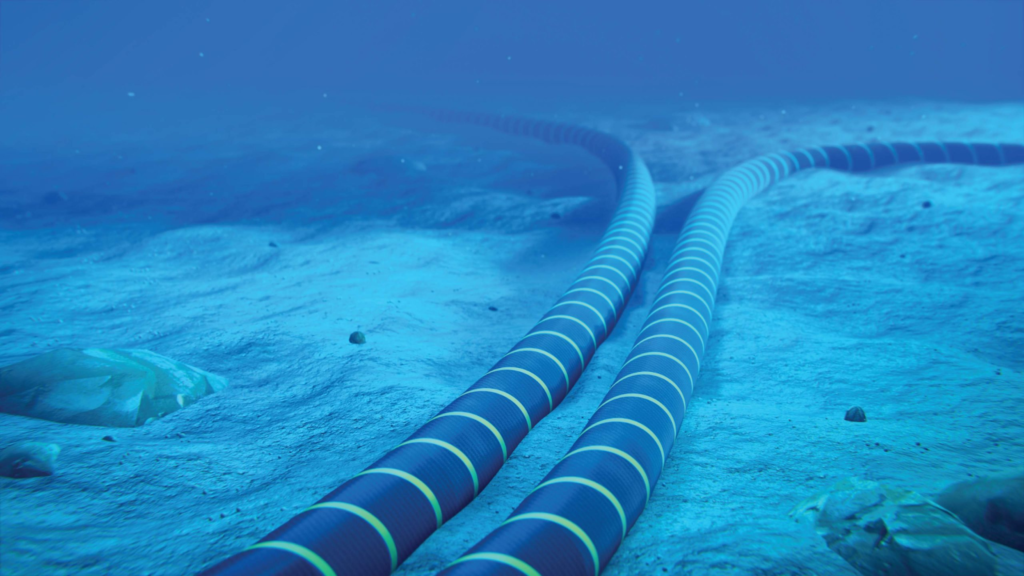
- Subsea cables are fiber-optic systems laid on ocean floors connecting continents digitally.
- Cable structure includes optical fibers, metal sheathing, steel armor, and polyethylene coating.
- They transmit over 99% of international digital communication, including Internet and financial transactions.
Global Subsea Network Overview
- The world has over 550 active and planned cable systems spanning 1.5 million kilometers.
- These networks carry more than 6,400 terabits per second of global digital information.
- Repeater stations every 50–100 kilometers amplify signals for long-distance transmission integrity.
- Major systems include SEA-ME-WE 6, Marea, Dunant, Equiano, and the 2Africa Project.
Subsea Cables and India
- India hosts 18 operational subsea cable systems, with four additional systems under development.
- Primary Cable Landing Stations operate in Mumbai, Chennai, and Kochi.
- The Visakhapatnam Open CLS is proposed as a future regional connectivity hub.
- Island CLS expansion links Andaman and Nicobar, and Lakshadweep through BSNL local networks.
- These initiatives enhance network redundancy, resilience, and digital economy connectivity.
Strategic Importance of Subsea Cables
- Subsea connectivity forms the economic backbone of banking, cloud services, and cross-border trade.
- Optical fiber provides a latency advantage over satellites for high-volume data transfer.
- Countries treat cables as critical information infrastructure for sovereignty and national security.
Challenges and Security Vulnerabilities
- Global cables cluster at strategic chokepoints, creating concentrated infrastructure risks.
- Key chokepoints include the Suez corridor, Strait of Malacca, and English Channel.
- Foreign ownership and jurisdictional exposure limit national oversight and data protection.
- Risks include espionage, hybrid warfare, sabotage, and attribution difficulty.
- Single-point failures can disrupt financial systems, stock exchanges, and business operations.
Global and National Policy Responses
- Around 500,000 kilometers of new cables may add 20,000 terabits per second capacity.
- Trends include open-access CLS models and public-private infrastructure collaboration.
- TRAI recommended Critical Information Infrastructure status for subsea cables in India.
- The National Telecommunications Policy 2025 emphasizes resilience and security of cable systems.
- Australia established a Cable Connectivity and Resilience Centre for Indo-Pacific cooperation.
Conclusion
- The principle of “diversity by design” is essential for secure, resilient global digital connectivity.
