


Brent Crude
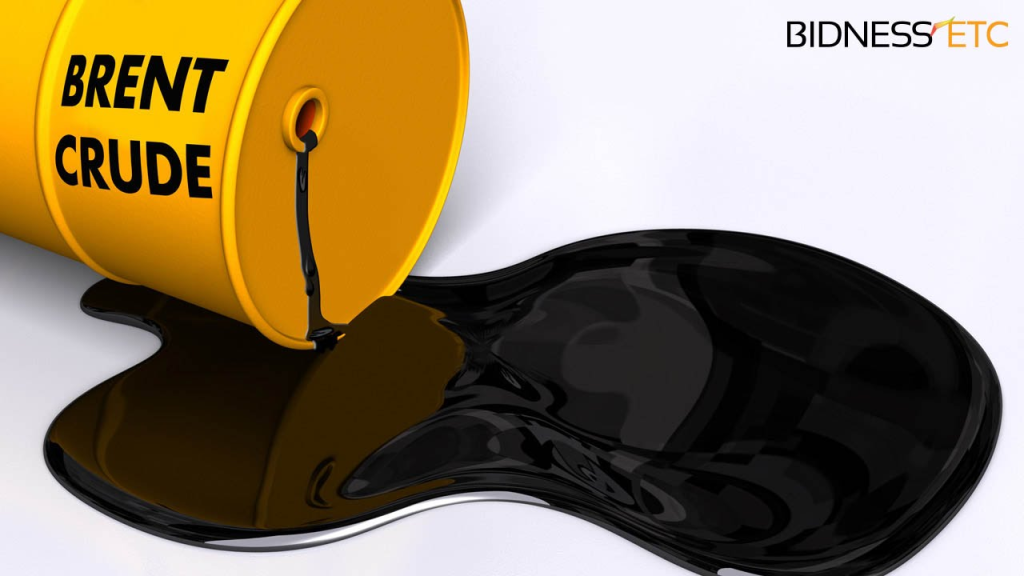
What is Brent Crude?
- The most widely used global benchmark for defining oil prices worldwide
- Named after the Brent oil field, discovered in the 1970s in the North Sea
- A light, sweet crude oil extracted from oil fields in the North Sea
- About two-thirds of all internationally traded crude oil is priced relative to Brent
Key Characteristics
- Low density and low sulphur content, making it easier to process into high-value products like gasoline and plastics.
- Being water-borne, it is easy to transport to distant locations.
- Falls under the category of Sweet Crude i.e. crude oil with very low sulphur content
- Sulphur is undesirable as it lowers the yield of high-value refined products
- Price Influencing Factors
- Supply and demand dynamics
- Geopolitical events
- Production disruptions
- Economic factors
US Foundational Defence Agreements
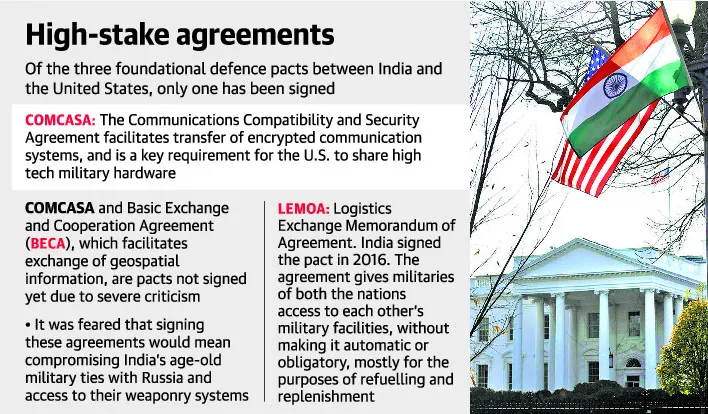
LEMOA
- Logistics Exchange Memorandum of Agreement (LEMOA) is an India-specific version of the US Logistics Support Agreement (LSA).
- Concluded between India and the US in 2016.
- One of the foundational agreements that the US signs with countries having close military ties.
- Key Provisions of LEMOA
- Gives both countries access to designated military facilities on either side
- Can be used for refuelling and replenishment in four primary areas:
- Port calls
- Joint exercises
- Training
- Humanitarian Assistance and Disaster Relief (HADR)
- Significance
- The biggest beneficiary is the Indian Navy, as it interacts and exercises most with foreign navies
- Fuel exchange gets subsumed into LEMOA by doing away with the need for a separate agreement
COMCASA
- Communications Compatibility and Security Agreement (COMCASA) is an India-specific version of the Communication and Information on Security Memorandum of Agreement (CISMOA).
- Signed in September 2018 after the first 2+2 Dialogue between India and the US.
- Key Provisions
- Allows the US to provide India with encrypted communications equipment and systems for US-origin military platforms such as:
- C-17, C-130 (transport aircraft)
- P-8I (maritime patrol aircraft)
- Enables Indian and US military commanders, aircraft, and ships to communicate through secure networks in both peace and war
- Paved the way for transfer of communication security equipment from the US to India
- Enables interaction not only between Indian and US forces but also potentially with other militaries using US-origin systems for secure data links
- Allows the US to provide India with encrypted communications equipment and systems for US-origin military platforms such as:
Quantum Computing

What is Quantum Computing?
- A rapidly emerging technology that harnesses the laws of quantum mechanics to solve problems too complex for classical computers
- A fundamentally different way of processing information compared to today’s classical computing systems
- Quantum mechanics is a subfield of physics describing the behaviour of atoms, electrons, photons, and particles at the molecular and submolecular level
How is it Different from Classical Computing?
- Classical computers store information as binary 0 and 1 states (bits)
- Quantum computers use quantum bits (qubits).
- Unlike a bit (which is either 0 or 1), a qubit can exist in a combination of states simultaneously and this allows for exponentially larger calculations.
- This enables quantum computers to solve complex problems that even the most powerful classical supercomputers cannot.
Significance
- Expected to shed light on molecular and chemical interactions
- Can address difficult optimisation problems
- Boosts the power of Artificial Intelligence
- Opens doors to new scientific discoveries, life-saving drugs, and improvements in supply chains, logistics, and financial modelling
India’s Key Initiatives
- National Mission on Quantum Technologies and Applications:
- Announced in the Union Budget 2021
- Allocation of ₹8,000 crore for developments in quantum computing, cryptography, communications, and material science
- Quantum Computing Laboratory (Indian Army):
- Set up in December 2021 at a military engineering institute in Mhow, Madhya Pradesh
- Also includes an AI centre
- Backed by the National Security Council Secretariat (NSCS).
- Quantum Communication Lab (C-DOT):
- Launched by the Centre for Development of Telematics (C-DOT) in October 2021
- Supports more than 100 km of standard optical fibre.
- I-HUB Quantum Technology Foundation (I-HUB QTF):
- Launched by the Department of Science and Technology along with 13 research groups from IISER Pune
- Aimed at enhancing the development of quantum technology.
Liquefied Petroleum Gas (LPG)
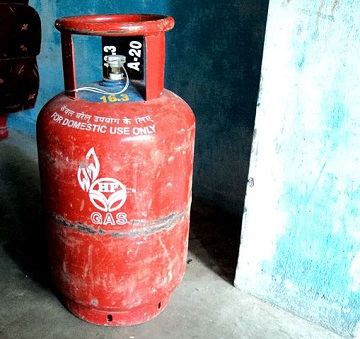
What is LPG?
- Liquefied Petroleum Gas (LPG) is a hydrocarbon fuel composed of:
- 50–60% Propane; 40–50% Butane
- Composition varies with season and supply
Production & Import in India
- Domestic production: ~12.8 MT (35%) of total requirement
- Imports: Exceeded ~21 MT (65%) of total requirement
- India is heavily import-dependent for LPG
- Qatar is largest source of import followed by UAE, Kuwait, and Saudi Arabia
- Demand Pattern: Households account for over 90% of India’s total LPG demand
Kalaripayattu

What is Kalaripayattu?
- One of the oldest and most scientific martial art forms in the world.
- Aimed at mind and body coordination.
- Originated and is widely practised in Kerala.
- “Kalari” in Malayalam refers to a traditional gymnasium where this martial art (Payattu) is taught.
- According to mythology, the warrior sage Parasurama is credited with establishing Kalaripayattu.
Four Stages of Kalaripayattu
- Maippayattu: Body conditioning phase that prepares the body for combat; must be completed before proceeding to the next stage
- Kolthari: Training with wooden weapons such as short sticks and long sticks for attack and self-defence
- Angathari: Introduction of sharp metal objects once the practitioner overcomes the fear of wooden weapon combat
- Verumkai: Bare-hand fighting where students are taught body anatomy to understand vulnerable pressure points
CMS Report on Migratory Wildlife
About the Report
- An interim report updating the landmark State of World’s Migratory Species, first released in 2024.
- Published under the UN’s Convention on the Conservation of Migratory Species of Wild Animals (CMS).
- Based on data from the IUCN Red List of threatened species and population trends documented in scientific literature.
Key Findings
- 49% of migratory species protected under CMS are declining in population.
- 24% of migratory species are now facing extinction.
- Threat of population decline has risen 5% in just two years.
- Percentage of species facing extinction has risen by 2% over the same period.
- Out of 1,189 total species listed under the global treaty, 582 migratory species face population decline challenges.
Species at Risk
- Species facing population declines range from many bird species (with flu recognised as a threat, including mass mortality) to:
- Ungulates/hooved animals: Wildebeest and Llama
- Freshwater fish
- Marine species: Sharks, rays, and turtles
- Between 2002 and 2021, mobility declined significantly for the Mongolian Gazelle
- India-Specific Concerns
- Pronounced long-term declines in migratory shorebirds noted at coastal sites in India
- Sharks and rays in the northern Indian Ocean are facing extinction risk
- Vulture populations are improving slowly in South Asia
F-1 Visa (USA)

Context: After the Donald Trump administration’s immigration crackdown last year, the number of F-1 visas issued to Indian students fell by 69% in June and July 2025 compared to the previous year.
What is an F-1 Visa?
- A non-immigrant visa allowing international students to enter the United States for full-time academic study.
- Valid for study at SEVP (Student and Exchange Visitor Program)-certified colleges, universities, seminaries, conservatories, or language training programs.
Key Requirements
- Must be admitted to a SEVP-approved school.
- Must hold a Form I-20 (certificate of eligibility issued by the school).
- Must maintain full-time student status.
- Must prove financial capability to support studies.
- Must demonstrate intent to return home after graduation.
Employment Provisions
- On-campus work: Permitted generally up to 20 hours per week.
- Off-campus work: Requires special authorisation such as:
- CPT (Curricular Practical Training)
- OPT (Optional Practical Training)
Duration
- Valid for the duration of the academic programme plus 60 days to depart (or the OPT period)
Dependents
- Spouses and unmarried children under 21 years may accompany the student on an F-2 visa
