

Context
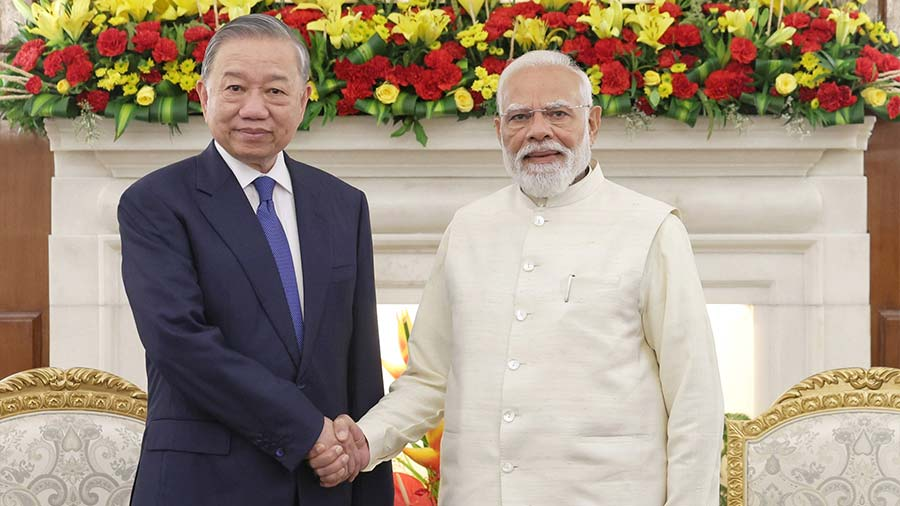
- Vietnamese President Tô Lâm’s visit to India in May 2026 marked a major advancement in India–Vietnam relations. Both countries elevated ties to an Enhanced Comprehensive Strategic Partnership, signalling deeper strategic convergence.
Evolution of India–Vietnam Relations
- Strategic Foundation
- India’s Look East Policy, later transformed into the Act East Policy, provided the initial foundation for bilateral engagement.
- The relationship gained institutional depth after elevation to a Comprehensive Strategic Partnership in 2016.
- Regular high-level exchanges and strategic dialogues strengthened long-term bilateral trust.
- Indo-Pacific Convergence
- Vietnam faces growing concerns regarding Chinese assertiveness in the South China Sea.
- India increasingly views the Indo-Pacific through a stronger security-oriented framework under the Act East Policy.
- Shared concerns regarding maritime coercion and strategic autonomy strengthened bilateral cooperation.
Defence Cooperation as Core Pillar
- Expanding Defence Engagement
- Defence cooperation has emerged as the backbone of partnership between both countries.
- India transferred the missile corvette INS Kirpan to Vietnam in 2023 as a strategic gesture.
- India has also provided financial assistance, training support, and maritime cooperation mechanisms.
- BrahMos and Capability Enhancement
- Discussions regarding export of BrahMos cruise missiles indicate growing strategic confidence between both countries.
- Defence cooperation is gradually shifting from capacity-building towards capability enhancement.
- Such developments may strengthen deterrence capabilities in the South China Sea region.
Expanding Economic and Technological Partnership
- Growth in Bilateral Trade
- Bilateral trade between India and Vietnam has crossed $16 billion in recent years.
- Both countries aim to increase trade to $25 billion by 2030.
- Economic ties increasingly reflect recognition of untapped commercial potential.
- Supply Chain and Manufacturing Cooperation
- Vietnam’s role as an ASEAN manufacturing hub makes it important for India’s diversification strategy.
- Both countries are focusing upon supply-chain resilience and reducing overdependence on China-centric networks.
- Cooperation in digital payments and economic security reflects next-generation engagement.
- Emerging Areas of Cooperation
- The partnership is expanding into sectors such as rare earth minerals and emerging technologies.
- Such cooperation reflects evolving strategic competition in technologically sensitive sectors.
Regional and Geopolitical Significance
- Strengthening Indo-Pacific Architecture
- India and Vietnam contribute towards maintaining a rules-based maritime order in the Indo-Pacific.
- Joint emphasis on rule of law and regional stability reflects shared normative priorities.
- The partnership supports broader minilateral balancing efforts alongside countries such as Japan, Australia, and the United States.
- Centrality of ASEAN
- Vietnam serves as a key gateway for India’s deeper engagement with Southeast Asia and ASEAN.
- The partnership reinforces ASEAN centrality within India’s Indo-Pacific strategy.
- Vietnam’s foreign policy of diversification aligns closely with India’s multipronged strategic approach.
- Economic Security Dimensions
- Strategic partnerships increasingly influence emerging economic architectures in the Indo-Pacific.
- Cooperation in critical sectors may help create resilient alternatives to vulnerable global supply chains.
Associated Challenges
- Implementation Gaps
- Significant gaps remain in translating strategic intent into operational outcomes across sectors.
- Trade expansion and defence industrial cooperation require stronger implementation mechanisms.
- Defence Export Constraints
- Defence exports such as BrahMos may face financial and geopolitical challenges.
- Strategic sensitivities in the Indo-Pacific may complicate advanced defence cooperation initiatives.
- Structural Economic Issues
- Achieving ambitious trade targets requires improvements in logistics and legal frameworks.
- Weak connectivity infrastructure may limit the pace of economic integration.
Way Forward
- India and Vietnam should strengthen institutional coordination for timely implementation of strategic agreements.
- Both countries should deepen cooperation in maritime security, defence manufacturing, and emerging technologies.
- Trade facilitation measures and connectivity improvements should support long-term economic integration.
- Greater collaboration in critical minerals and supply-chain resilience can strengthen economic security objectives.
- India should continue leveraging Vietnam’s strategic importance within its broader Indo-Pacific engagement framework.
Conclusion
- The India–Vietnam partnership is evolving into a mature strategic relationship amid changing Indo-Pacific dynamics. Sustained cooperation in defence, technology, and economic security can strengthen regional stability and strategic resilience.
