

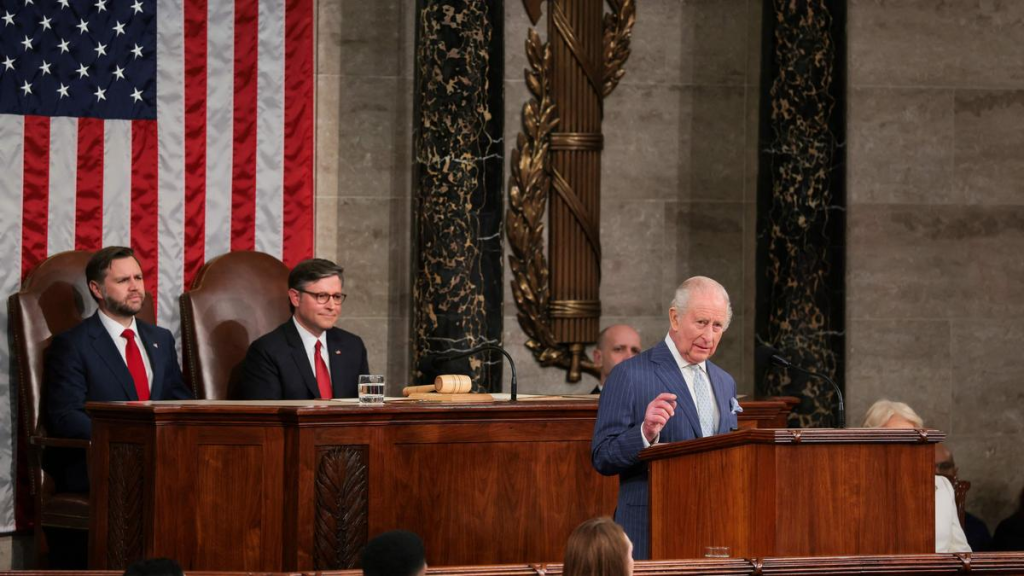
Context: King Charles III recently referred to the Magna Carta during his address to the U.S. Congress. The reference revived discussions regarding rule of law, constitutionalism, and limits on executive authority.
Historical Background of Magna Carta
- Origin of Magna Carta
- The Magna Carta was a royal charter of rights sealed by King John at Runnymede in 1215.
- The phrase “Magna Carta” means Great Charter in Latin and symbolises protection against arbitrary authority.
- The charter emerged after rebel barons compelled King John to accept limitations on power.
- Core Constitutional Principles
- Magna Carta established that the ruler remains subservient to law and cannot exercise unchecked authority.
- The charter introduced foundational ideas associated with due process and lawful governance.
- It emphasised that justice should neither be denied nor arbitrarily delayed to ordinary citizens.
Democratic and Constitutional Significance
- Foundation of Rule of Law
- Magna Carta became an enduring symbol of constitutional restraint and legal accountability.
- The charter strengthened the principle that governmental authority must operate within legal frameworks.
- It laid intellectual foundations for modern constitutional democracies and representative governance systems.
- Institutionalisation of Checks and Balances
- The document established the idea that executive power must remain subject to institutional checks.
- Modern democracies evolved around separation of powers and accountability mechanisms inspired by such principles.
- Legislatures and judiciaries emerged as safeguards against arbitrary authority and concentration of power.
- Evolution into Universal Democratic Symbol
- Magna Carta gradually evolved into a global metaphor for citizens’ rights and constitutional freedoms.
- Eleanor Roosevelt described the Universal Declaration of Human Rights as an “international Magna Carta”.
- Winston Churchill characterised it as a law standing above sovereign authority and political rulers.
Contemporary Relevance of Magna Carta
- Limits on Executive Power
- King Charles III highlighted that democratic executives must remain accountable to constitutional principles and institutions.
- The speech underscored concerns regarding concentration of authority and erosion of democratic accountability.
- The idea remains relevant amid rising tendencies towards executive centralisation and majoritarian politics.
- Protection of Democratic Institutions
- Magna Carta reinforces the importance of independent judiciary, parliamentary oversight, and constitutional morality.
- Democratic systems require safeguards against arbitrary governance, political manipulation, and abuse of power.
- Strong institutions remain essential for preserving civil liberties and public trust in governance.
- Importance of Due Process
- The charter continues to symbolise the principle that no individual should face punishment without lawful procedure.
- Due process remains central to modern ideas of justice, fairness, and dignity.
- Constitutional democracies derive legitimacy from transparent legal processes and equitable governance.
Humanistic and Ethical Dimensions
- Ethical Foundations of Governance
- Magna Carta emphasised that governance should operate through justice, restraint, and accountability.
- Democratic legitimacy depends not merely upon elections but also upon ethical constitutional conduct.
- The article highlights the importance of humane and equitable implementation of constitutional laws.
- Constitutional Morality in Democracies
- The “brooding spirit of law” obligates institutions to prevent democratic erosion through abuse of parliamentary majorities.
- Constitutional morality requires balancing popular mandates with protection of rights and institutional integrity.
- Democracies weaken when governance becomes driven by caprice, bias, or polarisation.
Relevance for India
- Importance of Constitutional Restraint
- India’s constitutional framework similarly rests upon rule of law, separation of powers, and federal balance.
- The Emergency period of 1975-77 demonstrated dangers associated with concentration of authority.
- Democratic institutions must continuously protect constitutional freedoms against authoritarian tendencies.
- Need for Institutional Accountability
- Legislatures, judiciary, media, and civil society remain important democratic safeguards within India’s constitutional structure.
- Constitutional governance requires elected representatives and executives to remain accountable under law.
- Federal and Democratic Ethics
- The article highlights the importance of federal ethics and democratic responsibility during governance processes.
- Democratic legitimacy depends upon respecting constitutional values and pluralistic coexistence.
Associated Challenges
- Rise of Majoritarian Politics
- Excessive reliance upon brute parliamentary majorities may weaken institutional checks and democratic deliberation.
- Electoral mandates should not undermine constitutional safeguards and minority protections.
- Institutional Erosion
- Political manipulation and concentration of power may gradually weaken democratic institutions and accountability structures.
- Democracies remain vulnerable to both overt authoritarianism and institutional subversion.
- Social Polarisation
- Political mobilisation based upon identity and suspicion can intensify social tensions and societal fragmentation.
- Weak democratic safeguards may increase risks of internal instability and civil strife.
Way Forward
- Democracies should strengthen constitutional morality, institutional independence, and parliamentary accountability.
- Executive authority must remain subject to transparent legal constraints and constitutional checks.
- Civic education should promote awareness regarding democratic ethics and citizens’ rights.
- Legislatures and judiciaries should actively safeguard constitutional values against arbitrary governance practices.
- Democratic systems should balance electoral legitimacy with protection of civil liberties and pluralistic coexistence.
Conclusion
- Magna Carta continues to remain a timeless symbol of rule of law, constitutional restraint, and democratic accountability. Modern democracies remain resilient only when political authority operates within ethical constitutional limits.
