

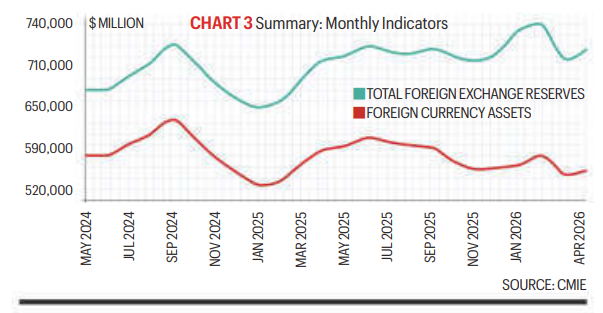
Context: Prime Minister Narendra Modi recently urged citizens to reduce dependence on imports and conserve foreign exchange reserves.
PM Modi’s Call for Forex Conservation
- Reducing Import Dependence
- The Prime Minister encouraged citizens to reduce use of imported edible oils and promote domestic alternatives.
- Citizens were urged to adopt natural farming and reduce dependence on imported fertilisers.
- The broader objective was to minimise unnecessary imports and conserve foreign exchange.
- Focus on Self-Reliance
- The appeal aligns with the broader vision of Atmanirbhar Bharat and domestic production enhancement.
- Reducing import dependence is viewed as a strategy for strengthening economic resilience.
Link between Forex and Economic Growth
- Current Account Dynamics
- Since economic reforms in 1991, India has generally imported more goods than it exports, creating a current account deficit.
- A CAD implies that Indians invest abroad less than foreigners invest in India.
- Usually, India finances the deficit through capital inflows such as foreign investments and external borrowings.
- Importance of Balance of Payments
- The Balance of Payments reflects the relationship between current account transactions and capital flows.
- Strong capital inflows help maintain external stability despite persistent trade deficits.
- Weak inflows may exert pressure on the rupee and reduce foreign exchange reserves.
- Inter-relationship between Factors
- Impact of CAD on Rupee: A sustained current account deficit can weaken the Indian rupee against the U.S. dollar. Greater dependence on imported crude oil further increases pressure on external balances. Further, the rupee depreciation raises import costs and increases macroeconomic vulnerabilities.
- Role of RBI and Forex Reserves: The RBI often intervenes in currency markets using foreign exchange reserves to stabilise the rupee. The healthy reserves help India manage external shocks and financial instability. However, accumulation of reserves alone cannot permanently strengthen export competitiveness.
Why Excessive Forex Conservation May Hamper Growth
- Reduction in Domestic Consumption
- Cutting imports often reduces availability of goods consumed by Indian households and industries.
- Lower consumption demand can negatively affect economic growth and employment generation.
- Excessive restraint on imports may reduce overall market dynamism within the economy.
- Impact on Industrial Production
- Several Indian industries depend heavily upon imported intermediate goods and raw materials.
- Reduction in imports may disrupt industrial supply chains and manufacturing productivity.
- Industries relying on imported technology and components may face higher production costs.
- Negative Impact on Export Competitiveness
- Weak domestic demand may discourage firms from investing in future production capacity.
- Reduced industrial productivity can weaken India’s long-term export competitiveness.
- Strong exports require efficient manufacturing ecosystems rather than merely lower imports.
- Structural Dependence on Imports
- Dependence on Crude Oil and Fertilisers: India imports significant quantities of crude oil, edible oils, and fertilisers.Domestic alternatives remain inadequate for fully meeting national consumption requirements.
- Food and Energy Security Dimensions: India cannot become completely self-reliant in sectors where structural constraints persist. Dependence on imported edible oils and fuel reflects broader limitations in domestic production systems.
Alternative Approach
- Boosting Production and Productivity
- India should focus on increasing domestic production capacity rather than suppressing demand.
- Higher productivity can improve competitiveness without constraining economic activity.
- Expanding industrial efficiency can generate sustainable export growth over time.
- Encouraging Foreign Investments
- India can strengthen foreign exchange availability through higher foreign direct investment inflows.
- Strong investment inflows support economic expansion and strengthen external-sector stability.
- Productive investments create employment opportunities and improve manufacturing capabilities.
- Export-Led Growth Strategy
- Long-term external stability depends upon stronger export performance rather than reduced imports alone.
- India must strengthen manufacturing, logistics, and industrial ecosystems to expand export competitiveness.
- Sustainable forex management requires balanced growth in trade and investments.
Way Forward
- India should strengthen manufacturing productivity and technological capabilities to reduce structural import dependence.
- Policymakers should promote export-oriented industrialisation instead of excessive import compression strategies.
- Greater investments in renewable energy and oilseed production can reduce external vulnerabilities gradually.
- India should attract higher FDI and strengthen participation in global supply chains.
- Balanced macroeconomic policies should combine forex stability with industrial expansion and employment generation.
Conclusion
- Sustainable forex management requires balancing external stability, domestic growth, and industrial competitiveness. India’s long-term economic resilience will depend more upon productive capacity enhancement than restrictive consumption reduction.
