

1. Nebular Hypothesis – Immanuel Kant (1755)
- Proposed by: Immanuel Kant, the eminent German philosopher
- Foundation: Newton’s Law of Universal Gravitation.
- Kant envisioned that the universe originated from an expansive distribution of cold, motionless solid particles, floating silently in space.
- Under the influence of gravitational attraction, these particles began to collide, generating heat and triggering rotational motion. Over time, this gave birth to a hot, rotating nebula.
- As the nebula spun faster, it developed strong centrifugal forces, causing rings of matter to detach. These rings gradually cooled and condensed into planets and satellites, including Earth.
| Limitations:Kant’s theory did not explain the origin of the primordial matter. However, Kant claimed that the universe included primordial matterIt also failed to clarify what initiated the movement of the initially static particles. |
2. Nebular Hypothesis – Pierre-Simon Laplace (1796)
- Proposed by: Pierre-Simon Laplace, renowned French mathematician and astronomer
- Building on Kant’s ideas, Laplace introduced a more scientifically grounded model.
- He proposed that the early solar system originated from a vast, rotating gaseous nebula, primarily composed of hydrogen, helium, and dust particles.
- As this nebula contracted under its own gravity, it began to spin faster.
- Most of the lighter gases gravitated towards the center, where intense pressure and temperature triggered nuclear fusion, giving rise to the Sun.
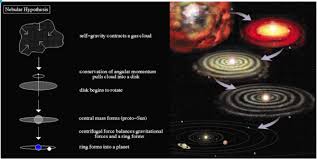
- Meanwhile, heavier elements drifted outward, cooling and coalescing to form planets. This explains why the Sun is predominantly made of lighter elements, whereas the planets are denser and more solid.
Supporting Evidence proposed by Laplace ;
- The disk-like structure of the solar system.
- The elemental composition difference between the Sun and the planets.
The Big Bang Theory
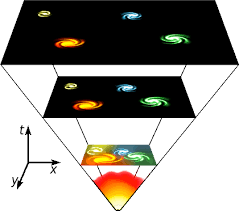
The Big Bang Theory posits that the universe began around 13.7 billion years ago from an infinitely dense and hot singularity — a point with zero volume and infinite energy.
- This singularity underwent a massive explosion, not in space, but of space itself, marking the birth of space, time, matter, and energy.
- According to this theory the timeline of Early Events:
- 0 seconds – The Big Bang: a sudden, rapid expansion of space.
- Fractions of a second – Rapid inflation; subatomic particles begin to form.
- 3 minutes – Formation of light atomic nuclei (hydrogen, helium).
- 300,000 years – Universe cools to ~4,500 K; atoms form, leading to cosmic microwave background radiation.
- As per the Big Bang theory the component of the Universe consists of Ordinary (visible) matter approx ~4%, Dark matter ~26%, Dark energy ~70%.
- Key Evidence in support of the theory;
- Redshift of galaxies (expansion of the universe).
- Cosmic Microwave Background Radiation (CMBR).
- Proportions of light elements predicted by nucleosynthesis.
Step wise formation of the planet.
- Formation of Localized Gas Lumps: the stars are localised gas lumps inside a nebula.
- Core Formation and Disc Rotation: Gravitational forces caused gas clouds to collapse, forming a central core (proto-star) surrounded by a rotating disc of dust and gas.
- Condensation of Matter: Material in the disc cooled and condensed into small, solid spherical particles.
- Formation of Planetesimals: Through a process of cohesion and accretion, these small particles collided and stuck together, gradually forming planetesimals.
- Accretion into Protoplanets: Planetesimals continued to merge, leading to the formation of larger bodies — the protoplanets.
Final Stage – Planetary Formation: Gravitational attraction and continued collisions allowed a few dominant bodies to grow, clearing their orbital paths and becoming fully-fledged planets
SOLAR SYSTEM ( UPSC PRE 2013 )
The Solar System is believed to have formed around 4.6 billion years ago from a massive rotating cloud of gas and dust known as the solar nebula.
- The collapse of this nebula, likely triggered by a nearby supernova, led to:
- Core formation around 5–5.6 billion years ago, giving rise to the proto-Sun.
- Surrounding matter flattened into a protoplanetary disk, leading to the formation of planets.
- The Solar System consist of ;
- Sun at the center, containing 99.86% of the solar system’s total mass.
- Planets- 8 planets, divided into inner (terrestrial) and outer (Jovian) types.
- Moons– At least 63 confirmed natural satellites, orbiting various planets.
- Other Bodies– Includes asteroids, comets, meteoroids, and interplanetary dust.
| Term | Definition |
| Asteroids | Chunks of rock orbiting in a belt between Mars and Jupiter |
| Meteors | Streaks of light when a meteoroid enters Earth’s atmosphere |
| Comets | Balls of ice orbiting the outer solar system beyond Neptune |
Classification of Planets
| Characteristic | Inner (Terrestrial) Planets | Outer (Jovian) Planets |
| Examples | Mercury, Venus, Earth, Mars | Jupiter, Saturn, Uranus, Neptune |
| Composition | Rock and metal | Gases (Hydrogen, Helium) and ices• Jupiter & Saturn: gas giants• Uranus & Neptune: ice giants |
| Density | Higher density | Lower density |
| Surface | Solid surfaces | No solid surface (gaseous) |
| Size | Smaller | Larger |
| Moons | Fewer or no moons | Many moons |
| Rings | No rings | Ring systems present |
| Formation Location | Close to the Sun (warmer region) | Far from the Sun (cooler region) |
| Temperature During Formation | Too warm for gases to condense into solid particles | Cool enough for gases and ices to condense |
| Solar Wind Effect | Intense solar winds blew off gases and dust | Weaker solar winds; retained gases |
| Gravity | Lower gravity; could not hold escaping gases | Higher gravity; retained thick atmospheres |
Pluto and the Dwarf Planets
- Until August 2006, Pluto was classified as the 9th planet.
- The International Astronomical Union (IAU) redefined the criteria of a planet:
- It must orbit the Sun and must be spherical in shape and have a cleared orbital path.
- Pluto failed the condition to have a cleared orbital path.
Hence, Pluto, along with objects like Eris (2003 UB313), Haumea, and Makemake, is now categorized as a dwarf planet.
Brief Review of the Solar System
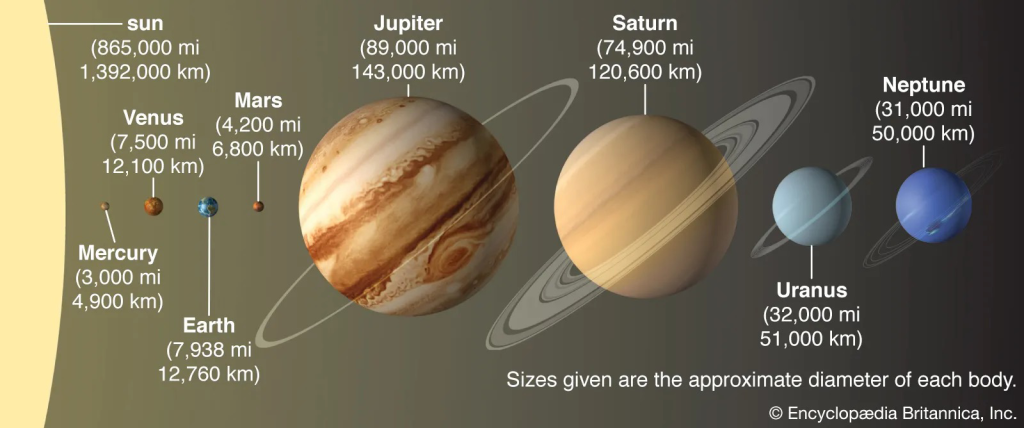
| Planet | Position | Key Characteristics |
| Mercury | 1st (Closest to Sun) | No atmosphere; extreme temperature variation: +427°C (day) to –270°C (night)Smallest planetSurface is heavily cratered |
| Venus | 2nd | Earth’s closest planetary neighbor (~40 million km)Thick atmosphere of 96% CO₂, SO₂, and COSurface temperature: ~480°C (due to runaway greenhouse effect)Brightest planet in the night skyRotates in retrograde direction |
| Earth | 3rd | Only known planet to support lifePresence of water, oxygen-rich atmosphere, and moderate climate |
| Mars | 4th | Known as the Red Planet (due to iron oxide)Atmosphere: 95% CO₂, thin and coldPresence of polar ice caps, largest volcano (Olympus Mons)Ongoing research on possible microbial life |
| Jupiter | 5th | Largest planet in the Solar SystemPrimarily composed of hydrogen and heliumFastest rotation (10 hours)No solid surface; dense atmosphere with ammonia cloudsKnown for the Great Red Spot (giant storm) |
| Saturn | 6th | Known for its spectacular ring systemMostly hydrogen and heliumContains hydrogen cyanide (toxic gas)Atmosphere also contains 90% nitrogenVery cold: average temperature ~ -184°C |
| Uranus | 7th | Ice giant; mainly methane, hydrogen, heliumAppears bluish-green due to methaneUnique feature: rotational axis tilted at ~98°, rolls like a ballVery cold and distant |
| Neptune | 8th | Smaller than Earth, dark and coldAtmosphere contains frozen methane, giving a deep blue colorStrongest winds in the solar system14 known moons; Triton is the largest |