

Context
- The Maharashtra government announced a ₹35,000 crore farm loan waiver scheme, ignoring caution from RBI and several working groups against such waivers.
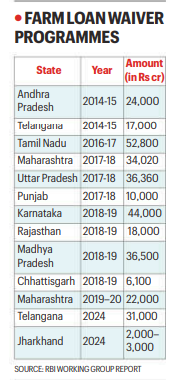
- Since FY15, 10 states have announced loan waiver programmes of an aggregate amount of ₹2.4 lakh crore (1.4% of 2016-17 GDP at current prices), significantly higher than the two previous nationwide debt waiver programmes.
- Central and state governments have spent a whopping ₹3.5 lakh crore in the last 35 years on farm loan waivers, yet only 50% of 3.7 crore eligible farmers benefited.
Stated Rationale
- Alleviate debt overhang of beneficiaries, enabling productive investment and boost real economic activity.
- States like Karnataka expanded loan waivers from ₹18,000 crore (FY18) to ₹44,000 crore (3.4% of GSDP) in FY19.
- Madhya Pradesh and Chhattisgarh announced new loan channels worth 1.9% and 1.7% of state GSDP respectively.
Impact of Farm Loan Waiver
- Fiscal Impact on States
- Fiscal burden on states’ budgets is typically staggered over 3-5 years through phased rollouts or clearing bank dues over multi-year pay-outs.
- Impact varies widely across states, ranging between 0.1% of GSDP (Andhra Pradesh and Tamil Nadu) to 1.8% of GSDP (Chhattisgarh in FY19).
- In FY20, states have allocated between 0.2% and 1.8% of GSDP to farm loan waivers.
- Impact on Credit Culture (RBI’s Concerns)
- Sharp deceleration in agricultural credit growth and declined agricultural credit disbursements observed in years following loan waiver programmes, with growth bouncing back in subsequent years.
- Waivers have adversely affected the credit history of borrowers and their future prospects of availing fresh loans for agricultural purposes.
- Many borrowers withhold repayment in anticipation of a loan waiver, thus directly undermining credit discipline.
- Gross NPA in the agriculture sector stood at 8.44% as on March 31, 2019, reflecting a high level of non-performing assets.
- In FY18 and FY19, all states that announced farm loan waivers showed either no material change in NPA levels or actually registered a decline, thus indicating the presence of moral hazard, with borrowers defaulting strategically in anticipation of waiver.
- RBI has discouraged loan waivers on various occasions, noting they affect credit culture and impact state finances adversely, harming farmers’ interests in the medium to long term.
Way Forward
- Targeted income support like PM-KISAN (₹6,000/year) is a more fiscally sustainable alternative to blanket loan waivers.
- Crop insurance strengthening through PM Fasal Bima Yojana reduces distress without moral hazard risks.
- Interest subvention schemes provide relief without undermining repayment culture or burdening state finances.
- Kisan Credit Cards (KCC) and institutional credit deepening can reduce dependence on moneylenders and prevent debt traps.
- Agricultural market reforms addressing MSP, procurement, and supply chain efficiency tackle root causes of farm distress rather than symptoms.
