

Removal of the Lok Sabha Speaker

Constitutional Basis for Removal
- Article 94 of the Constitution of India lays down the conditions under which the Speaker or Deputy Speaker of the Lok Sabha vacates office.
- Under Article 94(a), the Speaker ceases to hold office if they stop being a member of the Lok Sabha.
- Under Article 94(b), the Speaker may resign at any time by submitting a written resignation to Deputy Speaker.
- Under Article 94(c), the Speaker may be removed through a resolution passed by a majority of all the then members of the Lok Sabha.
- These provisions apply only to the Lok Sabha and not to the Rajya Sabha.
Initiation and Admission of the Removal Motion
- The procedure for removal is governed by Rules 200–203 of the Rules of Procedure and Conduct of Business in Lok Sabha.
- A removal resolution can be moved only after giving a minimum notice of 14 days.
- The notice must be submitted in writing to the Secretary-General of the Lok Sabha and signed by at least one Member of Parliament.
- If the notice is found in order, the motion is included in the List of Business and read before the House.
- For the motion to be taken up for discussion, at least 50 members must rise in support of the motion.
- If fewer than 50 members support it, the motion fails to obtain the “leave of the House” and is dropped.
Conditions and Majority Required for Removal
- The charges mentioned in the resolution must be precise, clear, and specific.
- The motion must not contain arguments, defamatory remarks, inferences, or ironic expressions and the debate in the House remains strictly confined to the charges mentioned in the resolution.
- For the removal to succeed, the resolution must be passed by a majority of all the then members of the Lok Sabha, which is known as an Effective Majority.
- Once the resolution is passed by this Effective Majority, the Speaker is removed from office immediately.
Role of the Speaker During Removal Proceedings
- According to Article 96, the Speaker cannot preside over the House while a resolution for their removal is under consideration.
- However, the Speaker has the right to participate in the debate and explain their position.
- The Speaker may vote in the first instance as an ordinary member, but cannot exercise a casting vote if the votes are equal.
Continuity of Office and Historical Instances
- The Speaker does not vacate office upon the dissolution of the Lok Sabha.
- The Speaker continues in office until immediately before the first meeting of the newly elected Lok Sabha.
- However, if a removal resolution is passed, the vacation of office takes effect immediately.
Historical Motions Against the Speaker
- 1954: Motion moved against G.V. Mavalankar, the first Speaker of the Lok Sabha.
- 1966: Motion moved against Hukam Singh.
- 1987: Motion moved against Balram Jakhar.
- Outcome:
- All three motions failed, and no Lok Sabha Speaker has ever been removed through this constitutional process.
Jal Jeevan Mission (JJM)
Why in News: The Union Cabinet approved the extension of the Jal Jeevan Mission until 2028 to strengthen rural drinking water supply.
Launch of Jal Jeevan Mission
- Jal Jeevan Mission (JJM) is a revamped and upgraded version of the National Rural Drinking Water Programme (NRDWP).
- The mission was launched in 2019 by the Government of India.
- At the time of its announcement on 15 August 2019, only 3.23 crore rural households (about 17%) had tap water connections.
- The mission aims to provide Functional Household Tap Connections (FHTC) to every rural household under the initiative Har Ghar Nal Se Jal (HGNSJ) by 2024.
- Its broader objective is to improve access to safe drinking water and enhance the health and quality of life in rural areas.
Institutional Framework and Funding Pattern
- The nodal ministry is the Department of Drinking Water and Sanitation under the Jal Shakti Ministry.
- The programme follows a community-centric approach with emphasis on Information, Education and Communication (IEC).
- Funding pattern:
- 50:50 between Centre and States.
- 90:10 for Himalayan and North-Eastern States.
- 100% funding by the Central Government for Union Territories.
Implementation and Community Participation
- Implementation of the mission occurs mainly through Paani Samitis at the village level.
- These committees usually consist of 10–15 members.
- At least 50% of the members must be women, and participation may include Self Help Groups (SHGs), ASHA workers, and Anganwadi teachers.
- The committee prepares a one-time village action plan, combining all available village water resources.
- The plan becomes operational only after approval by the Gram Sabha.
Key Features of the Mission
- Two Components of JJM
- JJM Rural
- JJM Urban
- JJM Rural
- Water Supply Target: Provision of 55 litres of water per person per day through Functional Household Tap Connections (FHTC).
- Water Source Strengthening: Focus on enhancing drinking water sources and monitoring water quality.
- Water Conservation: Promotion of efficient use of water and reuse of greywater.
- Community-driven governance: Paani Samitis manage planning, implementation, and maintenance of village water supply systems.
- JJM Urban
- Announced in the Budget 2021–22.
- Implemented under the Ministry of Housing and Urban Affairs (MoHUA).
- Seeks to provide tap and sewer connections to households across urban areas.
- Targets Functional Household Tap Connections in all 4,378 Urban Local Bodies.
- Includes liquid waste management initiatives in 500 cities under AMRUT (Atal Mission for Rejuvenation and Urban Transformation).
- Emphasises rejuvenation of water bodies and development of a circular water economy.
Aravalli Hills
Basic Features
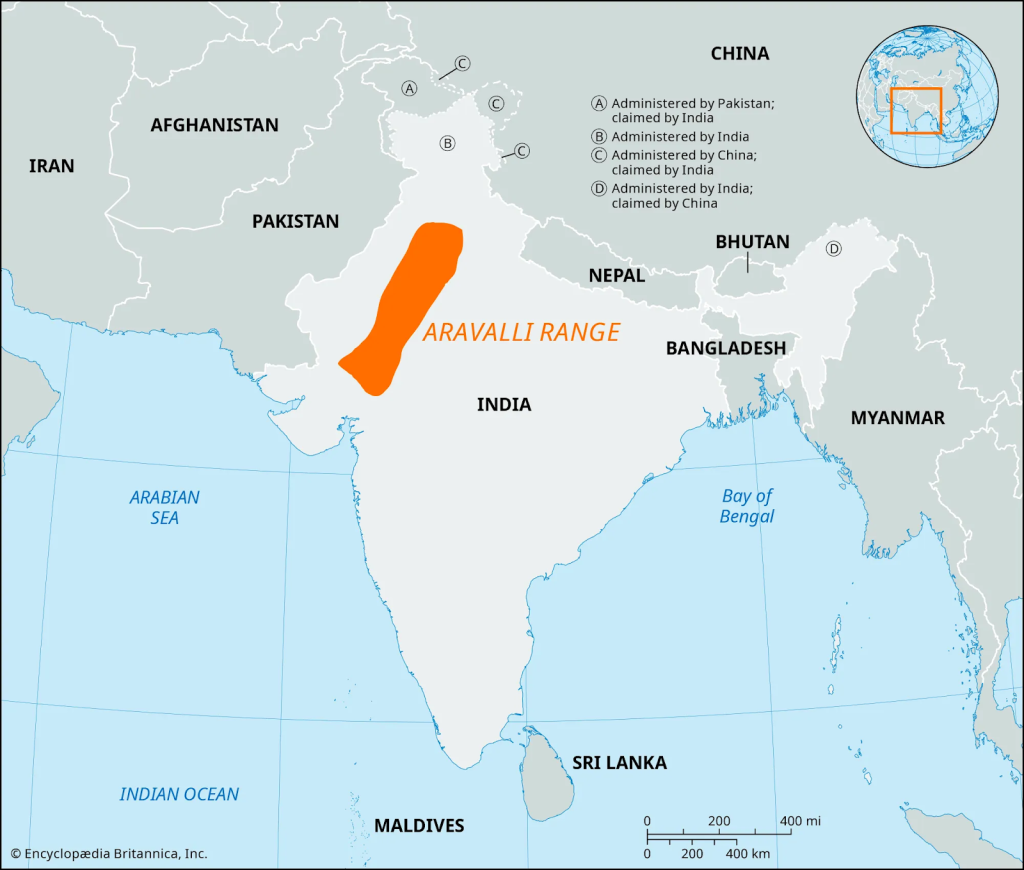
- The Aravalli Hills are among the oldest fold mountain ranges in the world.
- The range stretches for about 670 km, forming an important geographical feature of northern and western India.
- It extends from near Delhi through southern Haryana and Rajasthan to Gujarat.
- The range acts as an important ecological barrier and wildlife corridor in this region.
- It helps block sand and dust movement from the Thar Desert, protecting nearby agricultural and inhabited areas.
Geological Formation and Structure
- The Aravalli range was formed during the Proterozoic era through ancient tectonic collisions.
- It forms part of the Aravalli-Delhi orogenic belt.
- The hills generally rise between 300 and 900 metres in height.
- The highest peak is Guru Shikhar (1,722 m) located in Mount Abu.
- The Aravalli region contains rocks such as quartzite, marble, and granite.
- The range is also associated with mineral deposits containing copper and zinc.
- Several important rivers originate in this region, including Banas, Luni, Sabarmati, and Sahibi.
Aravalli “100-Metre Definition” Issue
- What is the 100-Metre Definition?
- The Supreme Court accepted a recommendation of the Environment Ministry regarding the definition of Aravalli hills.
- According to this rule, only landforms rising 100 metres or more above the surrounding ground level will be recognised as Aravalli Hills.
- Hills less than 100 metres in height are excluded from this classification.
- Implications of the New Definition
- Under this rule, only taller hill sections remain protected.
- The Forest Survey of India (FSI) indicated that the 100-metre definition may exclude nearly 90% of the hills from protection.
- Earlier scientific criteria that considered slope and a minimum height of 30 metres would have protected around 40% of the hills.
India–Bangladesh Friendship Pipeline
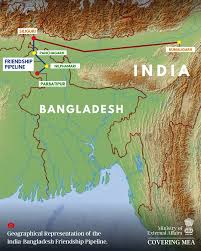
Context: India supplied diesel to Bangladesh through the India–Bangladesh Friendship Pipeline amid Dhaka’s petroleum shortage.
About the Pipeline
- The India-Bangladesh Friendship Pipeline (IBFP) is a cross-border energy pipeline connecting India and Bangladesh.
- It links Siliguri in West Bengal (India) with Parbatipur in Dinajpur district of Bangladesh.
- It has a transport capacity of 1 Million Metric Ton Per Annum (MMTPA).
- Construction of the pipeline began in September 2018.
Other India–Bangladesh Energy Cooperation Projects
- Maitree Power Project
- A US $2 billion thermal power project developed under a concessional financing scheme from India.
- The Maitree Super Thermal Power Plant in Khulna has begun supplying 660 MW of electricity to Bangladesh’s national grid.
- Bangladesh India Friendship Power Company Limited (BIFPCL)
- BIFPCL is a 50:50 joint venture between:
- National Thermal Power Corporation (NTPC), India
- Bangladesh Power Development Board (BPDB)
- The project aims to establish Bangladesh’s largest power plant once completed.
- BIFPCL is a 50:50 joint venture between:
Amendment to FDI Rules
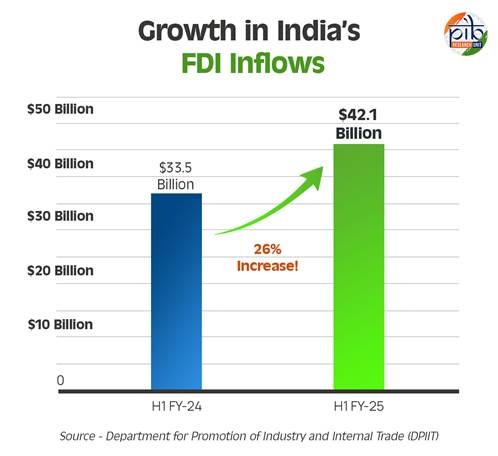
Background: Press Note 3 (2020) and FDI Restrictions
- In April 2020, the Government of India issued Press Note 3 to regulate Foreign Direct Investment (FDI) from countries sharing a land border with India.
- The measure was introduced during the COVID-19 pandemic to prevent opportunistic takeovers of Indian companies when markets were vulnerable.
- Under this rule, any investment from such countries required prior approval from the Government of India.
- The rule also applied where the beneficial owner of the investment belonged to a land-bordering country.
- China
- Pakistan
- Bangladesh
- Nepal
- Bhutan
- Myanmar
- Afghanistan
Key change in the policy
- Investments with up to 10% non-controlling beneficial ownership from land-bordering countries are now allowed through the automatic route.
- These investments must comply with sectoral caps, entry routes and other conditions.
Reporting and Ownership Conditions
- Even under the automatic route, the Indian company receiving the investment must report details to the Department for Promotion of Industry and Internal Trade (DPIIT).
- In sensitive sectors requiring approval, majority ownership and control must remain with resident Indian citizens or entities owned and controlled by them.
Faster Approval for Certain Manufacturing Sectors
- The government has introduced time-bound processing of 60 days for proposals involving investments from land-border countries in certain sectors.
- These sectors include manufacturing of:
- Capital goods
- Electronic capital goods
- Electronic components
- Polysilicon
- Ingot-wafer.
Essential Commodities Act, 1955

Context: The government invoked the Essential Commodities Act, 1955 to prioritise natural gas allocation for key sectors.
About the Essential Commodities Act, 1955 (ECA)
- Objective and Purpose
- The act was enacted by the Government of India to ensure availability of essential goods to citizens at fair prices.
- The law seeks to prevent hoarding, black marketing, and artificial shortages of important commodities.
- Historically, the Act has served as a key policy instrument to control inflation, discourage hoarding, and safeguard national food security.
- Powers of the Central Government
- Under Section 3 of the Act, the Central Government can regulate the production, supply, and distribution of essential commodities.
- These powers allow the government to: Impose stock limits; Regulate trade and distribution; Fix prices of commodities; Prevent hoarding and speculative storage.
- Delegation of Powers to States
- Section 5 of the Act authorises the Central Government to delegate powers under Section 3 to State Governments or designated officials.
- This delegation enables quick enforcement and monitoring at the State and local levels.
- LPG as an Essential Commodity
- Petroleum products, including Liquefied Petroleum Gas (LPG), are classified as essential commodities under the Act.
- The Central Government can direct oil refineries to maximise LPG production and prioritise supply for domestic households.
- Refineries have also been restricted from diverting propane and butane streams to petrochemical production, ensuring these inputs remain primarily available for LPG supply.
Essential Commodities (Amendment) Act, 2020
- In 2020, Parliament amended the Act to limit the Centre’s regulatory intervention in certain agricultural commodities.
- Regulation of these commodities is allowed only in extraordinary circumstances, such as:
- War, Famine, Natural calamity of grave nature, Extraordinary price rise.
- Commodities covered under the amendment
- Cereals
- Pulses
- Potatoes
- Onions
- Edible oilseeds and edible oils.
Lebanon
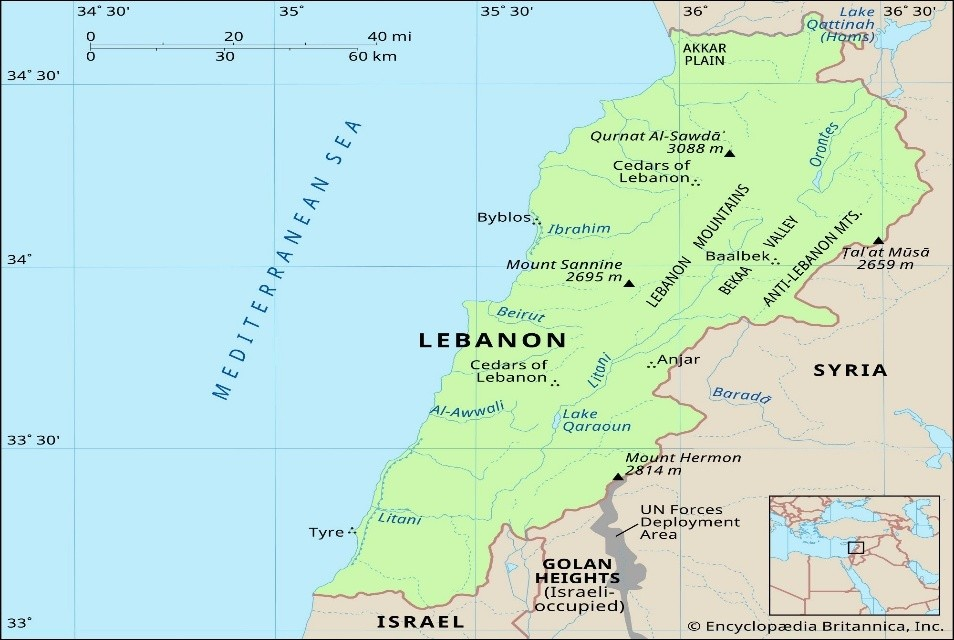
Why in News: An Israeli airstrike near Tyre in southern Lebanon followed warnings targeting Hezbollah infrastructure amid escalating West Asia conflict.
Basic Overview
- Lebanon is a sovereign country in the Middle East located on the eastern coast of the Mediterranean Sea.
- It lies in the Levant region of West Asia, historically acting as a commercial and cultural link between the Arab world, Europe, and Asia.
- Capital city: Beirut.
- Lebanon shares borders with:
- Syria to the north and east
- Israel to the south
- Mediterranean Sea to the west.
Major Physiographic Regions
- Lebanon has four important physical regions, which are important for geographical identification.
- Coastal Plain
- A narrow fertile strip along the Mediterranean coast.
- Contains major urban centres such as Beirut and Sidon.
- Lebanon Mountains (Mount Lebanon Range)
- A limestone mountain chain running parallel to the Mediterranean coast.
- Also known for the Cedars of Lebanon forests.
- Bekaa Valley
- A fertile agricultural valley located between the Lebanon Mountains and the Anti-Lebanon Mountains.
- Forms part of the Great Rift Valley system.
- Anti-Lebanon Mountains and Mount Hermon
- An eastern mountain chain forming a natural boundary with Syria.
James Webb Space Telescope (JWST)
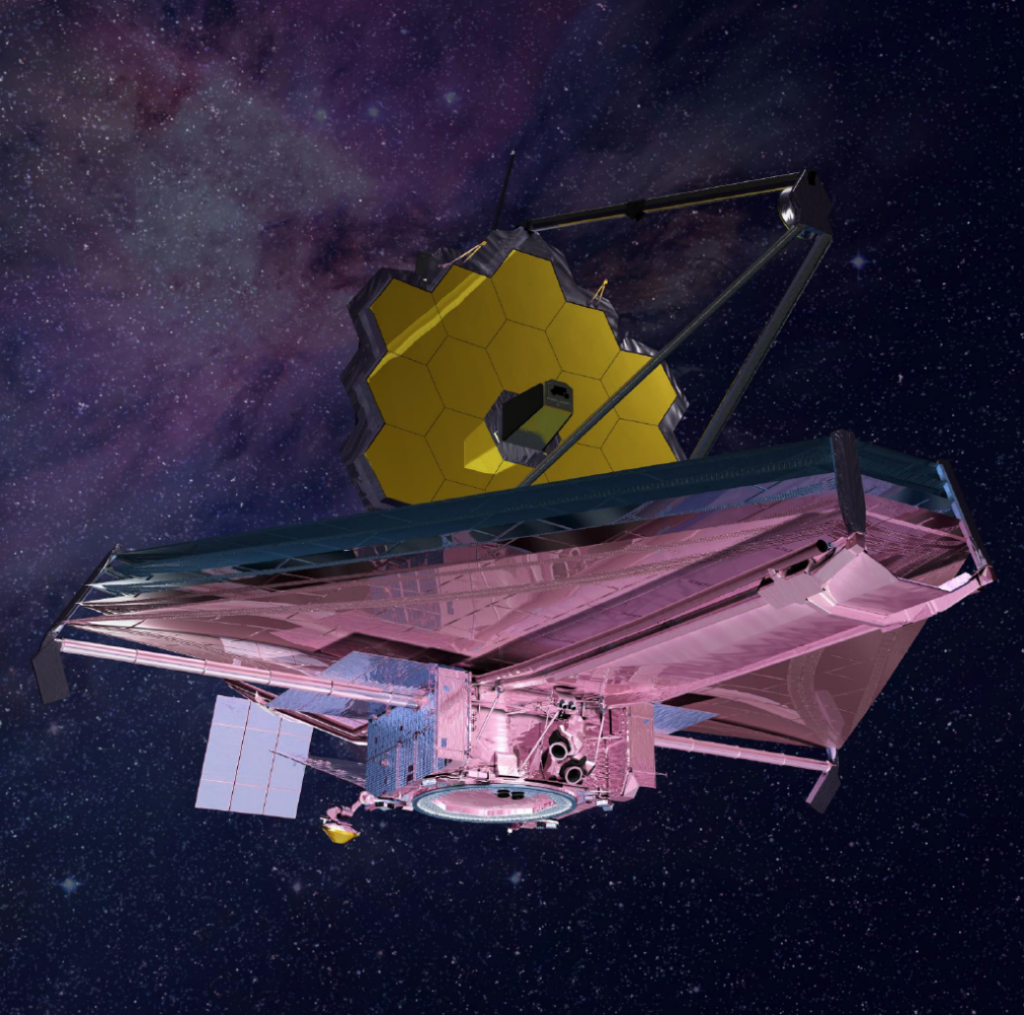
What is the James Webb Space Telescope?
- The James Webb Space Telescope (JWST) is the largest and most advanced infrared space observatory ever built.
- It is designed to study the early universe, formation of stars and galaxies, and atmospheres of exoplanets.
- Launch date: 25 December 2021.
- The mission was developed by NASA in collaboration with the European Space Agency (ESA) and the Canadian Space Agency (CSA).
Key Technological Features
- Large Deployable Structure
- The telescope is comparable in size to a tennis court and about three stories tall.
- It was engineered to fold in an origami-like configuration to fit inside a launch rocket.
- Infrared Observation Capability
- JWST observes the universe using infrared radiation (heat signals) that are invisible to the human eye.
- This capability allows it to see through cosmic dust and observe very distant objects in the early universe.
- Gold-Coated Mirror System
- The telescope contains 18 hexagonal mirrors coated with gold.
- These mirrors improve reflection of infrared light, enabling clearer and deeper observations of distant celestial objects.
- Sunshield Protection
- JWST is equipped with a large silver sunshield.
- The shield protects scientific instruments from solar heat.
- It maintains a temperature difference of about 600°F between its two sides, enabling sensitive infrared observations.
