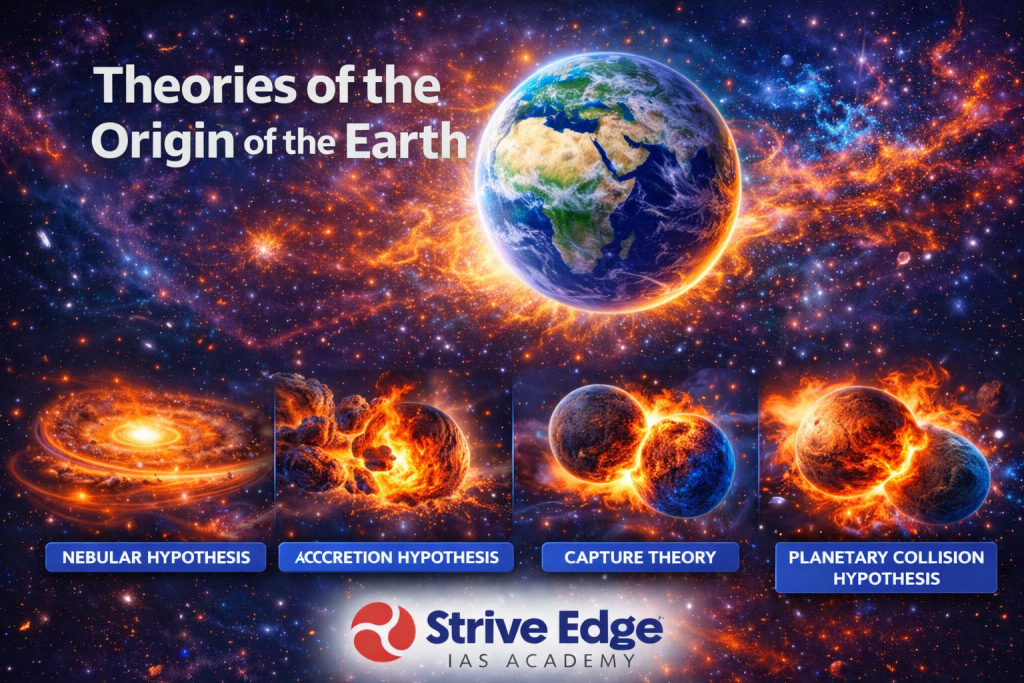
The Earth is approximately 4.54 billion years old. Its origin is linked to the formation of the Solar System, which itself evolved from a solar nebula.
Stage-by-Stage Evolution of the Earth:
| Primordial Stage (Around 4.6 billion years ago) The Earth formed as part of the accretion process from the solar nebula — a rotating cloud of gas and dust. Due to gravitational collapse, matter started coalescing to form the proto-Earth. During its early phase, Earth was a white-hot, incandescent mass composed of gas, dust, and molten rock. Accretion and Heating The accumulation of cosmic particles and dust led to frequent collisions and compression, which increased the Earth’s temperature. The Earth was in a molten or semi-molten state due to heat from accretional impact, Gravitational compression, And radioactive decay of isotopes (like Uranium, Thorium). This heat caused the interior to remain hot and the surface to undergo early differentiation Differentiation of Earth’s Layers Heavier elements like iron and nickel sank toward the center, forming the core and the lighter elements like silicates rose to form the mantle and crust. This process is called planetary differentiation and gives rise to Earth’s three main internal layers: Core (Inner & Outer), Mantle, Crust. Formation of Earth’s Crust After millions of years, the Earth’s outer layer cooled enough to solidify, forming the first crust. This early crust was unstable and frequently melted and reformed due to intense volcanic activity and asteroid impacts. Gradual cooling led to the formation of a more permanent crust, from solidified lava and basaltic rock. Formation of Water Bodies As the Earth cooled further: Water vapor present in the early atmosphere condensed into liquid. This condensation led to the formation of rain, which filled the low-lying depressions, creating oceans and seas. Volcanic eruptions released gases like CO₂, water vapor, nitrogen, which contributed to the formation of the primitive atmosphere and hydrosphere. |