

Context: India has announced its updated Nationally Determined Contributions (NDCs) for 2035, signalling continued commitment to a clean energy transition despite global uncertainties.
Key Features of India’s Updated Climate Targets
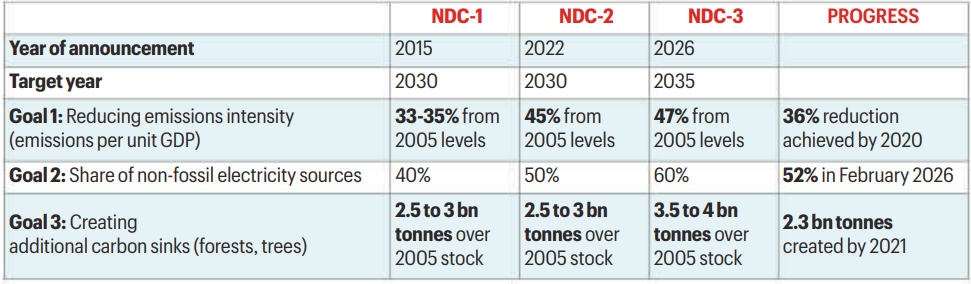
- India aims to reduce emissions intensity of GDP to 47% below 2005 levels by 2035, improving upon the 45% target for 2030.
- It targets 60% of installed electricity capacity from non-fossil fuel sources by 2035, up from 50% earlier.
- India has already achieved 36% emissions intensity reduction by 2020.
- Non-fossil fuel capacity has reached 52% (February 2026).
- Carbon sink creation target increased to 3.04 billion tonnes, compared to 2.5–3 billion tonnes earlier.
Significance of the New Targets
- Demonstrates India’s continued commitment to climate leadership, even as global momentum weakens.
- Reflects a balanced approach between development needs and climate responsibility.
- Signals policy continuity despite global uncertainties like reduced climate financing.
- Enhances India’s credibility in international climate negotiations.
Challenges
- Global Context and Emerging Challenges
- Global climate action is weakening, with some developed countries retreating from renewable commitments.
- The U.S. has scaled back international climate financing and multilateral engagement.
- Developed countries have not fulfilled the promised $100 billion annual climate finance.
- Developing nations, including India, face constraints due to lack of financial support.
- India’s Strategic Position and Constraints
- India is among the most vulnerable countries to climate change impacts, necessitating adaptive strategies.
- It has limited fiscal capacity to accelerate transition without adequate international funding.
- India has argued for greater focus on adaptation and resilience rather than only mitigation.
- Dependence on fossil fuels persists due to developmental and energy security needs.
Way Forward
- India should continue expanding renewable capacity in a phased manner, ensuring that the transition does not disrupt economic growth or energy security.
- There is a need to balance mitigation with stronger emphasis on climate adaptation, especially given India’s vulnerability to climate impacts and developmental priorities.
- India must persistently push for adequate climate finance, highlighting that developed countries have not fulfilled commitments such as the $100 billion annual support.
- Strengthening domestic capacity through consistent policy signals will help sustain progress in non-fossil energy expansion and carbon sink creation.
- India should adopt a flexible approach that allows it to scale ambition based on availability of technology and financial support, rather than committing to unrealistic targets.
- In global negotiations, India must continue advocating for equity and differentiated responsibilities, ensuring that developing countries are not overburdened.
- A calibrated transition strategy should ensure that fossil fuel dependence is reduced gradually, without undermining industrial growth and development needs.
Conclusion
- India’s updated climate targets reflect a pragmatic balance between ambition and feasibility. While modest in scale, they reinforce India’s commitment to a sustainable and equitable energy transition in a challenging global context.
