

Excise Duty on Petroleum Products
Context
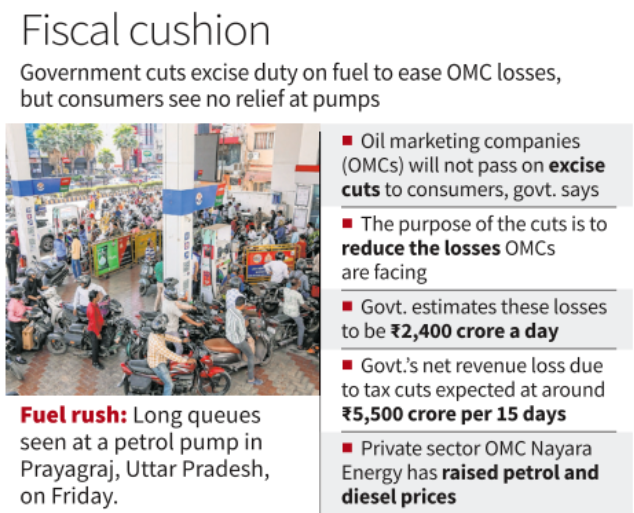
- The Union Government reduced special additional excise duty on petrol and diesel by ₹10 per litre. The duty on diesel reduced to zero and on petrol to ₹3 per litre.
About Excise Duty
- Excise duty is an indirect tax levied on manufacture or production of goods within a country.
- Though collected at production stage, the burden is passed on to consumers.
- Nature of Tax
- Levied on manufacture of goods, not on services.
- Taxable event: manufacture.
- Collected by the Central Government (pre-GST framework).
- Constitutional and Legal Basis
- Entry 84, Union List (Seventh Schedule) empowered Parliament to levy excise duty.
- Governed by the Central Excise Act, 1944.
- Post-GST (2017): Applicable mainly to petroleum products and tobacco.
Key Features
- Production-based tax.
- Can be:
- Ad valorem (percentage of value)
- Specific duty (fixed amount per unit)
- Earlier allowed input credit through CENVAT system.
- Goods Subject to Excise (Post-GST)
- Petroleum products (petrol, diesel, ATF)
- Tobacco and tobacco products
- Excise Duty vs GST
- Excise is levied on manufacture, whereas GST is levied on supply.
- Excise applies only to select goods, while GST covers goods and services.
Economic Significance
- Major source of Union Government revenue, especially from fuel.
- Used as a fiscal tool to influence prices and consumption.
- Continues to play a crucial role in fuel pricing and revenue mobilisation.
Zojila Pass
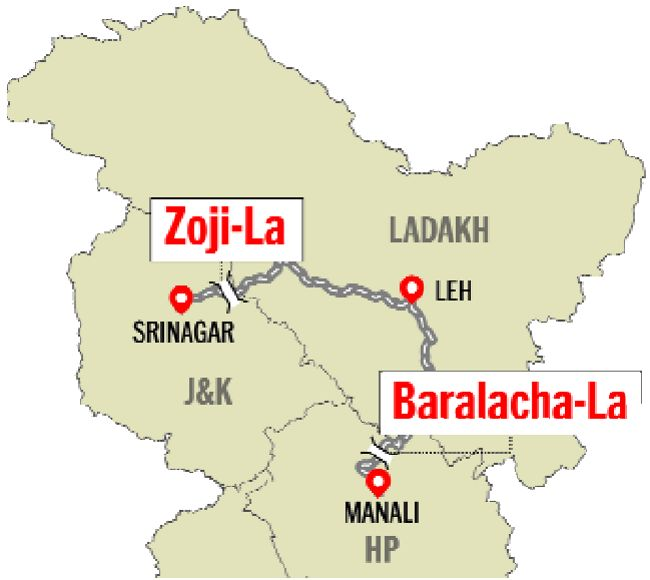
Context: An avalanche at Zojila Pass on the Srinagar–Leh National Highway led to the death of five persons and injuries to several others.
About Zojila Pass
- Location and Features
- Zojila Pass, also known as the “Mountain Pass of Blizzards”, connects the Kashmir Valley with Ladakh.
- It is located on the Srinagar–Kargil–Leh highway (NH-1) at an altitude of about 11,650 feet (≈ 3,500 metres).
- The pass remains closed for nearly half of the year due to heavy snowfall.
- Strategic Importance
- Zojila Pass serves as a crucial link between Kashmir and Ladakh.
- It holds significant importance for defence logistics and civilian connectivity.
- Historical Significance
- The pass played a key role during the Indo-Pakistan War (1947–48).
- It was recaptured by the Indian Army under Operation Bison (1 November 1948).
Zojila Tunnel
- The Zojila Tunnel is an under-construction tunnel on the Srinagar–Leh highway at an altitude of about 11,578 feet.
- Key Features
- It will have a total length of 14.15 km.
- It is expected to be India’s longest road tunnel and Asia’s longest bi-directional tunnel.
- It aims to provide all-weather connectivity between Srinagar and Leh.
Vacation of Seat in Legislature
Context: Bihar Chief Minister Nitish Kumar, after being elected to the Rajya Sabha, is required to resolve simultaneous membership between Parliament and State Legislature within the prescribed time limit.
Grounds
- Under the Representation of the People Act, 1951, in case of double membership:
- If a person is elected to both Houses of Parliament, they must intimate their choice within 10 days, failing which the Rajya Sabha seat becomes vacant.
- If a sitting member of one House is elected to the other, the seat in the first House becomes vacant.
- If a person is elected to two seats in the same House, both seats become vacant if they do not exercise their option.
- If a person becomes a member of both Parliament and a State Legislature, the Parliament seat becomes vacant if they do not resign from the State Legislature within 14 days.
- A seat becomes vacant on disqualification if the member is disqualified under the Constitution, the Representation of the People Act, or under the Tenth Schedule (anti-defection law).
- A member may vacate the seat through resignation, by submitting a written resignation to the Presiding Officer of the House.
- A seat becomes vacant due to absence if the member is absent from all meetings for 60 days without permission of the House.
- Other circumstances leading to vacancy include:
- If the election is declared void by a court.
- If the member is expelled by the House.
- If the member is elected as the President of India.
- If the member is appointed as a Governor.
World Buddhist Peace Conference 2026
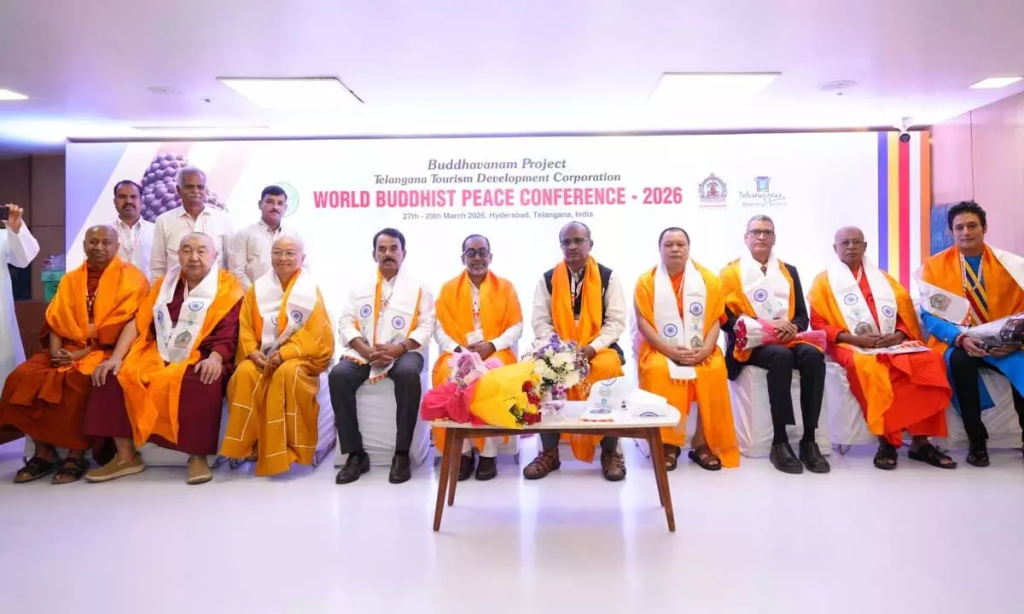
Context: Hyderabad hosted the World Buddhist Peace Conference 2026, with participation from delegates of over 20 countries.
Key Facts
- The conference was organised by the Buddhavanam project under the Telangana Tourism Development Corporation, in collaboration with international Buddhist institutions.
- It aims to promote Buddhist heritage diplomacy and position Telangana as a centre for Buddhist heritage and peace-building.
- The event emphasises Buddhist principles such as compassion, non-violence, ethical values, and dialogue.
- It is part of efforts to strengthen cultural ties, particularly between India and Sri Lanka.
Buddhist Heritage in Telangana
- Key sites included in the proposed Buddhist tourism circuit:
- Phanigiri
- Dhulikatta
- Nagarjunakonda
- Buddhavanam (Nagarjunasagar)
- Buddhavanam is being developed as a global centre for spiritual tourism and peace studies.
Musi River
About The River
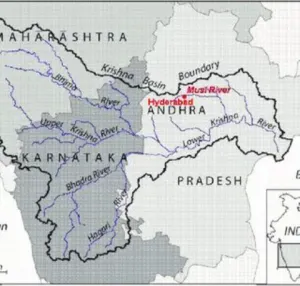
- The Musi River, also known as Muchukunda or Musunuru River, is a major tributary of the Krishna River flowing through Telangana in the Deccan Plateau.
- It originates from the Anantagiri Hills near Vikarabad district.
- The river is formed by the merging of two rivulets, Esi (8 km) and Musa (13 km).
- It flows eastward through Hyderabad, historically dividing the Old City and New City.
- The river finally joins the Krishna River near Wazirabad in Nalgonda district.
- The total length of the river is about 240 km.
Associated Features
- Major dams on the river include Himayat Sagar and Osman Sagar.
- Hussain Sagar Lake is constructed on a tributary of the Musi River.
- The river has 24 diversion weirs (locally called kathwas) used for irrigation.
- The riverbanks feature historic bridges and mosques from the Qutb Shahi and Nizam periods.
Historical Significance
- The river gained prominence when Muhammad Quli Qutb Shah founded Hyderabad along its banks in the late 16th century.
2K22 Tunguska Air Defence System
Context
- The Ministry of Defence signed contracts worth ₹858 crore for procurement of the 2K22 Tunguska air defence system and inspection of P-81 maritime reconnaissance aircraft.
- The Defence Acquisition Council (DAC) approved proposals worth about ₹2.38 lakh crore to strengthen defence capabilities.
- The Tunguska contract, valued at ₹445 crore, was signed with JSC Rosoboronexport (Russia).
- The system will enhance India’s multi-layered air defence network against threats such as aircraft, drones, and cruise missiles.
About Tunguska System
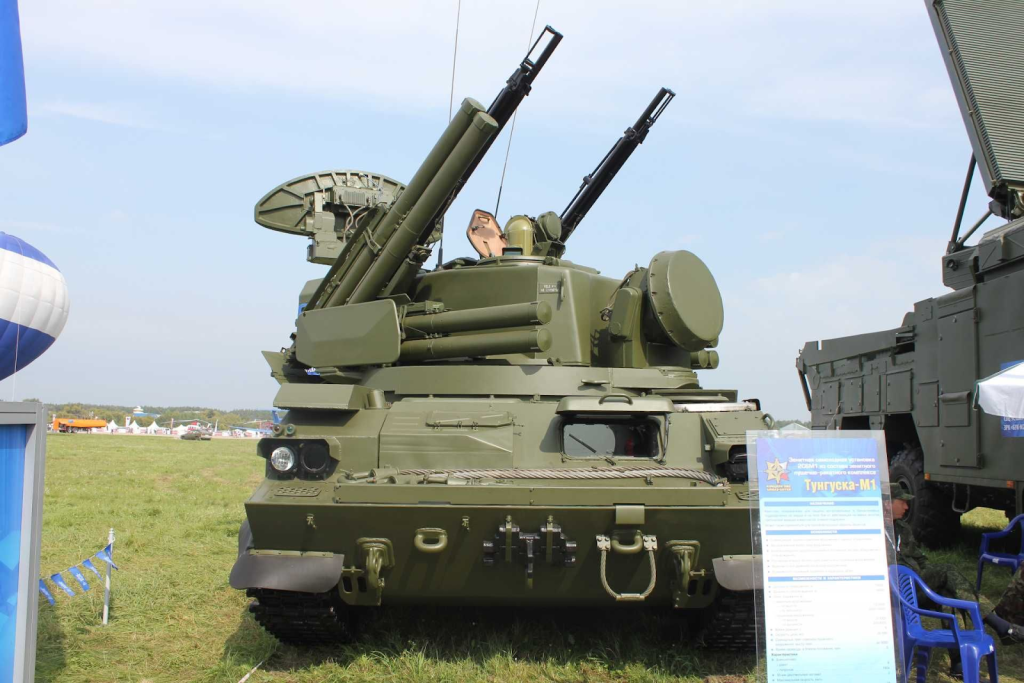
- The 2K22 Tunguska is a Soviet-origin, tracked, self-propelled air defence system.
- NATO designation: SA-19 “Grison”.
- Designed to protect ground forces from low-flying aerial threats.
- Combines missiles and guns on a single platform, enabling engagement across different ranges and altitudes.
Key Features
- Integrates surface-to-air missiles with twin 30 mm autocannons, making it a hybrid air defence system.
- Effective against helicopters, drones, and cruise missiles.
- Missile capability:
- Uses 9M311 missile family.
- Engagement range: 8–10 km.
- Altitude coverage: up to 3,500 metres.
- Uses radio command guidance for accuracy.
- Gun system:
- Twin autocannons fire at 3,900–5,000 rounds per minute.
- Provides rapid close-range defence.
- Radar and Tracking
- Equipped with 360-degree target acquisition radar.
- Detection range up to 18 km.
- Includes tracking radar and digital fire control system for precision.
- Has optical tracking capability, enabling operation even under radar jamming conditions.
- Mobility and Integration
- Mounted on a tracked chassis, allowing movement with armoured units across varied terrain.
- Designed to function as part of an integrated air defence network, receiving inputs from external systems.
BRICS
Brief Overview
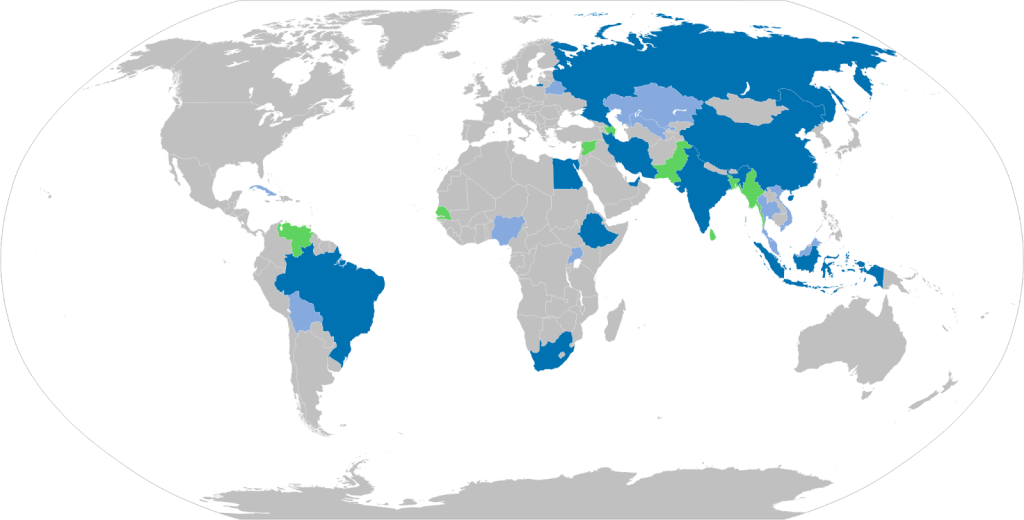
- The term BRIC was coined by Jim O’Neill in 2001 to describe emerging economies: Brazil, Russia, India, and China.
- South Africa joined in 2010, after which the grouping came to be known as BRICS.
- The group represents approximately 25% of the global economy and nearly 40% of the world’s population.
- BRICS seeks to function as a counterbalance to Western-dominated institutions such as the G7 and the World Bank.
Formation and Key Milestones
- The grouping first emerged informally during the G8 Outreach Summit at St. Petersburg in 2006.
- It was formally institutionalised through the BRIC Foreign Ministers’ Meeting in New York (2006).
- The first BRIC Summit was held in Yekaterinburg, Russia, in 2009.
- South Africa became a full member in 2010 and participated in its first summit in 2011 (China).
- The Fortaleza Declaration (2014) led to the establishment of the New Development Bank (NDB).
- The Ufa Declaration (2015) focused on issues relating to global governance and international security.
- The 13th BRICS Summit (2021) was hosted by India in virtual format.
- The Beijing Declaration (2022) emphasised cooperation in areas such as public health, supply chains, and low-carbon development.
Objectives and Agenda
- BRICS primarily aims to enhance economic cooperation among emerging economies.
- Its agenda has expanded to include issues such as international terrorism, climate change, food and energy security, and global financial stability.
- It also advocates reform of Bretton Woods institutions and addresses concerns related to trade protectionism and WTO mechanisms.
Functioning
- BRICS operates on principles of openness, pragmatism, solidarity, non-bloc character, and neutrality towards third parties.
- The chairmanship rotates annually among member countries.
- Its activities are guided by action plans adopted during annual summits.
Key Initiatives and Mechanisms
- Economic and Financial Cooperation
- The New Development Bank (NDB) was established in 2014 (Fortaleza) and became operational in 2015 to finance infrastructure and sustainable development projects.
- The NDB is headquartered in Shanghai, China, with regional offices in South Africa and Brazil.
- The bank’s membership is open to United Nations member countries, while BRICS nations retain at least 55% of voting power without veto rights.
- The Contingent Reserve Arrangement (CRA) was established in 2015 to provide liquidity support during balance of payments crises.
- It has a total capacity of $100 billion and was legally agreed upon during the Fortaleza Summit (2014).
- BRICS is also working towards establishing a payment system alternative to SWIFT, aimed at reducing dependence on the US dollar-dominated financial system.
- Political and Security Cooperation
- BRICS facilitates dialogue on global and regional security issues, including counter-terrorism and cyber security.
- The BRICS National Security Advisors’ meetings serve as an important platform for such discussions.
- People-to-People Cooperation
- The grouping promotes cooperation through initiatives such as the BRICS Parliamentary Forum, Film Festival, Youth Summit, and Academic Forum.
- Expansion of BRICS
- More than 40 countries have expressed interest, with 22 formal applications for membership.
- Countries invited to join (effective January 1, 2024) include Argentina, Egypt, Ethiopia, Iran, Saudi Arabia, and the UAE.
- Expansion reflects efforts to strengthen Global South cooperation and diversify global governance structures.
Coking Coal
Context and Legal Framework
- The Government of India has declared Coking Coal as a Critical and Strategic Mineral under the Mines and Minerals (Development and Regulation) Act, 1957 (MMDR Act).
- Using Section 11C of the MMDR Act, 1957, the government amended the First Schedule.
- Coking Coal has been included within “Coal” in Part A and also listed separately in Part D as a Critical and Strategic Mineral.
- The objective is to reduce import dependence and support Aatmanirbhar Bharat and Viksit Bharat 2047.
About Coking Coal
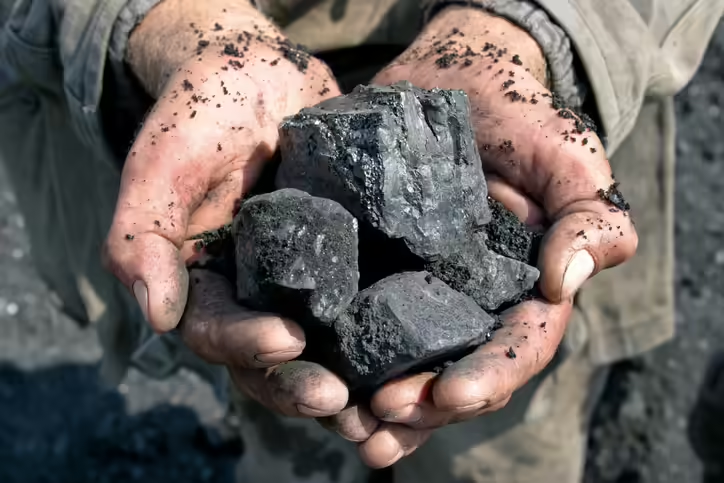
- Coking coal, also known as metallurgical coal, is a special grade of bituminous coal used in steel production.
- It undergoes carbonisation to produce coke, which is essential for converting iron ore into pig iron in blast furnaces.
- Its importance lies in its caking properties, as it softens and swells when heated to form coke.
- It contains low impurities, particularly low ash, sulphur, and phosphorus, making it suitable for metallurgical processes.
Strategic Importance and Global Scenario
- Approximately 780 kg of coking coal is required to produce one tonne of steel, highlighting its critical role in the steel industry.
- It is an irreplaceable input in traditional blast furnace steelmaking.
- Major global producers include China, Australia, Russia, the United States, and Canada.
Indian Scenario
- India is the second-largest producer of crude steel in the world.
- Nearly 95% of India’s coking coal requirement is met through imports, with a significant share coming from Australia.
- Imports reached about 57.58 million tonnes in 2024–25, indicating rising dependence.
- India has estimated reserves of about 37.37 billion tonnes, primarily located in Jharkhand, with additional reserves in Madhya Pradesh, West Bengal, and Chhattisgarh.
Indian Coffee
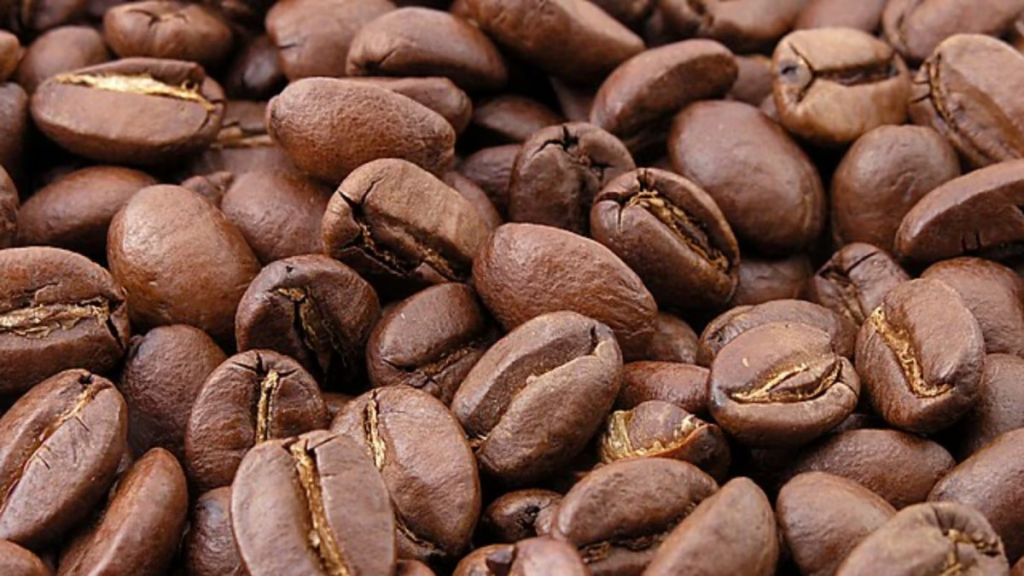
Context: India’s coffee exports have been disrupted due to the U.S.–Iran conflict, affecting shipping through the Strait of Hormuz.
About Coffee
- Coffee is a tropical plantation crop generally grown under shade trees.
- Two major varieties are Arabica and Robusta.
- Cultivation in India
- Major producing states include Karnataka, Kerala, Tamil Nadu, Andhra Pradesh, and Odisha.
- Karnataka contributes over 70% of India’s total coffee production.
- Climatic Requirements
- Grown at elevations of 600–1,600 metres above sea level.
- Requires hot and humid climate with temperature between 15°C and 28°C.
- Needs 150–250 cm of rainfall.
- Suitable soil includes well-drained loamy soil rich in humus and minerals (iron and calcium).
- Dry weather is essential during ripening of coffee berries.
- Trade and Export
- Europe is the largest destination for Indian coffee exports.
- Major importers include Italy, Germany, Belgium, Middle East countries, Korea, and Japan.
