

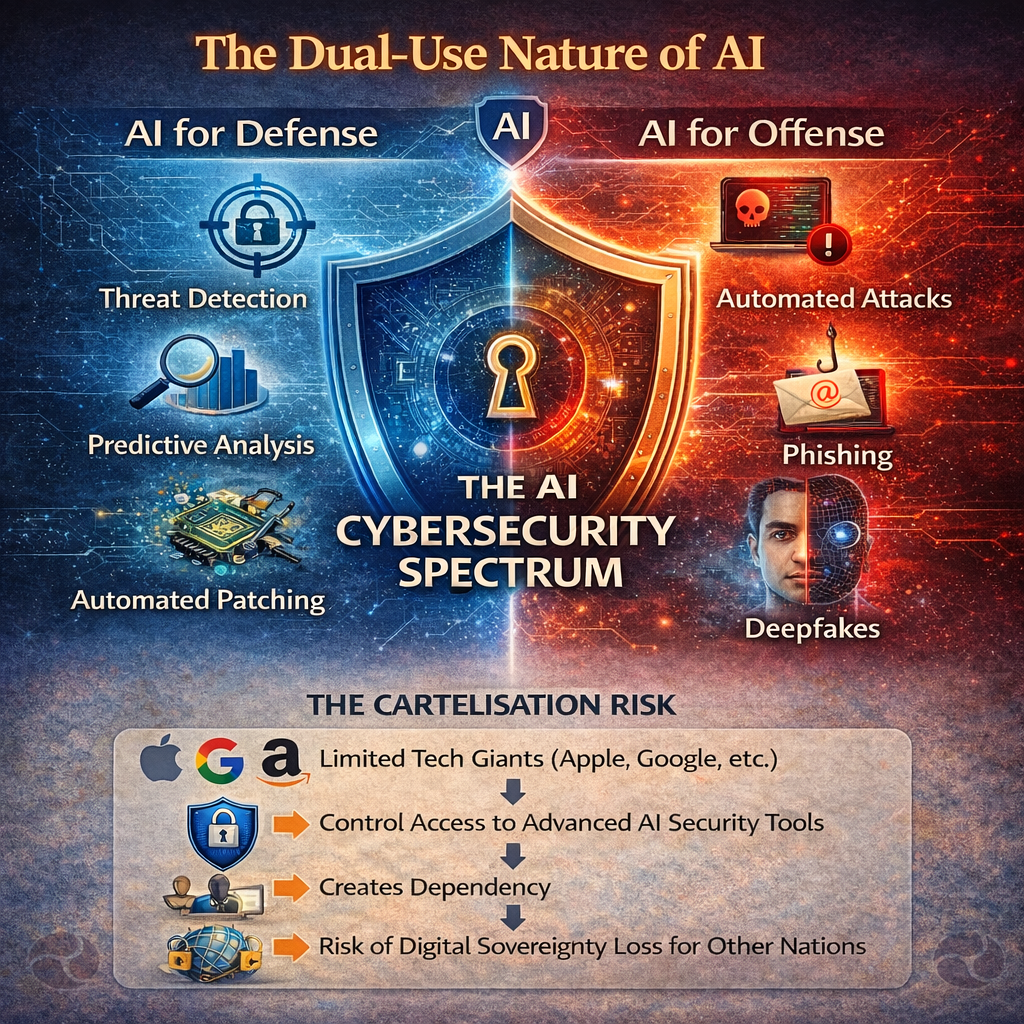
Context: Rapid advancements in AI are transforming cybersecurity, with initiatives like Project Glasswing showing how AI is becoming central to detecting and managing digital threats.
Transformative Role of AI in Cybersecurity
- AI models can identify zero-day vulnerabilities that remained undiscovered for decades.
- Tasks that earlier required weeks of expert effort can now be completed autonomously within hours.
- AI enables continuous scanning of software systems, improving real-time threat detection and response.
- AI tools are being used to secure widely used open-source ecosystems, which form the backbone of the internet.
- AI is shifting cybersecurity from a reactive model to a proactive and predictive system.
- Emerging Trends
- Companies are integrating AI with cloud platforms to create end-to-end cybersecurity solutions.
- Firms are combining AI models, cloud infrastructure, and security tools into unified offerings.
- Security is becoming a core differentiator in the tech industry, not just an auxiliary service.
Key Concerns
- Cartelisation risk: A small group of tech giants may control access to most advanced cybersecurity tools.
- Access inequality: Restricting powerful AI tools to select entities raises concerns about digital exclusion and security imbalance.
- Conflict of interest: The same companies detecting vulnerabilities are also selling solutions to fix them, creating structural dominance.
- Centralisation of control: Decision-making over cybersecurity access may shift from governments to private tech coalitions.
Strategic Implications
- Shift in global power dynamics: Cybersecurity is emerging as a domain of strategic technological dominance.
- Dependence on private actors: Nations may become reliant on corporate-controlled security ecosystems.
- Governance challenges: Lack of regulatory clarity raises concerns about accountability and oversight.
- Digital sovereignty concerns: Control over cybersecurity tools may affect a country’s ability to independently secure its infrastructure.
Way Forward
- Promote democratised access to cybersecurity tools while ensuring safeguards.
- Strengthen regulatory frameworks to prevent monopolistic control.
- Encourage public-private partnerships with accountability mechanisms.
- Invest in indigenous cybersecurity capabilities to reduce dependence.
- Ensure transparency in AI deployment for trustworthy and ethical security systems.
Conclusion
- AI is redefining cybersecurity by making it faster, smarter, and more predictive. However, ensuring that this power remains distributed, accountable, and equitable is essential to safeguard both security and sovereignty.
