

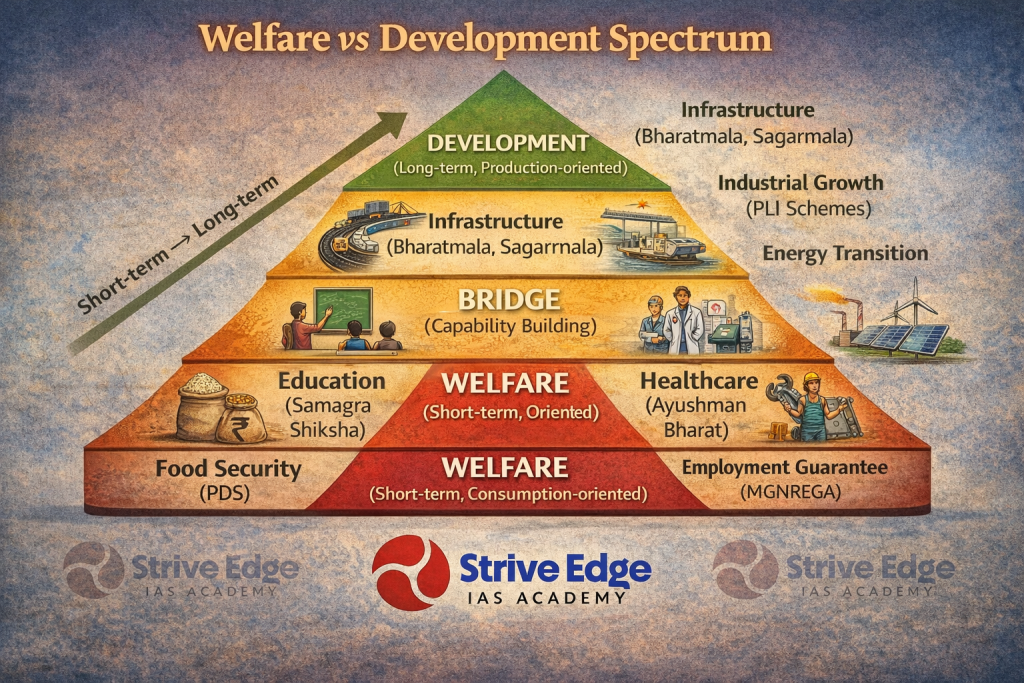
Context: In contemporary politics, “development” has become a powerful electoral slogan, but its meaning is often blurred with welfare, leading to conceptual confusion and policy misalignment.
Understanding the Core Distinction
- Welfare focuses on short-term relief, addressing poverty, vulnerability, and basic needs like food, income, and essential services.
- Development refers to a long-term process involving economic growth, productivity enhancement, and expansion of human capabilities.
- Welfare is consumption-oriented and immediate, while development is production-oriented and gradual.
- The challenge lies not in their existence, but in their misinterpretation and overlap.
The Illusion of “Quick Development” and Policy Confusion
- Political narratives often equate visible outputs like infrastructure and transfers with development.
- Electoral cycles incentivise focus on short-term gains, sidelining long-term structural reforms.
- Development is inherently incremental and path-dependent, requiring sustained improvements in institutions, productivity, and governance.
- The capability perspective highlights that real progress comes from expanding human freedoms through health, education, and inclusion.
- The idea of “instant development” is therefore a policy fallacy, masking deeper structural challenges.
The Risk of Welfare Populism
- Short-term appeal vs long-term cost: Populist measures prioritise immediate consumption gains over productive capacity.
- Fiscal strain: Excessive welfare spending crowds out investment in public goods and infrastructure.
- Distortion of incentives: Over-reliance on redistribution may weaken efficiency and economic dynamism.
- Substitution problem: Welfare replaces rather than complements long-term development investments.
Why Welfare Still Matters
- Well-designed welfare programmes can reduce vulnerability and enhance human capabilities.
- Schemes like nutrition and employment guarantees can support long-term productivity gains.
- Welfare provides the foundation upon which development can be sustained.
- Welfare and development are best seen as complementary, not contradictory.
Way Forward
- Design welfare policies that are targeted, efficient, and fiscally sustainable.
- Prioritise investment in public goods like education, health, and infrastructure.
- Align welfare with development goals to ensure long-term capacity building.
- Shift political discourse from visibility-driven policies to structural transformation.
- Strengthen institutions to ensure continuity and credibility in development efforts.
Conclusion
- The real challenge is not choosing between welfare and development, but harmonising them effectively. India’s progress depends on moving beyond populist shortcuts towards a model that ensures both dignity today and growth tomorrow.
