

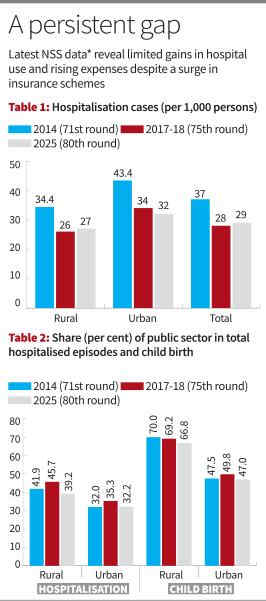
Context: The latest National Sample Survey (NSS) 80th round (2025) reveals rising insurance coverage but limited improvement in healthcare utilisation outcomes. Despite expansion of schemes like PMJAY, financial protection gaps and rising healthcare distress remain significant.
Key Findings from NSS Data
- Nearly 47.4% rural and 44.3% urban households now have health insurance coverage, largely driven by government-financed schemes.
- However, increased coverage has not resulted in proportional rise in hospitalisation rates or improved access to care.
- Out-of-pocket expenditure on hospitalisation has more than doubled, indicating weak financial risk protection mechanisms.
Associated Issues
- Coverage Without Care: Structural Paradox
- Expansion of government schemes has created nominal coverage, but failed to ensure effective healthcare utilisation.
- Hospitalisation rates remain below earlier levels, reflecting persistent access barriers despite expanded insurance coverage.
- Insurance expansion without systemic strengthening leads to illusory protection rather than meaningful healthcare security.
- Shift Towards Private Sector Care
- There is a growing shift from public institutions towards private healthcare providers, especially for hospitalisation and childbirth services.
- Public healthcare utilisation has declined due to service deficiencies and perceived quality concerns.
- Private sector dominance increases treatment costs, deepening healthcare inequality and financial vulnerability.
- Rising Out-of-Pocket (OOP) Expenditure
- OOP expenditure has significantly increased due to high private sector costs and gaps in public healthcare provisioning.
- Even in public hospitals, patients incur expenses due to medicine shortages and diagnostic unavailability.
- Non-medical costs like transport further increase financial burden on already vulnerable households.
- Limitations of Government-Financed Health Insurance (GFHI)
- Schemes like Pradhan Mantri Jan Arogya Yojana (PMJAY) aim to cover high-cost hospitalisation, but fail to deliver cashless treatment effectively.
- Majority beneficiaries seek care in private hospitals, yet incur substantial additional expenses beyond insurance coverage.
- Reimbursement limitations and under-regulation enable extra billing practices, reducing scheme effectiveness.
- Equity Concerns in Utilisation
- Although designed for vulnerable groups, utilisation benefits are disproportionately captured by relatively better-off sections.
- Only a small proportion of poorest households access hospitalisation services under insurance schemes, indicating exclusion gaps.
- Inclusion of non-poor populations dilutes targeting efficiency and increases resource allocation inefficiencies.
- Fiscal and Structural Concerns
- State governments are spending significant portions of health budgets on GFHI schemes, creating fiscal stress.
- Delays in reimbursement to private providers affect service delivery and increase systemic inefficiencies.
- Public funds are increasingly subsidising private healthcare expansion, raising concerns of market-driven health systems.
Way Forward
- Strengthen public healthcare infrastructure to ensure universal access and reduce dependence on private sector services.
- Prioritise primary healthcare through initiatives like Ayushman Arogya Mandir, focusing on comprehensive care delivery.
- Improve regulation of private sector to prevent exploitative pricing and ensure accountability in service delivery.
- Rationalise insurance schemes to enhance targeting efficiency and ensure benefits reach the most vulnerable populations.
Conclusion
- Rising insurance coverage without financial protection reflects a structural imbalance in India’s healthcare policy framework. A humane healthcare system must prioritise equity, accessibility, and affordability, not merely expansion of insurance coverage.
