

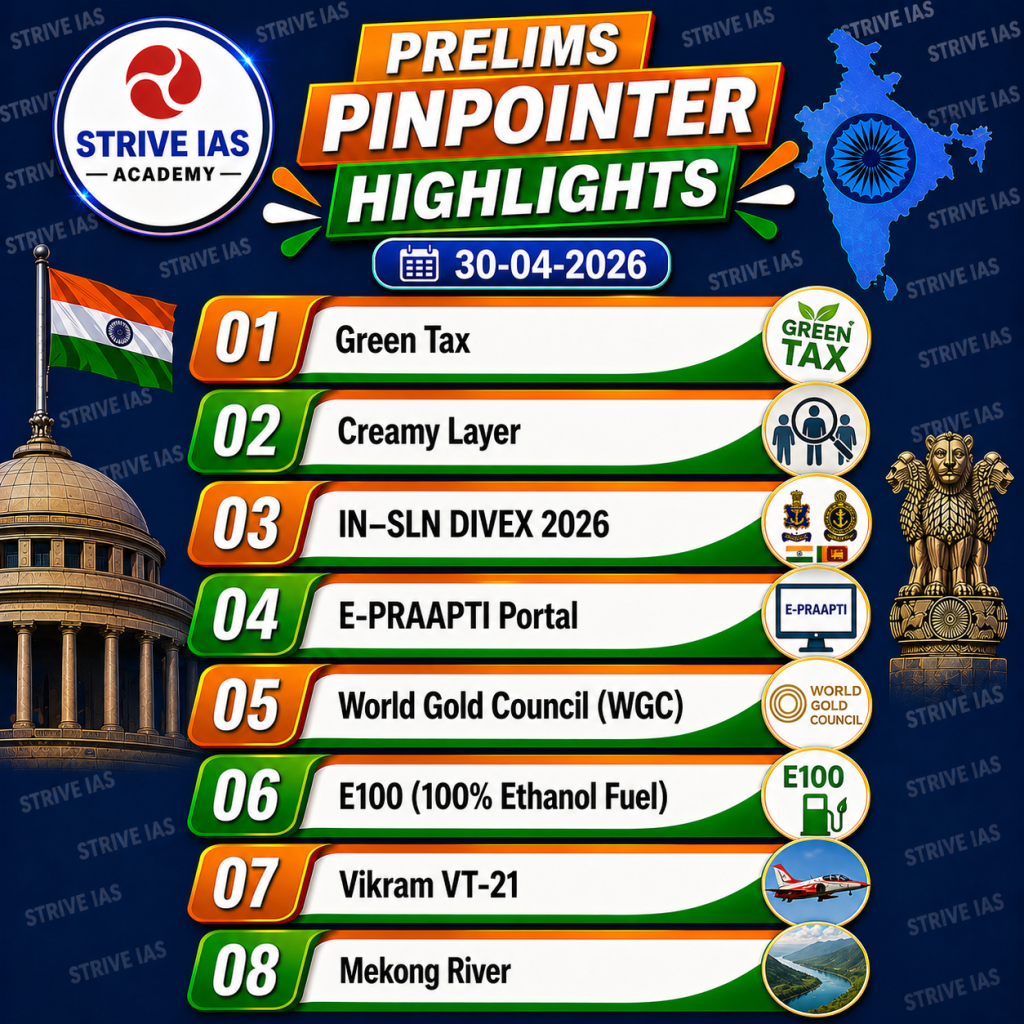
Green Tax

What is Green Tax?
- An environmental tax imposed on old and polluting vehicles.
- Aims to internalise environmental costs of vehicular emissions.
- Functions as a fiscal instrument to improve urban air quality.
- Key Provisions in India
- Transport vehicles (>8 years): Tax levied during fitness certificate renewal.
- Personal vehicles (>15 years): Tax imposed at registration renewal stage.
- Tax rate: 10%–25% of road tax.
- Public transport vehicles (e.g., buses) face relatively lower tax burden.
Objectives of Green Tax
- Reduce emissions of CO, NOx, and particulate matter (PM).
- Promote clean mobility (electric, hybrid, alternative fuels).
- Implement Polluter Pays Principle.
- Generate dedicated funds for pollution control measures.
Legal and Constitutional Basis
- Constitutional Provisions
- Article 21: Right to life includes clean and healthy environment.
- Article 48A: State to protect and improve environment.
- Article 51A(g): Duty of citizens to protect natural environment.
- Statutory Backing
- Motor Vehicles Act, 1988: Framework for registration and fitness renewal.
- Air Act, 1981: Provides for control of air pollution.
- Environment Protection Act, 1986: Empowers government for environmental regulation.
- Judicial Principle
- Polluter Pays Principle: Polluters must bear environmental costs.
- Federal Aspect
- Road tax and vehicle regulation fall under State jurisdiction.
- States decide implementation and rate structure within central guidelines.
Green Tax vs Carbon Tax
| Aspect | Green Tax | Carbon Tax |
| Scope | Transport sector | Economy-wide |
| Basis | Vehicle age, type, pollution | CO₂ emissions |
| Objective | Reduce local air pollution | Reduce greenhouse gases |
| Level | State-level implementation | National-level policy |
| Focus | PM, NOx, CO reduction | Climate change mitigation |
Creamy Layer

About Creamy Layer
- Refers to the socially advanced and economically better-off section within OBCs.
- These individuals are excluded from reservation benefits in:
- Education
- Government jobs
- Welfare schemes
Eligibility Criteria (Creamy Layer)
- Income Criterion
- Annual family income exceeds ₹8 lakh.
- Service-Based Criteria
- Children of Group A/Class I officers are excluded.
- If a person is promoted to Group A before 40 years, children fall under creamy layer.
- If both parents are Group B/Class II officers, children are excluded.
- Other Categories Included
- Holders of constitutional posts.
- PSU employees, professionals, businesspersons, and high-income groups.
- Individuals with significant property/wealth holdings.
- Armed Forces Criteria
- Officers above the rank of Lieutenant Colonel fall under creamy layer.
IN–SLN DIVEX 2026

Overview
- The India–Sri Lanka bilateral diving exercise (IN–SLN DIVEX 2026) was conducted in Colombo. It reflects strengthening maritime cooperation in the Indian Ocean Region (IOR).
- Participating Forces
- Indian Navy deployed INS Nireekshak.
- Sri Lanka Navy participated with specialised diving teams.
Nature of Exercise
- Focus on underwater operations and diving expertise.
- Includes:
- Deep-sea diving
- Mixed gas diving drills
- Search, rescue, and salvage operations
Objectives
- Enhance interoperability between Indian and Sri Lankan navies.
- Improve underwater search and rescue capabilities.
- Strengthen operational coordination and professional synergy.
| Additional CooperationIndia provided BHISM (Bharat Health Initiative for Sahyog, Hita and Maitri) cubes.Portable medical units for disaster response and emergency care. |
E-PRAAPTI Portal

Context: The Employees’ Provident Fund Organisation (EPFO) is set to launch E-PRAAPTI portal. It aims to tracking and activation of inoperative EPF accounts through digital interface.
About E-PRAAPTI Portal
- Full form: EPF Aadhaar-Based Access Portal for Tracking Inoperative Accounts.
- A digital platform for:
- Identification of old/inoperative EPF accounts
- Linking with Universal Account Number (UAN)
- Activation and profile updation
- Key Features
- Uses Aadhaar-based authentication for secure access.
- Initially member ID-based system.
- Future expansion to include users without member ID details.
- Reduces manual intervention and documentation burden.
- Key Terms
- Inoperative EPF Account
- EPF account with no contributions for a prolonged period.
- Universal Account Number (UAN)
- A unique 12-digit number assigned to EPFO members.
- Enables portability and consolidation of multiple EPF accounts.
- Inoperative EPF Account
About Employees’ Provident Fund Organisation (EPFO)
- A statutory body established under the Employees’ Provident Fund and Miscellaneous Provisions Act, 1952.
- Administered by the Ministry of Labour & Employment.
- Governance Structure: Managed by the Central Board of Trustees (CBT).
- Representatives of: Government (Central + State), Employers, Employees
- Major Schemes under EPFO
- Employees’ Provident Fund Scheme, 1952 (EPF) for retirement savings.
- Employees’ Pension Scheme, 1995 (EPS) for pension benefits.
- Employees’ Deposit Linked Insurance Scheme, 1976 (EDLI) for insurance cover.
- EPFiGMS (Grievance Portal)
- EPF i-Grievance Management System (EPFiGMS) is a customised digital grievance redressal platform.
- Enables:
- Online complaint filing
- Automatic routing to concerned office
- Faster grievance resolution
World Gold Council (WGC)

About WGC
- A non-profit association of leading gold mining companies.
- Established in 1987 by major gold producers.
- Headquarters: London, United Kingdom.
- Comprises ~33 member companies, primarily gold mining firms.
Nature of Organisation
- Functions as a market development organisation for gold industry.
- Works to promote usage, demand, and sustainability of gold.
Key Objectives
- Maximise long-term growth of gold demand and industry potential.
- Promote gold consumption across sectors (jewellery, investment, technology).
- Ensure fairness and sustainability in gold mining practices.
Key Initiatives
- Quarterly Gold Demand Trends Report
- Analysis based on:
- Sector-wise demand (jewellery, investment, central banks)
- Geographical distribution
- Analysis based on:
- Key Contributions
- Creator of the first Gold Exchange-Traded Fund (ETF).
- Covers markets accounting for ~75% of global gold consumption.
E100 (100% Ethanol Fuel)

Context: The Ministry of Road Transport and Highways (MoRTH) has proposed recognising E100 (100% ethanol) as an approved automotive fuel. The amendment relates to Central Motor Vehicles Rules (CMVR), Rule 115 governing alternative fuels.
What is E100?
- E100 refers to 100% ethanol used as fuel in vehicles.
- Differs from blended fuels like:
- E10: 10% ethanol
- E20: 20% ethanol
- E85: 85% ethanol
- E100 enables pure ethanol-powered vehicles, not just blended fuel systems.
Key Provision in Draft Notification
- Vehicles earlier approved for up to E85 can now be certified for E100.
- Enables homologation and type approval of E100-compatible vehicles.
- Homologation is the official certification process ensuring that vehicles comply with:
- Technical standards
- Safety norms
- Environmental regulations
- Homologation is the official certification process ensuring that vehicles comply with:
- Role of Certification Agencies: Agencies like Automotive Research Association of India conduct testing and certification.
Vikram VT-21

Context: The DRDO has unveiled the Vikram VT-21 Advanced Armoured Platform. It is proposed as a potential solution for the Indian Army’s Futuristic Infantry Combat Vehicle (FICV) requirement.
What is Vikram VT-21?
- An Advanced Armoured Platform (AAP) designed for modern battlefield conditions.
- Built with enhanced mobility, protection, and firepower capabilities.
- Variants
- Wheeled variant: Faster, suited for roads and urban terrain.
- Tracked variant: Better grip and performance in rough/off-road terrain.
Key Features
- Mobility
- High power-to-weight ratio ensures better speed and agility.
- Capable of crossing obstacles, trenches, and steep terrains.
- Protection
- Provides STANAG Level 4 & 5 protection (NATO standard).
- Resistant to heavy gunfire, blasts, and artillery fragments.
- Amphibious Capability
- Equipped with hydro-jet propulsion for water crossing.
Weapon Systems
- Fitted with 30 mm crewless (remotely operated) turret.
- Equipped with:
- 7.62 mm PKT machine gun
- Nag Anti-Tank Guided Missile (ATGM)
- Enhances precision strike capability against armoured targets.
What is FICV?
- Futuristic Infantry Combat Vehicle (FICV) is a next-generation combat vehicle for Indian Army.
- Need
- Replace ageing BMP-2 fleet (in service since 1980s).
- Adapt to modern network-centric warfare.
- Network-Centric Warfare (Concept)
- Integration of sensors, communication systems, and combat units.
- Enables real-time information sharing and faster decision-making.
Mekong River

Basic Features
- Longest river in Southeast Asia.
- 7th longest in Asia and 12th longest in the world.
- Total length: ~4,350 km (2,700 miles).
- Drainage basin: ~795,000 sq km.
Origin & Course
- Originates in southeastern Qinghai (China) on the Tibetan Plateau.
- Source region: Sanjianyuang (Three-River Source Area).
- Countries Traversed (6): China → Myanmar → Laos → Thailand → Cambodia → Vietnam
- Important Cities: Vientiane (Laos) and Phnom Penh (Cambodia) lie on its banks.
- Drainage & Delta
- Empties into the South China Sea near Ho Chi Minh City (Vietnam).
- Forms the Mekong Delta in southern Vietnam.
- Delta Significance
- One of the world’s most fertile rice-producing regions.
- Known as a major global rice bowl.
Tributaries
- Left-bank Tributaries (High Rainfall Areas)
- Nam Ou
- Nam Khan
- Tha
- Right-bank Tributaries (Lower Relief Areas)
- Ruak
- Kok
- Tonle Sap
- Mun
