

Jal Jeevan Mission (JJM)
About Jal Jeevan Mission
- The Jal Jeevan Mission (JJM) was launched on 15 August 2019.
- The mission aims to provide safe and adequate drinking water through Functional Household Tap Connections (FHTCs) to all rural households by 2024.
- JJM adopts a community-based approach to water management.
- It includes extensive Information, Education and Communication (IEC) activities as key components of the mission.
- Nodal Ministry: Ministry of Jal Shakti
Components of Jal Jeevan Mission
- Development of In-Village Water Infrastructure
- Development of in-village piped water supply infrastructure to provide tap water connections to every rural household.
- Community Participation and Bottom-Up Planning
- The mission emphasises community engagement in:
- planning,
- implementation,
- and Operation and Maintenance (O&M).
- The mission emphasises community engagement in:
- Women Empowerment
- Women are involved in planning, decision-making, implementation, monitoring and Operation and Maintenance (O&M) activities.
- Source Sustainability
- JJM promotes groundwater recharge and water conservation measures.
- Water Quality
- The mission seeks to ensure safe drinking water and reduce water-borne ailments.
Funding Pattern of Jal Jeevan Mission
| Category | Funding Pattern |
| General States | 50:50 between Centre and States |
| Himalayan and North-Eastern States | 90:10 |
| Union Territories | 100% Central Funding |
Election Commission Act, 2023
Context
- The Election Commission (Appointment, Conditions of Service and Term of Office) Act, 2023 was enacted to regulate the appointment, tenure, service conditions, and functioning of the Chief Election Commissioner (CEC) and Election Commissioners (ECs).
- The Act replaced the Election Commission (Conditions of Service of Election Commissioners and Transaction of Business) Act, 1991.
Judicial Background
- The Act emerged in the backdrop of judicial scrutiny regarding the appointment process of the CEC and ECs.
- In the Anoop Baranwal Case, the Supreme Court held that the appointment of the CEC and ECs should be made by a committee comprising:
- the Prime Minister, the Leader of Opposition (LoP) and the Chief Justice of India (CJI) until Parliament enacted a law on the matter.
- Earlier Appointment Process
- Prior to the judgment, the CEC and ECs were appointed by the President on the advice of the Union Council of Ministers headed by the Prime Minister.
Key Provisions of the 2023 Act
- Selection Committee
- The CEC and ECs are appointed by the President on the recommendation of a Selection Committee consisting of:
- Prime Minister: Chairperson
- Leader of the Opposition in the Lok Sabha
- Union Cabinet Minister nominated by the Prime Minister
- The CEC and ECs are appointed by the President on the recommendation of a Selection Committee consisting of:
- Search Committee
- The Act provides for a Search Committee headed by the Law Minister.
- It includes two other members not below the rank of Secretary to the Government of India.
- The committee shortlists five candidates for consideration.
- Section 8 of the Act
- Section 8 empowers the Selection Committee to consider names beyond the shortlisted candidates.
Eligibility Criteria
- A person appointed as CEC or EC must:
- Have held a post equivalent to Secretary-level in the Government of India,
- possess integrity,
- Have experience in election management.
- Salary: The CEC and ECs receive salary equivalent to that of a Supreme Court Judge.
- Term of office: 6 years or until attaining the age of 65 years, whichever is earlier.
- Reappointment
- CECs and ECs are not eligible for reappointment.
- If an EC is later appointed as CEC, the combined tenure cannot exceed six years.
- Pension Provision
- If a CEC or EC receives a government pension, their salary will be reduced by the pension amount received.
- Disability pension is excluded from this provision.
Removal
- The CEC can be removed only in the same manner and on the same grounds as a Judge of the Supreme Court.
- An Election Commissioner can be removed on the recommendation of the CEC.
- Both the CEC and ECs can resign by submitting resignation to the President.
Registrar General of India (RGI)
About Registrar General of India
- The Registrar General and Census Commissioner of India (RGI) is the highest authority for managing Census operations and civil registration in the country.
- The post is currently held by a senior civil servant of the rank of Additional Secretary in the Ministry of Home Affairs.
- Establishment: The office of the RGI was formally established in 1961 under the Ministry of Home Affairs.
Key Functions of the RGI Office
- Population and Housing Census
- The RGI conducts the decennial Census of India under the Census Act, 1948.
- It is responsible for:
- data planning,
- enumeration,
- tabulation,
- and dissemination of Census data.
- Civil Registration System (CRS)
- The RGI oversees compulsory registration of births and deaths under the Registration of Births and Deaths (RBD) Act, 1969.
- It coordinates with States and Union Territories for maintaining vital statistics.
- Sample Registration System (SRS)
- The RGI conducts bi-annual sample surveys under the Sample Registration System.
- The SRS provides reliable estimates of:
- Birth Rate,
- Death Rate,
- Infant Mortality Rate (IMR),
- and Maternal Mortality Ratio (MMR).
- It serves as a major source of demographic indicators at the state level.
- National Population Register (NPR)
- The National Population Register (NPR) is prepared under the Citizenship Act, 1955 and the Citizenship Rules, 2003.
- It records details of all usual residents in the country.
- The NPR currently contains around 119 crore entries.
- Mother Tongue Survey of India
- The RGI conducts the Mother Tongue Survey of India to document consistently used mother tongues across Census decades.
- The survey helps preserve India’s linguistic diversity by mapping phonetic and cultural characteristics.
5th BRICS SAI Leaders’ Summit
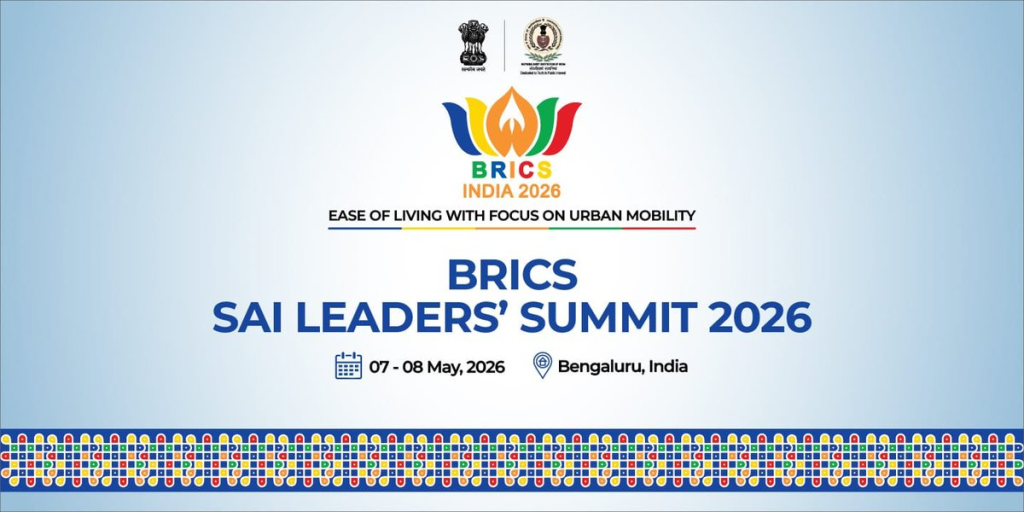
Context: India is hosting the 5th BRICS Supreme Audit Institutions (SAI) Leaders’ Summit in Bengaluru from 7–8 May 2026 under the theme “Ease of Living with a Focus on Urban Mobility.” The Summit is being convened during India’s BRICS Chairmanship 2026 by the Office of the Comptroller and Auditor General (C&AG) of India.
About the Summit
- The Summit brings together 42 delegates, including Heads of SAIs from BRICS member countries.
- It aims to:
- deliberate on audit themes of common relevance,
- exchange best practices,
- and strengthen public financial oversight mechanisms.
- BRICS countries collectively represent:
- over three billion people,
- and some of the world’s fastest-growing urban populations.
- Central Theme: Ease of Living with a Focus on Urban Mobility
- Sub-Themes
- Ease of Living: Audit of the Urban Sector
- Ease of Living: Audit of Urban Mobility
- Participating Countries: Brazil, China, Egypt, Ethiopia, India, Indonesia, Russia, South Africa, UAE
Key Areas of Discussion
- The Summit discussions focus on common urban governance challenges, such as:
- urban mobility,
- affordable housing,
- environmental sustainability,
- and equitable access to public services.
- The deliberations highlight the role of Supreme Audit Institutions (SAIs) in improving accountability and efficiency in urban governance.
About Supreme Audit Institutions (SAIs)
- Supreme Audit Institutions are national bodies responsible for:
- auditing public expenditure,
- ensuring financial accountability,
- and promoting transparency in governance.
- In India, this role is performed by the Comptroller and Auditor General (C&AG) of India.
Kalai-II Hydroelectric Project
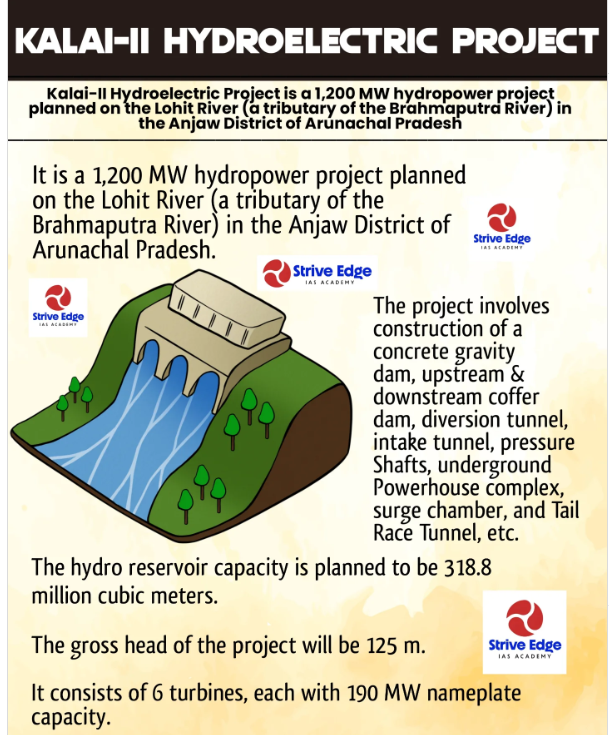
About the Project
- The project is planned on the Lohit River, a tributary of the Brahmaputra River.
- It is located in the Anjaw District of Arunachal Pradesh.
- The project is designed as a run-of-river project with pondage.
- The project involves the construction of a concrete gravity dam, upstream and downstream coffer dams, diversion tunnel, intake tunnel and tail race tunnel.
Installed Capacity and Power Generation
- The project has an installed capacity of 1,200 MW.
- It comprises:
- six units of 190 MW each,
- and one unit of 60 MW.
- The project is expected to generate around 4,852.95 million units of electricity annually.
About Lohit River
- The Lohit River is an important tributary of the Brahmaputra River.
- It flows through Arunachal Pradesh before joining the Brahmaputra in Assam.
Santa Marta Climate Conference
Context: Representatives from more than 50 countries, accounting for nearly 50% of global GDP, gathered in Santa Marta, Colombia, for the First International Conference on Transitioning Away from Fossil Fuels.
About the Conference
- The conference was jointly hosted by Colombia and Netherlands.
- It was conceptualised as a “safe harbour” for a “coalition of the willing” countries prepared to take concrete action towards phasing out fossil fuels.
- The initiative seeks to bypass political deadlocks often witnessed during traditional UN climate negotiations.
- The conference aims to:
- develop practical national and international roadmaps for transitioning away from fossil fuels,
- accelerate the shift towards renewable energy systems,
- and align trade, finance, and carbon pricing policies with green transition goals.
Key Highlights of the Conference
- Fossil Fuel Non-Proliferation Treaty
- The conference witnessed growing support for a Fossil Fuel Non-Proliferation Treaty.
- The proposal received strong backing from Small Island Developing States (SIDS), which are highly vulnerable to climate change impacts.
- The treaty seeks to address gaps in the supply-side governance of fossil fuels.
- Green Transition and Climate Finance
- Participants emphasised:
- phasing out fossil fuel subsidies,
- aligning global finance and trade with climate goals,
- and strengthening carbon pricing mechanisms.
- Participants emphasised:
Limitations of the Conference
- The conference did not include participation from three major greenhouse gas emitters:
- the United States, China, and India.
- Lack of Binding Authority
- Since the conference operates outside the UNFCCC framework, its decisions do not create universally binding international obligations.
- It functions primarily through voluntary political cooperation.
About United Nations Framework Convention on Climate Change (UNFCCC)
- The UNFCCC was adopted during the 1992 Rio Earth Summit.
- Its objective is to prevent dangerous human interference with the global climate system.
- Major Climate Agreements under UNFCCC
- Kyoto Protocol (1997)
- Paris Agreement (2015)
- About COP
- The Conference of the Parties (COP) is the supreme decision-making body of the UNFCCC.
- Member countries meet annually to:
- review climate progress, negotiate agreements and update climate commitments such as Nationally Determined Contributions (NDCs).
- Evolution of COP
- COP1 was held in Berlin in 1995.
- By COP30 (2025), participation expanded to 198 countries.
- Upcoming COP Hosts
| COP | Host Country | Year |
| COP31 | Türkiye | 2026 |
| COP32 | Ethiopia | 2027 |
Atlantic Meridional Overturning Circulation (AMOC)
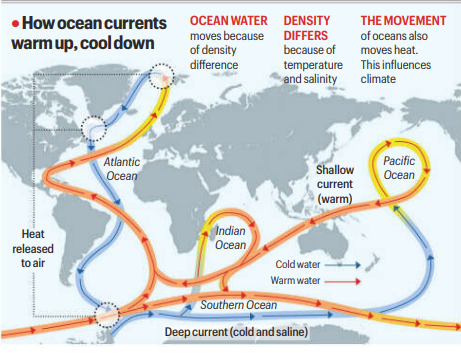
Context: Scientists are increasingly expressing concern over the weakening of the Atlantic Meridional Overturning Circulation (AMOC), a major ocean current system that regulates global climate patterns.
What is AMOC?
- Global Ocean Conveyor Belt
- The Atlantic Meridional Overturning Circulation (AMOC) is a large system of ocean currents in the Atlantic Ocean.
- It functions like a global “conveyor belt” that transports warm and cold water across oceans.
- The system plays an important role in regulating:
- global climate,
- rainfall distribution,
- temperature patterns,
- and marine ecosystems.
- How Does AMOC Function?
- Movement of Warm and Cold Water
- Warm and salty surface water moves from the tropics towards Greenland and the Arctic region.
- In colder regions, the water becomes:
- colder,
- denser,
- and saltier.
- The dense water sinks deep into the ocean and flows southward as cold deep-water currents.
- This process pulls warm surface water northward and maintains continuous circulation.
- Movement of Warm and Cold Water
- Why is AMOC Weakening?
- Impact of Global Warming
- Rapid melting of Arctic and Greenland ice is adding large quantities of freshwater into the North Atlantic Ocean.
- Freshwater is lighter and less saline, reducing the density of ocean water.
- As a result, water does not sink efficiently, weakening the entire circulation system.
- Impact of Global Warming
- Possibility of Irreversible Collapse
- Scientists warn that AMOC may reach a climatic “tipping point”.
- Once this threshold is crossed, the system could shift abruptly into a much weaker state or even collapse.
- Research suggests that the weakening trend may accelerate significantly during this century.
Global Consequences of AMOC Collapse
- A major weakening or collapse of AMOC could lead to:
- severe weather disruptions globally,
- increased frequency of extreme climatic events,
- and large-scale ecological instability.
- Sea-Level Rise
- North America and parts of Europe could witness accelerated sea-level rise due to changes in ocean circulation.
- Impact on Rainfall Patterns
- The weakening of AMOC may alter global rainfall distribution.
- It can intensify drought conditions in some regions while increasing floods in others.
