Musi River Rejuvenation Project
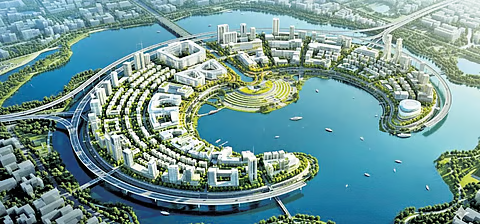
Context: The Telangana government issued detailed guidelines for the Musi Riverfront Development Project, emphasising that river rejuvenation should ensure minimal displacement and involve local residents as stakeholders.
More In News
- The project is planned in five phases covering nearly 55 km of the river stretch.
- Technical and financial discussions are currently underway for Phase-I, estimated at around ₹7,055 crore.
- The Cabinet sub-committee on Musi rejuvenation directed officials to begin construction work on the initial phase.
- The first phase covers a 5 km stretch within the larger 21 km corridor from:
- Himayatsagar to Bapughat,
- and Osmansagar to Bapughat.
- The government stressed that development activities should have minimal impact on residential settlements.
About Musi River
- The Musi River, also known as Muchukunda River or Musunuru River, is a major tributary of the Krishna River.
- It flows through the Telangana region of the Deccan Plateau.
- Historical Importance
- The river gained prominence in the late 16th century when Muhammad Quli Qutb Shah established the city of Hyderabad along its banks.
- Historically, the river divided the Old City and New City of Hyderabad.
- Origin: The Musi River originates from the Anantagiri Hills near Vikarabad district in Telangana.
- The Musi River ultimately joins the Krishna River near Wazirabad in Nalgonda district.
- Major Dams
- Himayat Sagar
- Osman Sagar
- Hussain Sagar Lake
- Hussain Sagar was constructed on a tributary of the Musi River.
- It was originally built to meet the:
- water needs,
- and irrigation requirements of Hyderabad city.
Narmada River
Brief Overview
- The Narmada River is the largest west-flowing river of Peninsular India.
- Among the major Peninsular rivers, only:
- Narmada, Tapti, and Mahi flow from east to west.
- It is one of the important rift valley rivers of India and acts as a geographical divider between North India and South India.
- The river was referred to as “Namade” by the 2nd-century Greek geographer Ptolemy.
- Total length of the river: 1,312 km
- It is the fifth longest river in India.
- The Tropic of Cancer passes through the upper plains region of the Narmada basin.
Course of River
- Origin
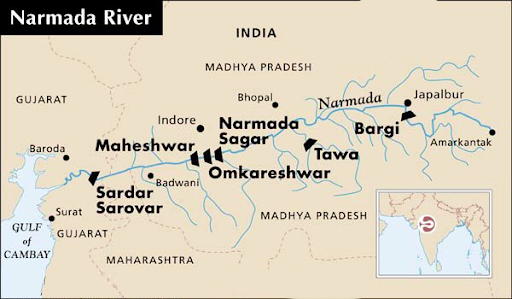
- The Narmada originates from Narmada Kund on the Amarkantak Hill in eastern Madhya Pradesh near the Chhattisgarh border.
- The source lies at an elevation of around 1,057 metres.
- The river flows through Madhya Pradesh, Maharashtra, and Gujarat.
- It flows between the:
- Vindhya Range in the north,
- and the Satpura Range in the south.
- Finally, it drains into the Gulf of Cambay (Khambhat) in the Arabian Sea near Bharuch in Gujarat.
Tributaries
- Major Tributaries
- Hallon River
- Banjar River
- Barna River
- Tawa River
- The Tawa River is the longest tributary of the Narmada.
Waterfalls and Major Dams
- Dhuandhar Falls
- The famous Dhuandhar Falls are located near Jabalpur.
- The waterfall is known for its mist-like appearance and marble rock formations.
- Major Dams on Narmada
- Sardar Sarovar Dam
- Indira Sagar Dam
- Omkareshwar Dam
- Bargi Dam
- Maheshwar Dam
Index Cards
Context
- The Election Commission of India released Index Cards and Statistical Reports for recent Assembly elections across five regions. The data was published through the official EC website and the ECINET digital application platform.
About Index Cards
- Index Cards are a non-statutory post-election statistical reporting format developed by the Election Commission of India.
- The initiative was introduced suo motu to improve accessibility of constituency-level electoral data for stakeholders and researchers.
- Data and Statistical Reports
- Index Cards provide data regarding candidates, electors, votes polled, vote share, and gender-based voting patterns.
- They form the basis for generating nearly 35 Lok Sabha and 14 Assembly election statistical reports.
- The reports include details regarding polling stations, voter turnout, women electors, and the performance of political parties.
- Digitalisation and Significance
- Earlier, election-related information was manually recorded through physical Index Cards using statutory reporting formats.
- The manual process was time-consuming and frequently delayed dissemination of statistical information.
- Digitalisation of Index Cards has improved transparency, efficiency, and timely accessibility of electoral data nationwide.
Tactical Advanced Range Augmentation (TARA) Weapon
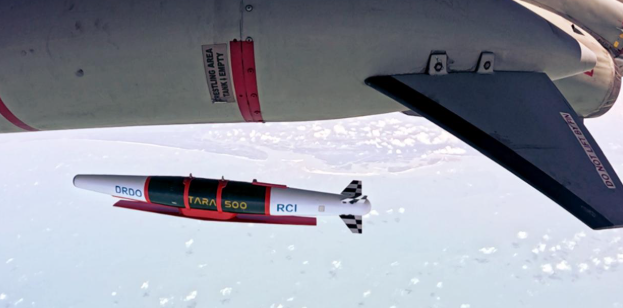
Context: The DRDO and the Indian Air Force (IAF) successfully conducted the maiden flight-trial of the TARA weapon off Odisha coast.
About the TARA Weapon
- TARA is a modular range extension kit and India’s first indigenous glide weapon system.
- The system converts existing unguided warheads into advanced precision-guided weapons.
- It has been developed by the Research Centre Imarat (RCI), Hyderabad.
- Objective
- TARA aims to provide a low-cost solution for improving accuracy and lethality of existing unguided munitions.
- The weapon is designed to neutralise ground-based targets with high precision and minimal collateral damage.
- Key Features
- TARA is India’s first fully indigenous glide-capable weapon system designed for traditional aerial bombs.
- The system features a modular design allowing integration with multiple types of unguided warheads.
- It uses advanced precision guidance systems for accurate targeting after aerial release.
- The weapon has been developed using low-cost technologies to enable large-scale operational deployment.
- As a glide weapon, TARA significantly enhances standoff strike range for combat aircraft.
- Significance
- TARA represents an important step towards Atmanirbhar Bharat in the defence manufacturing sector.
- The system reduces dependence on expensive imported precision-guided munitions for aerial strike operations.
- It substantially enhances the strike capability of the Indian Air Force using existing weapon stockpiles.
Rubber Plant
Brief Overview
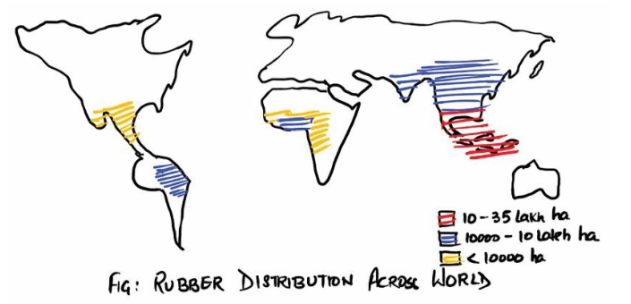
- Natural Rubber is native to the Amazon Basin and was introduced into Asia and Africa during the late 19th century.
- Rubber is primarily an equatorial crop, though it can also grow in tropical and subtropical climatic regions.
- The crop is obtained from the latex of Hevea brasiliensis, the most widely cultivated rubber species.
- Rubber is an important industrial raw material, extensively used in manufacturing automobile tyres and allied products.
- India and Global Position
- The first rubber plantations in India were established in Kerala in 1895.
- India is the third-largest producer and the fourth-largest consumer of natural rubber globally.
Requirements for Rubber Cultivation
- Climate and Rainfall
- Rubber cultivation requires a moist and humid climate throughout the growing season.
- The crop requires annual rainfall exceeding 200 cm for optimum productivity.
- Temperature and Elevation
- Rubber grows best in temperatures above 25°C with warm climatic conditions.
- Ideal cultivation occurs at elevations between 300–450 metres above sea level.
- Rubber yields decline at higher elevations due to lower temperatures and relatively immature soils.
- Soil Type
- The crop grows best in well-drained loamy soils rich in moisture and nutrients.
Major Producing Regions
- Kerala accounts for nearly 90% of India’s rubber production.
- Other important producing regions include:
- Tamil Nadu,
- Karnataka,
- Andaman and Nicobar Islands,
- Tripura,
- Garo Hills of Meghalaya.
Rubber Board of India
- The Rubber Board is a statutory body established under the Rubber Act, 1947.
- It functions under the administrative control of the Ministry of Commerce and Industry.
- Headquarters: Kottayam.
Cotton Cultivation in India
Brief Overview
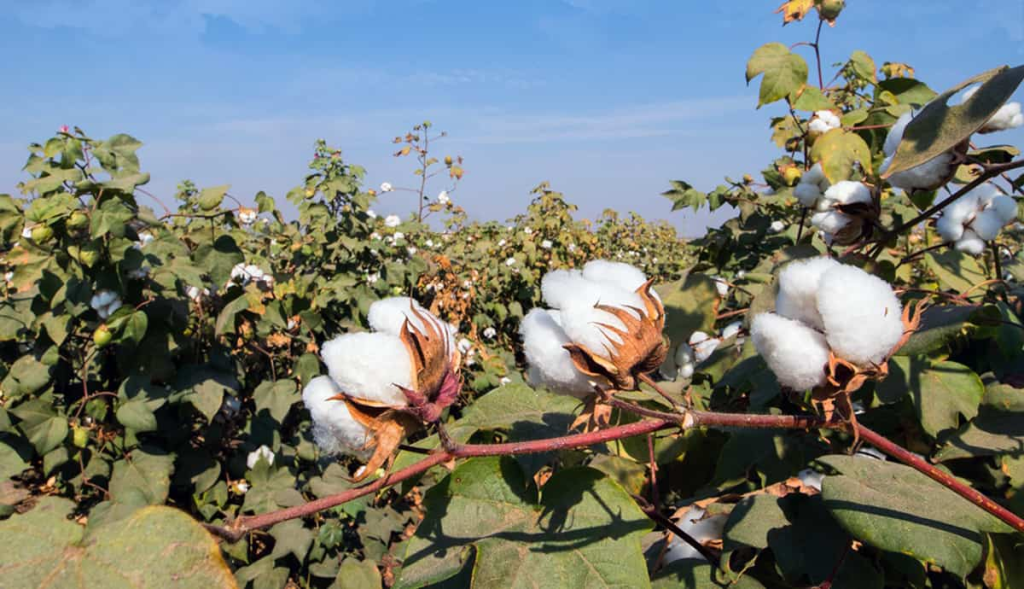
- India is the world’s largest cotton producer, followed by China and the United States.
- Cotton is an important commercial crop and forms the backbone of India’s textile industry.
- The Central Zone comprising Gujarat, Maharashtra, and Madhya Pradesh dominates India’s cotton production.
- India cultivates all four major cotton species:
- G. Arboreum
- G. Herbaceum
- G. Barbadense
- G. Hirsutum
Growing Conditions for Cotton
- Climate
- Cotton thrives in hot and sunny climates with long frost-free periods of nearly 210 days.
- The crop requires:
- high temperature,
- bright sunshine,
- light rainfall or irrigation support.
- Soil Types
- Cotton grows best in black cotton soils of the Deccan Plateau region.
- It is also cultivated in:
- deep alluvial soils of northern India,
- black clayey soils of central India,
- and mixed black-red soils in southern India.
- Sensitivity
- Cotton exhibits moderate tolerance towards soil salinity under suitable conditions.
- However, the crop is highly vulnerable to waterlogging and poor soil drainage.
- Growth Cycle
- Cotton is primarily cultivated as a Kharif crop in India.
- The crop generally requires 6–8 months to attain maturity.
B1 Bridge Strike in Iran
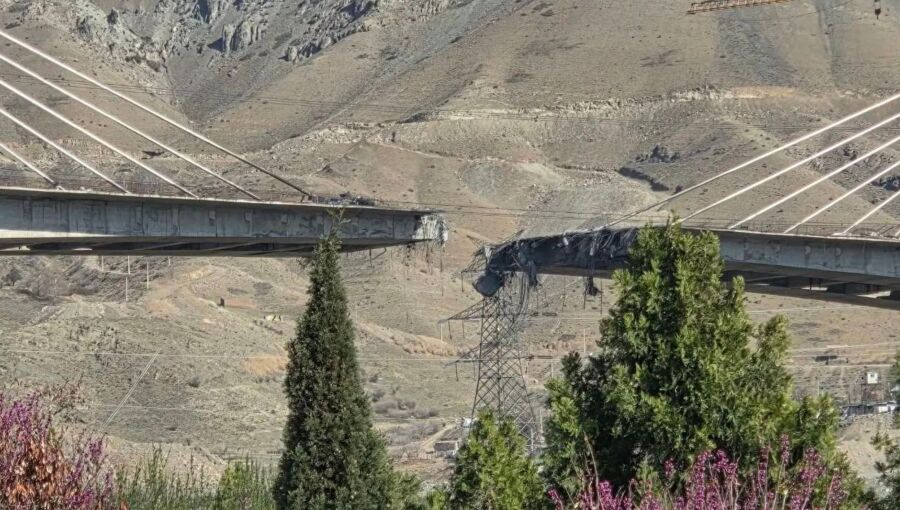
Context: The B1 Bridge in Karaj was struck during American-Israeli military strikes in April 2026. The bridge connected Karaj with Tehran and formed part of a major strategic transport corridor. Iranian authorities described the bridge as a symbol of national resistance and technological self-reliance.
Karaj and Karaj River
- Karaj
- Karaj is located nearly 35 km southwest of Tehran.
- It serves as Iran’s largest industrial suburb and an important transportation hub.
- Karaj lies at the foothills of the Alborz Mountains and connects Tehran with northern Iran.
- Karaj River
- The Karaj River is one of the major rivers of Iran’s central plateau.
- It originates in the Central Alborz Mountains north of Tehran and flows through Karaj city.
- The Amir Kabir Dam is constructed across the Karaj River for water supply, irrigation, and hydropower purposes.
About B1 Bridge
- The B1 Bridge, also known as Bilqan 1, is a cable-stayed bridge over the Karaj River.
- It forms part of the Northern Karaj Freeway project aimed at reducing congestion between Karaj and Tehran.
- The bridge was regarded as one of the tallest bridges in the Middle East/Persian Gulf region.
- It connected Tehran with northern regions through the strategically important Chalus Road corridor.
- The bridge was reportedly built largely using domestic Iranian technology and construction materials.
Qazvin and Tabriz
- Qazvin is an important city located northwest of Tehran. It serves as a major connectivity node linking Tehran with northwestern Iran and Central Asian trade routes.
- Tabriz is a major commercial and industrial city in northwestern Iran. The city has a predominantly Azeri population and strategic geopolitical importance near the Caucasus region.
Caspian Region
- The Caspian Region refers to areas surrounding the Caspian Sea.
- The Tehran–Karaj transport corridor connects Iran with the Caspian region and onward trade routes towards Russia and Central Asia.
- The region is strategically important for:
- energy resources,
- trade connectivity,
- and geopolitical influence.
Semaglutide
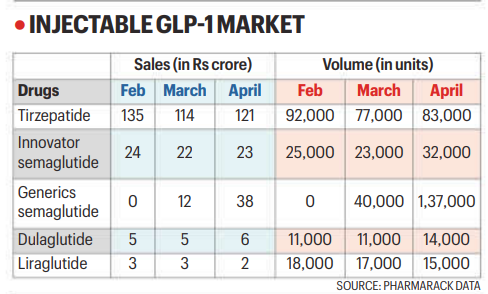
Context: The launch of generic Semaglutide formulations significantly increased sales of GLP-1 drugs in India.
About Semaglutide
- Semaglutide is a GLP-1 receptor agonist used primarily for:
- Type-2 Diabetes Mellitus
- and obesity management.
- It mimics the action of the GLP-1 hormone, which regulates blood sugar and appetite.
- The drug helps:
- increase insulin secretion,
- reduce glucagon levels,
- slow gastric emptying.
Mechanism of Action
- Semaglutide acts on GLP-1 receptors present in the pancreas and digestive system.
- It improves blood glucose control by enhancing insulin release after meals.
- The drug also suppresses appetite, contributing to weight reduction.
Medical Uses
- Type-2 Diabetes: Semaglutide is widely prescribed for management of Type-2 Diabetes Mellitus.
- Obesity Treatment: The drug is also approved in several countries for anti-obesity treatment and weight management.
Important Features
- Semaglutide belongs to the class of injectable GLP-1 drugs.
- It is considered effective in both:
- blood sugar regulation,
- body weight reduction.
- Generic versions have improved affordability and wider patient access.