

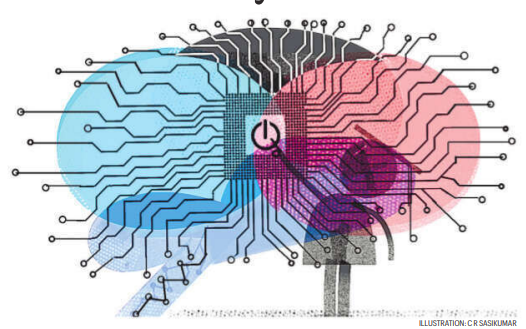
Context: Rapid advancements in Artificial Intelligence (AI) are transforming education systems, labour markets, and future skill requirements. The article argues that human success in the AI era will increasingly depend upon creativity, critical thinking, and ethical judgment rather than routine information recall.
Transformational Impact of Artificial Intelligence
- Changing Nature of Work
- AI is rapidly automating several routine, repetitive, and process-driven tasks across industries.
- Job roles increasingly demand higher-order abilities such as creativity, problem-solving, and collaborative thinking.
- Technological disruption is shortening skill cycles and continuously reshaping labour market expectations.
- AI as a Productivity Multiplier
- AI significantly enhances speed, efficiency, and analytical capacity within professional and institutional systems.
- Generative AI tools can process information, identify patterns, and accelerate routine decision-making processes.
- AI enables individuals and organisations to perform tasks previously requiring larger teams and institutional support.
- Democratisation of Access
- AI tools are expanding access to knowledge, information processing, and learning opportunities across sectors.
- Individuals from smaller institutions and resource-constrained backgrounds may increasingly access high-quality digital capabilities.
Limitations of Artificial Intelligence
- Absence of Human Judgment
- AI can generate answers rapidly, but cannot independently determine ethical priorities or social objectives.
- Human beings remain essential for deciding values, trade-offs, and long-term societal goals.
- Questions regarding justice, community welfare, and public good require human moral reasoning.
- Lack of Emotional and Social Intelligence
- AI lacks empathy, lived experiences, and contextual understanding required for sensitive social interactions.
- Human capacities such as compassion, leadership, and relationship-building remain difficult to automate fully.
- Accountability and Responsibility
- AI-generated decisions cannot independently bear responsibility for real-world social or political consequences.
- Human oversight remains essential to ensure transparency, accountability, and ethical governance of AI systems.
Need for Human-Centric Education
- Shift Beyond Rote Learning
- Traditional education models focused on memorisation are becoming increasingly inadequate in the AI-driven world.
- Educational systems should prioritise critical reasoning, creativity, and interdisciplinary learning.
- Students must learn how to analyse information rather than merely reproduce factual content.
- Importance of Curiosity and Exploration
- The article emphasises that curiosity and openness to learning will become major competitive advantages.
- Students should develop the ability to ask meaningful questions and explore problems independently.
- Lifelong learning will become essential within rapidly evolving technological and economic environments.
- Building Ethical and Civic Consciousness
- Education must nurture awareness regarding social responsibility, ethics, and democratic values.
- Students should understand how technology influences society, inequality, and human relationships.
- Humanistic education remains essential for balancing technological progress with societal well-being.
Emerging Skills Required in the AI Era
- Higher-Order Cognitive Skills
- Future economies will increasingly reward analytical thinking, intellectual humility, and structured problem-solving.
- Complex decision-making abilities will remain valuable despite technological automation.
- Communication and Collaboration
- Human interaction, teamwork, and effective communication will remain critical in organisational environments.
- Leadership in the AI era will require balancing technological understanding with interpersonal capabilities.
- Adaptability and Lifelong Learning
- Continuous technological change requires individuals to regularly update their knowledge and professional competencies.
- Adaptability will become a core determinant of employability and career resilience.
Challenges Associated with AI-Led Transformation
- Educational Inequality
- Unequal access to digital infrastructure may widen existing educational and socio-economic disparities.
- Students from marginalised backgrounds may face disadvantages in accessing AI-enabled learning opportunities.
- Workforce Displacement
- Automation may displace workers engaged in repetitive and low-skilled occupations across sectors.
- Labour market transitions could generate uncertainty, anxiety, and livelihood disruptions.
- Ethical and Governance Concerns
- AI systems may reproduce biases, misinformation, and opaque decision-making processes.
- Weak regulatory frameworks may increase risks related to surveillance, privacy, and algorithmic discrimination.
Way Forward
- Educational institutions should integrate critical thinking, ethics, creativity, and interdisciplinary learning within curricula.
- Governments should strengthen digital infrastructure and reduce inequalities in access to quality education.
- India should promote responsible AI governance frameworks balancing innovation with accountability and transparency.
- Universities should encourage research, innovation, and industry-academia collaboration in emerging technologies.
- Policymakers should focus on reskilling and upskilling programmes to support workforce transitions during technological disruption.
Conclusion
- The AI era will reward societies capable of combining technological advancement with human creativity and ethical wisdom. Sustainable progress will depend upon building education systems that strengthen both innovation and human-centric development.
