
VB-G RAM G
Context: The Union Government notified that the VB-G RAM G Act will come into force from July 1, 2026. All schemes, rules, and notifications under the MGNREGA, 2005 will stand repealed from the same date.
Key Features of the Act
- Enhanced Employment Guarantee
- The Act guarantees at least 125 days of wage employment annually for every rural household.
- The right to demand employment remains legally enforceable.
- Agriculture and Labour Balance
- States may notify a pause period of up to 60 days during peak sowing and harvesting seasons.
- The provision aims to prevent agricultural labour shortages while retaining the 125-day guarantee.
- Timely Wage Payments
- Wages must be paid:
- Weekly or within 15 days of work completion.
- Delayed payments will attract mandatory compensation provisions.
- Wages must be paid:
- Decentralised Planning
- Planning will originate through Viksit Gram Panchayat Plans (VGPPs) approved by Gram Sabhas.
- Panchayats will retain authority over identification of works, prioritisation, monitoring and social audits.
- Financial Architecture
- The programme will operate as a Centrally Sponsored Scheme.
- Funding pattern:
- 60:40 between Centre and States,
- 90:10 for North-Eastern and Himalayan States,
- 100% central funding for Union Territories without legislatures.
- Administrative Reforms
- Administrative expenditure ceiling has been increased from 6% to 9%.
- The increase aims to improve staffing, technical expertise and field-level supervision.
- Technology and Transparency
- The Act promotes use of biometric authentication, geo-tagging and real-time digital dashboards.
- Social audits by Gram Sabhas continue as an important accountability mechanism.
- Restoration of Unemployment Allowance
- Unemployment allowance becomes payable if employment is not provided within the stipulated period.
- The allowance will be payable after 15 days of failure to provide work.
Liberalised Remittance Scheme (LRS)

Context: Recent RBI data indicated a decline in foreign expenditure by Indian tourists during the last two financial years. The data showed that outward remittances increasingly originated from high-net-worth individuals (HNIs) investing in overseas assets. Total remittances under the Liberalised Remittance Scheme (LRS) reached nearly $26.4 billion during 2025–26.
About Liberalised Remittance Scheme (LRS)
- The Liberalised Remittance Scheme (LRS) operates under the provisions of the Foreign Exchange Management Act (FEMA), 1999.
- The scheme provides a regulated framework for outward remittances by resident individuals from India.
- LRS was introduced by the Reserve Bank of India on 4 February 2004.
- Remittance Limit
- Resident individuals are permitted to remit up to USD 250,000 during a single financial year.
- The limit applies to:
- current account transactions,
- capital account transactions,
- or a combination of both.
- Any remittance exceeding the prescribed limit requires prior approval from the Reserve Bank of India.
- Private visit remittances do not apply to Nepal and Bhutan.
- Eligible Persons Under LRS
- The scheme is applicable only to resident individuals, including minors.
- The provisions of LRS do not extend to:
- Corporates, partnership firms, Hindu Undivided Families (HUFs), or trusts.
- Transactions Not Permitted
- LRS does not permit remittances for purchase of lottery tickets, margin trading in overseas exchanges, or foreign exchange trading abroad.
- The scheme also prohibits remittances towards:
- purchase of FCCBs in overseas secondary markets,
- entities linked with terrorism,
- and jurisdictions identified by the Financial Action Task Force (FATF).
- Taxation Under LRS
- Tax Collected at Source (TCS) is applicable on remittances exceeding ₹7 lakh during a financial year.
- Presently, general remittances under LRS attract a 20% TCS rate under applicable provisions.
- Income generated from overseas investments remains taxable in India under prevailing taxation laws.
Solar Energy in India
Context: India added a record 44 GW solar capacity during 2025, increasing total installed capacity significantly. The Ministry of New and Renewable Energy credited PM Surya Ghar and PLI Scheme for rapid solar expansion.
India’s Solar Energy Profile
- India’s installed solar energy capacity stands at nearly 129 GW as of 2025.
- India has set a target of achieving nearly 292 GW solar capacity by 2030.
- India ranks third globally in solar energy deployment according to IRENA Renewable Energy Statistics 2025.
- India’s non-fossil fuel capacity crossed 259 GW, constituting over half of total installed electricity capacity.
Major Government Initiatives
- PM Surya Ghar Yojana
- The PM Surya Ghar Yojana aims to provide rooftop solar systems to one crore households nationwide.
- Nearly 24 lakh households adopted rooftop solar systems under the scheme by December 2025.
- National Solar Mission
- The National Solar Mission, launched in 2010, remains India’s flagship solar energy development programme.
- PLI Scheme for Solar PV
- The PLI Scheme promotes domestic manufacturing of high-efficiency solar photovoltaic (PV) modules.
- PM-KUSUM Scheme
- The PM-KUSUM Scheme promotes installation of standalone solar pumps and decentralised renewable energy infrastructure.
- Solar Parks Programme
- India approved 55 solar parks across 13 States with nearly 40,000 MW sanctioned capacity.
- International Solar Alliance (ISA)
- International Solar Alliance was jointly established by India, and France.
- The alliance promotes global cooperation and investment in solar energy development.
- One Sun, One World, One Grid (OSOWOG)
- The OSOWOG initiative aims to interconnect renewable energy grids across countries for efficient energy sharing.
International Big Cat Alliance (IBCA)
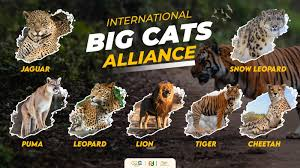
Brief Overview
- The International Big Cat Alliance is a multi-country conservation alliance focused on protection of big cats globally.
- The alliance includes:
- 95 big cat range countries,
- conservation organisations,
- scientific institutions,
- and corporate partners.
- The idea of IBCA was first proposed by Narendra Modi in 2019.
- IBCA was officially launched in April 2023 during the 50th anniversary celebrations of Project Tiger.
- The support period extends from 2023–24 to 2027–28.
- Big Cats Covered Under IBCA
- Tiger
- Lion
- Leopard
- Snow Leopard
- Cheetah
- Jaguar
- Puma
- The Indian subcontinent historically hosted:
- Bengal Tiger, Asiatic Lion, Indian Leopard, Asiatic Cheetah and Snow Leopard.
- The Cheetah was officially declared extinct in India in 1952.
Governing Structure
- IBCA will consist of:
- an Assembly of Members, a Standing Committee, and a Secretariat.
- The headquarters of IBCA will be located in India.
- The statute of IBCA will be finalised through an International Steering Committee.
Project Cheetah
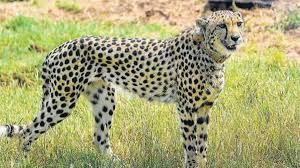
Context: Two female Cheetah brought from Botswana were released into the wild at Kuno National Park.
About Project Cheetah
- Project Cheetah was launched in 2022 under the broader framework of Project Tiger.
- The project aims to reintroduce cheetahs into India after their official extinction in 1952.
- It is regarded as the world’s first intercontinental wild carnivore translocation project.
- Governance Framework
- The National Tiger Conservation Authority functions as the primary implementing agency for the project.
- The project is implemented in coordination with:
- the Madhya Pradesh Forest Department,
- and the Wildlife Institute of India.
- A dedicated Steering Committee was constituted in 2023 for project supervision and monitoring.
Cheetah Habitats
- Kuno National Park presently serves as the principal habitat for translocated cheetahs.
- Gandhi Sagar Wildlife Sanctuary has also been identified as a major cheetah habitat.
- Nauradehi Wildlife Sanctuary has been selected for future expansion of the cheetah landscape.
About Cheetah
- Scientific name of cheetah is Acinonyx jubatus.
- Major subspecies include:
- African Cheetah (Acinonyx jubatus jubatus),
- and Asiatic Cheetah (Acinonyx jubatus venaticus).
- African Cheetah
- The African cheetah is distributed across several regions of the African continent.
- It possesses:
- slightly golden skin,
- and more prominent facial spots.
- IUCN conservation status of the African cheetah is Vulnerable.
- Asiatic Cheetah
- The Asiatic cheetah is currently found only in Iran.
- India officially declared the Asiatic cheetah extinct in 1952.
- IUCN conservation status of the Asiatic cheetah is Critically Endangered.
Gold Monetisation Scheme (GMS)

Brief Overview
- The Gold Monetisation Scheme (GMS) was launched in November 2015 by the Government of India.
- The scheme replaced the earlier:
- Gold Deposit Scheme (GDS),
- and Gold Metal Loan (GML) Scheme.
- It allows individuals and institutions to deposit idle gold with banks and earn interest.
Objectives of GMS
- The scheme aims to mobilise idle gold held by:
- Households, institutions, and government entities.
- It seeks to bring gold into the formal financial system.
- The scheme also aims to reduce:
- physical gold imports, and the Current Account Deficit (CAD).
Key Features of GMS
- Deposited gold may include:
- Jewellery, bars, and coins.
- Depositors can redeem deposits upon maturity in:
- Cash, gold bars, or coins.
- Redemption is not permitted in the original deposited form such as jewellery.
Types of Gold Deposits
| Type | Tenure | Key Purpose |
| Short-Term Gold Deposit (STGD) | 1–3 Years | Used by banks for domestic lending requirements |
| Medium-Term Gold Deposit (MTGD) | 5–7 Years | Utilised by government and RBI for reserves |
| Long-Term Gold Deposit (LTGD) | 7–12 Years | Used for monetary management and reserves |
