

Context:
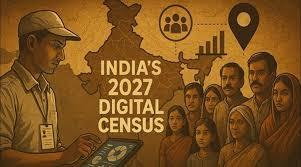
- India’s 2027 Census includes caste enumeration for the first time since Independence and will use digital data collection entirely.
- Its population figures will directly determine the next delimitation of Lok Sabha and state assembly constituencies.
Census Methodology
- India follows an extended de facto method i.e. people counted where they are physically present.
- Members absent but stayed at least one night during the 20-day enumeration period are included.
- A household includes all members sharing a common kitchen, regardless of whether they are related.
- Household help and paying guests sharing a common kitchen must be enumerated at that household.
- NRI dimension: India has 1.58 crore NRIs abroad i.e. over 1% of total population that is currently not counted.
- Kerala Migration Survey 2023 estimates 22 lakh Keralites abroad; exclusion may cost Kerala one Lok Sabha seat.
- States with significant NRI populations include Kerala, Gujarat, Punjab, Telangana and Tamil Nadu.
Opportunities Of Digital Census
- Entire data collection planned through mobile electronic devices and smartphones.
- Consistency checks during data collection lead to improved data quality and reduced errors.
- Saves significant time for computerisation and faster data processing nationally.
- Self-enumeration facility allows respondents to directly fill schedules via computer or smartphone.
- Enables real-time monitoring of enumeration progress across states and districts.
Challenges Associated
- Technological:
- Large proportion of enumerators are not smartphone-savvy as Karnataka caste survey revealed similar difficulties.
- Family members assisting enumerators may create accountability and data confidentiality issues.
- Risk of fraudulent enumerations in certain areas thus census cancellation in some areas in 2001 is a precedent.
- Questionnaire Complexity:
- Complex questions on disability, occupation and industry ran to multiple pages in 2011 Census.
- Respondent fatigue likely when detailed questions must be completed for every household member individually.
- Self-enumeration becomes unreliable unless questions are simplified with embedded explanations.
- Omission Risks:
- Distant relatives and domestic helpers face historically higher omission rates in past censuses.
- Self-enumeration worsens the risk of omitting such persons further.
- Children living in hostels may be incorrectly included in household enumeration by families.
- NRI Gap:
- No mechanism currently exists to enumerate NRIs, distorting delimitation outcomes for high-migration states.
Way Forward
- Pre-test an appropriately worded NRI question to capture non-residents for accurate delimitation.
- Retain paper schedule option with robust accountability mechanisms for non-smartphone-savvy enumerators.
- Simplify concepts and definitions — embed explanations within questions rather than separate instruction pages.
- Include structured follow-up questions to minimise omission of domestic helpers, distant relatives and hostel students.
- Develop a robust mechanism to detect and control data-entry errors across all enumeration modes.
- Ensure extensive field testing of all digital schedules before full-scale national deployment.
Conclusion
- The 2027 Census uniquely combines caste enumeration, digital collection and delimitation implications simultaneously. A credible Census is not merely a statistical exercise rather it is the foundation of India’s democratic and developmental governance.
