

Context:
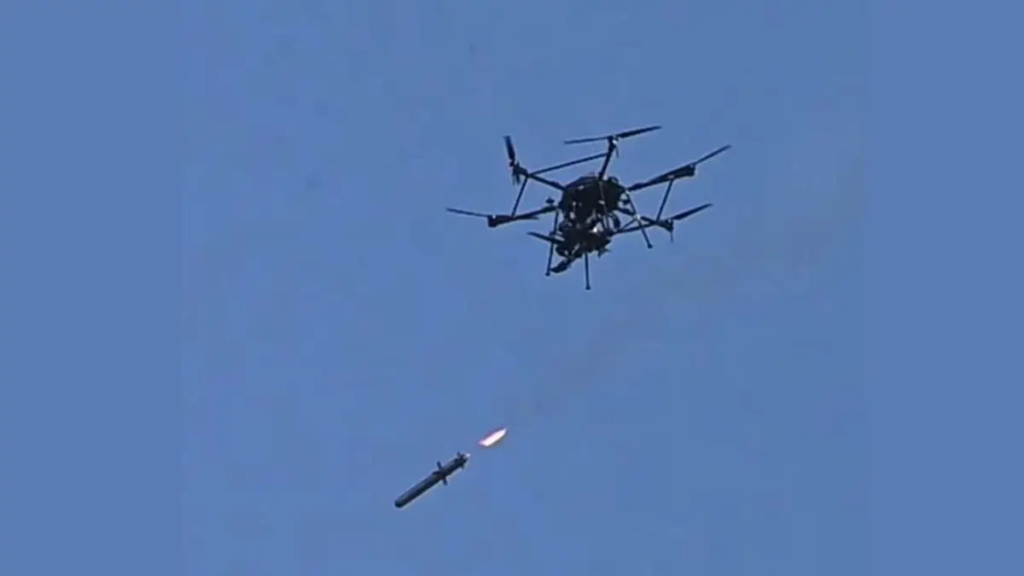
- Operation Sindoor (May 7-10, 2025) saw extensive use of small Unmanned Aerial Vehicles (UAVs) by both India and Pakistan. Drones have acquired an outsized image due to their small size, low cost and no-combatant-risk advantages.
- Fibre-optic-guided first-person-view drones used by Hezbollah against Israel have further added to the hype. The key question is whether drones have revolutionised warfare or merely evolved within existing domains.
Doctrinal Analysis
- Revolutionary technologies fundamentally reshape warfare by opening entirely new domains.
- The advent of air power was truly transformational as UAVs are merely an evolution within the air domain.
- Drones operate within a restricted airspace layer i.e. from ground up to the coordinating altitude separating conventional aircraft from UAVs.
- The concept of “air littoral” as a new warfare domain is misleading as drones are reshaping ground combat, not air warfare.
- Air superiority through manned systems remains as important as ever despite drone proliferation.
Strategic Implications
- Ukraine’s Operation Spider’s Web inserted drones in specially constructed containers deep inside Russia — destroying costly strategic air fleet assets.
- This points to a new requirement of strong counterintelligence to thwart long-term drone strategies at the planning stage.
- Drone warfare has shifted kinetic boundaries hundreds of kilometres inland — similar to a global cyberattack in reach.
- New requirement has emerged to protect interior assets on a 24×7 basis — not just frontline infrastructure.
- The U.S. has introduced laws restricting foreign land purchase near military bases and critical infrastructure.
- Integration of Artificial Intelligence will bring exponential increase in drone capabilities leading to fully autonomous operations.
- A UN committee is examining ethical and moral issues around allowing machines to make life-and-death decisions.
Counter-Uas (Cuas) Strategies
| System | Country | Key Feature |
| Iron Beam | Israel | Laser system — costs only $2-$3.50 per shot vs $40,000-$50,000 per missile |
| Iron Dome | Israel | Missile-based interception — high cost per engagement |
| Drone Wall | European Union | Layered mesh of detection and interception capabilities |
| Golden Dome | USA | Space-based and hypersonic interceptors for incoming projectiles |
| Sudarshan Chakra | India | Nationwide terrestrial and space-based system planned by 2035 |
- In Operation Sindoor, waves of Pakistani drones were neutralised by India’s integrated CUAS network.
- Drone swarms are multiple drones overwhelming air defence by sheer numbers are the next major challenge.
- Directed energy weapons like laser systems are the most promising and cost-effective counter-swarm solution.
Way Forward
- India’s Sudarshan Chakra system requires phase-wise operationalisation and committed long-term funding.
- New Delhi must urgently find financial resources to support its air defence modernisation over the next decade.
- India must invest in counterintelligence capabilities to detect drone-based long-range strategic threats early.
- Domestic drone manufacturing must be accelerated under Make in India for both offensive and defensive systems.
- India must engage actively with UN discussions on autonomous weapons and AI-driven warfare ethics.
Conclusion
- Drones are a significant but not revolutionary addition to the modern battlefield. They are reshaping ground combat tactics while the primacy of air superiority through manned systems remains unchanged. India must invest seriously in layered CUAS architecture, counterintelligence and AI integration to remain strategically prepared.
