

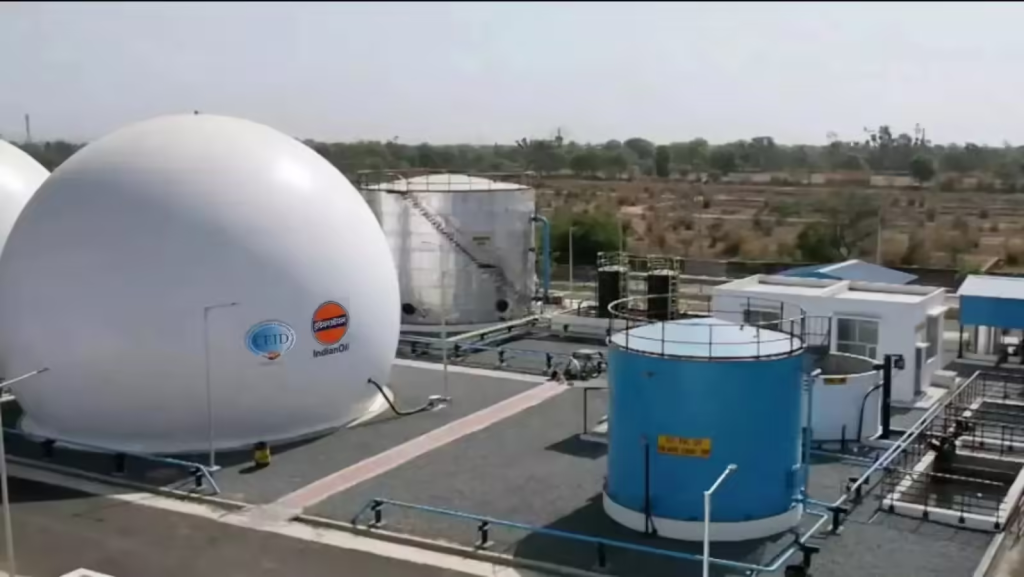
Context
- Global energy supply chains face uncertainty; fuel prices remain vulnerable to international disruptions. India generates enormous volumes of agricultural residue, food waste, sewage sludge and organic municipal waste annually. India produces nearly 750 million tonnes of agricultural biomass per year; around 230 million metric tonnes is surplus biomass.
Challenge With Raw Biomass
- Unlike conventional fuels, biomass is highly inconsistent in nature.
- Moisture levels, density and ash content vary significantly across feedstocks.
- This affects combustion efficiency, transport economics, emissions performance and industrial reliability.
- Most energy systems require stable and predictable fuel inputs which raw biomass cannot provide.
- Hence the focus shifts to technologies that convert waste into cleaner and energy-efficient forms.
Key Technologies
- Gasification:
- Effective for dry biomass such as crop residue, husk, woody waste and solid organic materials.
- Inside a gasifier, feedstock undergoes drying, pyrolysis, partial oxidation and reduction at 800-1,000°C.
- Produces syngas i.e. a mix of carbon monoxide, hydrogen, carbon dioxide and methane.
- Syngas can be used for heat, power or upgraded into renewable methane, methanol, ethanol and hydrogen.
- Also produces biochar i.e. a carbon-rich material improving soil quality and enabling carbon credit opportunities.
- Anaerobic Digestion:
- Suited for wet organic waste such as sewage, food waste, animal manure and industrial organic streams.
- Microorganisms break down waste in absence of oxygen to produce biogas (mainly methane and CO₂).
- Also produces nutrient-rich digestate usable as a soil amendment.
- Relevant across urban waste systems, dairy clusters, food processing units and rural communities.
- Requires continuous and consistent feedstock supply for long-term operational efficiency.
Integrated And Decentralised Approach
- Gasifiers handle dry waste; anaerobic digestion handles wet waste — together they create a complete solution.
- Forcing wrong feedstock into wrong technology reduces efficiency and increases operational challenges.
- India needs smaller distributed systems supporting rural industries, agro-processing clusters and MSMEs.
- Localised systems convert local waste into local energy, lowering fuel costs and improving waste management.
- Transporting biomass over long distances is economically inefficient — decentralisation is the logical solution.
Policy And Government Initiatives
- SATAT (Sustainable Alternative Towards Affordable Transportation) Scheme demonstrates how biomass converts into compressed biogas (CBG) replacing natural gas across applications.
- Bioenergy is a broader umbrella of technologies, each serving different end uses based on feedstock and energy needs.
- Waste segregation at source is essential — without it, neither gasification nor anaerobic digestion achieves full potential.
- Stronger carbon markets and long-term regulatory clarity are essential to attract investor commitment at scale.
- Decentralised infrastructure development and policy certainty must go together for ecosystem scaling.
Way Forward
- India must build efficient systems converting waste into reliable and commercially viable energy solutions at scale.
- Match the right feedstock with the right technology for maximum efficiency and minimum waste.
- Strengthen carbon credit markets to incentivise biochar production and carbon sequestration.
- Ensure inter-ministerial coordination between energy, agriculture and waste management ministries.
- Scale up SATAT scheme and similar initiatives for compressed biogas production nationwide.
- Invest in policy ecosystems enabling decentralised bioenergy infrastructure across rural and semi-urban India.
Conclusion
- India’s energy future cannot rely only on imported fuels and conventional energy systems. The country already possesses a large and underutilised resource base in the form of waste streams. Building the right technologies, infrastructure and policy ecosystems is the defining challenge ahead.
