

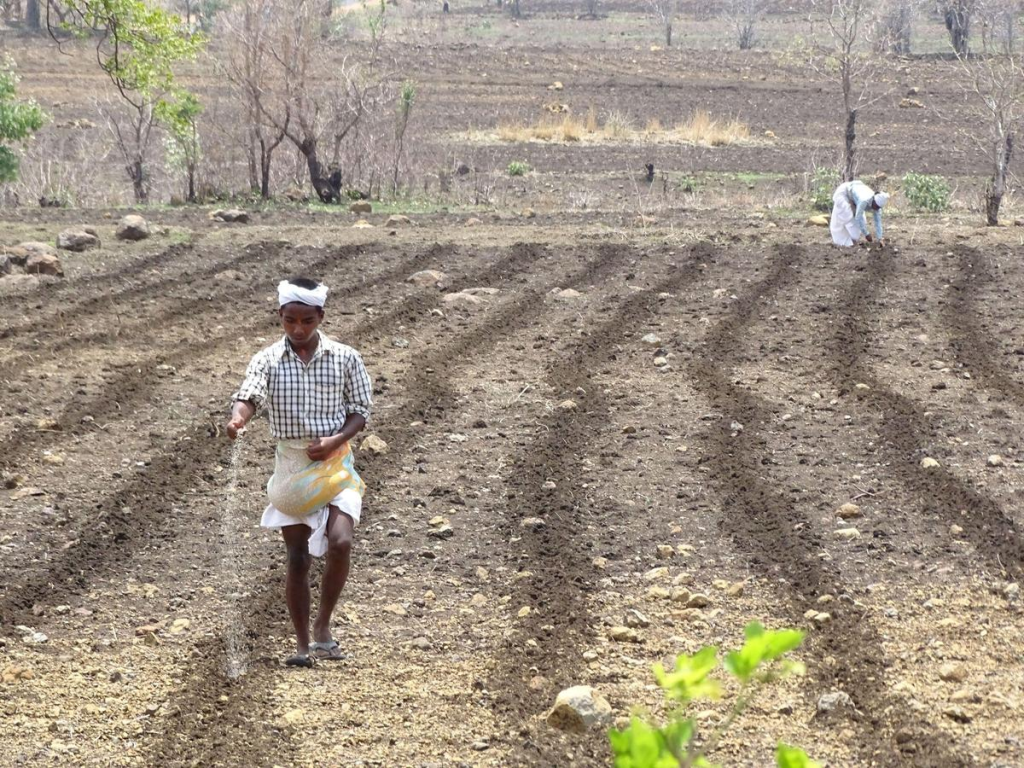
Context
- Rising costs of fuel and fertilizers due to West Asia war create an opportunity to enhance efficiency. India produces 80% of urea domestically and imports the rest; aiming for full self-reliance. However, over two-thirds of ₹2 lakh crore annual fertilizer subsidy is lost to pollution, not harvested as food.
The Fertilizer Trap
- Inefficient and excessive fertilizer use damages soil, water, air, human health and biodiversity.
- Excess fertilizers deplete soil organic matter and water-holding capacity, threatening crop yields.
- This pushes farmers to add more fertilizers, creating a self-reinforcing trap.
- India’s national fertilizer demand never saturates even as supply has increased over decades.
- Most urea is lost as ammonia to air pollution; most phosphatic fertilizers are lost to water pollution.
Policy Failures And Gaps
- Nutrient-based subsidy did not improve efficiencies as urea was excluded from the scheme.
- Neem-coated urea was meant to improve nitrogen-use efficiency but could not prevent ammonia losses.
- PM Modi’s 2017 Mann ki Baat call to halve fertilizer usage within five years — consumption only increased.
- Failure due to lack of inter-ministerial and interdepartmental coordination in addressing farming systems.
- Government announces MSP for over 20 crops but actual procurement is limited to rice, wheat and sugarcane.
- These three crops consume over two-thirds of all urea in India, destroying traditional crop rotations.
Role Of Pulses And Crop Rotation
- Pulse-cereal rotations sustained agriculture for thousands of years before fertilizers were invented.
- Pulses fix atmospheric nitrogen and need no urea or only 10% of urea used for cereals.
- Legumes are ideal for rain-fed areas facing deficit monsoons.
- Dalhan Aatmanirbharta Mission (October 2025): promised 100% procurement of Tur, Urad and Masoor at MSP for four years.
- Allocated ₹11,440 crore to scale up pulse production to 350 lakh tonnes per year in five years.
- However, area under pulse cultivation grew only 1.26% in April 2026 — negligible against a 10% fall between 2021-22 and 2024-25.
Way Forward
- Triple the recycling of manure, compost and biochar to replace fertilizers and boost soil health.
- Organics must form the basal dose; fertilizers used only as top-up after exhausting local organic sources.
- Coordinated crop trials show up to half of recommended fertilizer doses can be replaced with manure or biochar without yield loss.
- India’s rice germplasm has potential to double nitrogen-use efficiency in terms of grain yield per unit urea.
- Government must incentivise pulse and legume-based crop rotations and multicropping systems.
- Revive the Interministerial National Nitrogen Steering Committee whose tenure expired before recommendations were implemented.
- Investment needed in affordable improved crop varieties — not capital-intensive technologies — for farmer adoption.
Conclusion
- India must move decisively beyond supply-side management toward demand moderation through efficiency. Addressing the fertilizer trap requires integrated farming systems approach with strong inter-ministerial coordination. Food security, fiscal sustainability and environmental health all depend on breaking India’s fertilizer dependence urgently.
