


Context
- Rising geopolitical tensions in West Asia are exposing India’s economic vulnerabilities, especially due to high energy import dependence.
- As of March 2026, the rupee depreciated to ₹95 per dollar, reflecting rising external pressures.
- The Indian crude oil basket reached $156.29 per barrel, increasing inflationary and fiscal stress.
- Foreign exchange reserves declined to $709.76 billion, with over $8 billion FPI outflows intensifying currency volatility.
- Despite these pressures, India’s GDP growth remains strong at around 8.1% (Q3 FY26), reflecting a macroeconomic divergence.
Structural Vulnerabilities in India’s Fiscal and Revenue System
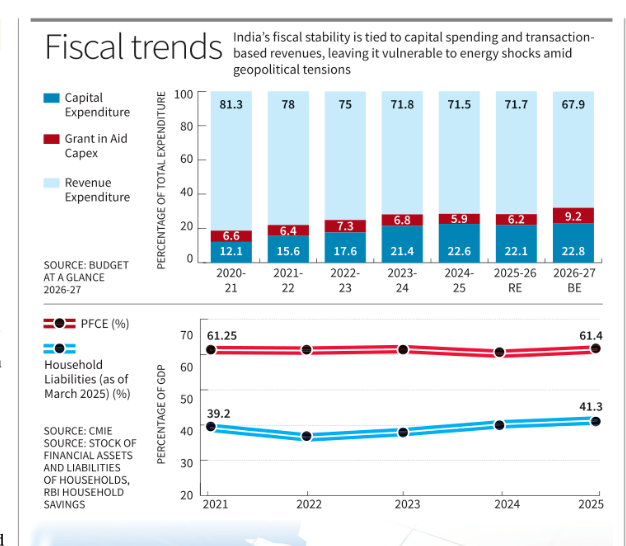
- Shift in Revenue Structure
- Revenue receipts increased from 8.5% of GDP (FY16–20) to 9.1% (FY22–25), driven mainly by structural recomposition.
- GST collections reached ₹22.8 lakh crore (FY25), indicating growing reliance on transaction-based taxation.
- Direct tax growth remains limited due to slower expansion of stable formal employment.
- This makes fiscal stability dependent on economic activity levels, which are vulnerable to external shocks.
- Exposure to Oil Price Volatility
- India imports around 85–87% of crude oil, creating structural dependence on global markets.
- A $10 increase in crude prices can:
- Raise inflation by 0.2 percentage points
- Widen current account deficit by $9–10 billion
- Reduce GDP growth by 0.5 percentage points
- Oil shocks increase subsidy burdens and compress fiscal space through higher LPG, fertiliser, and transport costs.
Transmission of External Shocks to Domestic Economy
- Impact on Fiscal System
- Excise duty cuts during past oil shocks caused revenue losses of about ₹2.2 lakh crore.
- Energy subsidies increased sharply, reaching nearly ₹3.2 lakh crore during crisis periods.
- If oil averages $100 per barrel, fiscal expenditure may rise by ₹3.6 trillion, widening deficits.
- Impact on Households
- Private consumption constitutes 61.4% of GDP, making households central to economic stability.
- Household liabilities increased to over 41% of GDP (2025), indicating rising dependence on credit.
- Net financial savings fluctuated between 3–7.6% of GDP, reflecting economic uncertainty.
- LPG supply disruptions, with over 60% import dependence, increased household energy costs.
- Rising inflation compresses real incomes, especially in a low-wage environment, increasing financial stress.
- Impact on Industrial Sector
- Industrial output grew by 7.8% (December 2025), driven by capital-intensive sectors.
- High- and medium-tech industries account for 46% of manufacturing value added.
- Labour-intensive sectors remain weak, with limited employment generation and wage growth.
- Only 9% of private projects were completed in 2022–23, reflecting cautious investment behaviour.
- LPG shortages led to closure of small businesses, with 50–60% decline in food delivery orders.
Way Forward
- Rebalance growth strategy towards income-led demand, ensuring stronger wage growth and consumption stability.
- Strengthen fiscal resilience by diversifying revenue beyond transaction-based taxation.
- Accelerate energy diversification, reducing dependence on imported fossil fuels.
- Maintain balance between capital expenditure and social welfare spending to protect vulnerable groups.
- Enhance policy flexibility to respond effectively to geopolitical and commodity shocks.
Conclusion
- India’s strong growth indicators coexist with underlying structural vulnerabilities exposed during global shocks. Building resilience requires a shift towards balanced growth, energy security, and inclusive fiscal frameworks.
