


Introduction: India’s Zero Tolerance Policy
- India has faced terrorism for several decades, particularly from across its borders. Terrorism in the region has often been supported by state-sponsored elements. India does not associate terrorism with any religion, nationality or civilization.
- The country follows a policy of “Zero Tolerance” against terrorism. India firmly believes that no justification exists for violence in any form. This principled approach guides India’s counter-terrorism strategy called “PRAHAAR.”
India’s Threat Profile
- Cross-Border & Global Terrorism
- India faces sponsored terrorism from across the border, particularly in Punjab and Jammu & Kashmir.
- Global terror outfits like Al-Qaeda and ISIS have attempted to radicalize Indian youth.
- Sleeper cells and foreign handlers coordinate terror activities inside India.
- Technology-Driven Terror
- Terror groups misuse drones, robotics, encryption, dark web and crypto wallets.
- Social media and instant messaging apps are used for recruitment and propaganda.
- Threat of CBRNED misuse remains serious.
- C – Chemical
- B – Biological
- R – Radiological
- N – Nuclear
- E – Explosive
- D – Digital
- It represents a spectrum of high-impact, low-probability but catastrophic threats.
- Crime-Terror Nexus
- Terror groups increasingly collaborate with organized criminal networks.
- Illegal arms syndicates are linked with terrorist outfits.
Core Pillars of India’s Counter-Terror Strategy (PRAHAAR)
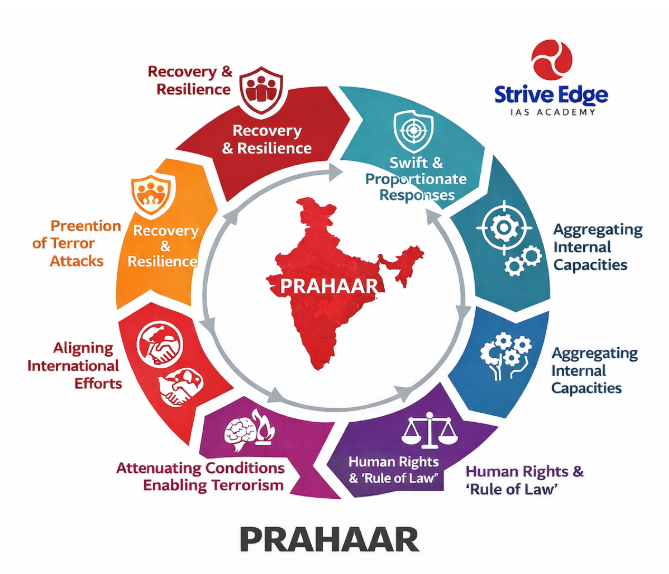
- Prevention: Intelligence-Led Approach
- India follows a proactive and intelligence-guided model.
- The Multi Agency Centre (MAC) and Joint Task Force on Intelligence (JTFI) ensure real-time sharing.
- Close coordination exists between Central Agencies and State Police Forces.
- Online radicalization is disrupted through cyber monitoring and network dismantling.
- Over Ground Workers (OGWs) providing logistics and funding are regularly neutralized.
- Terror funding is disrupted through strong legal mechanisms.
- Border & Infrastructure Protection
- Security forces guard threats across water, land and air.
- Borders are secured using state-of-the-art surveillance technology.
- Critical sectors like power, railways, aviation, ports, defence, space and atomic energy are protected.
- Response Mechanism
- The local police acts as the first responder in terror incidents.
- States have established specialized Anti-Terrorism Squads (ATS).
- The National Security Guard (NSG) provides assistance during major attacks.
- The Ministry of Home Affairs has issued a Standard Operating Procedure (SOP) for coordination.
- Central Armed Police Forces (CAPFs) support law and order and CT operations.
- The National Investigation Agency (NIA) ensures professional investigation and prosecution.
- Aggregating Capacities
- Continuous modernization of security forces is undertaken.
- Advanced tools, weapons and technologies are regularly procured.
- Training institutions are upgraded to meet evolving threats.
- The Bureau of Police Research & Development (BPR&D) conducts regular training.
- NSG provides specialized urban combat training.
- Efforts are ongoing to ensure uniform anti-terror structures across States.
- Human Rights and Rule of Law
- Counter-terror operations follow the Rule of Law and constitutional safeguards.
- The Protection of Human Rights Act, 1993 ensures accountability.
- India adheres to the Universal Declaration of Human Rights (1948).
- The Unlawful Activities (Prevention) Act, 1967 (UAPA) is the primary anti-terror law.
- The above laws are supplemented by
- Bharatiya Nyaya Sanhita 2023,
- Bharatiya Nagarik Suraksha Sanhita 2023,
- Bharatiya Sakshya Adhiniyam 2023, and others.
- Thus India balances security with civil liberties.
- Countering Radicalization
- Radicalized youth undergo a graded police response mechanism.
- Community leaders, NGOs and religious figures spread awareness.
- De-radicalization programmes are conducted in prisons.
- Youth are engaged through education, employment and empowerment schemes.
- Poverty and unemployment are addressed to remove enabling conditions.
- International Cooperation
- Terrorism has a transnational character requiring global coordination. India has signed Extradition Treaties and MoUs with many countries.
- Agency-to-agency intelligence sharing strengthens investigations.
- India works actively in global forums for designation of terrorists at the UN.
- India advocates for a Comprehensive Convention on International Terrorism (CCIT).
- Recovery & Resilience (Whole-of-Society Approach)
- Public-private partnerships assist in post-attack recovery. Further the psychologists, doctors and civil society assist affected communities.
- Civil administration leads reconstruction efforts.
- Police strengthen preventive measures to restore confidence.
- Community resilience is considered essential for long-term stability.
Way Forward
- Greater inter-agency coordination is required for intelligence and investigation.
- Anti-terror laws must be periodically updated for emerging threats.
- Uniform training, structure and resources for State Anti Terrorism Squad units are necessary.
- Legal experts must be involved from FIR stage to prosecution.
- Strong international cooperation is essential against global terror networks.
- Technology investment and private sector partnerships must address futuristic threats.
