
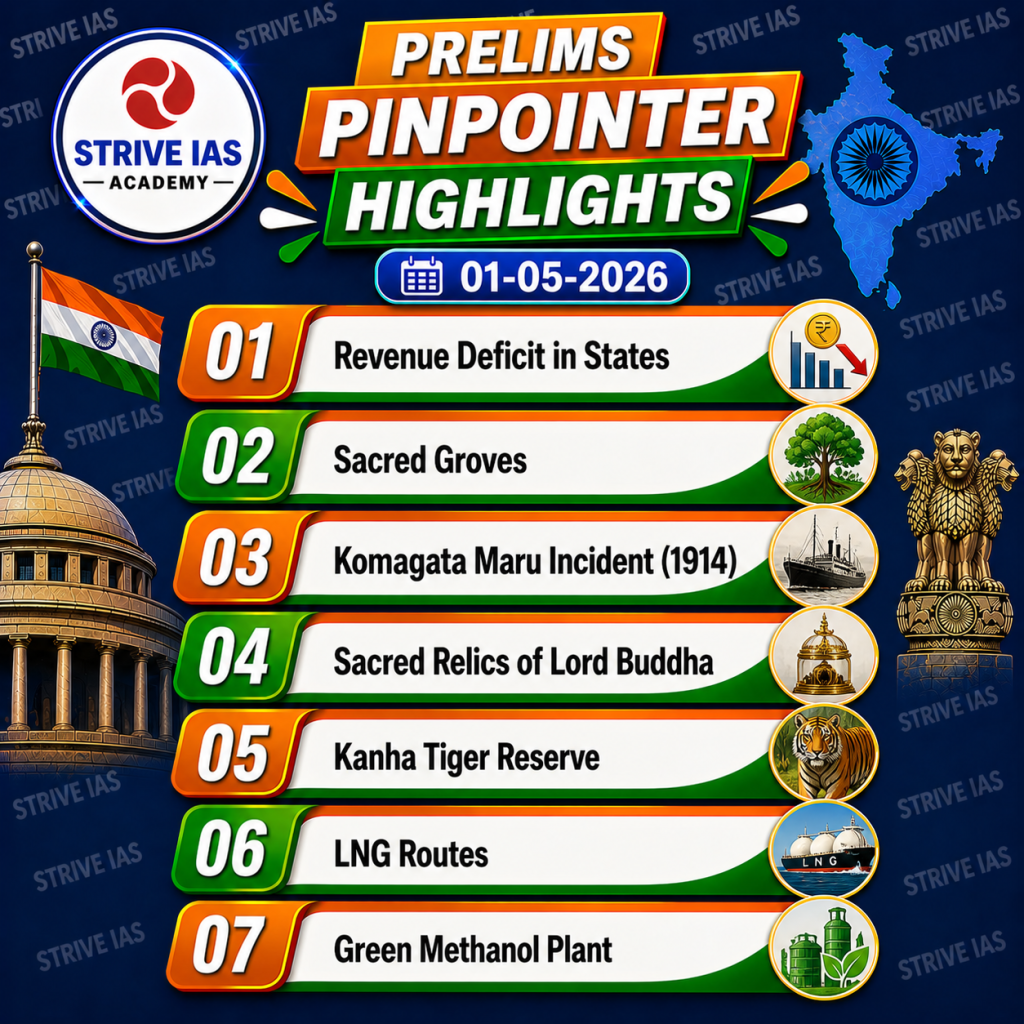
Revenue Deficit in States

Context: The Union Finance Ministry warned that States with revenue deficits and high debt may face fiscal stress, especially amid global uncertainties like the West Asia crisis.
More in News
- As per projections for 2026-27, 9 out of 18 major States are expected to run revenue deficits.
- States like Punjab, Kerala, Himachal Pradesh, Andhra Pradesh, and Maharashtra show notable deficits.
- Revenue-deficit States spend a significant share (>15%) of revenue receipts on interest payments.
- Punjab has the highest projected interest burden (~22.8% of revenue receipts).
- Revenue-surplus States include Odisha, Jharkhand, Uttar Pradesh, and Gujarat, indicating relatively better fiscal health.
About Revenue Deficit
- Revenue deficit arises when government’s revenue expenditure exceeds its revenue receipts.
- Formula: Revenue Deficit = Revenue Expenditure – Revenue Receipts
- Key Features
- Indicates inability to meet routine expenses from regular income.
- Reflects poor fiscal discipline and quality of expenditure.
- Implies borrowing for consumption rather than asset creation.
- Components of Revenue Expenditure
- Salaries
- Pensions
- Subsidies
- Interest payments
Effective Revenue Deficit
- Refers to revenue deficit minus grants for capital asset creation.
- Formula: Effective Revenue Deficit = Revenue Deficit – Grants for Capital Assets
- Significance
- Provides clearer picture of actual fiscal burden.
- Distinguishes productive expenditure from pure consumption.
- Improves transparency in fiscal analysis.
Sacred Groves

Context: The Kerala State Biodiversity Board has initiated a pilot project to restore sacred groves in collaboration with local Biodiversity Management Committees. The initiative aims to revive ecologically degraded sacred groves amid rising developmental pressures.
More in News
- Five sacred groves were selected across Ernakulam, Palakkad, Kozhikode, Kannur, and Kasaragod for the pilot phase.
- Project includes biodiversity assessment and identification of endangered and invasive species.
- Establishment of “kavu nurseries” to propagate native sacred grove plant species.
- Activities include bio-fencing, removal of invasive species and plastic waste, and pond rejuvenation.
- Nearly 3,000 saplings of native and threatened species to be planted for ecological restoration.
About Sacred Groves
- Sacred groves are patches of natural vegetation preserved due to religious and cultural beliefs.
- Often dedicated to local deities, they function as ecological sanctuaries and cultural landscapes.
- Ecological Significance
- Act as repositories of biodiversity, conserving rare, endemic, and medicinal species.
- Support soil conservation, groundwater recharge, and micro-climatic stability.
- Serve as gene banks for native plant diversity.
- Community Practices
- Hunting and tree felling are traditionally prohibited.
- Limited sustainable use allowed, such as collection of honey or fallen wood.
- Regional Names
- Kavu / Sarpa Kavu: Kerala
- Devrai / Deorai: Maharashtra
- Sarna: Bihar
- Dev Van: Himachal Pradesh
- Devarakadu: Karnataka
- Law Kyntang / Asong Khosi: Meghalaya
- Oran: Rajasthan
Komagata Maru Incident (1914)

Overview
- In 1914, the ship Komagata Maru carried 376 Indian passengers (majority Punjabis) to Canada.
- Canadian authorities denied entry under the “Continuous Journey Regulation” (1908).
- After a two-month standoff, only 22 passengers were allowed to disembark.
- On return to India, British authorities fired upon passengers near Calcutta (Budge Budge), killing around 20 people.
- Komagata Maru Incident: Key Facts
- Ship chartered by Gurdit Singh to challenge discriminatory immigration laws.
- Passengers were British subjects, yet denied entry thus exposing racial discrimination within the Empire.
- Incident symbolised failure of imperial promises of equality.
About Ghadar Movement
- Founded in 1913 in San Francisco (USA) by Indian expatriates.
- Objective: Overthrow British rule through armed revolution.
- Key Leaders
- Lala Har Dayal
- Baba Sohan Singh Bhakna
- Features of Ghadar Movement
- Strong base among Punjabi immigrants, especially in North America.
- Promoted secular nationalism and anti-colonial unity.
- Used propaganda, publications, and revolutionary mobilisation.
- Activities of Ghadar Movement
- Published weekly newspaper “Ghadar” (Urdu & Gurmukhi).
- Attempted to incite armed revolt during World War I (1915 Ghadar Mutiny).
- Encouraged Indian soldiers to revolt against British rule.
- Involved in propaganda campaigns among Indian diaspora.
Sacred Relics of Lord Buddha

What are Sacred Relics?
- Sacred relics are physical remains or objects associated with Lord Buddha, preserved for veneration.
- They serve as symbols of enlightenment, spiritual continuity, and devotional focus.
- Preserved and curated by the National Museum of India.
- Supported by:
- Ministry of Culture
- International Buddhist Confederation
Types of Buddha Relics
- Saririka Relics (Physical Remains)
- Includes bones, ashes, teeth of Buddha.
- Paribhogika Relics (Use Objects)
- Items used by Buddha such as:
- Robe
- Alms bowl
- Walking stick
- Items used by Buddha such as:
- Uddesika Relics (Symbolic Representations)
- Includes stupas, statues, and symbolic images representing Buddha.
Important Relic Sites
- Mahabodhi Temple: Site of enlightenment.
- Kapilavastu Relics (Piprahwa, Uttar Pradesh): Linked to Buddha’s Shakya lineage.
- Temple of the Sacred Tooth Relic: Houses Buddha’s tooth relic.
- Sarnath: Site of first sermon (Dhammacakkappavattana).
Kanha Tiger Reserve

Context
- Recent cub deaths in Kanha Tiger Reserve have raised concerns regarding effectiveness of tiger monitoring systems.
About Kanha Tiger Reserve
- The Kanha Tiger Reserve is located in the Maikal ranges of the Satpura Hills.
- Situated in Madhya Pradesh, it is one of India’s premier tiger conservation landscapes.
- Connectivity
- Forms an active wildlife corridor with Pench Tiger Reserve.
- Also connected to Achanakmar Tiger Reserve (Chhattisgarh).
- Physiography & Terrain
- Characterised by:
- Shallow undulating landscapes
- Hills and plateaus
- Valleys and grasslands
- Characterised by:
- Vegetation
- Dominated by moist Sal forests and mixed deciduous forests.
- Major Flora: Sal, Bamboo, Tendu, Jamun, Arjun, Lendia
- Fauna
- Royal Bengal Tiger
- Leopard
- Sloth bear
- Indian wild dog (Dhole)
- Tribal Presence: Inhabited by indigenous communities such as Gond and Baiga
LNG Routes

Context
- An LNG carrier from Dahej (India) is moving through the Strait of Hormuz towards Das Island (UAE), signalling gradual normalisation of shipping activity.
Key Locations in News
- Strait of Hormuz
- The Strait of Hormuz is a narrow waterway connecting:
- Persian Gulf → Gulf of Oman → Arabian Sea
- Bounded by:
- Iran (north)
- Oman & UAE (south)
- The Strait of Hormuz is a narrow waterway connecting:
- Dahej (India)
- Dahej is located in Gujarat on the Gulf of Khambhat.
- Major LNG import terminal of India.
- Das Island (UAE)
- Das Island is located in the Persian Gulf.
- Operated by ADNOC (Abu Dhabi).
- LNG production capacity: ~6 million tonnes per annum.
- Persian Gulf
- Inland sea bordered by: Iran, Iraq, Kuwait, Saudi Arabia, Bahrain, Qatar, UAE, Oman
- Major global hub for oil and natural gas reserves.
- Nagoya (Japan)
- A major port city in Japan, located on the Pacific coast (Honshu Island).
- Important Maritime Route
- Das Island (UAE) → Persian Gulf → Strait of Hormuz → Gulf of Oman → Arabian Sea → Indian Coast (Dahej/Mumbai)
Green Methanol Plant

Context
- India is setting up its first green methanol plant in Kandla (Gujarat) using an invasive species, Prosopis juliflora, as feedstock.
- The initiative reflects a convergence of biodiversity management and clean fuel transition.
More in News
- The plant will be located at Deendayal Port Authority (Kandla, Gujarat) and produce ~5 tonnes methanol per day.
- Prosopis juliflora, an invasive shrub in Kutch’s Banni grasslands, will be utilised as biomass feedstock.
- The project supports India’s policy of developing “green ports” along the western coast.
- Green methanol is being promoted as a marine fuel alternative to bunker oil under global shipping norms.
- The production process involves gasification to produce syngas, followed by conversion into methanol.
About Green Methanol
- Green methanol is produced from renewable biomass sources (agricultural residues, wood, etc.).
- Unlike conventional methanol, it does not rely on fossil fuels (coal or natural gas).
- Environmental Benefits
- Reduces CO₂ emissions by up to ~95%.
- Cuts NOx emissions by up to ~80%.
- Eliminates sulphur oxides and particulate matter.
- Key Process: Gasification
- Gasification converts biomass into syngas (mixture of hydrogen, CO, CO₂).
- Occurs under limited oxygen conditions (between combustion and pyrolysis).
- Syngas is further processed to produce methanol fuel.
About Prosopis juliflora
- A Mexican-origin invasive species introduced in India during:
- British period (1920s)
- Gujarat (1961) for desert control
- Key Features
- Highly invasive, outcompetes native grasses.
- Widely spread in Banni grasslands (Kutch, Gujarat).
- Known locally as:
- Gando Baval (Gujarat)
- Vilayati Keekar (North India)
- Seemai Karuvelam (Tamil Nadu)
