

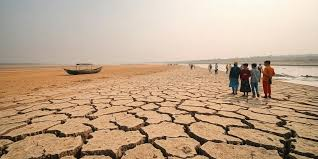
Context: The IMD’s April 2026 forecast indicates a likely below-normal monsoon, with uneven rainfall distribution across regions. This warning comes amid climate variability driven by ENSO (El Niño Southern Oscillation) and highlights India’s deepening water stress crisis.
Climatic Drivers and Monsoon Uncertainty
- El Niño Effect: Typically weakens the Indian monsoon by altering atmospheric circulation, leading to reduced rainfall.
- Indian Ocean Dipole (IOD): May partially offset El Niño, but its effect is limited and region-specific.
- Super El Niño Phenomenon: Increasing frequency and intensity signal greater volatility in rainfall patterns.
- Changing Rainfall Pattern:
- Shift from steady rainfall to short, intense bursts
- Leads to floods followed by dry spells, reducing effective water retention
India’s Structural Water Stress
- India faces increasing water scarcity despite monsoon dependence, due to poor management and rising demand.
- Low Wastewater Reuse: India treats only ~30% of its wastewater and less than 3% is reused, compared to 40% in cities like Singapore
- Urban Vulnerability: Cities struggle to ensure reliable water supply, increasing dependence on private water markets.
- Agricultural Pressure: High dependence on monsoon for irrigation amplifies rural vulnerability and income instability.
Deep-Rooted Governance and Economic Issues
- Underpricing of Water:
- Water is undervalued, leading to overuse and wastage
- Political reluctance to price water due to concerns over service quality and public resistance
- Fragmented Institutional Framework:
- Multiple agencies with overlapping roles lead to poor coordination and accountability gaps
- Infrastructure Deficits:
- Lack of adequate storage, distribution, and recycling systems
- Limited financial capacity of local governments to invest in water systems
- Rise of Informal Markets:
- Dependence on water tankers reflects governance failure and inequitable access
Key Policy Insights from the Article
- Rainfall Alone is Not Enough: Focus must shift from dependence on rainfall to effective capture, storage, and reuse.
- Urban Water Mission Targets:
- 50% wastewater treatment by 2028
- 100% treatment by 2035
- 50% reuse by 2035
- Global Learning: Models from Surat, Taiwan, and Jordan show success in public-private partnerships and water recycling.
Way Forward: Towards Water Security
- Adopt Circular Water Economy: Treat wastewater as a resource, not waste.
- Rational Pricing of Water: Introduce pricing mechanisms linked with service quality improvements.
- Strengthen Infrastructure: Invest in storage systems, rainwater harvesting, and urban water networks.
- Promote Behavioural Change: Encourage citizens to adopt water conservation as a daily practice.
- Enhance Institutional Coordination: Create integrated frameworks for water governance across sectors.
- Leverage Technology and PPP Models: Scale up reuse, recycling, and smart water management systems.
Conclusion
- The warning of a below-normal monsoon is not merely a seasonal concern but a signal of deeper structural vulnerabilities in India’s water management. Addressing water stress requires a shift from short-term crisis response to long-term systemic reform, ensuring that water remains a sustaining force rather than a limiting constraint for India’s development.
