

Context
- Jal Jeevan Mission has brought tap water to nearly 8 out of every 10 rural households successfully. However, a vast and overlooked landscape exists between the village and the city which faces acute water challenges.
- The number of Census towns has jumped from 1,362 to 3,784, a growth of 178% in two decades, creating a governance vacuum.
What Are Peri-Urban Areas
- Peri-urban areas are zones where farmland and scattered habitations give way to factory sheds and dense settlements.
- These areas are no longer villages but are not recognised as cities either, creating an institutional limbo.
- Nowhere does this limbo exact a higher price than in water and sanitation governance.
- By 2047, India will need 230 million new housing units and 500 new cities. Today’s peri-urban fringe is tomorrow’s city centre.
Human Cost Of Governance Failure
- Water Access:
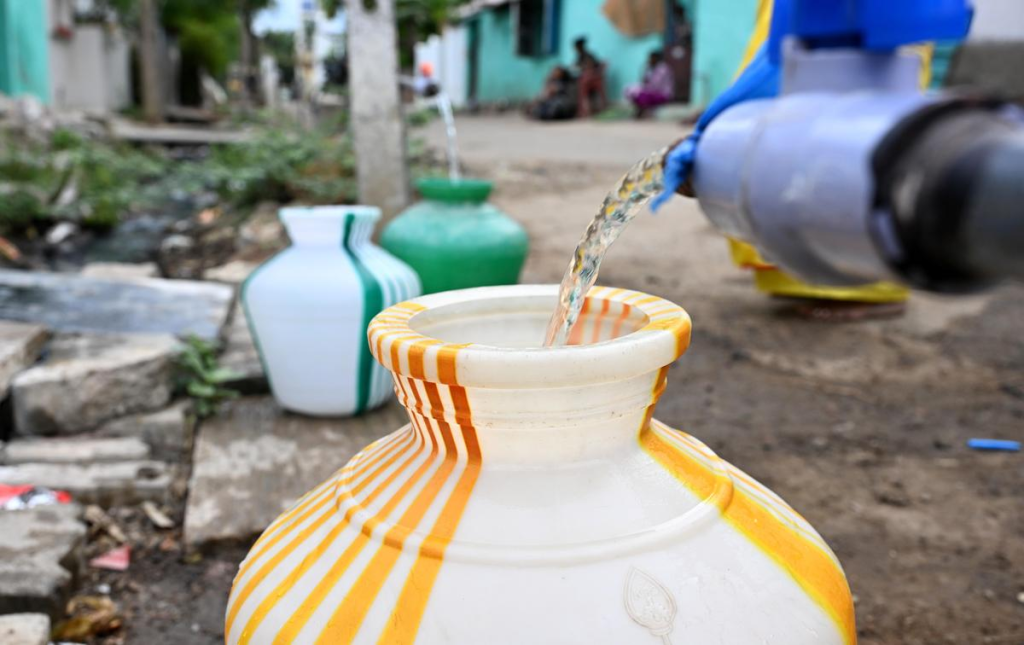
- In Rawta village on the edge of Delhi, residents receive water only on alternate days between 7 PM and midnight, forcing families to sacrifice sleep to fetch water.
- Private water vendors exploit this gap and charge exploitative prices from helpless residents.
- In Gurugram, rural governance was abolished and areas were placed under a municipal corporation that struggles with administrative inefficiencies. Residents receive urban prices without urban services.
- Environmental Damage:
- In peri-urban Hyderabad, toxic leachate from waste dumps has contaminated the groundwater used by local communities.
- The Bisalpur dam, originally built to irrigate farmers in Tonk and Sawai Madhopur, now prioritises Jaipur’s growing water demand leaving downstream farmers to bear the cost silently.
- When water moves from rural to urban areas without accountable governance, the peri-urban becomes a zone of sacrifice.
- Sanitation Crisis:
- Nearly 40 million urban households rely on on-site systems such as septic tanks for sanitation.
- Desludging is irregular and illegal dumping of septage into rivers and open fields is routine.
- A single 5,000-litre tanker discharging its load openly undoes the work of thousands of toilets built under the Swachh Bharat Mission.
Way Forward
- Resolve the Governance Vacuum:
- State governments must constitute Nagar Panchayats for all Census towns as envisioned under the 74th Constitutional Amendment.
- Multi-stakeholder platforms like the one in Sultanpur village that brought together engineers, panchayat members and residents show that accountability can be built when institutions are made to coordinate.
- Secure Water Sources at Their Origin:
- The Jal Jeevan Mission succeeded in expanding tap connections but source sustainability needs relentless focus.
- This means protecting catchments from encroachment, preventing solid waste dumping and adopting community-driven sanitary inspections of local water sources as Maharashtra has already demonstrated.
- Swachh Bharat Mission 3.0 for Peri-Urban Sanitation:
- A dedicated mission should be housed under the Ministry of Jal Shakti and should leverage rural employment guarantee schemes.
- Priority actions should include building faecal sludge treatment plants where sewage treatment plants are beyond 15-20 km.
- GPS-equipped desludging trucks should be deployed to prevent illegal dumping of septage.
- Mini-cesspool vehicles for narrow lanes should be introduced as the city of Berhampur in Odisha has successfully done.
- Desludging costs ranging from Rs 1,500 to Rs 6,000 per trip should be folded into monthly water bills through a small sanitation levy.
- Scale Up Decentralised Wastewater Treatment:
- Startups such as Indra Water and Tigreen have built modular plug-and-play systems that treat used water close to its source and recover over 95% of water with minimal land and energy use.
- These need clear policy signals, single-window clearances, public procurement mandates and government-backed guarantees to create a viable market.
- Finance Peri-Urban Water as Strategic Infrastructure:
- The Uttarakhand model of blended finance combining State risk-bearing with World Bank concessional loans linked to disbursement indicators offers a replicable template for other states.
- Similar mechanisms can be extended to cover septage management and decentralised treatment systems.
Conclusion
- India’s water future will be decided not in its megacities or its villages but in these overlooked in-between spaces. If governance, technology and finance are brought together urgently, the missing middle can become the core of a water-secure and thriving urban India.
