

Context
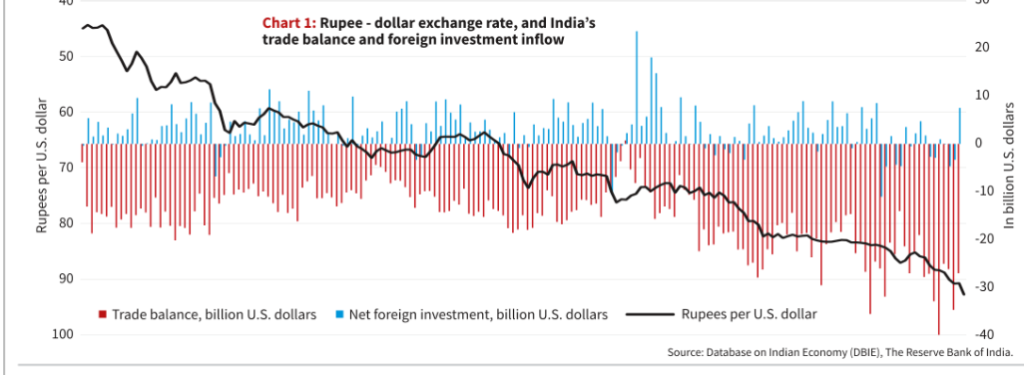
- The rupee-to-dollar exchange rate crossed 96 in May 2026 compared to around 85 a year ago. This sharp decline reflects deep structural and geopolitical pressures on the Indian economy. The exchange rate is simply the price a currency commands in the market relative to other currencies, determined by demand and supply just like any other commodity.
How Trade Deficits Weaken The Rupee
- When India exports goods, foreign buyers pay in dollars which are converted to rupees, increasing demand for the rupee.
- When India imports goods, especially oil, rupees are converted to dollars, reducing demand for the rupee.
- India consistently runs a merchandise trade deficit as imports of goods exceed exports.
- This deficit is partially offset by a surplus in invisibles which includes software service exports and remittances from migrant workers especially in West Asian countries.
- India’s current account which is the sum of merchandise trade and invisibles has remained in deficit overall.
- The gap in the current account is bridged by capital account inflows mainly through foreign investment and loans.
How Capital Outflows Weaken The Rupee
- Foreign Direct Investment (FDI) involves investment in factories and businesses and has long-term ties binding it to the host country.
- Foreign Portfolio Investment (FPI) involves purchases of stocks and bonds and is highly volatile and driven by speculation.
- Portfolio investors enter a country seeking quick financial returns and exit at the first sign of risk or when higher returns are available elsewhere.
- When FPI flows out, investors sell their rupee assets and convert them to dollars, causing a sharp fall in rupee demand and value.
- Recent rupee losses have been mainly due to foreign investors withdrawing from India amid growing geopolitical tensions and higher United States interest rates.
Impact Of Rupee Depreciation
- Negative Impact:
- Importing a barrel of oil at USD 100 now costs Rs 9,600 compared to Rs 8,500 when the rupee was at 85 per dollar.
- Rising import costs fuel domestic inflation and increase the current account deficit further.
- Ongoing geopolitical tensions and rising oil prices create compounding pressure on the rupee’s value.
- Positive Impact:
- A weaker rupee makes Indian exports cheaper for foreign buyers. A shirt costing Rs 1,200 can now be sold in the United States at USD 12.5 instead of USD 15.
- However, rupee depreciation alone may not help much given the range of supply and demand constraints weighing on Indian manufacturing.
Role Of The Reserve Bank Of India
- The RBI intervenes to prevent the exchange rate from falling to very low levels through active market management.
- When foreign investors rush out by selling rupee assets for dollars, the RBI sells dollars from its reserves to prop up the rupee and slow its decline.
- India’s forex reserves stood at approximately USD 691.11 billion at the end of March 2026.
- This is sufficient to cover 10.8 months of India’s imports making it a formidable buffer against speculative attacks.
- The RBI actively deployed its reserves during October 2024 to January 2025 and again during August to December 2025 to stabilise the rupee.
Way Forward
- India must take steps to regulate speculative capital outflows that cause sudden and sharp rupee depreciation.
- Reducing dependence on oil imports through accelerated renewable energy adoption will structurally reduce pressure on the rupee.
- Boosting merchandise exports and services exports will improve the current account balance and support rupee stability.
- Attracting long-term FDI over volatile FPI will create a more stable capital account and reduce rupee vulnerability.
- Strengthening domestic manufacturing under Make in India will reduce import dependence and improve the trade balance over time.
