Prelims
Somnath Temple
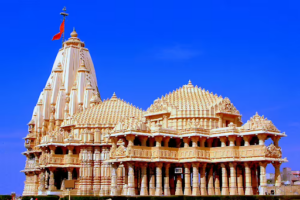
In News: 2026 marks 1,000 years since the 1026 CE attack by Mahmud of Ghazni.
Religious Significance
- Somnath Temple is one of the 12 Jyotirlingas of Lord Shiva.
- Often referred to as the “Eternal Shrine”.
Location
- Located at Prabhas Patan, near Veraval, in Saurashtra, Gujarat.
- Situated on the Arabian Sea coast.
- At the Triveni Sangam of Kapila, Hiran and Saraswati rivers.
Historical Milestones
- Attacked in 1026 CE by Mahmud of Ghazni.
- Historical records indicate multiple destructions and reconstructions.
- Rebuilt by rulers including Kumarapala (12th century) and Chudasama kings.
- Documented as destroyed six times and rebuilt each time.
Architecture
- Constructed in the Chaulukya (Solanki) architectural style.
- Features a shikhara, ornate stone carvings, and garbhagriha.
- Inscription mentions no landmass southwards till the South Pole.
Modern Reconstruction
- Reconstruction initiated by Vallabhbhai Patel after Independence.
- Rebuilt during 1947–1951 using traditional techniques.
- Inaugurated on 11 May 1951 by Rajendra Prasad.
- Currently managed by the Somnath Trust, chaired by the Prime Minister of India.
Parole and Furlough

Parole
- Parole involves temporary release with suspension of sentence.
- Release is conditional, with periodic reporting to authorities.
- Parole is not a prisoner’s right.
- Granted for specific reasons such as family emergencies.
- Can be denied in public interest, despite eligibility.
Furlough
- Furlough applies mainly to long-term imprisonment cases.
- Period spent on furlough is treated as sentence remission.
- Considered a matter of right, granted periodically.
- Granted without specific reasons to maintain social ties.
Common Provisions
- Both are reformative measures in prison administration.
- Aim to humanise the prison system.
- Governed under the Prisons Act, 1894.
Payments Regulatory Board (PRB).
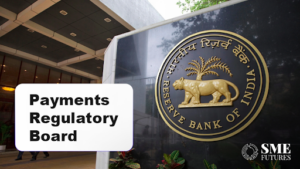
In News
- First PRB meeting held in Mumbai, chaired by Sanjay Malhotra.
- Marks operationalisation of the new payments governance framework.
Legal Status
- PRB is a statutory body for payment systems regulation.
- Established under Section 3 of the Payment and Settlement Systems Act, 2007.
- Came into force from 9 May 2025.
- Replaced the Board for Regulation and Supervision of Payment and Settlement Systems (BPSS).
Institutional Role
- PRB is the forum through which Reserve Bank of India exercises regulatory and supervisory powers over payment systems.
Composition
- Chairperson: RBI Governor.
- Includes RBI Deputy Governor (payments).
- Includes Central Government nominees.
- Includes domain experts in payments, fintech and cybersecurity.
- Includes officials linked to digital identity and payment infrastructure.
Core Functions
- Grants and regulates authorisation of payment systems.
- Prescribes technical, operational and security standards.
- Oversees risk management and settlement finality.
- Conducts inspection and enforcement under the PSS Act.
Global Environment Facility (GEF)

In News
- GEF approved US$52.8 million for four UNEP-led projects.
- Approval taken at the 70th GEF Council meeting.
About GEF
-
- GEF is a multilateral environmental financing mechanism.
- Provides grants and blended finance to developing countries.
- Supports economies in transition.
- Establishment
-
- Established in 1991.
- Set up ahead of the 1992 Rio Earth Summit.
- Core Mandate
-
- Supports country-driven projects with global environmental benefits.
- Integrates action on climate change, biodiversity and land degradation.
- Covers oceans, chemicals and pollution.
- Financial Mechanism For
-
- Convention on Biological Diversity (CBD).
- UN Framework Convention on Climate Change (UNFCCC).
- UN Convention to Combat Desertification (UNCCD).
- Stockholm Convention on POPs.
- Minamata Convention on Mercury.
- BBNJ (Biodiversity Beyond National Jurisdiction) Agreement.
- Also supports the Montreal Protocol.
- Key Functions
-
-
- Provides grants and concessional financing.
- Mobilises co-financing from public and private sources.
- Supports capacity building and technology transfer.
- Funds climate reporting under the Paris Agreement.
-
- Importance of the Body
-
- Largest multilateral funder of biodiversity projects globally.
- Has provided over US$26 billion in grants.
- Mobilised over US$153 billion in co-financing.
- Active in 160+ countries.
Popocatépetl Volcano
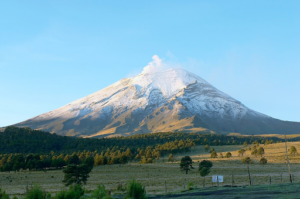
Context: Scientists obtained first 3D images from inside the volcano.
About the Volcano
- Basic Facts
-
-
- Name Popocatépetl means “Smoking Mountain” in Nahuatl.
- Located in central Mexico, about 72 km southeast of Mexico City.
- Lies on the border of México and Puebla states.
-
- Tectonic Setting
-
- Part of the Trans-Mexican Volcanic Belt.
- Formed due to Cocos Plate subducting beneath North American Plate.
- Volcanic Characteristics
-
- Classified as a stratovolcano.
- Elevation is 5,452 m above sea level.
- Among Mexico’s most active volcanoes.
- Eruptions recorded since 1519.
- Considered one of the most dangerous volcanoes in the Pacific Ring of Fire.
Stratovolcano
- Stratovolcanoes are tall, steep, cone-shaped volcanoes.
- Commonly found at subduction zones.
- Dominant volcano type in the Ring of Fire.
- Account for about 60% of Earth’s volcanoes.
- Built from alternating lava and pyroclastic layers.
- Typically associated with explosive eruptions.
- Usually possess a small summit crater.
Aditya-L1 Mission
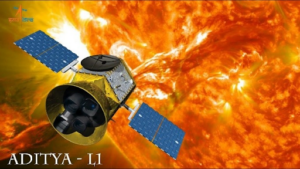
Context: On the second anniversary of Aditya-L1 reaching the Lagrangian point (L1), ISRO announced the first Announcement of Opportunity (AO) cycle soliciting proposals from Indian scientists for observations.
About the Mission
- Launch and Orbit
- Aditya-L1 was launched using PSLV XL.
- Launch site was Satish Dhawan Space Centre.
- Mission placed in a halo orbit around the L1 Lagrangian Point.
- Mission Profile
- Aditya-L1 is India’s first solar observatory mission.
- It carries seven scientific payloads.
- Mission performs multi-wavelength observations of the Sun.
- Payloads on Aditya-L1
- Remote Sensing Payloads
- VELC (Visible Emission Line Coronagraph) studies the solar corona and CME dynamics.
- SUIT (Solar Ultra-violet Imaging Telescope) images the photosphere and chromosphere in near-UV.
- SoLEXS (Solar Low Energy X-ray Spectrometer) observes soft X-ray solar flares.
- HEL1OS (High Energy L1 Orbiting X-ray Spectrometer) observes hard X-ray solar flares.
- In-situ Payloads
- ASPEX (Aditya Solar Wind Particle Experiment) studies solar wind and energetic ions.
- PAPA (Plasma Analyser Package for Aditya) analyses plasma properties in interplanetary space.
- MAG (Advanced Tri-axial High-Resolution Digital Magnetometers) measures interplanetary magnetic field.
- Magnetometer sensors placed on a 6-metre deployable boom.
- Remote Sensing Payloads
Capabilities of Aditya-L1
- Provides first spatially resolved solar disk images in near-UV band.
- Observes CME dynamics close to the solar disk (~1.05 solar radius).
- Enables study of CME acceleration region.
- Equipped with onboard intelligence for detecting CMEs and solar flares.
- Studies directional and energy anisotropy of solar wind.
- Uses multi-directional observations of solar wind.
Major Scientific Objectives
- Studies coronal heating mechanisms.
- Examines solar wind acceleration processes.
- Investigates initiation of CMEs and solar flares.
- Analyses Sun–Earth space weather interactions.
- Studies solar atmosphere coupling and dynamics.
Calamaria Mizoramensis
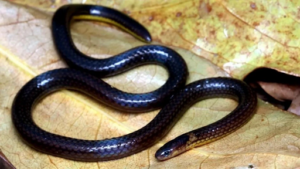
Context: A new reed snake species was discovered in Mizoram. The species is named Calamaria mizoramensis after the state.
Species Profile
- Calamaria mizoramensis is a non-venomous reed snake.
- It belongs to the genus Calamaria.
- Family classification: Colubridae.
Habitat and Behaviour
- The species is nocturnal and semi-fossorial.
- Inhabits humid, forested hill regions.
- Recorded at elevations between 670 and 1,295 metres.
- Found in areas close to human settlements.
Physical Characteristics
- Small-sized snake with dark brown to blackish coloration.
- Displays faint body stripes.
- Underside is yellow in colour.
Distribution
- Confirmed occurrence limited to Mizoram.
- Presence in Manipur, Nagaland and Assam remains unverified.
Reed Snakes
- Reed snakes are small, slender and non-venomous.
- They are native to South and Southeast Asia.
- Prefer moist forests and leaf-litter habitats.
- Commonly found under logs, stones and soil.
- Mostly fossorial or semi-fossorial in nature.
- Feed on small, soft-bodied invertebrates.