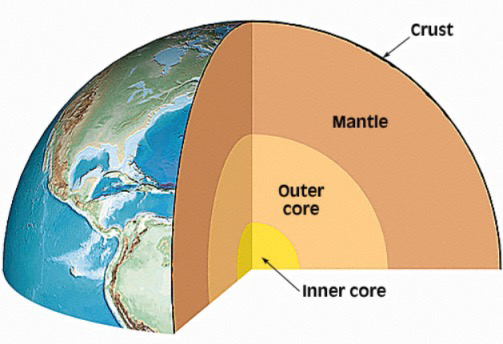
Understanding the Earth’s interior is essential for grasping geological processes such as earthquakes, volcanic activity, plate tectonics, and the formation of various landforms. While we cannot directly observe much of Earth’s interior, scientific advancements have allowed us to infer a great deal through both direct and indirect sources.
- The interior structure of the Earth is made up of three main shells: the very thin and brittle
- Crust
- Mantle
- Core
| Do you know: The core of the earth only occupies 15 percent of Earth’s volume whereas the mantle occupies 84 percent and the crust occupies the remaining 1 percent. |
Sources of Information about Earth’s Interior
1. Direct Sources; These involve actual physical materials from or near the Earth’s surface:
- Surface Rocks and Minerals;
- It represents the most accessible geological material. Through petrological and geochemical analyses in laboratories, scientists simulate the temperature and pressure conditions of the Earth’s deeper layers. They help in modeling crustal formation, mineral behavior under stress, and tectonic processes.
- Mining Activities
- Mining provides another direct method of accessing subsurface materials. However, even the world’s deepest mines only penetrate to depths of less than 5 kilometers, as extreme heat and pressure at greater depths make further excavation impractical.
- Deep Ocean Drilling Projects
- Projects like the one conducted at Kola, in the Arctic region, have pushed the boundaries of drilling technology. The Kola Superdeep Borehole, reaching a depth of 12 kilometers, has yielded a wealth of geological data, enabling researchers to analyze samples from layers otherwise unreachable.
- Volcanic Eruptions
- Volcanic activity offers a natural glimpse into Earth’s inner workings. During eruptions, magma from beneath the surface is expelled as lava, allowing scientists to analyze its chemical and mineral composition. Despite its value, this method does not clearly reveal the exact depth from which the magma originates.
2. Indirect Sources
- Meteors
- Meteors are fragments of celestial bodies—mostly remnants of asteroids—that enter Earth’s atmosphere and burn due to friction, often appearing as bright streaks in the sky.Some meteors survive atmospheric entry and reach Earth’s surface as meteorites. These objects are believed to have originated from bodies that formed in the early solar system, similar in composition to the Earth.Studying meteorites helps infer the composition of the mantle and core.
- Gravitational Measurements (Gravity Anomalies): When the measured gravity differs from what is theoretically expected, it is called a gravity anomaly. While studying these anomalies it reveals dense or light material in the crust, useful for understanding geological structures.
- While we measure the force of gravity at different locations on Earth we find a variation which is influenced by ;
- The distribution and density of underground materials
- The Earth’s shape and rotation
- Distance from the Earth’s center
- Magnetic Field Studies
- While having magnetic surveys we find variations in the Earth’s magnetic field. Changes in the field over regions can indicate different rock types and structures beneath the surface.
- Magnetic surveys help map the distribution of magnetic materials in the Earth’s crust, aiding in geological and tectonic studies, and in locating iron ore deposits.
- Seismic Activity :
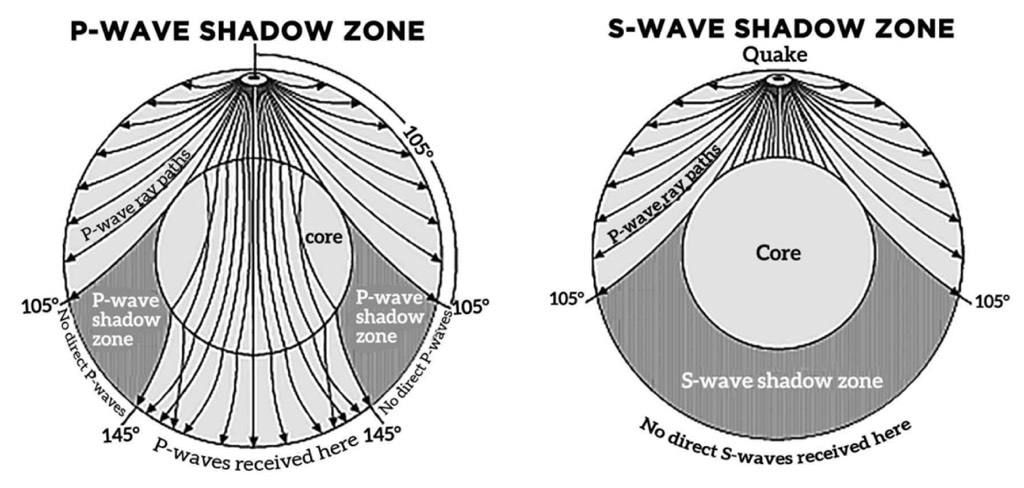
- Seismic activity is one of the most important sources of information about the interior of the earth. Body waves, generated by an earthquake, especially S-waves, which travel only through solid material, have helped in understanding the interior structure of the Earth.
The Layers of the Earth
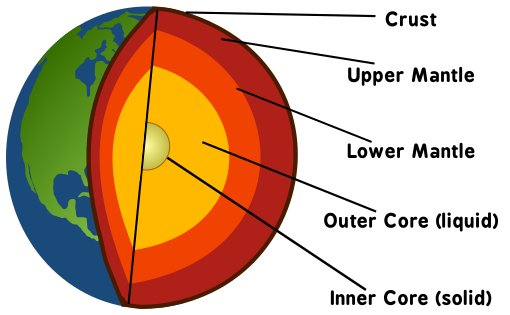
The Earth’s interior is broadly divided into three concentric layers: the crust, the mantle, and the core. Each layer differs in terms of composition, thickness, density, and physical properties.
The Crust : The crust is the Earth’s outermost solid layer. Despite being the layer we live on, it represents only about 1% of the Earth’s total volume. It is brittle in nature and characterized by a relatively low density compared to the layers beneath.
- The Earth’s crust exists in two distinct forms, each shaped by different geological processes and composed of different materials:
| Characteristic | Continental Crust | Oceanic Crust |
| Thickness | Averages ~30 kmCan extend up to 70 km in mountain regions (e.g., Himalayas) | Averages ~5 km |
| Density | Less dense (~2.7 g/cm³) | Denser (~2.9 g/cm³) |
| Composition | Primarily granite-type rocksRich in Silicon (Si) and Aluminium (Al) = SIAL | Primarily basaltic rocksContains Silicon (Si) and Magnesium (Mg) = SIMA |
| Location | Forms continents and large landmasses | Underlies ocean basins and seafloor |
| Relative Properties | Thicker and less dense | Thinner but denser |
The Mantle
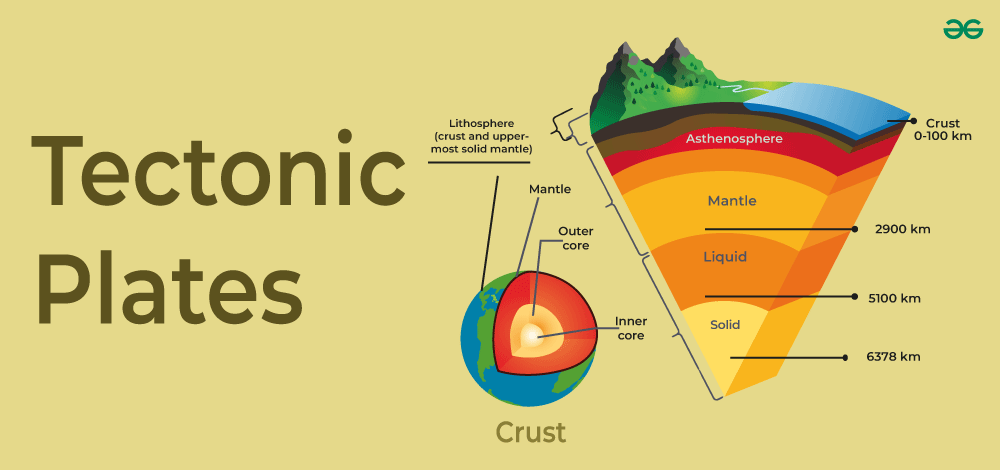
The mantle is the intermediate layer of the Earth, situated between the crust and the core. It is a highly significant region geologically and dynamically, as it plays a crucial role in plate tectonics, volcanic activity, and the transfer of heat from the Earth’s interior to the surface.
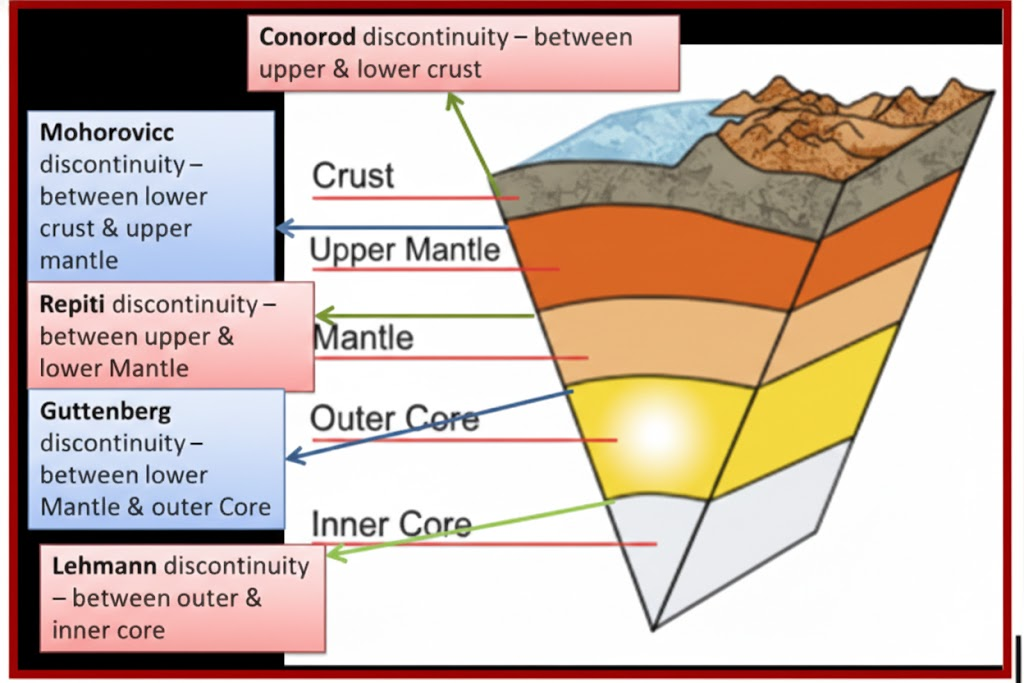
- The mantle begins at the Moho Discontinuity (Mohorovičić Discontinuity), which separates the crust from the mantle.
- It extends up to a depth of approximately 2,900 km.
- The boundary between the mantle and the core is marked by the Gutenberg Discontinuity.
- The mantle makes up about 84% of the Earth’s total volume and nearly 67% of its mass.
- The average density of the mantle is about 3.4 g/cm³, which is higher than that of the crust.
- The mantle is composed primarily of silicate minerals rich in magnesium (Mg) and iron (Fe).
- Due to the dominance of Silicon (Si) and Magnesium (Mg), the mantle is often referred to as SIMA.
- Major rocks found in the mantle include peridotite, dunite, and olivine-rich rocks.
The mantle is divided into two primary layers based on depth, physical properties, and behavior under stress:
Upper Mantle; Further subdivided into Lithosphere, Asthenosphere.
- Extends from the Moho Discontinuity (~35 km) to about 660 km depth.
Lithosphere
- Comprises the crust and the rigid uppermost part of the mantle.
- Thickness ranges from 10 km under oceans to 200 km beneath continents.
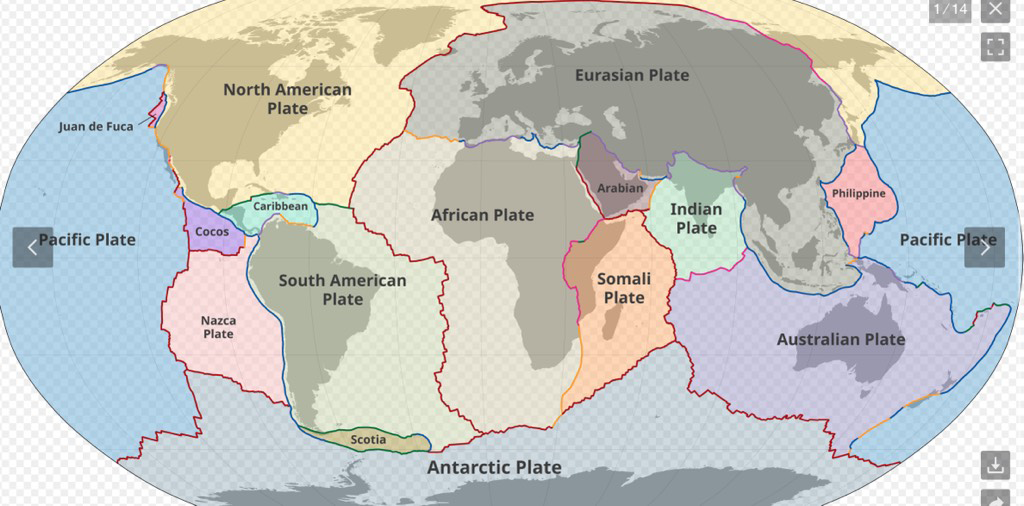
- Broken into tectonic plates that float on the softer asthenosphere.
- These plates are responsible for earthquakes, mountain building, and continental drift.
Asthenosphere
- Lies just below the lithosphere, extending roughly from 100 km to 400 km in depth.
- The word ‘astheno’ means weak.
- It is partially molten and behaves in a plastic or ductile manner, allowing tectonic plates to move over it.
- It is the main source of magma that rises during volcanic eruptions.
- It transmits seismic waves slowly, confirming its semi-fluid nature.
Lower Mantle
- Extends from 660 km to 2,900 km depth.
- This region is solid due to extremely high pressure, even though the temperatures are very high.
- Material here is denser and less ductile than the upper mantle.
- Plays a key role in mantle convection, which drives plate tectonics.
| Mantle role in GeodynamicsThe mantle acts as the driving force behind plate tectonics. Convection currents, generated by heat from the Earth’s core, cause the movement of lithospheric plates. This movement leads to key geological processes such as earthquakes, volcanic activity, mountain building, and continental drift. |
The Core
The core is the innermost and most dense layer of the Earth, lying beneath the mantle. Our understanding of the core is primarily based on seismic wave analysis, particularly the behavior of P-waves and S-waves, which change speed or disappear entirely as they pass through different layers. The core plays a vital role in geodynamics, particularly in generating the Earth’s magnetic field.
- The core begins at a depth of about 2,900 km, marking the boundary with the mantle (known as the Gutenberg Discontinuity).
- It extends to the center of the Earth, at around 6,371 km depth.
- Thus, the core is approximately 3,500 km in radius.
- The core is the densest layer of the Earth.The increase in density is due to the compaction of heavy metals under extreme pressure.
- It is mainly composed of Nickel (Ni) and Iron (Fe).Hence, the core is often referred to as the NIFE layer. It may also contain lighter elements like sulphur, oxygen, or silicon in small amounts.
- Although the core is vast, it makes up about 15% of the Earth’s total volume and approximately 33% of its mass due to its high density.
The core is divided into two distinct sub-layers based on the behavior of seismic waves and the physical state of materials:
Outer Core:
- It is in Liquid state.
- Thickness: Extends from 2,900 km to 5,150 km depth.
- The S-waves do not pass through the outer core, confirming its liquid nature. However, the P-waves slow down significantly, creating a shadow zone.
- It is primarily composed of molten iron and nickel.
- The movement of liquid metals in the outer core is responsible for generating the Earth’s magnetic field through the dynamo effect.
Inner Core
- It is in Solid state.
- It extends from 5,150 km to 6,371 km (center of the Earth).
- Here P-waves travel faster than in the outer core. However, S-waves can be partially transmitted due to the solid state.
- It is primarily composed of solid iron and nickel, with extremely high pressure.
- Here the estimated temperatures reach up to 5,000–6,000°C, with immense pressure preventing the material from melting.
Seismic Discontinuities: Seismic discontinuities are boundaries within the Earth where rock properties change abruptly, altering seismic wave speed, direction, or causing reflection/refraction. They help reveal Earth’s internal structure and are identified through seismic wave behavior.
| Discontinuity | Depth | What Changes | Effect on Waves | Importance |
| Mohorovičić Discontinuity (Moho) | ~5–10 km (oceanic crust)~30–50 km (continental crust) | Transition from crust (basalt/granite) to mantle (peridotite) | Increase in wave velocity | Marks the base of the Earth’s crust |
| Lithosphere-Asthenosphere Boundary (LAB) | ~100–200 km | Rigid lithosphere to ductile asthenosphere | Subtle velocity decrease or seismic attenuation | Helps define tectonic plate boundaries |
| Mantle Transition Zone | Between ~410 km and 660 km | • 410 km: Phase change from olivine to wadsleyite• 660 km: Transition to ringwoodite or bridgmanite (start of lower mantle) | Sudden increases in velocity | Affects mantle convection and slab penetration |
| Core-Mantle Boundary (CMB) / Gutenberg Discontinuity | ~2,900 km | Solid mantle to liquid outer core | P-waves slow down;S-waves disappear | Indicates liquid state of the outer core |
| Lehmann Discontinuity | ~5,100 km | Liquid outer core to solid inner core | P-wave velocity increases;S-waves reappear (PKJKP phase) | Proves inner core is solid |
Temperature, Pressure, and Density of the Earth’s Interior
Temperature
- Temperature increases with depth, but not uniformly—steep near the crust, moderate in the mantle, and very high in the core.
- Core temperature is estimated between 3000°C and 5000°C, due to:
- Radioactive decay,
- Residual heat from Earth’s formation, and
- Chemical reactions under high pressure.
Pressure
- Pressure rises steadily with depth from the surface to the core due to the weight of overlying rocks.
- It reaches over 3.5 million atmospheres near the core, influencing rock behavior and seismic waves.
Density
- Density increases from about 2.7 g/cm³ in the crust to over 13 g/cm³ in the inner core.
This increase is due to the compression of materials under pressure and the presence of heavier elements like iron and nickel in deeper layers.