

Narcotics Control Bureau
Context
- The Narcotics Control Bureau (NCB) seized 349 kg of high-grade cocaine worth ₹1,745 crore in Mumbai, exposing a major transnational drug network. The operation, named “Operation White Strike”, followed six months of intelligence development and surveillance.
About Narcotics Control Bureau (NCB)
- Nodal drug law enforcement and intelligence agency under Ministry of Home Affairs.
- Established in 1985 under the NDPS Act, 1985.
- Headquarters: New Delhi.
- Key Functions of NCB
- Coordinates Central and State agencies in drug enforcement.
- Collects and disseminates intelligence on narcotics trafficking.
- Analyses seizure data and trafficking trends.
- Acts as national contact point for international cooperation.
- Works with agencies like INTERPOL and UN bodies.
GST Revenue Trends
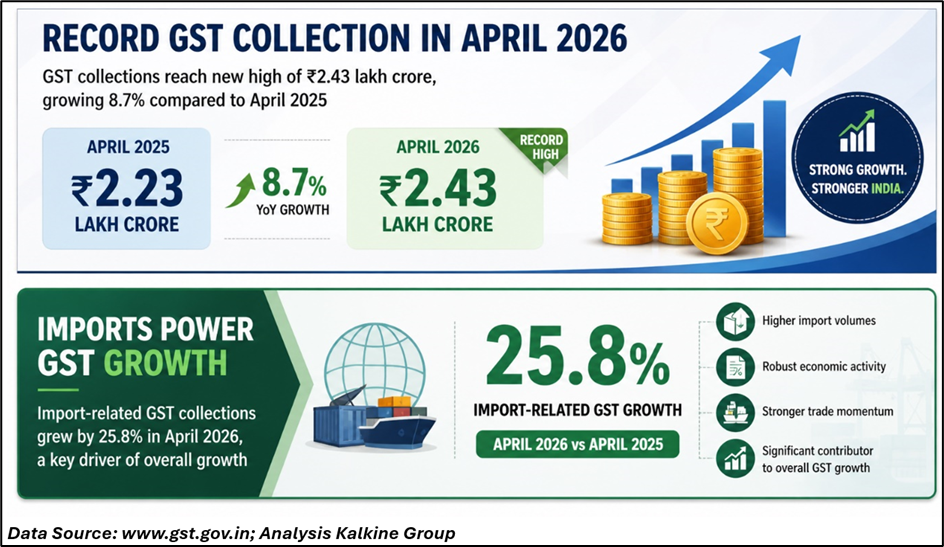
Context: India’s GST collections reached a record ₹2.43 lakh crore in April 2026, reflecting robust tax mobilisation. The surge indicates resilient economic activity despite global uncertainties and geopolitical tensions.
Key Findings
- Gross GST revenue grew 8.7% year-on-year, continuing a trend of record April collections since GST rollout (2017).
- Net GST collections (after refunds) stood at ₹2.11 lakh crore, showing 7.3% growth.
- Growth was primarily driven by import-related GST (up ~26%), indicating strong external trade linkages.
- Domestic GST growth remained moderate (~4.3%), reflecting relatively stable consumption demand.
- Experts caution that such high collections are partly due to year-end compliance push, with expected normalisation ahead.
About Goods and Services Tax (GST)
- GST is a comprehensive indirect tax on goods and services, implemented in 2017.
- It replaced multiple taxes such as VAT, excise duty, and service tax.
- Key Features
- Based on the principle of “One Nation, One Tax”.
- Dual structure:
- CGST (Central GST)
- SGST (State GST)
- IGST (Inter-State GST)
Pradhan Mantri Jan Arogya Yojana (PM-JAY)
Brief Overview
- PM-JAY is the flagship health assurance scheme under Ayushman Bharat, aimed at providing financial protection against catastrophic health expenditure.
- Launched on 23 September 2018 in Ranchi (Jharkhand), it represents a major step towards Universal Health Coverage (UHC) in India.
About PM-JAY
- World’s largest government-funded health assurance scheme.
- Provides ₹5 lakh per family per year for secondary and tertiary hospitalization.
- Targets over 12 crore poor and vulnerable families (~55 crore beneficiaries).
- Eligibility & Coverage
- Based on Socio-Economic Caste Census (SECC) 2011 data.
- Covers both rural and urban deprived categories.
- Includes beneficiaries of Rashtriya Swasthya Bima Yojana (RSBY) not listed in SECC.
- Funding Pattern
- Fully funded by Government of India.
- Cost-sharing between Centre and States for implementation.
- Key Features
- Cashless and paperless access at empanelled hospitals.
- Covers 1,900+ procedures (diagnostics, surgery, ICU care, medicines).
- Family floater scheme with no cap on age, gender, or family size.
- Covers pre-existing diseases from day one.
- Provides pan-India portability of benefits.
- Includes 3 days pre-hospitalization and 15 days post-hospitalization care.
- Covers:
- Medical consultation and treatment
- Medicines and diagnostics
- ICU and surgical procedures
- Hospital stay and food
El Niño (ENSO Warm Phase)

Context: El Niño is a major climatic phenomenon influencing global weather patterns, including the Indian monsoon. It forms part of the El Niño–Southern Oscillation (ENSO) cycle.
What is El Niño?
- El Niño is the warm phase of ENSO, characterised by abnormal warming of surface waters in the central and eastern equatorial Pacific Ocean.
- Occurs irregularly every 2–7 years.
- Leads to increase in global average temperatures.
Mechanism of Formation
- Weakening of trade winds along the equator.
- Warm water shifts eastward from western Pacific to South American coast.
- Thermocline deepens in eastern Pacific, reducing upwelling.
- Disrupts Walker Circulation, linking oceanic and atmospheric changes.
Key Indicators
- Rise in Sea Surface Temperature (SST) anomalies in Niño regions.
- Build-up of subsurface warm water (100–250 m depth).
- Oceanic Niño Index (ONI): SST anomaly ≥ +0.5°C for 5 consecutive overlapping 3-month periods.
- Weakening or reversal of trade winds and Walker Circulation.
Factors Influencing El Niño
- Strength and variability of trade winds.
- Subsurface heat content of Pacific Ocean.
- Interaction between ocean temperature and atmospheric pressure systems.
- Natural variability + global warming, which may intensify impacts.
Impacts of El Niño
- Global
- Leads to warmer global temperatures.
- Often associated with record-breaking heat years.
- Regional Impacts
- India: Weak monsoon, drought conditions.
- South America (Peru, Ecuador): Heavy rainfall, floods.
- Australia & Southeast Asia: Droughts, heatwaves, wildfires.
PM E-DRIVE Scheme

Context
- The Government has launched the PM E-DRIVE Scheme to accelerate electric vehicle (EV) adoption and green mobility transition in India.
- It builds upon earlier initiatives like FAME-I (2015) and FAME-II (2019), signalling a policy continuity towards sustainable transport.
About PM E-DRIVE Scheme
- A flagship scheme approved by the Cabinet with an outlay of ₹10,900 crore.
- Implementation period: October 2024 – March 2026.
- Aims to promote EV adoption, charging infrastructure, and domestic manufacturing ecosystem.
- Objectives
- Accelerate adoption of electric vehicles across segments.
- Develop robust charging infrastructure network.
- Promote indigenisation under Aatmanirbhar Bharat.
- Eligible Categories
- Electric 2-wheelers (e-2Ws)
- Electric 3-wheelers (e-3Ws), including e-rickshaws and e-carts
- e-Ambulances
- e-Trucks
- e-Buses
- Charging infrastructure
- Upgradation of testing agencies
Key Components
- Demand Incentives
- Incentives capped at 15% of ex-factory price or fixed limit.
- Applicable only to vehicles below specified price thresholds.
- Charging Infrastructure
- Target: 72,300 public fast chargers across cities and highways.
- Bharat Heavy Electricals Limited to develop EV “Super App” for:
- Charger availability
- Slot booking
- Payments
- Testing Infrastructure
- ₹780 crore allocated for upgrading testing agencies.
- Focus on advanced technologies for EV validation and certification.
Eligibility Conditions
- Only EVs with advanced battery technologies qualify.
- Vehicles must comply with Central Motor Vehicles Rules (CMVR), 1989.
- Applies to vehicles manufactured and registered within scheme period.
- Government-purchased EVs excluded (to avoid fiscal recycling).
Tuapse Oil Terminal (Russia)
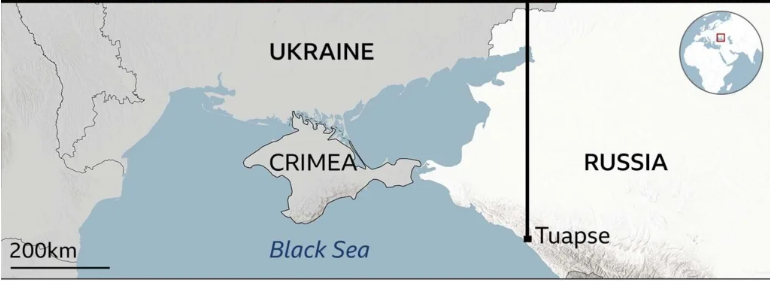
Context: Ukraine has reportedly targeted the Tuapse oil terminal in Russia’s Black Sea region, marking repeated strikes on critical energy infrastructure. The attacks highlight the strategic vulnerability of Russia’s oil export hubs in the ongoing conflict.
Location
- The Tuapse is located in Krasnodar Krai, Russia.
- Situated on the northeastern coast of the Black Sea.
- Nearby Geographical References
- Close to Crimea region (strategic conflict zone).
- Part of the Russian Riviera (Black Sea coastal belt).
About Tuapse Oil Terminal
- Operated by Rosneft.
- Functions as a major oil export terminal linked to Tuapse refinery.
- Processing capacity: ~12 million tonnes annually.
Strategic Importance
- Key node for Russia’s oil exports via the Black Sea.
- Supports logistics and supply chain to southern Russia and Crimea.
- Critical for energy security and export revenues.
Great Nicobar Project
Location
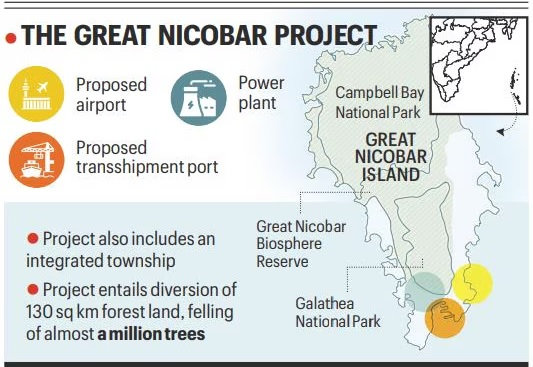
- Great Nicobar Island lies in the Nicobar group of islands in the Andaman and Nicobar archipelago.
- It hosts Indira Point, the southernmost point of India.
- The island is located near the Malacca Strait, a critical global maritime chokepoint.
Project Overview
- Total project area: ~166 sq km.
- Total island area: ~910 sq km.
- Objective: Develop a strategic, economic, and logistics hub in the Indo-Pacific region.
- Conceptualised by NITI Aayog.
- Implemented by Andaman and Nicobar Islands Integrated Development Corporation (ANIIDCO).
Core Components
- Integrated Township
- Planned over ~149 sq km.
- Includes residential, commercial, tourism, logistics, and defence infrastructure.
- Transshipment Port
- Proposed at Galathea Bay (southern tip).
- Designed to position India as a global cargo transshipment hub.
- Located in an ecologically sensitive zone, including turtle nesting habitats.
- Civil and Military Airport
- Dual-use international airport near the port.
- Will complement INS Baaz, India’s southernmost air station.
- Power Plant
- Capacity: 450 MVA (gas and solar-based).
- Intended to provide reliable energy support for the project infrastructure.
Strategic Significance
- Enhances India’s presence in the Indo-Pacific region.
- Strengthens access to major international shipping routes.
- Supports maritime security, trade logistics, and defence preparedness.
