Lipulekh Pass
Context
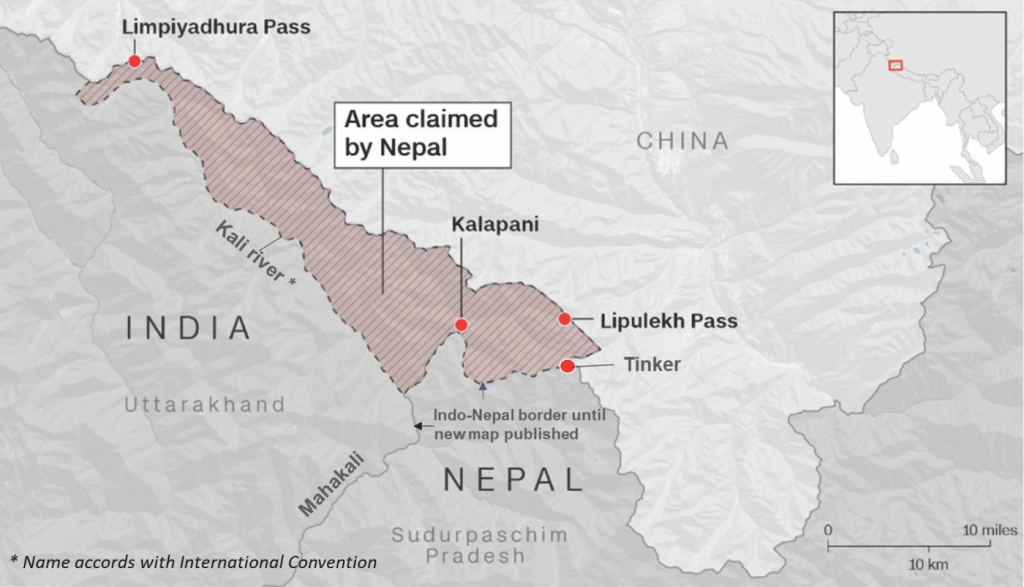
- Nepal has reiterated its claim over the Kalapani–Limpiyadhura–Lipulekh region, raising concerns over the Kailash Mansarovar Yatra route.
- India has responded that Nepal’s claims lack historical basis, highlighting an ongoing boundary sensitivity.
Location
- The Lipulekh Pass is a high-altitude Himalayan pass.
- Located in Kumaon region (Pithoragarh district), Uttarakhand.
- Lies near the tri-junction of India, Nepal, and China (Tibet Autonomous Region).
- Geographical Setting
- Situated in the Vyas Valley of the higher Himalayas.
- Connects Uttarakhand (India) with Tibet (China).
- Part of the trans-Himalayan trade and pilgrimage routes.
Strategic Significance
- Acts as a key border pass for India-China trade.
- Important for military logistics and border management in high-altitude terrain.
- Located in a sensitive tri-junction zone, making it geopolitically significant.
Religious Importance
- Serves as a route for the Kailash Mansarovar Yatra.
- Provides access to Mount Kailash and Lake Mansarovar in Tibet.
Sarna Religion
Context
- Jharkhand Chief Minister has sought inclusion of a separate ‘Sarna religion code’ in Census 2027 to ensure distinct identification of tribal communities. The demand highlights the need for accurate socio-religious classification for targeted welfare and policy design.
More in News
- Around 50 lakh people identified as ‘Sarna’ in Census 2011, despite absence of a separate code.
- The demand aims to distinguish tribal religious identity from other major religions.
- However, the concerns exist that introducing new categories may complicate Census operations.
About Sarna Religion
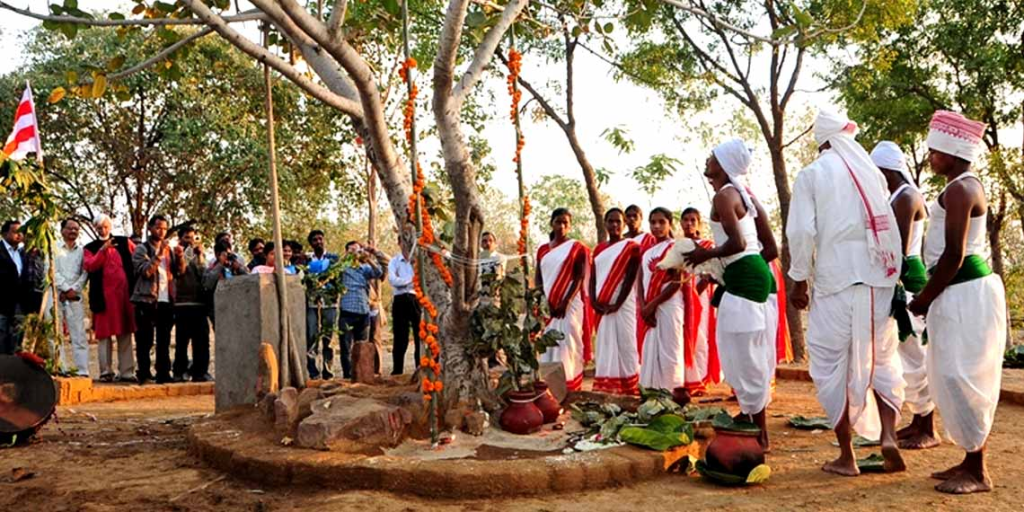
- Sarna is a nature-centric tribal faith practiced primarily by Adivasi communities.
- Core philosophy revolves around “Jal, Jungle, Zameen” (water, forest, land).
- Key Features
- Followers worship nature elements such as trees, hills, and sacred groves.
- Does not involve idol worship or organised temple-based rituals.
- Rejects Varna system and concepts like heaven–hell.
- Strongly linked with environmental conservation and community traditions.
- Geographical Distribution
- Concentrated in tribal belt states:
- Jharkhand
- Odisha
- Bihar
- West Bengal
- Assam
- Concentrated in tribal belt states:
Nuclear Non-Proliferation Treaty (NPT)
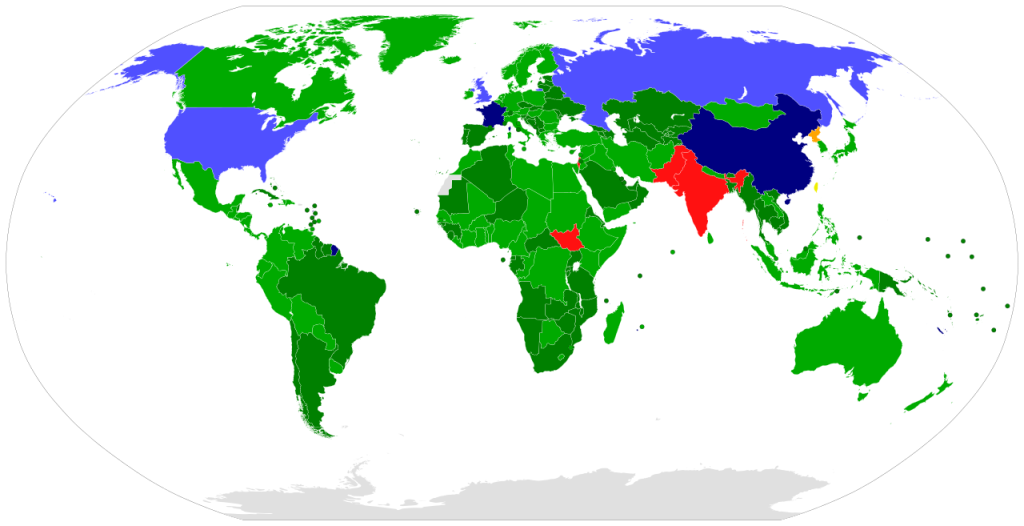
About NPT
- A multilateral treaty aimed at preventing spread of nuclear weapons.
- Drafted by the 18-Nation Committee on Disarmament.
- Opened for signature in 1968 and entered into force in 1970.
- Membership: 191 countries.
- Three Pillars of NPT
- Non-Proliferation: Prevent spread of nuclear weapons.
- Disarmament: Promote gradual elimination of nuclear arsenals.
- Peaceful Use: Allow nuclear technology for civilian purposes.
Classification under NPT
- Nuclear Weapon States (NWS)
- Defined as states that tested nuclear weapons before 1 January 1967.
- Includes:
- United States
- Russia
- United Kingdom
- France
- China
- Non-Nuclear Weapon States (NNWS)
- Agree not to acquire nuclear weapons.
- Receive access to peaceful nuclear technology under safeguards.
- Key Provisions
- NNWS cannot develop or acquire nuclear weapons.
- NWS cannot transfer nuclear weapons or assist others in acquiring them.
- Promotes International Atomic Energy Agency (IAEA) safeguards.
International Atomic Energy Agency (IAEA)

About IAEA
- An intergovernmental organisation promoting peaceful use of nuclear energy.
- Seeks to prevent diversion of nuclear technology for military purposes.
- Established in 1957 under the “Atoms for Peace” initiative.
- Institutional Features
- Governed by its Statute of the IAEA (independent founding treaty).
- Reports to:
- United Nations General Assembly (UNGA)
- United Nations Security Council (UNSC)
- Headquarters: Vienna, Austria.
- Membership
- 178 member states.
- India is a founding member.
- Core Functions
- Promotes safe, secure, and peaceful nuclear technology use.
- Implements nuclear safeguards and inspections.
- Facilitates international cooperation in nuclear science and technology.
- Ensures nuclear safety and radiation protection standards.
- Recognition
- Awarded the Nobel Peace Prize (2005) for promoting nuclear safety and non-proliferation.
About International Conference on Nuclear Security (ICONS)
- A major global platform organised by IAEA for nuclear security dialogue.
- Key Insights (ICONS 2024)
- 145 countries report incidents involving radioactive/nuclear materials.
- Radioactive materials widely used in:
- Medical sector
- Industry
- Research institutions
- Concern over use in “dirty bombs” (radiological dispersal devices).
| Dirty BombA radiological dispersal device using conventional explosives to spread radioactive material.Causes contamination and panic rather than large-scale destruction. |
Mission Drishti (OptoSAR Satellite)

Context
- India’s first privately developed Earth observation satellite, Mission Drishti, has been launched aboard SpaceX’s Falcon 9 rocket from California.
- The mission introduces the world’s first operational integration of Electro-Optical and SAR sensors, marking a technological milestone.
About Mission Drishti
- Developed by GalaxEye, a Bengaluru-based space start-up.
- Weighs approximately 190 kg, making it India’s largest privately built EO satellite.
- Designed to address limitations in conventional satellite imaging systems.
OptoSAR Technology
- Integrates:
- Electro-Optical (EO) sensors for high-resolution visual imagery.
- Synthetic Aperture Radar (SAR) for all-weather, day-night imaging.
- Enables simultaneous observation of the same geographical area, improving data accuracy and usability.
Key Features
- Provides continuous imaging capability irrespective of weather or light conditions.
- Eliminates dependency on multi-satellite data fusion.
- Utilises artificial intelligence to generate optical-like outputs from SAR data.
- Ensures higher temporal consistency and improved data reliability.
Significance
- Particularly relevant for tropical regions with high cloud cover.
- Enhances applications in disaster management, agriculture, defence, and environmental monitoring.
- Represents a significant step in India’s private space sector capabilities.
OPEC and OPEC+

About OPEC
- The Organization of the Petroleum Exporting Countries (OPEC) is a permanent intergovernmental organisation established in 1960 at the Baghdad Conference.
- Founding members: Iran, Iraq, Kuwait, Saudi Arabia, Venezuela.
- Headquarters: Vienna, Austria.
- Objective
- To coordinate petroleum policies among members.
- To ensure stable oil prices, regular supply, and fair returns.
- Institutional Features
- Operates on “one member, one vote” and unanimity principle.
- Holds about 80% of global proven crude oil reserves.
About OPEC+
- Formed in 2016, also known as the Vienna Group.
- It is a coalition of OPEC + 10 non-OPEC oil-producing countries.
- Key Non-OPEC Members
- Russia, Kazakhstan, Mexico, Oman, Azerbaijan, etc.
- Objective
- To stabilise oil markets through coordinated production adjustments.
- Significance
- Accounts for ~40% of global crude oil production.
Benchmark Crude Oil Prices

Context
- Recent volatility in oil markets, especially around the Strait of Hormuz, has highlighted that benchmark crude prices may not reflect actual market conditions.
- Disruptions in physical supply chains have widened the gap between paper prices and real transaction prices.
What are Benchmark Crude Prices?
- Benchmark crude prices are reference prices used globally to price different types of crude oil.
- They serve as pricing standards for oil trade, contracts, and futures markets.
- Major Global Benchmarks
- Brent Crude → Used for pricing Europe, Africa, and parts of Asia.
- West Texas Intermediate → US benchmark crude.
- Dubai/Oman Crude → Used for pricing oil exports to Asia.
- How Benchmark Prices are Determined
- Based on futures trading in commodity exchanges.
- Reflect expected supply-demand conditions, not immediate physical availability.
- Influenced by:
- Geopolitical events
- Speculation
- Inventory levels
- Production decisions (e.g., OPEC+)
Paper Market vs Physical Market
- Paper Market (Futures Market)
- Trading of oil contracts (not actual oil).
- Prices reflect expectations of future supply-demand.
- Physical Market
- Actual buying and selling of crude oil shipments.
- Prices reflect real-time supply constraints.
NASM-SR (Naval Anti-Ship Missile – Short Range)

Context
- India successfully tested an indigenously developed helicopter-launched anti-ship missile from the Odisha coast.
- The test marks a significant advancement in naval strike capability and indigenous defence technology.
About NASM-SR
- NASM-SR is a short-range, helicopter-launched anti-ship missile.
- Developed by Defence Research and Development Organisation in collaboration with the Indian Navy.
- Designed for deployment from ship-borne helicopters (e.g., Sea King 42B).
Key Features
- Solid propulsion system with booster and sustainer engine.
- Equipped with seeker technology for target detection and tracking.
- Includes radio altimeter for altitude measurement during flight.
- Features two-way data link enabling real-time communication with operator.
- Uses proximity fuse for detonation near target.
Operational Capabilities
- Enables helicopters to engage hostile ships from stand-off distance.
- Can be launched in salvo mode (multiple missiles in quick succession).
- Enhances ability to overwhelm enemy ship defence systems.
Advantages over Older Systems
- Lighter (~380 kg) compared to older Sea Eagle missile (~580 kg).
- Improved targeting, communication, and adaptability.
- Indigenous development ensures strategic autonomy.
Range & Performance
- Range: ~55 km.
- Designed for low-altitude, sea-skimming trajectory to evade radar detection.
Auroras

What are Auroras?
- Auroras are natural light displays in Earth’s upper atmosphere, predominantly observed in high-latitude regions near the poles.
- They appear as curtains, arcs, rays, or flickering patterns of coloured light.
Types of Auroras
- Aurora Borealis (Northern Lights)
- Occurs in the Northern Hemisphere, near the Arctic Circle.
- Visible in regions such as:
- Norway, Sweden, Finland
- Iceland
- Canada and Alaska
- Aurora Australis (Southern Lights)
- Occurs in the Southern Hemisphere, near the Antarctic Circle.
- Visible in:
- Antarctica
- Australia and New Zealand
- Southern South America
Mechanism of Formation
- The Sun emits solar wind (charged particles: electrons and protons).
- Earth’s magnetic field (magnetosphere) deflects most particles.
- Some particles are guided along magnetic field lines toward the poles.
- They collide with gases in the upper atmosphere, producing light emissions.
Colour Formation
- Oxygen: Green / Red light
- Nitrogen: Blue / Purple light
Role of Solar Activity
- Enhanced during:
- Solar flares
- Coronal Mass Ejections (CMEs)
- These increase intensity of solar wind, leading to stronger auroral displays.
Apnea Test

Context
- The Supreme Court has directed AIIMS, New Delhi to constitute an expert committee to evaluate the reliability of the apnea test in determining brain death.
- The directive follows concerns regarding potential malpractice in brain-death certification linked to organ transplantation procedures.
Brain Death: Concept
- Brain death is defined as the irreversible cessation of all functions of the brain, including the brainstem.
- It is legally recognised as death, particularly for the purpose of organ donation and transplantation.
Apnea Test
- The apnea test is a clinical bedside procedure used to assess brainstem function, specifically the respiratory drive.
- It evaluates whether the patient initiates spontaneous breathing in response to elevated carbon dioxide levels.
- Limitations of Apnea Test
- The procedure may compromise oxygenation and cerebral perfusion, potentially aggravating neurological injury.
- Concerns have been raised that it should not be employed as the sole determinant of brain death.
- Ancillary (Confirmatory) Tests
- Electroencephalogram (EEG): Assesses electrical activity of the brain.
- Cerebral Angiography: Evaluates cerebral blood flow.
- CT / Radionuclide Angiography: Detects absence of intracranial circulation.
- These tests provide objective confirmation of brain death, supplementing clinical evaluation.