

Context
- Justice B.V. Nagarathna recently observed that Public Interest Litigation (PIL) has increasingly transformed into “private interest litigation”, “publicity interest litigation”, and even “paisa/political interest litigation”, reflecting growing concerns regarding misuse of PIL jurisdiction.
- These observations emerged during the Sabarimala review proceedings, where the Supreme Court questioned the locus standi of the Indian Young Lawyers Association, which had challenged the prohibition on entry of women aged 10–50 into the Sabarimala temple.
- The debate has revived larger concerns regarding the need to recalibrate PIL jurisdiction while preserving its original constitutional purpose.
About Public Interest Litigation (PIL)
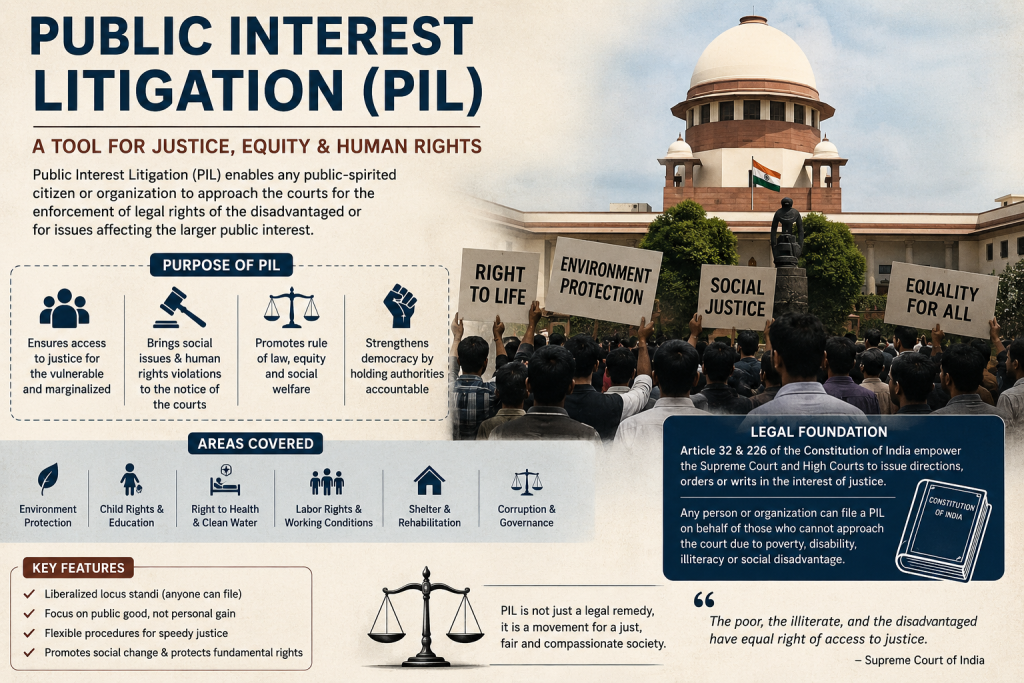
- According to the Supreme Court in Janata Dal v. H.S. Chaudhary (1993), PIL refers to a legal action initiated for the enforcement of public or general interest, where the rights or liabilities of a class of people are affected.
- PIL emerged in India during the post-Emergency phase, inspired by the need to make justice accessible to the poor, marginalised, and underrepresented sections.
- The concept traces its origins to the United States in the 1960s, but evolved uniquely in India through judicial activism.
- Thus, PIL transformed the judiciary from a passive adjudicatory institution into a proactive instrument of social justice.
Features and Constitutional Basis of PIL
- Constitutional Foundation
- The Supreme Court and High Courts exercise PIL jurisdiction under Articles 32 and 226, respectively.
- PIL has significantly expanded the scope of Article 32 (Right to Constitutional Remedies).
- Relaxation of Locus Standi
- Traditional litigation required direct personal injury; PIL relaxed this rule, enabling public-spirited individuals or organisations to approach courts on behalf of affected groups.
- Non-Adversarial and Flexible Nature
- Unlike traditional litigation, PIL is non-adversarial, focusing on public welfare rather than private disputes.
- Courts adopt a proactive and flexible approach, often appointing committees, commissions, and amici curiae.
- Suo Motu and Social Justice Orientation
- Courts may initiate action suo motu based on letters, newspaper reports, or public grievances.
Significance of PIL in India
- Expanding Access to Justice
- PIL enabled marginalised groups such as bonded labourers, prisoners, slum dwellers, and women to secure constitutional protection.
- Strengthening Judicial Accountability Mechanism
- It empowered courts to address executive inaction, governance failures, and rights violations.
- Social and Political Transformation
- PILs played a transformative role in areas such as:
- Environmental protection
- Prison reforms
- Child labour abolition
- Gender justice
- PILs played a transformative role in areas such as:
- Democratisation of Constitutional Remedies
- Public-spirited citizens became active participants in enforcing constitutional morality and public accountability.
Factors Responsible for Growth of PILs
- Increased legal awareness and education improved citizen engagement with constitutional rights.
- Strengthening of the judiciary and formulation of PIL guidelines by the Supreme Court made access easier.
- Expanding media coverage amplified public issues requiring judicial attention.
- Rise of civil society activism and political mobilisation encouraged greater use of PIL as a governance accountability tool.
Issues and Concerns Associated with PIL
- Misuse of PIL Jurisdiction
- Courts increasingly face petitions motivated by publicity, political rivalry, ideological agendas, or financial interests.
- Justice Nagarathna’s observation regarding “paisa interest litigation” reflects this concern.
- Judicial Overreach
- Excessive judicial intervention in policy matters sometimes disturbs the balance between judiciary, legislature, and executive.
- Critics argue that PIL occasionally converts courts into policy-making institutions.
- Frivolous and Meddlesome Litigation
- During the Sabarimala hearing, the Supreme Court questioned whether the petitioner had any genuine connection with the issue involved.
- Chief Justice Surya Kant distinguished between a “bona fide petitioner” and a “meddler”.
- Overburdening the Judiciary
- Increasing PILs add to the already massive judicial backlog, affecting disposal of regular cases.
- Weak Enforcement and Delays
- Implementation of PIL judgments often remains weak due to administrative inertia and monitoring deficiencies.
Supreme Court Guidelines to Prevent Misuse
- Courts must encourage only genuine PILs filed in public interest and discourage extraneous petitions.
- Verification of the credentials and bona fides of petitioners is necessary before admission.
- Courts must ensure that PILs address real public injury rather than private or political interests.
- Frivolous PILs should attract costs, penalties, or deterrent action.
- High Courts should frame formal procedural rules to regulate PIL jurisdiction effectively.
Way Forward
- Recalibrate PIL Jurisdiction: Restore focus on issues involving genuine rights violations and marginalised communities.
- Strengthen Preliminary Scrutiny: Introduce stricter admission standards to filter frivolous petitions.
- Promote Institutional Accountability: Encourage executive institutions to address grievances proactively, reducing overdependence on courts.
- Maintain Judicial Restraint: Courts should intervene cautiously in matters involving complex policy decisions.
- Improve Implementation Mechanisms: Strengthen monitoring of PIL judgments through periodic compliance reviews.
Conclusion
- Public Interest Litigation remains one of the most significant innovations of the Indian judiciary, ensuring that constitutional justice reaches the weakest and most vulnerable sections of society. However, its increasing misuse risks diluting both judicial credibility and the original spirit of social justice. The need of the hour is not the abolition of PIL, but its careful recalibration to preserve its transformative democratic role while preventing institutional misuse.
