

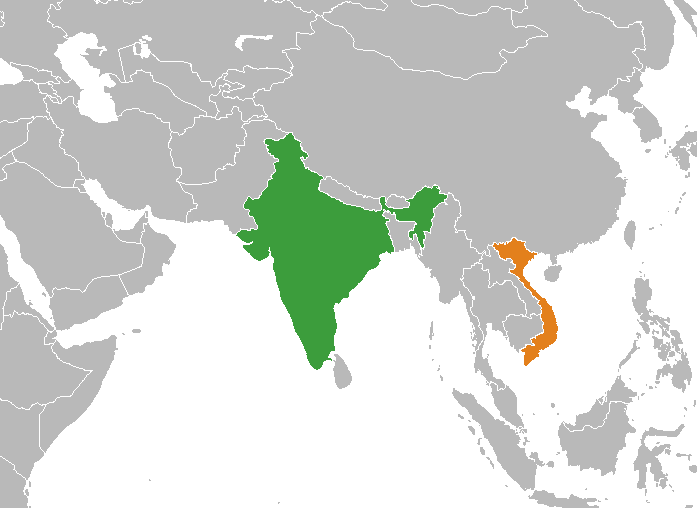
Context: During Vietnamese President To Lam’s visit to India, both countries elevated bilateral ties to an “Enhanced Comprehensive Strategic Partnership”, reaffirming Vietnam’s importance in India’s Act East Policy and Vision MAHASAGAR.
Evolution of India–Vietnam Relations
- Historical and Civilisational Foundations
- India supported Vietnam’s struggle for independence against colonial powers and opposed excessive U.S. intervention during the Vietnam War.
- India was among the first countries to recognise a unified Vietnam in 1975.
- The relationship is rooted in more than 2,000 years of cultural and Buddhist civilisational linkages.
- Vietnamese leadership continues to acknowledge India’s historical solidarity, including Jawaharlal Nehru’s 1954 visit to Vietnam soon after the liberation of Hanoi.
- Strategic Evolution
- Bilateral ties were elevated to a:
- Strategic Partnership (2007)
- Comprehensive Strategic Partnership (2016)
- Enhanced Comprehensive Strategic Partnership (2026)
- Bilateral ties were elevated to a:
- Present cooperation is guided by the vision of “Peace, Prosperity and People”.
Strategic Significance of Vietnam for India
- Pillar of Act East Policy and Indo-Pacific Vision
- Vietnam is a key ASEAN partner in India’s Act East Policy and broader Indo-Pacific strategy.
- Its geostrategic location in the South China Sea (SCS) makes it crucial for secure maritime trade routes.
- Convergence on China and Maritime Security
- India and Vietnam share concerns regarding China’s assertive territorial claims:
- India: Ladakh and Arunachal Pradesh
- Vietnam: Paracel and Spratly Islands in SCS
- Vietnam remains among the strongest Southeast Asian voices opposing unilateral actions in the South China Sea.
- India and Vietnam share concerns regarding China’s assertive territorial claims:
- Energy and Supply Chain Security
- Indian companies are engaged in oil and gas exploration projects in Vietnamese waters, supporting India’s energy security.
- Vietnam’s integration into global manufacturing and FTAs, particularly with the EU, strengthens India’s role in resilient supply chains.
- Support on Global Platforms
- Vietnam strongly supports India’s aspiration for permanent membership in an expanded UNSC.
Key Areas of Cooperation
- Defence and Security Cooperation
- Defence ties include:
- PASSEX naval exercises
- VINBAX military exercise
- Participation in MILAN exercises
- India extended Defence Lines of Credit (LoC) to strengthen Vietnam’s defence capabilities.
- Both countries signed joint Vision Statement on Defence Partnership towards 2030 and MoU on Mutual Logistics Support (2022).
- India also transferred the indigenously built missile corvette INS Kirpan to Vietnam in 2023.
- Defence ties include:
- Economic and Trade Cooperation
- Bilateral trade reached nearly $16 billion, with a target of $25 billion by 2030.
- Vietnam is India’s:
- 23rd-largest global trade partner
- 5th-largest ASEAN trading partner
- Both countries signed MoUs on:
- Digital payment systems
- Critical minerals and rare earth cooperation
- Cultural and Capacity Building Cooperation
- India and Vietnam share strong Buddhist cultural linkages and people-to-people ties.
- India provides:
- Educational scholarships
- Capacity-building programmes
- Training initiatives for Vietnamese nationals
- Cooperation under Mekong-Ganga Cooperation (MGC) strengthens cultural and connectivity linkages.
Challenges in India–Vietnam Relations
- Balancing China Factor
- Vietnam remains cautious in deepening military ties with India to avoid provoking China.
- Chinese territorial claims in the South China Sea affect India’s hydrocarbon exploration interests.
- Modest Trade Volume
- Despite steady growth, India–Vietnam trade remains modest compared to Vietnam’s trade with:
- China (~$100 billion)
- United States (~$142 billion)
- Despite steady growth, India–Vietnam trade remains modest compared to Vietnam’s trade with:
- Reluctance in Defence Procurement
- Vietnam has shown hesitation in fully utilising India’s defence LoC and resisted procurement of systems such as the Akash missile system.
- Connectivity and Cultural Gaps
- Limited physical connectivity and language barriers continue to restrict deeper people-to-people engagement.
Way Forward
- Deepen Economic Integration
- India and Vietnam should promote greater joint ventures and investment partnerships in sectors such as renewable energy, critical minerals, electronics manufacturing, and digital economy to strengthen long-term economic interdependence.
- Enhance Connectivity
- Both countries should expand regional connectivity initiatives through projects such as the India–Myanmar–Thailand Trilateral Highway, with the potential extension of connectivity corridors towards Vietnam.
- Strengthen Maritime and Defence Cooperation
- India and Vietnam should deepen cooperation in naval engagement, maritime domain awareness, defence technology sharing, and defence industrial collaboration to strengthen security architecture in the Indo-Pacific region.
- Build Resilient Supply Chains
- India should leverage Vietnam’s growing manufacturing ecosystem to diversify and strengthen regional and global supply chains beyond China-centric production networks.
- Expand Cultural Diplomacy
- Both countries should strengthen tourism linkages, Buddhist civilisational circuits, academic exchanges, and language training programmes to deepen people-to-people engagement.
Conclusion
- As geopolitical competition intensifies in the Indo-Pacific, both countries are likely to play a central role in promoting regional stability, maritime security, and rule-based order. Thus, strengthening India–Vietnam partnership will remain crucial for advancing India’s Act East Policy, strategic autonomy, and Indo-Pacific vision.
