Context
- The 2026 Assembly election verdicts across Assam, Kerala, Tamil Nadu, and West Bengal reflect not only political preferences but also the underlying economic and fiscal conditions of these States.
Economic Growth and Income Trends
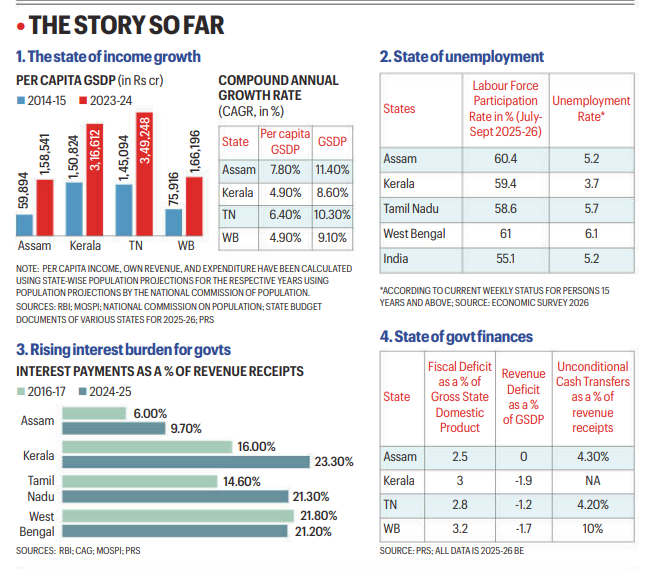
- Over the decade (2015–2024), Assam recorded the fastest GSDP growth among the four States, positioning itself among the fastest-growing States nationally.
- Assam also achieved the highest growth in per capita income, narrowing the gap with West Bengal despite starting from a lower base.
- Tamil Nadu demonstrated strong economic performance, with higher growth translating into greater per capita income than Kerala.
- Kerala and West Bengal registered relatively modest growth, with per capita income growth below 5%, indicating stagnation in income expansion.
- Therefore, the economic growth patterns highlight the importance of sustained expansion for improving living standards.
Employment Dynamics and Labour Market Stress
- All four States recorded higher Labour Force Participation Rates (LFPR) than the national average (55.1%), indicating strong demand for employment.
- West Bengal exhibited the highest unemployment rate, significantly above the national average, reflecting acute labour market stress.
- Kerala recorded the lowest unemployment rate, indicating relatively better employment absorption.
- Tamil Nadu, despite lower LFPR compared to Assam, experienced higher unemployment, suggesting hidden labour market stress.
Fiscal Health of State Governments
- Fiscal Deficit Concerns
- Fiscal deficit reflects the extent of borrowing required to bridge revenue-expenditure gaps, with a prudential limit of 3% of GSDP.
- West Bengal exceeded this threshold, indicating higher fiscal stress relative to other States.
- Revenue Deficit and Quality of Expenditure
- Revenue deficit indicates that governments are borrowing to finance routine expenses such as salaries and pensions.
- Except Assam, all other States exhibited revenue deficits, suggesting poor quality of public expenditure.
- Ideally, borrowing should finance capital expenditure (infrastructure, productive assets) rather than consumption.
- Rising Debt and Interest Burden
- Persistent borrowing has led to rising interest payment obligations across States.
- Kerala and Tamil Nadu have witnessed a sharp increase in interest liabilities, while West Bengal’s burden remains structurally high.
- Freebies and Fiscal Stress
- Increasing reliance on unconditional cash transfers (“freebies”) has raised concerns regarding fiscal sustainability.
- Example: West Bengal spends nearly 10% of its revenue receipts on such transfers, often financed through borrowing.
Political Economy of Electoral Outcomes
- Voters tend to reward high growth and improved incomes, as seen in Assam’s electoral outcome.
- Conversely, high unemployment, fiscal stress, and weak growth can influence voters to reject incumbents.
- Electoral behaviour increasingly reflects economic rationality alongside political factors.
Key Challenges for Incoming Governments
- Generating Employment: Addressing job creation amid rising working-age population.
- Improving Fiscal Discipline: Reducing deficits while ensuring adequate developmental expenditure.
- Balancing Welfare and Growth: Managing demands for social support without compromising fiscal sustainability.
- Enhancing Capital Expenditure: Prioritising infrastructure and productivity-enhancing investments.
Way Forward
- Strengthen Fiscal Prudence: Adhere to FRBM norms and ensure sustainable borrowing practices.
- Shift Towards Productive Expenditure: Increase investment in infrastructure, industry, and human capital.
- Promote Job-Centric Growth: Align growth strategies with employment generation and skill development.
- Rationalise Welfare Schemes: Target subsidies effectively to avoid fiscal strain and inefficiency.
- Enhance Transparency and Accountability: Improve fiscal reporting and public scrutiny of government finances.
Conclusion
The 2026 Assembly election outcomes underline that economic performance, employment generation, and fiscal discipline are central to democratic accountability. The states that successfully balance growth, jobs, and fiscal responsibility are more likely to sustain both economic progress and political legitimacy.