

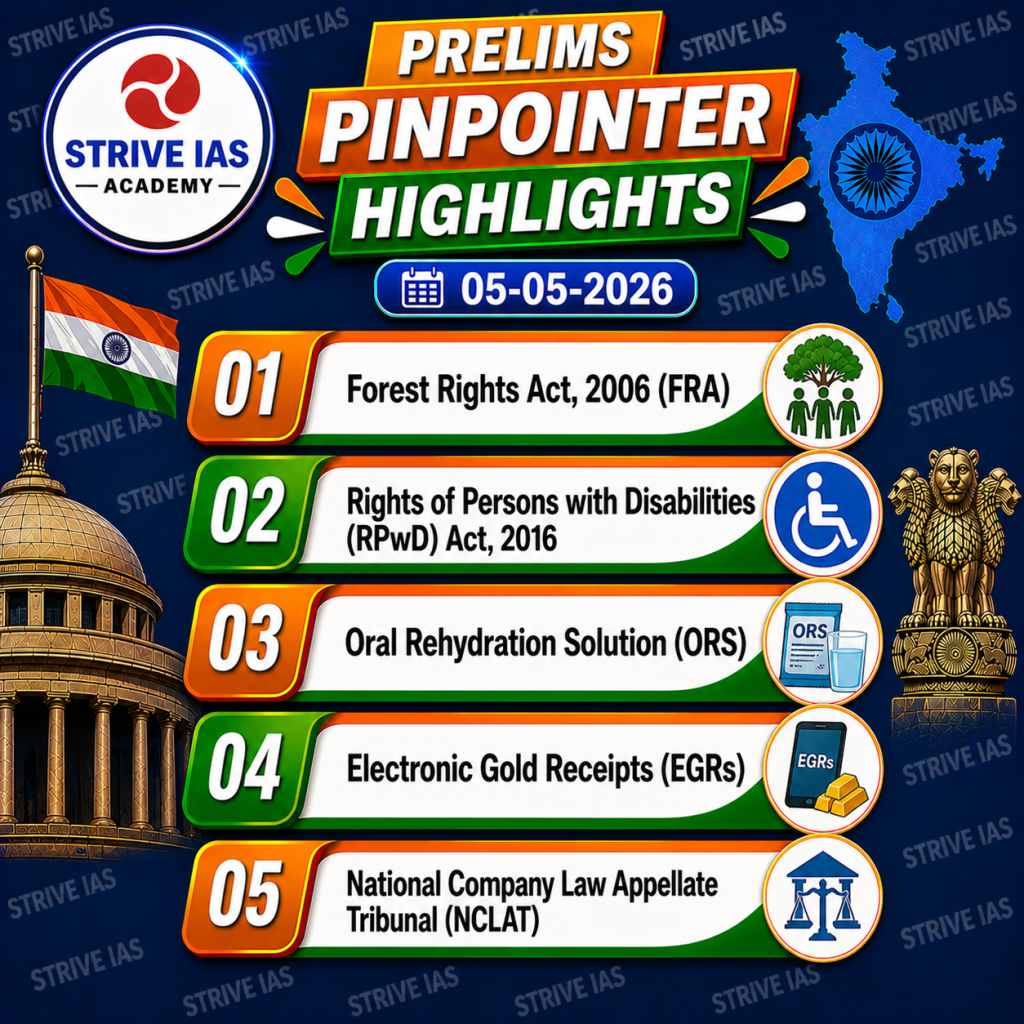
Forest Rights Act, 2006 (FRA)

Overview
- The Forest Rights Act, 2006 seeks to legally recognise the customary rights of forest-dwelling communities over land and forest resources.
- It represents a corrective framework aimed at addressing historical injustices arising from colonial and post-colonial forest governance regimes.
Objectives
- To vest forest rights in Scheduled Tribes (STs) and Other Traditional Forest Dwellers (OTFDs).
- To ensure livelihood security through access to forest land and produce.
- To promote decentralised forest governance through community participation.
- To align environmental conservation with social justice principles.
Key Provisions
- Rights are recognised for communities occupying and dependent on forest land prior to 13 December 2005.
- Individual land titles are restricted to actual occupation, subject to a ceiling of 4 hectares.
- Titles granted are heritable but non-transferable, preventing alienation of land.
- The Act provides statutory protection against eviction until due verification and recognition of claims is completed.
- It also recognises community rights to conserve, manage, and protect forest resources.
Categories of Rights
- Individual Forest Rights (IFR)
- Provide ownership rights over cultivated forest land within prescribed limits.
- Community Forest Rights (CFR)
- Confer rights to access, use, and manage common forest resources, including minor forest produce.
- Habitat Rights
- Extend special protection to Particularly Vulnerable Tribal Groups (PVTGs) and pastoral communities.
- Rehabilitation and Development Rights
- Ensure protection from displacement and access to basic developmental facilities.
Institutional Mechanism
- The Gram Sabha functions as the primary authority for initiating, verifying, and recommending claims.
- The Sub-Divisional Level Committee (SDLC) undertakes scrutiny of claims.
- The District Level Committee (DLC) serves as the final authority for approval and issuance of titles.
- The framework reflects a bottom-up approach to governance and decision-making.
Constitutional and Legal Framework
- Article 46 mandates protection of the interests of Scheduled Tribes.
- Article 244 and Fifth/Sixth Schedules provide for administration of tribal areas.
- Articles 48A and 51A(g) emphasise environmental protection.
- Complemented by legislations such as the PESA Act, 1996 and the Forest Conservation Act, 1980.
Rights of Persons with Disabilities (RPwD) Act, 2016

Context
- The Supreme Court has expanded the definition of acid attack victims under the RPwD Act, 2016 to include victims of forcible acid ingestion.
- The Court exercised its powers under Article 142, making the recognition applicable retrospectively from 2016.
More in News
- The earlier law recognised only acid-throwing victims, excluding those subjected to forcible ingestion of acid.
- The judgment enables such victims to access disability benefits, including compensation and identity certification.
- The Court emphasised the need for a comprehensive policy framework for long-term rehabilitation and medical care.
- The Union Government has initiated steps to amend the Schedule of the Act to formally incorporate this category.
About Rights of Persons with Disabilities (RPwD) Act, 2016
- Enacted to ensure dignity, equality, and non-discrimination for persons with disabilities.
- Gives effect to the United Nations Convention on the Rights of Persons with Disabilities (UNCRPD), 2007.
- Definition
- A person with disability is one with long-term physical, mental, intellectual, or sensory impairment, which, in interaction with barriers, restricts full participation in society.
- Key Features
- Recognises 21 categories of disabilities, including acid attack victims.
- Guarantees rights such as:
- Equality and non-discrimination
- Protection from abuse and exploitation
- Accessibility and participation in public life
- Persons with Benchmark Disabilities (PwBD)
- Defined as individuals with at least 40% of a specified disability, certified by a competent authority.
- Eligible for targeted reservations and welfare measures.
- Special Provisions for PwBD
- Education: Free education (6–18 years) and minimum 5% reservation in government and aided higher educational institutions.
- Employment: At least 4% reservation in government jobs, with provision for age relaxation.
- Private Sector: Government may incentivise employers to ensure minimum 5% workforce participation of PwDs.
- High Support Needs: Provision for specialised assistance for persons requiring intensive care.
- Institutional & Legal Features
- Introduces limited guardianship, based on joint decision-making.
- Mandates social security measures to ensure an adequate standard of living.
- Places responsibility on governments to ensure inclusive development and accessibility.
Oral Rehydration Solution (ORS)

What is ORS?
- ORS is a standardised mixture of essential salts and glucose dissolved in safe water, used to treat dehydration.
- It is effective in conditions such as diarrhoea, heat stress, and excessive fluid loss.
- Recognised by the World Health Organization as part of its Essential Medicines List.
Composition (WHO Formula)
- Sodium Chloride (NaCl): Replenishes lost sodium and maintains electrolyte balance.
- Glucose: Facilitates absorption of sodium and water in the intestines.
- Potassium Chloride (KCl): Restores potassium levels depleted during dehydration.
- Trisodium Citrate: Corrects metabolic acidosis and stabilises pH balance.
Mechanism of Action
- Functions through the Glucose–Sodium Co-transport mechanism in the intestinal lining.
- Presence of glucose enhances active absorption of sodium, which in turn promotes water uptake.
- Prevents severe dehydration and electrolyte imbalance, rather than directly curing the underlying cause.
Significance
- Considered one of the most effective and low-cost public health interventions.
- Has significantly reduced mortality due to diarrhoeal diseases globally.
- Plays a crucial role in heatwave management and community health resilience.
Electronic Gold Receipts (EGRs)

Context
- The National Stock Exchange of India has launched Electronic Gold Receipts (EGRs) as a new trading segment.
- The initiative aims to enable transparent price discovery and integrate physical gold with financial markets.
What are EGRs?
- EGRs are securities representing ownership of physical gold stored in accredited vaults.
- They enable trading of gold in dematerialised form on recognised stock exchanges.
Need for EGRs
- To discourage physical hoarding of gold and promote financialisation.
- To enable transparent price discovery through exchange-based trading mechanisms.
- To enhance liquidity, allowing conversion into cash or physical gold.
- To ensure quality assurance and standardisation of gold.
- To help India transition from a price taker to a potential price influencer in global gold markets.
How EGRs Work
- Physical gold is deposited with SEBI-accredited vault managers.
- Equivalent EGRs are issued in electronic form to the depositor.
- EGRs can be traded on stock exchanges like other securities.
- Holders can redeem EGRs for physical gold by surrendering them.
Role of Vault Managers
- Responsible for:
- Storage and safekeeping of gold
- Creation and redemption of EGRs
- Periodic reconciliation of physical gold with records
- Grievance redressal
- Minimum net worth requirement: ₹50 crore.
National Company Law Appellate Tribunal (NCLAT)

About NCLAT
- A quasi-judicial body constituted under Section 410 of the Companies Act, 2013.
- Became operational from 1 June 2016.
- Established to hear appeals against decisions of the National Company Law Tribunal (NCLT).
Objectives
- To ensure efficient and time-bound resolution of corporate disputes.
- To enhance transparency and accountability in corporate governance.
- To strengthen the insolvency resolution framework under the Insolvency and Bankruptcy Code (IBC).
Jurisdiction and Functions
- Hears appeals against:
- Orders of NCLT under Section 61 of IBC.
- Orders of Insolvency and Bankruptcy Board of India (IBBI).
- Orders of Competition Commission of India (CCI).
- Decisions of National Financial Reporting Authority (NFRA).
- Provides a unified forum for corporate law, insolvency, and competition-related appellate matters.
Composition
- Consists of:
- Chairperson
- Judicial Members
- Technical Members
- Members are appointed by the Central Government, based on expertise in law, finance, accountancy, and administration.
Powers and Procedure
- Can regulate its own procedure.
- Possesses powers equivalent to a civil court under the Civil Procedure Code, 1908.
- Can:
- Summon witnesses
- Receive affidavits
- Enforce production of documents
- Issue commissions
- Orders are enforceable as civil court decrees.
Appeals and Jurisdiction
- Appeals against NCLAT orders lie with the Supreme Court of India.
- Civil courts have no jurisdiction over matters within its domain.
- No authority can grant injunctions against actions taken by NCLAT.
