

Context: The demonetisation announcement of November 8, 2016 aimed to curb black money, counterfeit currency, and corruption. NCRB’s ‘Crime in India 2024’ report indicates that the problem of fake currency circulation continues nearly a decade later.
Trends in Counterfeit Currency Seizures
- Persistent Seizure of Fake Currency
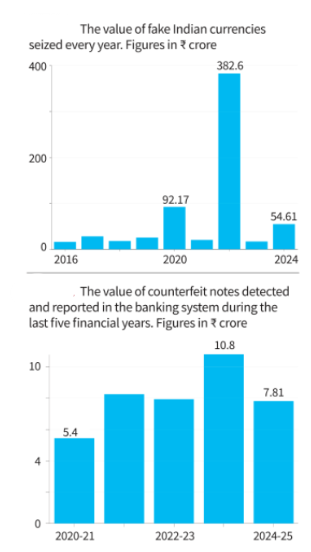
- More than ₹54.61 crore worth of counterfeit currency was seized across States during 2024.
- Since 2017, authorities have seized approximately ₹638 crore worth of fake Indian currency.
- The value of counterfeit currency seized in 2024 was the third highest since demonetisation.
- Rise in Counterfeit High-Denomination Notes
- Authorities seized nearly six lakh counterfeit ₹500 notes during 2024.
- More than one lakh fake ₹2,000 notes were also recovered despite withdrawal from circulation in 2023.
- Counterfeit ₹500 notes seized in 2024 were almost four times higher than seizures recorded in 2016.
- Surge During Pandemic Period
- Counterfeit currency seizures reached ₹92 crore during the COVID-19 year of 2020.
- Seizures further increased to nearly ₹382.6 crore during 2022, indicating continued circulation networks.
Counterfeit Currency within Banking System
- Detection by Banks
- Parliament data showed detection of over 11 lakh counterfeit notes between 2020-21 and 2024-25.
- The total value of fake currency detected within banks stood at approximately ₹40.26 crore.
- Banks detected nearly two lakh counterfeit notes annually during the five-year period.
- Counterfeiting of New Currency Series
- Newly introduced denominations such as ₹200 and ₹500 notes were also counterfeited.
- More than four lakh fake ₹500 notes from the new currency series were detected by banks.
- Close to three lakh counterfeit ₹100 notes accounted for a significant share of banking detections.
Implications for Demonetisation Objectives
- Limited Impact on Counterfeit Currency
- Continued seizure of fake notes suggests that demonetisation did not fully eliminate counterfeit currency networks.
- Reintroduced currency denominations also became vulnerable to sophisticated counterfeiting activities.
- Continued Dominance of Cash Economy
- RBI data showed that currency in circulation increased to over ₹42.12 lakh crore by May 2025.
- Currency circulation increased by nearly 137% compared to pre-demonetisation levels of November 2016.
- The data indicates limited success in reducing cash-based transactions within the economy.
- Economic and Governance Concerns
- Demonetisation initially caused significant disruptions, especially for the MSME sector and informal economy.
- Persistent counterfeit circulation raises concerns regarding currency security and enforcement effectiveness.
Associated Challenges
- Sophisticated Counterfeiting Networks
- Advancements in printing and duplication technologies have strengthened organised counterfeit operations.
- Cross-border networks may continue facilitating circulation of fake Indian currency.
- Enforcement and Detection Constraints
- Detecting counterfeit currency within a large cash-driven economy remains administratively challenging.
- Banking institutions and enforcement agencies require stronger technological detection mechanisms.
- High Dependence on Physical Currency
- Large sections of the population continue relying upon cash transactions for daily economic activities.
- Informal and rural sectors remain less integrated with formal digital financial systems.
Way Forward
- India should strengthen currency security features and continuously upgrade anti-counterfeit technologies.
- Enforcement agencies should improve intelligence-sharing and coordination against organised counterfeit networks.
- Banks should adopt advanced detection systems and enhance staff training for counterfeit identification.
- Greater financial inclusion and digital payment infrastructure can gradually reduce dependence on cash transactions.
- Public awareness campaigns should improve citizens’ ability to identify counterfeit currency effectively.
Conclusion
- The continued prevalence of fake currency highlights the limitations of relying solely upon demonetisation measures for curbing counterfeiting. Sustainable reduction in counterfeit circulation requires stronger institutional capacity, technological safeguards, and financial digitisation.
