

Context
- India and South Korea have steadily expanded their defence cooperation framework since establishing diplomatic relations in 1973. The launch of the Korea-India Defence Accelerator (KIND-X) marks a new phase in bilateral defence innovation cooperation.
Evolution of India–South Korea Defence Relations
- Institutional Expansion of Defence Cooperation
- The 2005 MoU on Defence Industry and Logistics promoted collaboration in defence production, procurement, and logistics.
- Separate agreements signed in 2010 strengthened cooperation in defence exchanges and emerging defence technologies.
- The partnership was elevated to a Special Strategic Partnership in 2015, deepening strategic engagement.
- Defence Industrial Collaboration
- The 2020 Roadmap for Defence Industries Cooperation expanded engagement across land, naval, aero, and guided weapon systems.
- The roadmap also encouraged technology transfer and investments within India’s defence industrial corridors.
- The K9 Vajra-T artillery system emerged as a successful example of bilateral co-production under the Make in India initiative.
Korea–India Defence Accelerator (KIND-X)
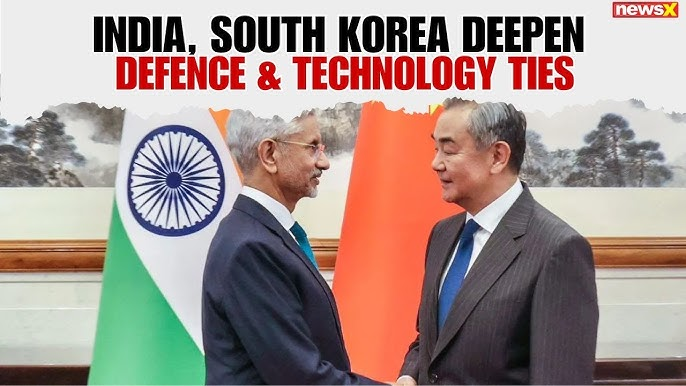
- KIND-X was announced during the India–South Korea Summit 2026 between Prime Minister Narendra Modi and President Lee Jae Myung.
- The platform aims to connect start-ups, incubators, investors, universities, and defence industries from both countries.
- KIND-X seeks to strengthen bilateral cooperation in defence innovation, co-development, and advanced technology ecosystems.
- Institutional Architecture
- KIND-X is expected to be led by South Korea’s Defense Acquisition Program Administration (DAPA) and India’s Defence Innovation Organisation (DIO).
- The initiative draws upon India’s existing defence innovation partnerships such as INDUS-X and FRIND-X.
- The platform aligns with South Korea’s defence innovation programmes and India’s Innovations for Defence Excellence (iDEX) initiative.
Potential Areas of Cooperation under KIND-X
- Defence Research and Innovation
- KIND-X may support joint grants and innovation challenges for defence technologies identified under the 2020 roadmap.
- The initiative can facilitate access to testing facilities, laboratories, and certification systems in both countries.
- Joint accelerator and incubator programmes may strengthen collaboration among innovators and investors.
- Defence Industrial Integration
- Workshops under KIND-X may help stakeholders understand export controls, funding models, and licensing requirements.
- The initiative can connect South Korea’s industrial hubs with India’s defence corridors and aerospace centres.
- Participation of firms such as L&T, Hanwha, Tata Advanced Systems, Mahindra, and Bharat Forge may strengthen industrial linkages.
- Emerging and Future Technologies
- Potential cooperation areas include Artificial Intelligence, autonomous systems, robotics, and defence semiconductors.
- Both countries may collaborate in satellites, surveillance systems, communication technologies, and navigation systems.
- Cooperation in critical mineral supply chains can strengthen long-term technological resilience.
Significance of KIND-X
- Strengthening Defence Innovation Ecosystem
- KIND-X can emerge as a major defence innovation bridge connecting industries, academia, think tanks, and start-ups.
- The initiative may deepen collaboration in defence R&D, co-development, and advanced manufacturing capabilities.
- Support for Strategic and Technological Convergence
- The platform complements growing bilateral cooperation in sectors such as shipbuilding, semiconductors, and space technologies.
- Joint investments in emerging technologies can strengthen long-term strategic and industrial cooperation.
- Contribution to Atmanirbhar Bharat
- The initiative supports India’s objective of technological self-reliance in defence manufacturing and innovation.
- Expanded co-production and industrial partnerships can strengthen India’s defence export capabilities.
Associated Challenges
- Institutional and Funding Uncertainty
- The long-term success of KIND-X depends upon clearly defined funding mechanisms and governance structures.
- Lack of clarity regarding operational frameworks may delay implementation of collaborative projects.
- Technology Transfer and Regulatory Complexities
- Defence cooperation may face challenges related to intellectual property rights and technology-sharing arrangements.
- Differences in export-control regimes and regulatory procedures may affect project execution.
- Need for Sustained Strategic Coordination
- Effective implementation requires continuous coordination among governments, industries, and innovation ecosystems.
- Bilateral initiatives may lose momentum without measurable deliverables and regular institutional review mechanisms.
Way Forward
- India and South Korea should establish a clear institutional roadmap defining operational structures and funding arrangements.
- Both countries should prioritise collaboration in emerging defence technologies and future warfare capabilities.
- Annual KIND-X summits and Track 1.5 dialogues should be institutionalised for strategic coordination and progress review.
- Governments should encourage deeper integration among start-ups, industries, universities, and research institutions.
- India should leverage KIND-X to strengthen domestic defence innovation and expand indigenous manufacturing capabilities.
Conclusion
- KIND-X represents a significant step towards building a future-oriented defence innovation partnership between India and South Korea. Sustained collaboration in advanced technologies and defence manufacturing can strengthen strategic autonomy and technological resilience for both countries.
