
Civilisational Context and Technological Continuity
- India’s hosting of the AI Impact Summit 2026 reflects its ambition to shape global AI governance debates.
- The central idea is that countries must design their own AI systems rather than depend entirely on foreign capital.
- Artificial intelligence is presented not merely as technology, but as a framework shaping future economic power.
Three Pillars of India’s AI Vision: People, Planet and Progress
- India’s AI framework rests on the pillars of people-centric development, environmental sustainability and technological progress.
- The vision emphasises that AI must serve inclusive growth rather than deepen inequality.
- It recognises that AI expansion increases energy demand through data centres and high computational usage.
- The framework seeks to balance innovation with accountability and ethical governance safeguards.
- This approach aims to embed democratic values within technological systems from the outset.
Digital Public Infrastructure as the Foundation
- India’s AI ambitions are built upon its robust Digital Public Infrastructure (DPI) model.
- The Aadhaar–UPI–JAM architecture has enabled financial inclusion and direct welfare transfers at national scale.
- UPI processed more than ₹228 billion transactions in 2025, demonstrating massive digital capacity.
- Over $3.48 lakh crore in welfare benefits have been transferred through JAM-linked systems.
- India generates nearly 20% of global data, yet lacks proportional data storage infrastructure.
- This imbalance highlights the need to strengthen domestic AI compute and storage capacity.
Data Sovereignty and Global Equity
- India strongly advocates for data sovereignty, arguing that nations must control their own digital resources.
- The article critiques models where multinational corporations extract data and monetise it globally.
- India has proposed the idea of a global public digital infrastructure bank, potentially capitalised at $6.5 trillion.
- This proposal seeks to assist developing countries in building their own AI and digital infrastructure.
- The broader goal is to prevent AI capabilities from becoming concentrated within a few advanced economies.
Investment and Infrastructure Expansion
- The government has committed $1.1 billion in venture funding for AI and advanced technology startups.
- The National Critical Minerals Mission secures lithium, cobalt and rare earths needed for AI hardware production.
- India is expanding compute clusters, semiconductor capacity and sovereign AI model development.
- Significant investment is directed toward building domestic data centres and AI processing units.
- The strategy aims to shift India from being a data provider to becoming a data processor and innovator.
Ethical AI and Governance Safeguards
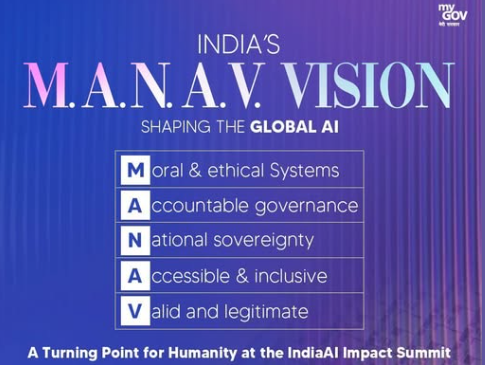
- The Prime Minister’s MANAV vision stresses ethical guardrails, accountability and transparent governance.
- The article warns against treating intelligence purely as a commercial commodity.
- India aims to create AI systems aligned with democratic principles and human dignity.
- Ethical safeguards are seen as essential to prevent surveillance-driven or exploitative AI ecosystems.
- Governance frameworks are designed to ensure trust, fairness and public confidence in AI systems.
Strategic and Geopolitical Implications
- Artificial intelligence increasingly determines economic competitiveness and geopolitical influence.
- Control over AI infrastructure strengthens a nation’s position in global supply chains.
- India seeks to reduce technological dependence on foreign digital ecosystems.
- Sovereign AI models and infrastructure are viewed as instruments of strategic autonomy.
- The AI stack is therefore presented as both an economic and national security imperative.
Conclusion
- India’s AI stack represents a structural transformation of digital governance and economic capability.
- By combining data sovereignty, digital infrastructure and ethical safeguards, India seeks inclusive technological leadership.
- The transition from Panini’s structured knowledge to AI frameworks symbolises continuity in systemic thinking and innovation.