

The Strategic Shift
- India moved away from its earlier cautious approach of engaging only with similarly structured economies. It now proactively pursues trade agreements with major developed economies, aiming to integrate into high-value global markets and global value chains.
Key Statistics
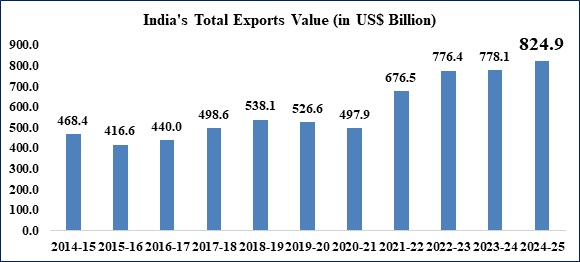
- Total exports reached $825.25 billion, a 6.05% annual increase (As reported by Department of Commerce, 2025)
- FTA coverage of export basket projected at 71% by 2026, up from 22% in 2019
- Target: $2 trillion in exports by 2030 under Foreign Trade Policy (FTP) 2023
Three Typologies of International Trade Agreements
- Multilateral Trade Agreements (WTO/GATT Framework)
- The foundation of global trade rests on the GATT and WTO framework, built around the Most Favoured Nation (MFN) principle i.e. any concession granted to one country must be extended to all WTO members.
- WTO (established 1995) expanded trade coverage to services and intellectual property
- It also established a structured dispute settlement mechanism
- Follows one-country-one-vote principle, giving developing nations meaningful agency
- Preferential Trade Agreements (FTAs and Customs Unions)
- WTO permits exceptions under Article XXIV of GATT, allowing Free Trade Areas and Customs Unions on a non-MFN basis.
- FTAs must cover ‘substantially all trade’ between members.
- Customs Unions must additionally maintain a common external trade policy for non-members.
- It must be notified to the WTO, enabling scrutiny by other countries
- Many modern FTAs are WTO-plus i.e. covering labour, environment, and investment protection
- New Category- Agreements on Reciprocal Trade (ARTs)
- The Trump administration introduced a new typology Agreements on Reciprocal Trade (ART), signed with countries like Malaysia, Cambodia, Argentina, Bangladesh, and now announced with India.
- These are not signed under Article XXIV of GATT, making them legally suspicious and institutionally disconnected from the WTO.
India’s Key Trade Agreements
- India-EU FTA (January 27, 2026)
- After nearly two decades of negotiations, India and the EU created a free trade zone covering nearly two billion people and thus described as the “mother of all deals.” It is a WTO-compliant FTA.
- Tariff reduction or elimination on over 90% of traded goods.
- Enhanced market access for textiles, leather, pharmaceuticals, chemicals, and marine products
- Removal of tariffs on pharmaceutical exports with stronger regulatory cooperation
- Improved competitiveness against Bangladesh and Vietnam.
- Promotes digital trade and strengthens investor confidence
- India–US Interim Trade Framework (February 2026)
- It is Agreements on Reciprocal Trade (ARTs), not an FTA. It is fundamentally different from India’s EU or UK agreements.
- Progressive tariff reduction to facilitate greater Indian exports
- Strategic collaboration in rare earths and semiconductors
- Strengthens India’s position in high-technology manufacturing and electronics exports
- Reduces overdependence on any single market
Concerns with Agreements on Reciprocal Trade (ARTs)
- Legal Suspicion: ARTs operate outside the GATT-WTO architecture, lack institutional legitimacy, and are not notified to the WTO, preventing scrutiny by other countries.
- One-Sided Provisions: While the US continues imposing tariffs inconsistent with WTO obligations, partner countries are pressured into drastically reducing tariffs on US goods.
- Compromise of Sovereignty: The US-Bangladesh ART requires Bangladesh to adopt complementary trade restrictions whenever the US invokes national security.
- It thus effectively subordinates the partner’s trade interests to US decisions.
- A similar provision in the India-US deal would be concerning.
- Data Sovereignty Restrictions: The US-El Salvador ART prohibits El Salvador from imposing customs duties on electronic transactions — undermining digital regulatory autonomy. This sets a worrying precedent for India’s digital trade interests.
- Imperial Character: ARTs reflect an ‘America First’ policy that weakens multilateralism and places disproportionate obligations on developing countries.
Four Strategic Dimensions of India’s Trade Approach
- Market Access: Preferential entry into high-demand markets of EU and US, benefiting labour-intensive sectors and MSMEs through Global Value Chain (GVC) integration.
- Supply Chain Integration: Reduced barriers on intermediate goods enable Indian firms to compete efficiently, especially in technology, electronics, pharmaceuticals, and services.
- Diplomatic Leverage: Economic interdependence with major powers strengthens India’s voice in global economic governance and influence over international trade norms.
- Export Diversification: Agreements spread across continents deliberately reduce overdependence on any single geography.
